Trump Says the US Could “Open” Hormuz and “Take the Oil”—What That Really Means for War, Markets, and Power
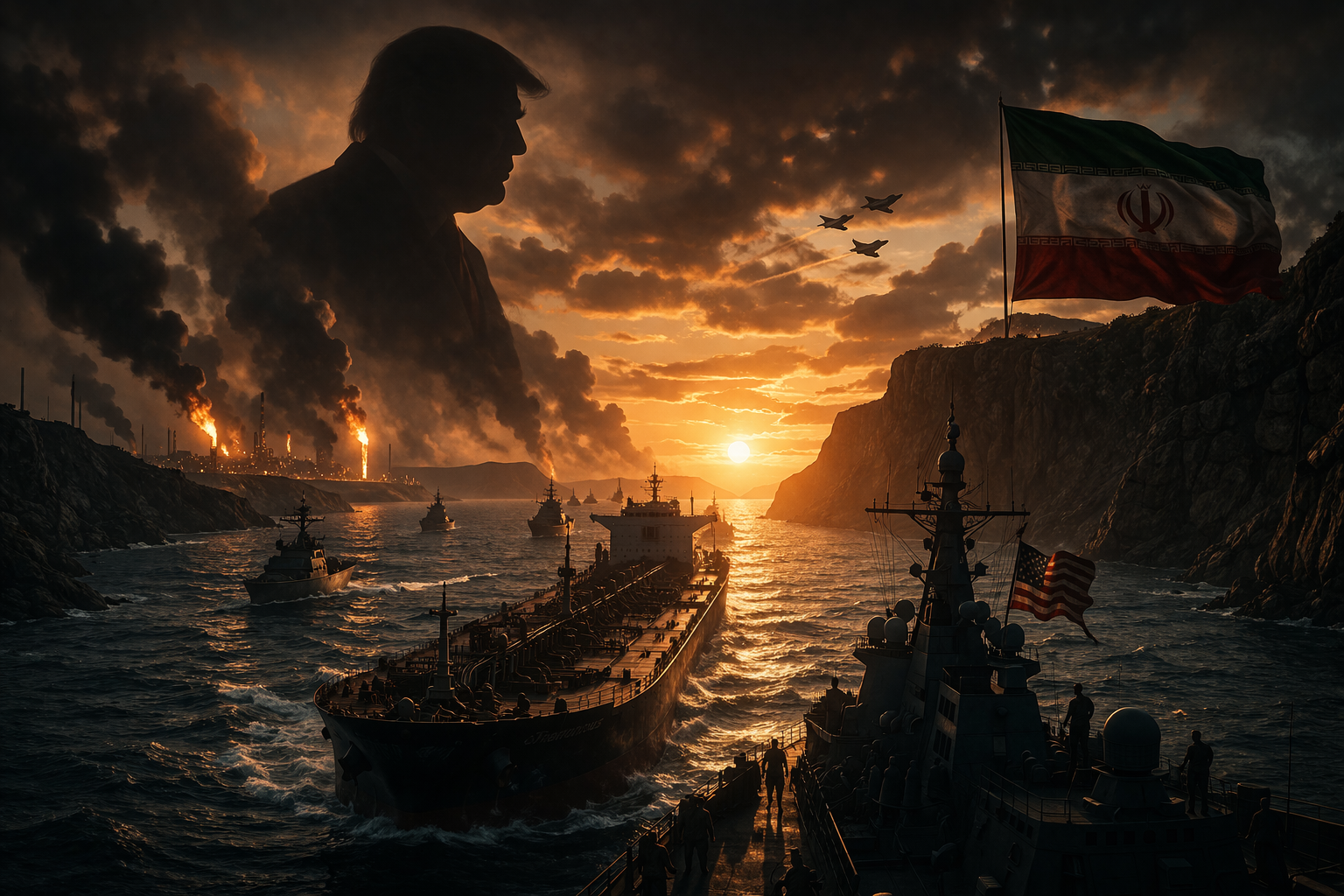
The Strait That Controls the World’s Oil Is Now a War Zone
Can the US Really Control Global Oil Flow?
The United States could reopen the Strait of Hormuz and even “take the oil,” according to recent comments from Donald Trump—a statement that lands in the middle of an already escalating war with Iran.
This is not routine rhetoric. It comes as the strait—a narrow maritime chokepoint handling roughly 20% of global oil supply—remains disrupted by conflict, with global energy prices surging and shipping under threat.
Within hours, markets reacted. Oil spiked sharply above $110, reflecting the reality that the conflict is no longer just a regional war—it is a global economic event.
The key question is simple: can the US actually do what Trump is suggesting—and what would it cost?
The story turns on whether military capability translates into controllable outcomes in a narrow, hostile, globally critical waterway.
Key Points
Trump says the US could reopen the Strait of Hormuz and “take the oil,” escalating the economic framing of the war.
Iran’s disruption of the strait is already hitting global markets, with oil prices surging and shipping constrained.
The strait carries around one-fifth of global oil supply, making it one of the most important chokepoints in the world.
A coalition of countries is exploring diplomatic and military options—without clear US alignment.
The conflict has expanded beyond military strikes into infrastructure attacks and global economic disruption.
The real constraint is not opening the strait—it is keeping it open under sustained threat.
The Strategic Reality of the Strait
The Strait of Hormuz is not just another shipping lane.
It is a narrow corridor—at points barely 20–30 miles wide—through which a fifth of the world’s oil and gas flows.
That creates a structural vulnerability:
It is easy to disrupt
It is hard to secure
And it is almost impossible to fully control without escalation
Iran does not need to “win” in a conventional sense. It only needs to make passage unsafe, uncertain, or expensive.
That alone is enough to spike oil prices.
What Trump Is Actually Signalling
Trump’s comments serve a dual purpose.
First, they signal confidence—the idea that US naval and air power could forcibly reopen the strait.
Second, they introduce something more controversial:
economic capture—the suggestion that the US could directly benefit by “taking the oil.”
Tha”
Tha”
That framing matters.
Because it shifts the perception of the war:
From security enforcement
To resource control
And that changes how allies, markets, and adversaries respond.
Military Reality vs Political Rhetoric
With pure capability, the US can project overwhelming forces into the Gulf.
But reopening the strait is not a single operation. It is a continuous one.
To achieve it, the US would need to:
Clear naval mines
Suppress missile and drone threats
Escort tankers continuously
Protect infrastructure across multiple countries
And Iran has already shown it can:
Target regional infrastructure
Strike shipping indirectly
Escalate asymmetrically across the Gulf
Such an approach creates a mismatch.
The US can win battles quickly.
But the strait requires persistent control, not a one-time victory.
Why Markets Reacted So Fast
Oil markets are not reacting to what has happened.
They are reacting to what might happen next.
Prices surged because traders are pricing in:
Prolonged disruption
Escalation risk
Lack of a clear endgame
Brent crude moving above $110 is not just a number.
It feeds directly into the following:
Inflation
Transport costs
Food prices
Interest rate expectations
This is why the Hormuz story is not just geopolitical.
It is macroeconomic.
What Most Coverage Misses
The overlooked hinge is not whether the US can reopen the strait.
It is whether the insurance and shipping system believes it is safe.
Even if the US Navy clears a path, commercial shipping depends on:
Insurers willing to underwrite voyages
Crews willing to transit a war zone
Companies willing to risk multi-billion-dollar cargo
If insurers price risk too high—or withdraw entirely—the strait remains effectively closed.
That is the hidden constraint.
It turns a military problem into a financial one.
And it means that “opening” the strait is not a switch you can simply flip.
It is a confidence system you have to rebuild.
The Coalition Problem
More than 40 countries are now discussing coordinated responses, including diplomatic pressure and potential military measures.
But there is a fracture:
The US is escalating militarily
Others are pushing for coordination and de-escalation
This issue matters because securing Hormuz is not just a US problem.
The biggest customers of that oil flow are:
Asia
Europe
Many of those countries hesitate to engage in a US-led war without a clear strategy.
The Real Stakes: Energy, Inflation, and Control
This scenario is where the story becomes bigger than the battlefield.
If Hormuz stays unstable:
Oil could push toward $130–$150
Inflation could re-accelerate globally
Central banks may delay rate cuts
Growth slows
There is also a second-order effect:
Energy insecurity forces countries to rethink supply chains, alliances, and energy policy.
That is how a regional war becomes a structural global shift.
Where This Goes Next
There are three plausible paths from here:
1. Military enforcement succeeds (short-term)
The US and partners secure shipping lanes, oil flows resume, and prices stabilize.
2. Prolonged disruption (most likely)
Iran continues asymmetric attacks, shipping remains risky, and prices stay elevated.
3. Escalation spiral (high impact)
Strikes expand, infrastructure damage spreads, and the conflict widens across the Gulf.
The constraint is not power.
It is sustainability.
Reopening the Strait of Hormuz is not about winning a fleeting moment.
It is about controlling a system under constant pressure.
And that is where wars like these are decided.
