

Trump–Xi Summit Is Really About One Thing: The Taiwan Red Line
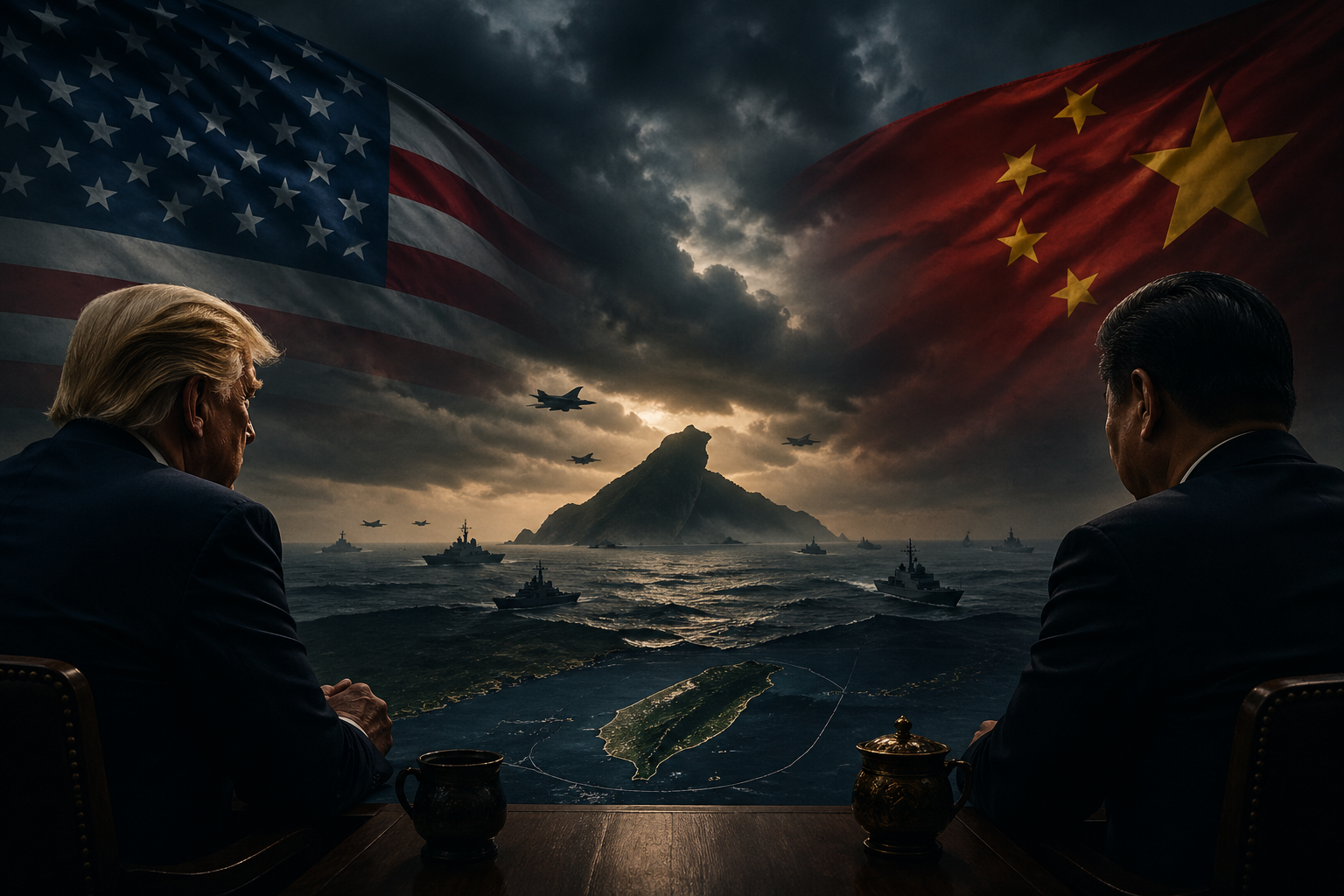
Why Taiwan Has Overtaken Trade As The Most Dangerous Issue In US–China Talks
The Taiwan Flashpoint That Could Define The Trump–Xi Meeting
The upcoming Trump–Xi summit is not really about trade, technology, or even diplomacy.
It is about a single question that neither side can afford to answer incorrectly: what happens to Taiwan next?
Taiwan has emerged as the dominant issue ahead of the meeting, with Beijing pushing for clearer U.S. opposition to Taiwanese independence — a shift that would go beyond current American policy language.
That may sound like a technical diplomatic tweak. It is not. It is the difference between ambiguity and commitment — and in geopolitics, that difference can shape the likelihood of conflict.
Why Taiwan Has Suddenly Moved To The Top Of The Agenda
For years, U.S.–China summits have revolved around trade disputes, tariffs, and economic competition. Taiwan was always present—but often kept in the background.
That has changed.
China now treats Taiwan as the central issue in its relationship with the United States, and it is actively trying to reshape the language Washington uses to describe it.
The distinction matters:
The U.S. position: it does not support Taiwan's independence
China’s demand: the U.S. should actively oppose Taiwan independence
That shift would signal a stronger alignment with Beijing’s position—and potentially weaken Taiwan’s international standing.
From Beijing’s perspective, ththis move isot symbolic. It is strategic.
What Taiwan Actually Represents
Taiwan is not just a disputed island.
It is:
A self-governing democracy with its own military and political system
A critical node in global semiconductor supply chains
A strategic location at the centre of the Indo-Pacific security architecture
Despite functioning as a sovereign state in practice, Taiwan lacks widespread formal recognition due to Chinese pressure.
That creates a fragile reality:
It operates independently
But its status remains politically unresolved
And China has not ruled out the use of force to change that
This is why Taiwan is not just a diplomatic issue — it is a potential trigger point.
The Real Strategy Behind China’s Push
China is not necessarily expecting a dramatic concession at this summit.
The more realistic goal is incremental:
Shift U.S. language slightly
Create ambiguity around support for Taiwan
Gradually weaken Taiwan’s international position
Analysts describe this as a long-term strategy: small rhetorical changes that accumulate into strategic advantage.
At the same time, Beijing is applying pressure through multiple channels:
Military drills near Taiwan
Economic leverage and supply chain control
Diplomatic efforts to isolate Taiwan internationally
The summit is just one part of that broader approach.
The U.S. Position—And Its Limits
The United States faces a difficult balancing act.
On paper, it follows the “One China” policy—acknowledging Beijing’s position without fully endorsing it.
In practice, it
Maintains unofficial relations with Taiwan
Provides military support and arms sales
Signals a “rock solid” commitment to Taiwan’s defence
That ambiguity is deliberate.
It deters China from acting aggressively while avoiding a formal commitment that could trigger escalation.
But ambiguity only works if both sides accept it.
China increasingly does not.
What Most People Miss About This Summit
The real risk is not that something dramatic happens.
It is that something subtle does.
A single phrase in a joint statement.
A slight shift in wording.
An unclear commitment.
These are the kinds of changes that rarely dominate headlines but reshape expectations.
Taiwan is watching closely for exactly such developments.
Because in geopolitics, perception becomes reality quickly.
If Taiwan’s position looks weaker, pressure increases.
If pressure increases, the risk of miscalculation rises.
And miscalculation is how stable situations break.
The Wider Context: More Than Just Taiwan
Taiwan is the headline issue—but it sits inside a larger system of tension:
Intensifying U.S.–China tech rivalry
Expanding economic pressure tools from Beijing
Ongoing military signalling in the Indo-Pacific
China has already been strengthening its leverage ahead of the summit through economic and diplomatic moves.
At the same time, both sides appear to be trying to stabilize relations without conceding ground.
That creates a paradox:
Neither side wants escalation
But neither side wants to look weak
Taiwan sits directly inside that tension.
The Summit’s Real Outcome May Be Invisible
Expectations for a breakthrough are low.
The likely outcome is more subtle:
No major agreement
No dramatic shift
But small signals that shape future behaviour
That is how most modern great-power diplomacy works.
Quiet moves.
Measured language.
Strategic ambiguity—or the erosion of it—remains a key issue.
The Line That Cannot Be Crossed — But Might Be Tested
For China, Taiwan is a core sovereignty issue.
For the United States, it is a test of credibility in Asia.
For Taiwan itself, it is existential.
That makes this summit uniquely sensitive.
Because, unlike trade or tariffs, Taiwan cannot be negotiated in the same way.
It is a line.
And both sides are trying to move it—without appearing to cross it.
What Happens Next
The immediate outcome of the Trump–Xi summit may look uneventful.
But the real impact will be measured in the following:
Policy language
Military posture
Diplomatic signalling
If nothing changes, tension remains contained.
If something shifts—even slightly—the consequences could unfold slowly but decisively.
Final Thought
The most important thing about this summit is not what is announced.
It is what is implied.
Because in the background of every handshake, every statement, and every carefully chosen word, one reality remains:
Taiwan is no longer a side issue. It is the center of gravity.
And once an issue reaches that point, it stops being manageable—and starts becoming decisive.
