America’s Divided Government
The Battle for Capitol Hill
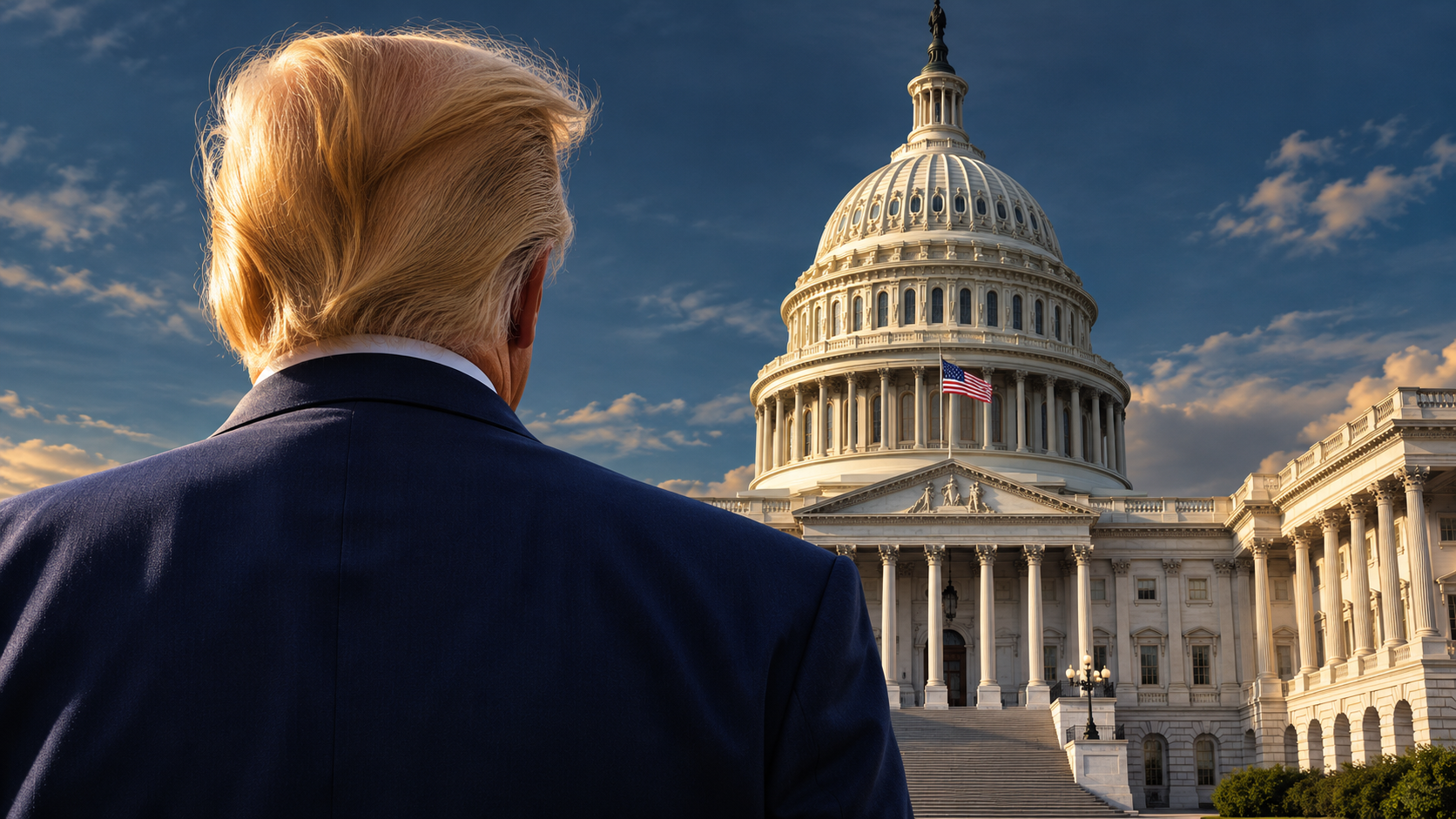
A Democratic victory could block Trump’s legislation and expose his administration to tougher scrutiny, but the Senate result would decide how far that restraint reaches.
Donald Trump could lose control of Congress and still remain the most powerful individual in American government. He would retain the presidency, command of the armed forces, substantial executive authority and the ability to veto legislation. What he would lose is the help of congressional majorities willing to advance his programme.
The polling available on 3 November 2026 points towards a favourable national environment for Democrats. An Ipsos survey conducted from 29 October to 2 November put them eight percentage points ahead among likely voters. But a national lead cannot tell us, by itself, who will control both chambers.
The distinction matters. A Democratic House could obstruct legislation and investigate the administration. A Democratic Senate could also block nominations. Neither result would automatically remove Trump, repeal his policies or transfer the government to his opponents.
What Are the Latest Polls Saying?
Ipsos found that 52% of likely voters supported or leaned towards the Democratic congressional candidate, compared with 44% for the Republican. Trump’s approval stood at 32% among adults.
Those figures measure different things. The congressional question concerns voting preference; approval measures assessments of the president’s performance. A voter can disapprove of Trump while still supporting a Republican candidate.
The survey interviewed 1,765 adults. Its published margin of sampling error was 2.4 percentage points for the full adult sample; Ipsos cautions that subgroup margins are larger. That full-sample figure should therefore not be presented as the precise uncertainty surrounding the likely-voter result.
The broader polling picture also favours Democrats. The national polling average checked on 3 November showed a Democratic lead of 8.8 points, with 52.1% against 43.3%. An average reduces dependence on one survey, although it cannot eliminate an error shared across several pollsters.
The careful reading is that Republicans face a difficult national environment. It is not that Democrats have already won, or that an eight-point polling lead translates into a fixed number of seats.
A forecast adds assumptions about individual races, turnout, historical errors and how errors may move together. Nate Silver and Eli McKown-Dawson’s final forecast commentary favoured Democrats in both chambers and described their House position as especially strong. That is a model-based judgement, separate from the Ipsos survey.
Its publicly accessible commentary listed Democratic polling-average leads of 3.9 points in Maine, three in Ohio and 1.1 in Iowa. Those figures illustrate why the Senate deserves separate attention: relatively small changes across several competitive states can alter the majority.
No precise national win probability is being inferred here from those margins. The evidence supports a Democratic advantage, especially in the House, while leaving uncertainty about the final Senate arithmetic.
Why the Same National Vote Can Produce Different Winners
House elections are decided district by district. Senate elections are decided state by state. Neither chamber distributes seats in proportion to the national vote.
A party could accumulate enormous margins in constituencies it already holds without gaining many additional seats. A smaller improvement spread across competitive districts might deliver more. District boundaries, candidate quality and local turnout affect the conversion from votes into representation.
The Senate adds another complication: only part of it is elected in a given cycle. A favourable national mood cannot dislodge a senator whose seat is not on the ballot.
Imagine two hypothetical elections producing the same national Democratic advantage. In the first, most movement occurs in safe Democratic areas. In the second, it occurs in closely contested districts and states. The national headline would look similar; the balance of power could look very different.
That is why the question “How far ahead are Democrats?” needs a companion question: “Where are they ahead?”
It also explains why the presidency’s popularity is informative without being decisive. Voters are choosing named candidates, and the geography of those choices determines which constitutional powers change hands.
Losing the House and Losing the Senate Are Different Defeats
If Democrats win the House, they would ordinarily gain control of its speakership, committees and legislative agenda. Republican proposals could be denied a vote, amended substantially or rejected.
That would make passing major new tax, spending or domestic policy legislation dependent on negotiations with the opposition. Senate Republicans could still pass measures, but a bill normally needs agreement from both chambers before it reaches the president.
The Senate has an additional power the House lacks: giving or withholding consent to many presidential appointments. A Democratic majority could reject nominees or decline to advance them, making judicial vacancies and senior administration posts major bargaining points.
These possibilities produce distinct governing arrangements:
If Democrats win the House while Republicans retain the Senate, Trump would need opposition cooperation to pass legislation and would face tougher House investigations. A Republican Senate could nevertheless continue confirming his judicial and executive nominees.
If Republicans retain the House but Democrats win the Senate, legislation would encounter an opposition-controlled upper chamber. Trump’s appointments would also face Democratic scrutiny and possible rejection.
If Democrats win both chambers, they would control Congress’s legislative agendas and gain broader investigative and negotiating power. Trump would retain his executive authority and presidential veto.
If Republicans retain both chambers, Trump would keep the most favourable congressional arrangement for advancing his programme. Internal party divisions and Senate procedures could still obstruct legislation.
There is an important limit to the appointments scenario. A Senate defeat would not automatically dismiss officials already confirmed, remove existing judges or reverse earlier judicial appointments. Its sharpest effect would concern appointments still requiring action.
The result would therefore shape both the immediate administration and opportunities to leave a longer institutional legacy.
The Powers Trump Would Keep
The presidency does not depend on retaining the confidence of Congress in the way a British government normally depends on the Commons. Congressional defeat is not a vote that automatically ends a president’s term.
Trump would continue directing the executive branch within constitutional and statutory limits. His administration could implement existing laws, establish lawful enforcement priorities, conduct diplomacy and take administrative decisions supported by existing authority.
He would retain the constitutional pardon power for federal offences, subject to its limits, including the impeachment exception. Congressional opposition would not acquire a general power to approve or reject each pardon.
He would also remain commander-in-chief. That does not give a president unlimited authority to wage war or spend military funds: Congress possesses its own powers over war, legislation and appropriations. But losing congressional majorities would not transfer operational command to congressional leaders.
His veto would remain central. Democrats could pass legislation through both chambers and still see it rejected. Overriding a veto requires two-thirds support in each chamber, a much higher threshold than an ordinary partisan majority.
This creates an uneven distribution of power. Democrats might gain the ability to stop Trump obtaining a new law without gaining the votes needed to impose their own alternative.
For households and businesses, that means existing policy could persist even after an election apparently delivered a mandate for change. Blocking the next decision and reversing the last one require different coalitions.
Could He Simply Govern Through Executive Orders?
Trump could continue issuing executive orders, but an order is not a substitute constitution that becomes available when Congress refuses to cooperate.
Its legal effect depends on the authority behind it. Some presidential action rests on constitutional powers; other action relies on authority Congress has delegated through legislation. Writing a directive does not itself create the missing legal power.
Consider a hypothetical environmental programme. A president might direct an agency to change its priorities within the law. He could not assume that the same document authorised spending Congress had never provided or erased a statutory duty.
Opposition lawmakers could try to restrict implementation through new legislation or funding conditions. Those measures would still face the normal legislative hurdles, including the president’s veto. Litigation could separately test whether an executive action exceeded lawful authority.
The likely pressure under divided government is therefore towards greater reliance on administrative decisions wherever legal room exists. That is an inference from the institutional incentives, not a prediction that every proposed order would succeed.
The practical questions become more specific: which statute authorises the action, what money is available, what procedures must be followed, and what happens if a court rules against it?
Why Investigations Could Change Daily Life in the White House
An opposition-controlled chamber can scrutinise an administration without first passing a bill the president is willing to sign.
Committees can hold hearings, seek documents and testimony, and use subpoenas within their authority. Their investigations must respect jurisdictional and constitutional limits. Executive privilege, legal challenges and enforcement disputes can complicate access to evidence.
Nevertheless, the change from a sympathetic majority to an adversarial one can be substantial. Committee leaders decide which questions deserve sustained attention and where staff, hearings and investigative resources are directed.
Potential subjects could include spending decisions, implementation of immigration policy, conflicts of interest or the legal basis for executive action. These are examples of possible oversight areas, not claims that a particular future investigation has already been authorised.
The consequence would extend beyond televised exchanges. Responding to inquiries consumes officials’ time, forces decisions about disclosure and can reveal information that changes subsequent legislation or public opinion.
It would be wrong to treat a subpoena as proof of wrongdoing. It would be equally wrong to dismiss oversight as powerless merely because Congress cannot prosecute an ordinary criminal case itself. Obtaining evidence and making it public can change the political cost of continuing a policy.
Would Losing Congress Mean Impeachment or Removal?
A Democratic House could pursue impeachment if its members chose to do so. An election victory would not require it, and policy disagreement alone would not establish the constitutional case.
The House brings charges through impeachment; the Senate conducts the trial. Conviction requires two-thirds of senators present. If all 100 participate, that means 67 votes.
A narrow Democratic Senate majority would therefore fall well short of removing Trump without substantial Republican support. Impeachment, conviction and removal are separate stages, not interchangeable descriptions of the same event.
Trump’s first term supplies a direct example. The House impeached him in 2019, but the Senate acquitted him in February 2020. On the first article, 48 senators voted guilty and 52 not guilty.
The political consequences of an investigation or impeachment can be substantial even when removal does not follow. But the claim that Democrats could simply “vote Trump out” after winning ordinary congressional majorities misstates the process.
Similar Polling Before: What Happened in 2018?
The closest comparison combines the same president with a recognisably similar national Democratic advantage.
In September 2018, a Pew Research Center survey found Democrats ahead by ten points among registered voters, 52% to 42%. That survey was earlier in the campaign and used a different voter population from the latest Ipsos likely-voter figures, so the numbers are not a like-for-like trend.
Near the election, the historical national polling-average page records a Democratic advantage of 7.3 points. Democrats subsequently gained 41 House seats. Republicans nevertheless gained two Senate seats.
That is a useful precedent for what a strong Democratic national environment can achieve—and why it does not settle both chambers.
The post-election balance also demonstrated the Senate’s independent importance. Despite Democratic control of the House, Trump secured Amy Coney Barrett’s confirmation to the Supreme Court in October 2020. The Senate approved her by 52 votes to 48; the House had no confirmation vote.
For 2026, the lesson is conditional. If Republicans retain the Senate, losing the House would still leave Trump a route to consequential appointments. If they lose the Senate too, that route becomes much less reliable.
The historical resemblance strengthens the case for taking the polling seriously. It does not justify predicting another 41-seat gain. The candidates, boundaries, contested states and starting distribution of seats are different.
Clinton, Obama and Bush Show the Range of Outcomes
Several modern midterms reveal how congressional losses can change a presidency without ending it.
In 1994, Bill Clinton’s Democrats lost 54 House seats and eight Senate seats, surrendering control of both chambers. His subsequent negotiations with Republicans show that a president can suffer a major congressional defeat and still agree significant legislation.
In 2006, George W. Bush’s Republicans lost 30 House seats and six Senate seats. Democrats took control of Congress, providing a comparison for a second-term president facing opposition majorities during his remaining years in office.
In 2010, Barack Obama’s Democrats lost 63 House seats and six Senate seats. They retained the Senate but lost the House, transforming the balance of power in negotiations over spending and borrowing.
In 2018, Donald Trump’s Republicans lost 41 House seats while gaining two Senate seats. The result demonstrated that a substantial defeat in one chamber can coexist with gains in the other.
In 2022, Joe Biden’s Democrats lost nine House seats while gaining one Senate seat. Republicans captured the House, while Democrats strengthened their Senate position—another example of the chambers moving
These are changes for the president’s party using the American Presidency Project’s historical series. Different reference points, including vacancies and changes during a Congress, can produce slightly different totals elsewhere.
Clinton’s experience shows why divided government should not be equated with complete legislative paralysis. After the 1994 defeat, he vetoed welfare proposals before signing the Personal Responsibility and Work Opportunity Reconciliation Act in August 1996.
Whatever judgement one makes about that law, the institutional lesson is clear. The Republican Congress could shape the available legislation, while Clinton’s refusal to sign earlier versions affected the eventual bargain.
Obama’s experience after 2010 highlights a different consequence: the bargaining power created by financial deadlines. The Budget Control Act signed in August 2011 combined authority to increase the debt limit with discretionary spending limits and a deficit-reduction process.
That history does not establish that another standoff is inevitable. It shows why an opposition House can matter enormously even without controlling every institution.
Bush’s 2006 setback provides the second-term comparison. The relevant similarity is a president facing the remaining years of his administration with an opposition Congress. The subjects of conflict and the political conditions must still be assessed separately.
Budgets Could Become the Most Consequential Battleground
The dispute most likely to affect ordinary people need not be the hearing that attracts the most attention. It may concern legislation required to keep parts of government operating.
Congress controls appropriations, while the president participates through signing or vetoing funding measures. An opposition majority can seek conditions on spending; the White House can resist them. Agreement requires enough support across the institutions involved.
If funding authority expires without a replacement, affected operations can face a shutdown. That is different from a debt-limit crisis, which concerns borrowing authority and the financing of obligations.
Confusing them hides the practical risk. A shutdown concerns which activities can continue under available funding and legal exceptions. A borrowing impasse raises questions about cash, refinancing and payment deadlines.
The distinction becomes clearer when examining what would happen if the US government could no longer borrow money. The immediate danger depends on the constraint, available cash and obligations falling due—not simply on the size of the national debt.
A Democratic victory would not itself create either emergency. A confrontation would require subsequent choices about legislation and whether the parties could reach agreement.
Nor would Democrats possess unlimited leverage. Lawmakers seeking restrictions would also have to consider the effects on constituents, federal employees and programmes they support. Trump would face equivalent questions about the costs of refusing a deal.
That mutual exposure can encourage compromise. It can also produce a prolonged dispute when each side believes the other will receive more blame.
What Would Change for Britain and the Wider World?
A congressional defeat would not mean American foreign policy immediately reversed direction.
Trump would remain the principal presidential actor in diplomacy and military leadership. Congress could influence funding, legislation, oversight and appointments, but a new majority would not automatically cancel every existing international policy.
For Britain, the practical task would be to identify which American decisions require congressional cooperation and which can proceed under existing executive authority. A presidential announcement and a durable, funded commitment are not always the same thing.
The same distinction matters in international negotiations. An administration may be able to discuss an agreement while needing congressional action for particular elements of its implementation. Foreign governments would have reason to examine the legal route as well as the political promise.
Businesses should likewise avoid assuming that legislative gridlock means policy stability. Administration decisions, litigation and funding disputes can continue even when major new laws become harder to pass.
The uncertainty would change form: fewer straightforward opportunities for a partisan legislative programme, but potentially more conflict over implementation and the limits of existing powers.
The Result Matters—and So Does the Size of the Majority
Election night would establish more than a winner’s label. The size and composition of each majority would help determine whether its leaders could deliver on their promises.
A narrow House majority can be disrupted by a small number of defections. A broader one gives leaders more room to lose votes. Senators representing competitive states may assess a confrontation differently from colleagues in safer seats.
There is also a delay between voting and the transfer of congressional power. The incoming members’ terms begin on 3 January 2027. The outgoing Congress retains its powers in the intervening period.
That interval could matter for unfinished legislation and nominations, especially if Republicans expected to lose control of the Senate. A rush to act would be possible, but individual decisions would still require the necessary votes and procedures.
The most revealing early test of a Democratic victory would therefore be practical: whether the new majority could agree on its first funding demands, investigative priorities and approach to nominations.
Trump would still possess considerable power. The question would be how often exercising it required agreement from people elected to restrain him.
Sources
Ipsos — Reuters/Ipsos Early November Survey — Fieldwork dates, likely-voter preferences, presidential approval and sampling limitations. Ipsos
RealClearPolling — Generic Ballot: 2026 Compared With Previous Midterms — Current national average and the historical 2018 polling comparison. realclearpolling.com
Nate Silver and Eli McKown-Dawson — Final FLIPR 2026 Midterm Election Forecast — Publicly accessible forecast commentary and selected Senate polling averages. Silver Bulletin
National Archives — The Constitution of the United States — Legislative powers, presidential authority, appointments, vetoes and impeachment. National Archives
National Archives — Constitutional Amendments 11–27 — Congressional terms and the January transfer of power. National Archives
Congressional Research Service — Executive Orders: Issuance, Modification, and Revocation — Legal authority for executive orders and congressional responses. EveryCRSReport.com
Congressional Research Service — Congressional Oversight and Investigations — Committee investigations, legislative purpose and constitutional constraints. everycrsreport.com
Pew Research Center — Democrats Have Edge in 2018 Midterm Voting Preferences — September 2018 registered-voter polling. Pew Research Center
American Presidency Project — Seats in Congress Gained/Lost by the President’s Party in Mid-Term Elections — Historical seat changes and methodological notes. The American Presidency Project
US Senate — Trump Impeachment Vote, 5 February 2020 — The first article’s acquittal vote. 2nd Session
US Senate — Amy Coney Barrett Confirmation Vote — Confirmation date and 52–48 result. 2nd Session
Clinton White House Archives — Statement on Welfare Reform, 22 August 1996 — The signed legislation and earlier presidential vetoes. clintonwhitehouse6.archives.gov
Obama White House Archives — Statement on the Budget Control Act, 2 August 2011 — Debt-limit authority and spending provisions enacted after the 2010 midterms. whitehouse.gov
Next Reads
What Would Happen If the US Government Could No Longer Borrow Money? — How a borrowing restriction could affect government payments and financial markets.
What Actually Happens When a Country Runs Out of Money? — Why national wealth, government cash and the ability to meet obligations are different things.
Iran’s Two-Day Hormuz Proposal: The Conditions Behind a Possible Reopening — The distinction between diplomatic proposals, agreed commitments and implementation.
