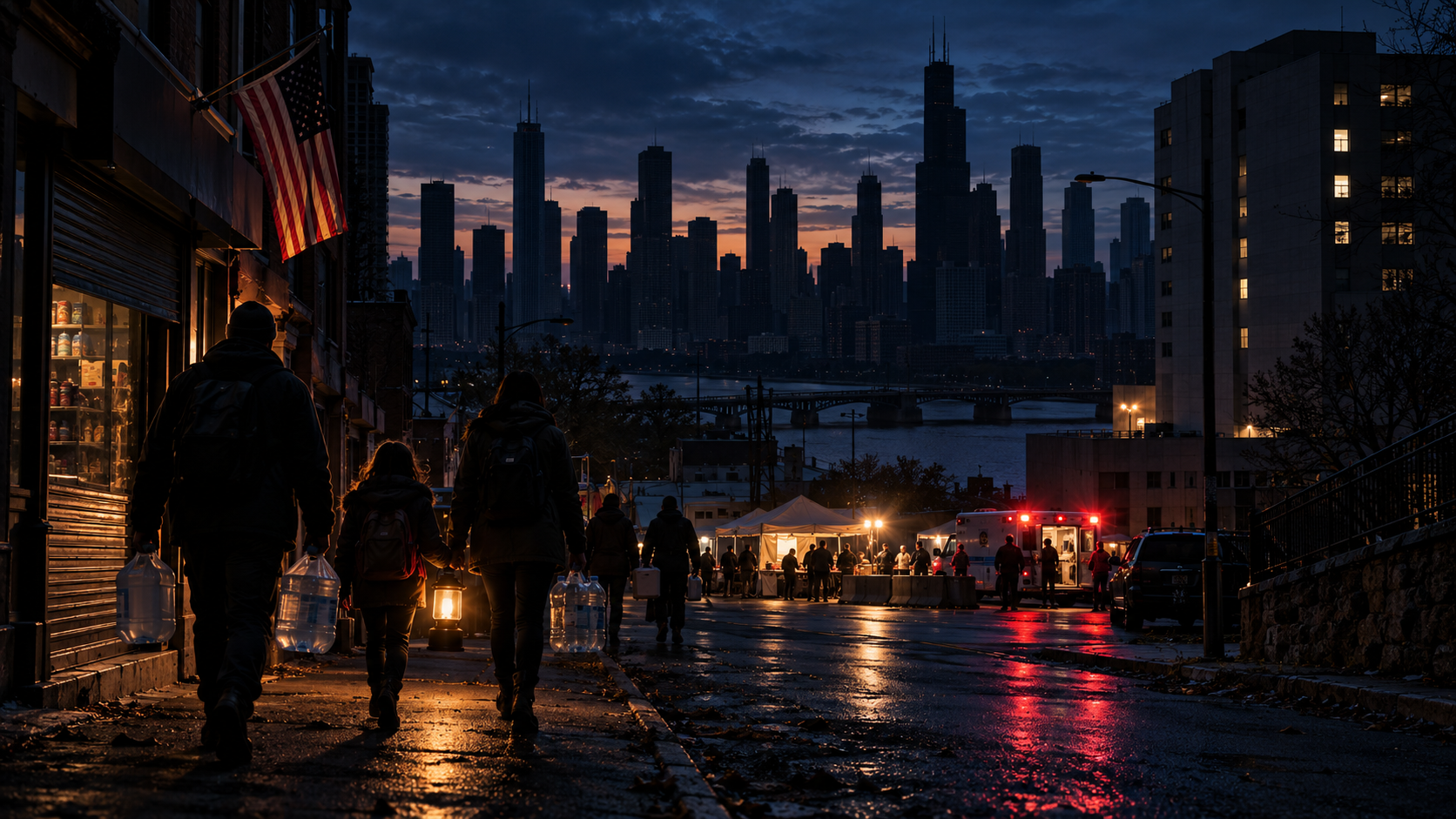
How an American Blackout Would Become a Public Emergency
America After the Lights Go Out
A week without grid electricity would become a struggle to keep water, fuel, communications and care reaching the people who need them.
The first problem would be darkness. The more dangerous problems would arrive through ordinary needs: a lift that no longer reaches an upstairs flat, a petrol pump that cannot dispense fuel, a water system losing pressure and a medical device with a battery that needs charging.
If the United States lost normal grid electricity for seven days, the result would be a severe national emergency. Backup generators, batteries and functioning microgrids would preserve pockets of service, but their endurance would depend on fuel, maintenance and staffing. The consequences would vary enormously with weather, location, health and the cause of the outage.
There is no credible universal timetable for when every city would lose water or every hospital would fail. The useful timeline follows the pressures that accumulate, the resources that run down and the decisions that can prevent one failure from causing another.
Define the Blackout Before Predicting the Damage
For this scenario, assume widespread loss of normal grid supply across the United States for a full week. Local batteries, emergency generators and suitably equipped independent systems can still operate. Most physical infrastructure survives, and electricity begins returning at the end of the period.
This is an extreme stress test, not a forecast or a claim that a single routine fault could cause it. The Energy Information Administration explains that the lower 48 states have three main interconnections: Eastern, Western and the system covering most of Texas. Alaska and Hawaii have separate arrangements. America is not one undivided electrical circuit.
A simultaneous national failure would therefore require an exceptional combination of events or a deliberately imposed hypothetical. The cause would change the recovery. Undamaged equipment disconnected for operational reasons presents a different problem from widespread destruction of transformers or transmission infrastructure.
Season would also matter. A mild week would create serious disruption. Extreme heat or cold would turn many buildings into unsafe environments much faster and increase demand for emergency shelter and medical care.
The timeline below describes plausible pressures under the stated assumptions. Its days are stages of an illustrative scenario, not deadlines at which every community undergoes the same event.
The First Hour: Safety Systems and Immediate Decisions
Lights, domestic appliances and ordinary electric heating or cooling would stop where no backup existed. People would be trapped in some lifts. Electrified transport could halt, and unpowered traffic signals would complicate road movement.
Cars would not all become unusable. A petrol or diesel vehicle with fuel could generally still operate, and an electric vehicle with a charged battery would retain stored energy. The difficulties would concern road conditions, information and eventual replenishment rather than an instant disappearance of transport.
Hospitals and other critical facilities would move onto available backup arrangements. The important qualification is “available”: a generator must start, connect to the required circuits and carry the load. Different facilities have different equipment, maintenance and coverage.
Operators would need to determine whether they faced a local interruption or something much larger. That distinction affects whether they can rely on nearby hospitals, neighbouring utilities or commercial suppliers for assistance. In a nationwide event, many of the normal destinations for mutual aid would be managing their own emergencies.
Members of the public would also make consequential choices with limited information. Leaving immediately could create congestion. Staying could be unsafe for someone dependent on powered medical equipment. Authorities would need to communicate priorities through channels that did not assume uninterrupted household internet access.
The first hour would reward systems designed to fail safely and people who already knew what their fallback arrangements were.
The First Evening: Buildings Would Become Unequal Environments
The same loss of electricity would feel very different in different homes. A ground-floor house in mild weather with stored water presents different challenges from an upper-floor flat with no lift during a heatwave.
Gas heating would not automatically solve the problem. Many heating systems need electricity for controls, pumps or fans. A fuel supply and a working heating appliance are separate requirements. Improvised indoor heating and cooking would introduce additional hazards.
Darkness would also increase practical difficulties for people with limited mobility or vision. Charging a phone could become important for accessibility as well as communication. The household with the least need to travel might be the one whose residents could move most easily; someone urgently needing assistance might face the greatest barriers to leaving.
Hotels and public buildings with backup power could become valuable refuges, but capacity would be limited. A building suitable for a brief gathering might lack the sanitation, staffing or equipment needed to support vulnerable people overnight.
Emergency planning would therefore need to distinguish shelter from support. Providing a roof does not automatically provide a way to charge essential equipment, store medication appropriately or help a person reach a toilet.
This would be the first major social divide of the blackout: who could remain safely where they were, and who needed help before supplies visibly ran out.
Day One: Food Safety Would Become a Clock
Refrigeration begins losing effectiveness as soon as power stops, although stored cold provides a temporary buffer. The US Centers for Disease Control and Prevention advises that, with doors kept closed, food can remain safe for up to four hours in a refrigerator, 48 hours in a full freezer and 24 hours in a half-full freezer.
Those are conditional guidance figures, not a promise that every item remains safe until the final minute. Temperature, handling and the type of food matter. Food should not be tasted to determine whether it is safe after an outage.
For households, this would turn meal planning into a practical problem. Perishable food might need safe cooling or disposal, while shelf-stable supplies became more useful. Cooking arrangements would also matter: food requiring substantial preparation is less useful when ordinary appliances cannot operate.
Retailers and distributors would face a larger version of the same challenge. Some refrigerated storage would have backup generation. Other stock could deteriorate, while uncertainty about temperature histories might make products unsuitable for sale even if they looked normal.
The national food supply would not disappear in a day. The harder question would be how much remained safe, where it was located and whether it could be transported and sold. Food in a warehouse does little for a household that cannot reach it.
Preventing waste would require coordination between suppliers, emergency services and communities. Unplanned crowds at shops could make that coordination more difficult, even when people were acting from an understandable desire to provide for their families.
Water Would Become More Important Than the Lights
Drinking-water systems depend on electricity in different ways, including pumping, treatment and monitoring. Some communities benefit from stored water and gravity. Others rely more heavily on continuous pumping. There is no national hour at which every tap would stop.
The Environmental Protection Agency's power-resilience guidance identifies risks from inoperable pumps, loss of pressure and wastewater failures. Reduced pressure can allow contamination to enter a distribution system. Failed wastewater pumping can contribute to sewage backups or untreated discharges.
Backup power can prevent or delay these outcomes, but it needs to be matched to the actual equipment and supported through the outage. A generator at one facility does not automatically power every pump elsewhere in the network.
For a high-rise building, water could become difficult to obtain even while the wider municipal system retained some service. Building-level pumps and access arrangements would matter. A household might therefore lose practical access before a citywide announcement described a general failure.
The public-health implications would extend beyond drinking. Toilets, handwashing, cleaning, food preparation and some medical services all depend on usable water. Firefighting also requires reliable supply and pressure.
Advice would need to distinguish the type of problem. Boiling is relevant to some microbial contamination risks but does not make every contaminated supply safe, and people without electricity may not have a safe way to boil water. Specific local instructions would be essential.
The priority would be maintaining safe water service wherever possible and delivering appropriate alternatives where it could not be maintained.
Days Two and Three: Fuel Would Become a National Allocation Problem
Emergency generators convert a power failure into a fuel requirement. That is extremely useful, but it means that endurance depends on a supply chain rather than on the presence of the machine alone.
Hospitals, water facilities, communication sites, shelters and distribution centres could all seek deliveries at the same time. A supplier's promise to serve one customer might be difficult to fulfil when many customers activated emergency arrangements simultaneously.
Fuel also needs to move through powered infrastructure. Storage, loading, pumping, payment and communications can each become constraints. A tanker driver needs a usable route, a functioning loading point and reliable information about where the delivery is most urgent.
This creates an uncomfortable dependency: fuel is needed to generate electricity, while electricity helps make fuel available. Breaking that loop requires identifying the facilities that enable other facilities to remain operational.
The 2021 Texas and South Central US freeze provides a real, limited comparison. The joint federal reliability investigation identified freezing and fuel problems, including interactions between gas infrastructure and electricity loss. It was a regional event with its own weather conditions, not proof of what a nationwide seven-day blackout would do.
Its relevance is that sectors cannot plan in isolation. Protecting a hospital's generator while overlooking the infrastructure that supplies its fuel leaves an important part of the resilience problem unsolved.
By this stage, decisions about priority would have visible consequences. Keeping a water pumping station operating could support many other services. Sending scarce fuel elsewhere might preserve a valuable facility while leaving a larger population without a basic need.
Communications Would Fade Unevenly
A charged phone is only one component of a working call. Mobile sites, network equipment and the connections between them also need power. Backup batteries and generators can sustain service, but their duration varies and they need support.
Some areas could retain connectivity while others lost it. Congestion could make a functioning network difficult to use. People might interpret an unanswered message as evidence of danger when the immediate cause was simply a depleted battery or unavailable local site.
Broadband at home commonly depends on powered equipment in the premises. A data centre operating on backup power does not restore access to a household whose router and local network have no supply. The resilience of the central service and the resilience of the last connection are separate questions.
Broadcast radio could remain important where transmitters and programme feeds had power. Battery-powered receivers would allow information to reach people without requiring them to establish an individual internet connection.
Authorities would need predictable updates, clear locations for assistance and alternatives for people unable to travel. Information that arrived late could be actively unhelpful if it directed people towards a distribution point that had already exhausted its supplies.
The communication challenge would therefore concern accuracy as much as reach. A surviving channel is valuable only if it carries instructions that reflect what is happening on the ground.
Hospitals Would Need More Than Generator Hours
Hospital resilience is often described through a single question: how long will the generator last? That matters, but a functioning hospital also requires water, staff, medicines, consumables, waste handling and routes for patients and supplies.
A facility could retain electricity while losing one of those other essentials. Staff might be unable to travel because they were caring for relatives or could not obtain fuel. A supplier might have stock but no way to deliver it. Another hospital expected to accept transferred patients could be under equal pressure.
Demand could rise at the same time. People using powered equipment at home might seek help. Temperature exposure, accidents and problems obtaining routine treatment could add to the workload. Some of these patients would need practical support rather than the most intensive clinical care, but they would still require safe arrangements.
The response would likely include cancelling non-urgent activity, concentrating resources and relocating some services or patients where feasible. The precise choices would depend on local capabilities and clinical judgement.
It would be irresponsible to predict a national death toll from the headline alone. Weather, warning time, backup reliability and the success of mutual aid would all change outcomes. The absence of a defensible number should not be mistaken for the absence of serious risk.
The most important measure would be how long essential care could continue as a complete service, rather than how long one part of the hospital could remain electrically powered.
Days Four and Five: The Emergency Would Move Into Homes
By the middle of the week, differences in household resources could become increasingly consequential. Some people would have safe accommodation, transport and enough supplies. Others would face depleted food, inaccessible water, missed income and growing difficulty maintaining ordinary care.
A person living alone might have nobody nearby who knew they needed assistance. A family with young children could struggle to queue for supplies while supervising them. Someone with limited mobility might be unable to carry water upstairs even if a distribution point existed nearby.
This is why counting delivered supplies is not enough. The response must consider whether the intended recipients can collect and use them. A successful delivery to a town is not necessarily a successful delivery to the people most at risk within it.
Neighbourhood support could make a substantial difference. Residents might share information, help with transport or check on people who could not leave home. Such cooperation is a plausible and valuable response; the scenario does not justify assuming that society would automatically descend into violence.
Equally, cooperation would not remove every conflict. Scarcity, poor information and perceptions of unfair treatment could create tension. Clear priorities and visible, consistent distribution would help more than vague reassurances that everyone was being served.
The national emergency would increasingly be experienced through small practical questions: who knows that this person is upstairs, who can reach them, and what can they safely do next?
Improvised Power Could Create a Second Emergency
People understandably try to solve immediate problems. During a prolonged blackout, some would use generators, camping equipment or vehicles in ways they had not previously attempted. An unsafe workaround can create a danger separate from the original outage.
Carbon monoxide is especially important because it cannot be reliably detected by smell. CDC guidance says portable generators should be operated outdoors, more than 20 feet from windows, doors and vents, and never inside a home or garage even with doors open. Battery-powered or battery-backup carbon monoxide alarms provide another safeguard.
Indoor charcoal use and unsuitable indoor cooking or heating arrangements can also be dangerous. The practical message belongs near the discussion of backup power, rather than being treated as a minor detail after the benefits have been described.
Electrical connections require care too. Restoring power to a building through improvised wiring can expose occupants and workers to hazards. Installed equipment needs appropriate isolation and professional arrangements; possessing a generator does not make every method of connecting it safe.
Public communication would need to be specific enough to prevent predictable mistakes while reaching people before they improvised. Instructions available only online would be inadequate for many of those most likely to need them.
The response would be more effective if safe options were accessible. Telling a household not to use a dangerous heat source is more useful when there is a realistic route to warmth or shelter.
Why Solar Panels Would Not Automatically Keep a Home Running
A roof covered in solar panels does not necessarily provide electricity during a grid outage. Many systems disconnect when the grid fails unless they have the equipment and configuration needed for safe independent operation.
The Department of Energy distinguishes ordinary distributed generation from microgrids that can separate from the main network and operate autonomously. Suitable batteries, controls and system design can make local generation more useful during an outage.
Even a capable system has limits. The amount of energy available changes with weather and time of day. Running essential lights, communications and refrigeration requires less than powering every appliance as normal. A battery's usefulness depends on the loads connected to it and how it is managed.
This makes prioritisation part of the technology. A household or facility that identifies essential circuits in advance can preserve important functions for longer. A system designed only around normal financial savings may not provide the same emergency capability as one designed explicitly for resilience.
At community scale, functioning microgrids could support shelters, clinics or other valuable services. They would create islands of continuity rather than erase the national emergency.
The useful question is therefore specific: what can this installation power independently, under which conditions and for how long? The presence of a renewable energy source alone does not answer it.
Days Six and Seven: Keeping the Response Working
Towards the end of the week, the emergency response would face its own endurance problem. Vehicles need maintenance, equipment develops faults and staff need rest. A plan that succeeds for one shift can become fragile when repeated continuously.
Relief arrangements would be complicated by the scale of the event. Assistance from outside the affected area is a cornerstone of many disaster responses. A nationwide blackout greatly reduces the unaffected domestic area from which resources can be drawn.
International assistance could help, but it would still need to enter through functioning transport and distribution systems. Supplies at an airport would not automatically reach a remote town. Imported generators would require appropriate connections, fuel and people who could operate them safely.
Economic losses would also deepen. Some production could be delayed, but spoiled food, interrupted services and lost trading hours could not all be recovered. Small businesses with limited reserves might face lasting harm from a week without ordinary income.
Claims about the cost would need a defined method. Multiplying daily national output by seven would ignore activity that continued, work later recovered and additional damage that lasted beyond the outage. A credible estimate would need sector-level assumptions and a clear description of the event.
The final days would test whether the response could keep renewing its own capacity while preparing for a recovery that would be uneven and demanding.
Turning the Grid Back On Would Be an Engineering Process
An electrical system cannot always be restarted by reconnecting every customer at once. Generation and demand need to remain balanced, and equipment must be brought back safely in an appropriate sequence.
The Department of Energy describes black start as using suitable resources to help restore a system without relying on an already operating external grid. Smaller restored sections can support additional generation and load as recovery proceeds.
The difficulty would depend heavily on what caused the outage. If equipment remained intact, operators would face a different task from rebuilding damaged infrastructure. If a security problem remained unresolved, restoring connections without addressing it could expose the system to further failure.
Customers might receive power at different times. Critical infrastructure could be prioritised, while some neighbourhoods waited. Even after supply returned, a building might need inspection or repair before all its equipment could be used safely.
Water services would also require their own recovery checks. Food would need assessment and replacement. Businesses would reconcile records and suppliers would rebuild normal schedules. Restored lights would be an important milestone, but they would not erase the week's accumulated consequences.
The Most Valuable Backup Would Be a Working Chain
The scenario exposes the limits of preparing one institution at a time. A hospital depends on a fuel supplier; the supplier depends on transport and powered loading; the transport system depends on communications and staff who can reach work.
For households, modest preparations and reliable local support can reduce immediate dependence. For essential services, resilience requires identifying and sustaining the chain that makes the backup usable. That includes people and arrangements as well as hardware.
E. M. Forster's The Machine Stops imagines technological dependence taken to an extreme. A real blackout would be less uniform and more practical: different systems failing at different times, with opportunities to preserve service at each connection.
A seven-day American power failure would not have one inevitable ending. Its human cost would turn on how effectively limited working capacity reached the places where it prevented the greatest harm. The most valuable generator might be the one powering a pump that kept an entire community supplied with water.
Sources
US Energy Information Administration — Electricity Explained: How Electricity Is Delivered to Consumers — The structure of US grid interconnections and the need to balance supply and demand.
CDC — Keep Food Safe After a Disaster or Emergency — Conditional refrigeration and freezer guidance during power loss.
US Environmental Protection Agency — Power Resilience: Guide for Water and Wastewater Utilities, December 2015 — The mechanisms linking power loss to pumping, water pressure, contamination and wastewater risks.
Federal Energy Regulatory Commission — Final Report on February 2021 Freeze Underscores Winterization Recommendations — The documented interaction of freezing, fuel supply and electricity failures during the regional event.
CDC — Carbon Monoxide Poisoning Basics — Generator placement, ventilation hazards and carbon monoxide precautions.
US Department of Energy — Solar Integration: Distributed Energy Resources and Microgrids Basics — Islanding, microgrid operation and the distinction between solar generation and independent backup capability.
US Department of Energy — Hydropower Plants as Black Start Resources — Black-start restoration and the staged return of generation and load.
Next Reads
The Machine Stops: Did a 1909 Story Imagine Life Through a Screen? — A fictional exploration of technological dependence and the loss of practical alternatives.
What Causes A Financial Crisis? Banks, Debt And Contagion Explained — How disruption can spread between connected systems, examined through finance rather than electricity.
