Why Europe Is Quietly Turning Lake Geneva Into a Fortress Ahead of the G7 Summit
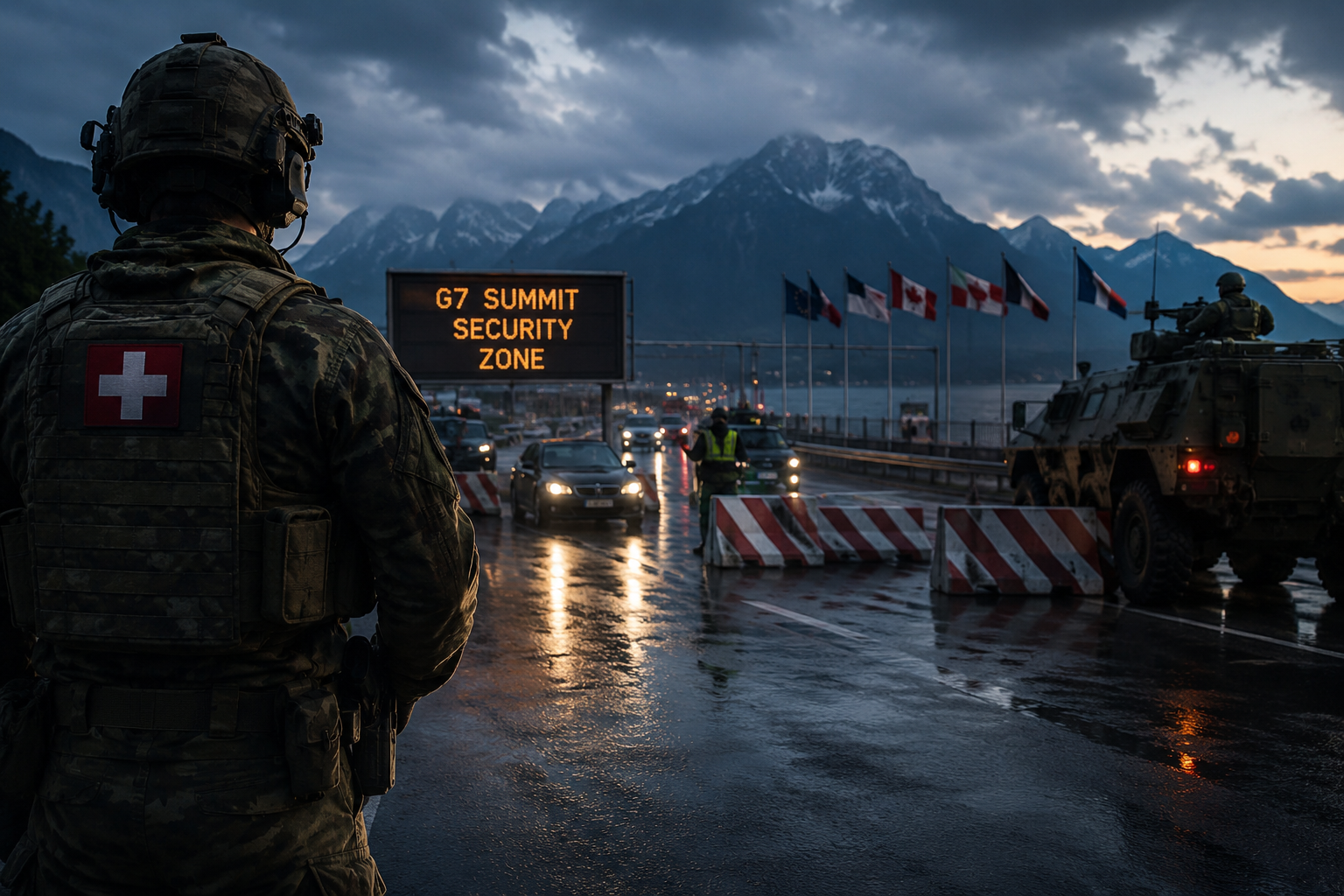
Europe’s Next Security Test Is Happening Before Most People Notice
4,000 Troops, Airspace Restrictions and Border Controls: The Security Operation Behind Europe’s Most Sensitive Summit
The agreement between Switzerland and France ahead of the upcoming G7 summit might sound like a routine piece of diplomatic administration. In reality, it is something much larger. The two countries have approved extensive military cooperation measures, with security planning stretching across borders, airspace, transport networks and even cyberspace.
The summit will take place from 15–17 June in Évian-les-Bains, a French town on Lake Geneva that sits only a short distance from Swiss territory. Because of that geography, Switzerland is becoming deeply involved in securing an event it is not formally hosting. The arrangement highlights a reality increasingly visible across Europe: modern geopolitical risk no longer respects borders.
A Security Operation On A Rare Scale
Swiss authorities have confirmed that approximately 4,000 military personnel will be deployed to support security efforts during the summit period. Their role includes protecting key infrastructure, supporting border operations, monitoring transport routes and helping secure Lake Geneva itself.
Airspace restrictions will also be imposed around the summit zone, with enhanced air policing operations, counter-drone capabilities and additional protective measures against a range of modern security threats. Geneva International Airport is expected to play a critical role because many world leaders and delegations are likely to arrive through Switzerland before travelling into France.
This is not simply about crowd management. The operational planning extends into areas such as cyber security, information protection and coordinated cross-border military procedures. Swiss officials have openly stated that heightened global tensions require exceptional measures.
The Shadow Of Global Instability
The most revealing part of the story is not the number of troops. It is the language being used to justify their deployment.
Officials have repeatedly referenced a deteriorating international security environment and rising global tensions. While no single threat has been identified publicly as the driving factor, the broader context is obvious. Europe is operating in a world shaped by the continuing consequences of the Ukraine conflict, Middle East instability, growing cyber threats, political extremism, disinformation campaigns and concerns about attacks on critical infrastructure.
Large international gatherings have always attracted security concerns, but the modern threat landscape is radically different from that of previous decades. Drones, cyber disruption, lone-actor attacks and coordinated online campaigns all force governments to think far beyond traditional physical security.
The result is a summit that increasingly resembles a protected strategic asset rather than a diplomatic conference.
Why Switzerland Is So Deeply Involved
One of the more unusual aspects of this story is that Switzerland is carrying a significant security burden despite not being a G7 member.
The simple explanation is geography. Évian sits directly beside Lake Geneva, meaning Swiss territory, roads, airports and infrastructure become part of the wider operational picture. Security planners cannot separate the French summit site from the surrounding Swiss environment.
That reality has generated political discussion within Switzerland. Some Swiss voices have questioned whether the costs and disruptions are proportionate, particularly given that the summit itself is taking place on French soil. Previous G8 and G7 events in the region also remain part of the political memory, especially after significant protests and disturbances linked to earlier gatherings.
For Swiss authorities, however, the calculation appears straightforward. If the summit affects Swiss territory, then Swiss security agencies must prepare accordingly.
The Return Of Border Controls
Perhaps the clearest sign of the seriousness surrounding the summit is the decision to strengthen border measures.
Authorities have confirmed temporary border controls, enhanced surveillance and transport restrictions across parts of the Franco-Swiss region. Residents and travellers have already been warned to expect delays and disruptions as security operations intensify.
In many ways, this reflects a broader European trend. Open borders remain a defining feature of modern Europe, but major security events increasingly require governments to temporarily reintroduce controls when risk levels rise.
The symbolism is difficult to ignore. In an era built on mobility and openness, security concerns are once again reshaping the movement of people and goods.
What This Really Tells Us About 2026
The most important takeaway is not that Switzerland and France are coordinating military security operations. It is that such measures are now considered necessary.
A major international summit near a peaceful European lake would once have been viewed primarily as a diplomatic event. Today it is treated as a potential security challenge spanning land, water, airspace, cyberspace and information networks.
That shift reflects the defining reality of modern geopolitics. Governments are increasingly planning for uncertainty rather than reacting to it. The extensive preparations around the G7 summit are not necessarily evidence that a specific threat exists. They are evidence that leaders believe the consequences of being unprepared have become too great.
Lake Geneva may look calm in June. Behind the scenes, however, one of Europe’s most sophisticated security operations will be underway — and that says a great deal about the world leaders are preparing to navigate in the years ahead.
