

Why Romania’s Government Breakdown Could Reshape Europe’s Political Balance
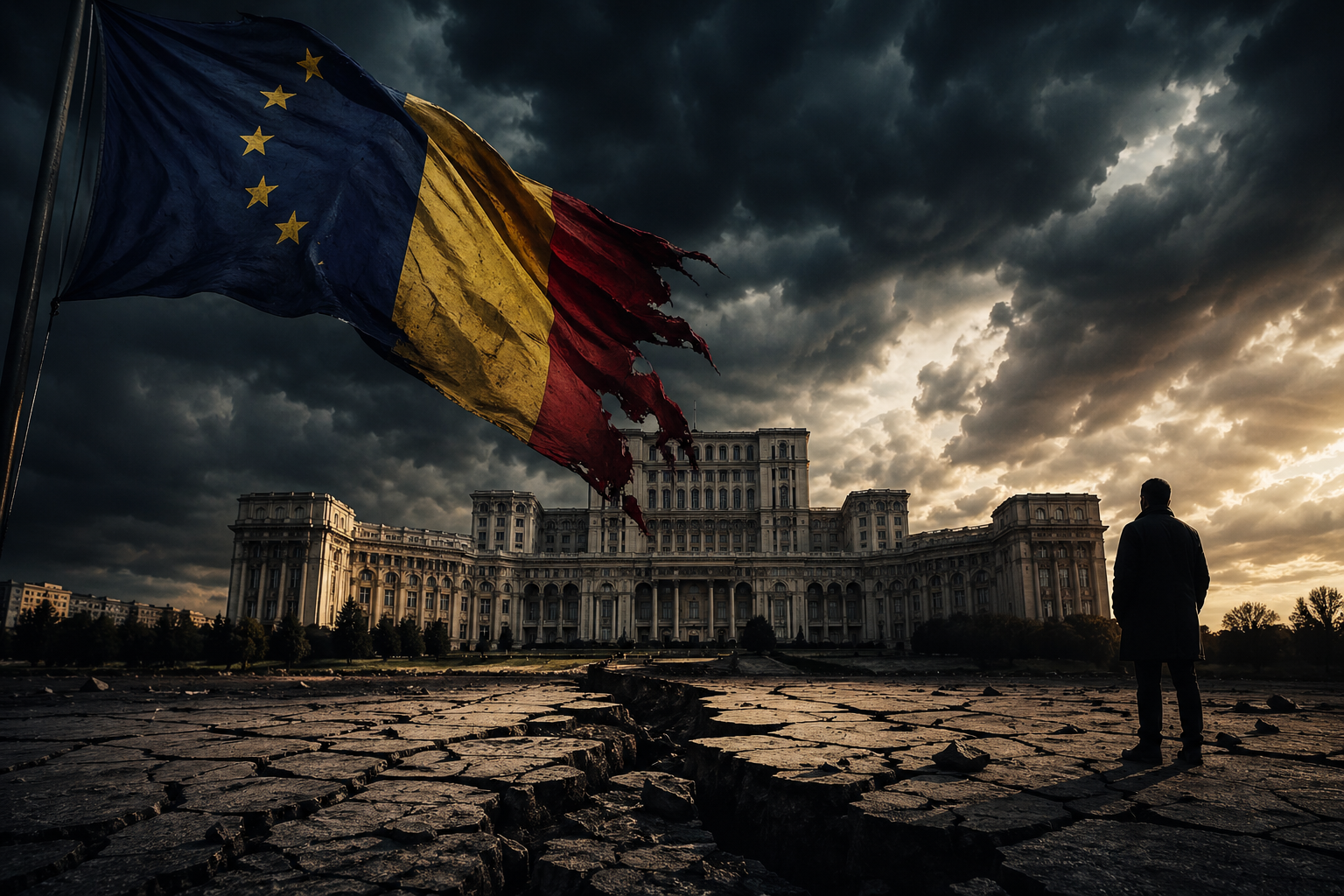
Why Romania’s Government Breakdown Could Reshape Europe’s Political Balance
The Coalition Collapse Threatening Romania’s Economy And Europe’s Stability
Romania is edging toward a political rupture that could reshape not just its own government but also its position inside the European Union.
What began as an internal coalition dispute has escalated into a full-scale crisis: the country’s largest party has withdrawn support from the government, stripping it of its parliamentary majority and opening the door to collapse.
This is not a routine reshuffle. It is a structural stress test — one that combines economic pressure, political fragmentation, and the growing gravitational pull of the far right.
And the implications are bigger than Romania alone.
What has actually happened
Romania’s governing coalition was designed as a defensive structure — a broad alliance of pro-European parties built to keep the far right out of power.
That structure is now breaking.
The Social Democratic Party (PSD), the largest force in parliament, has withdrawn support from Prime Minister IBolojanment after escalating tensions over austerity measures and fiscal reforms.
The immediate consequences are clear:
The government has lost its parliamentary majority
Ministers have resigned, weakening executive control
A no-confidence vote is now a credible near-term risk
If that vote succeeds — particularly with backing from opposition forces — the government could fall entirely.
Even without a formal collapse, Romania is already operating in a state of political fragility.
Why this crisis exists
At the core of the crisis is a familiar but dangerous tension: economic necessity versus political survival.
Romania is pressured to reduce the largest budget deficit in the European Union, requiring spending cuts and fiscal discipline aligned with EU rules.
These reforms are not optional. They are tied directly to access to billions in EU funding—money that supports infrastructure, recovery programs, and long-term growth.
But they are also politically toxic.
Inflation has been elevated
Economic pressure has hit households
Support for governing parties has weakened
As a result, the PSD has shifted from partner to critic—distancing itself from the very policies it previously endorsed.
This is not just a policy disagreement. It is a strategic repositioning ahead of future elections, driven by the rise of an alternative force.
The far-right factor
The most destabilizing element in this crisis is not the coalition split itself.
It is what comes next.
Romania’s far-right opposition — particularly the Alliance for Uniting Romanians (AUR) — has been gaining support and now leads opinion polls.
This changes the political calculation entirely.
If the PSD aligns tactically with far-right forces to topple the government, it would not necessarily form a lasting alliance—but it would create a moment of shared leverage.
That alone is enough to shift the balance of power.
The original coalition existed to prevent exactly this scenario: a fragmented center allowing the far right to exert disproportionate influence.
Now, that firewall is weakening from within.
Why EU funding is at risk
The economic dimension of this crisis is immediate and measurable.
Romania must meet reform milestones and maintain fiscal discipline to access EU funding, including recovery funds and broader financial support.
Political instability threatens both of them.
Around €11 billion in recovery funds could be at risk if reform deadlines are missed
Broader access to up to €27 billion in EU funds and loans could be jeopardised by prolonged deadlock
Additional funding programmes face delays if approvals stall
This scenario is where the crisis becomes self-reinforcing:
Political instability → Reform delays → Funding risk → Economic pressure → More political instability
Markets are already reacting, with concerns about borrowing costs and credit ratings beginning to surface.
The deeper implication: a credibility problem
This crisis is not just about who governs Romania.
It is about whether Romania can deliver.
The country sits at a critical intersection:
It is one of the EU’s largest recipients of development funding
It has one of the bloc’s highest deficits
It is strategically important in Eastern Europe, particularly in the context of regional security
A prolonged political deadlock sends a signal—not just internally, but to Brussels and to financial markets.
That signal is uncertainty.
And uncertainty has consequences:
Delayed investments
Increased borrowing costs
Reduced influence within EU decision-making
In other words, the risk is not just economic loss. It is diminished credibility.
What most people will miss
The visible story is a collapsing coalition.
The deeper story is a structural shift in Romanian politics.
The pro-European center is no longer stable enough to govern without constant compromise.
At the same time:
Economic reform is politically costly
Voters are increasingly fragmented
Anti-establishment narratives are gaining traction
This trend creates a long-term pattern, not a one-off crisis:
Governments may become harder to form
Coalitions may become shorter-lived
Policy consistency may weaken
That is how political instability becomes normalized.
What happens next
There are three realistic paths forward:
1. Minority government survival
The current prime minister remains in place, governing with reduced authority and limited ability to pass major reforms.
2. Government collapse
A successful no-confidence vote triggers negotiations for a new coalition—likely messy, prolonged, and uncertain.
3. Coalition reset
A compromise is reached, potentially involving leadership changes but preserving a pro-European majority.
None of these options offer immediate stability.
Why this matters beyond Romania
Romania’s crisis matters because it reflects a broader European pattern:
Economic pressure testing political coalitions
Rising support for anti-establishment and far-right movements
Increasing difficulty maintaining reform-driven governments
It is not an isolated case. It is part of a trend.
And trends matter more than single events.
The bottom line
Romania is not just facing a government crisis.
It is facing a convergence of pressures—political, economic, and ideological—that are testing its ability to function as a stable EU member.
The outcome will determine more than who holds office.
It will determine whether Romania remains a predictable partner within Europe or becomes another pressure point in an already fragile geopolitical landscape.
