What Sparked the Renaissance?
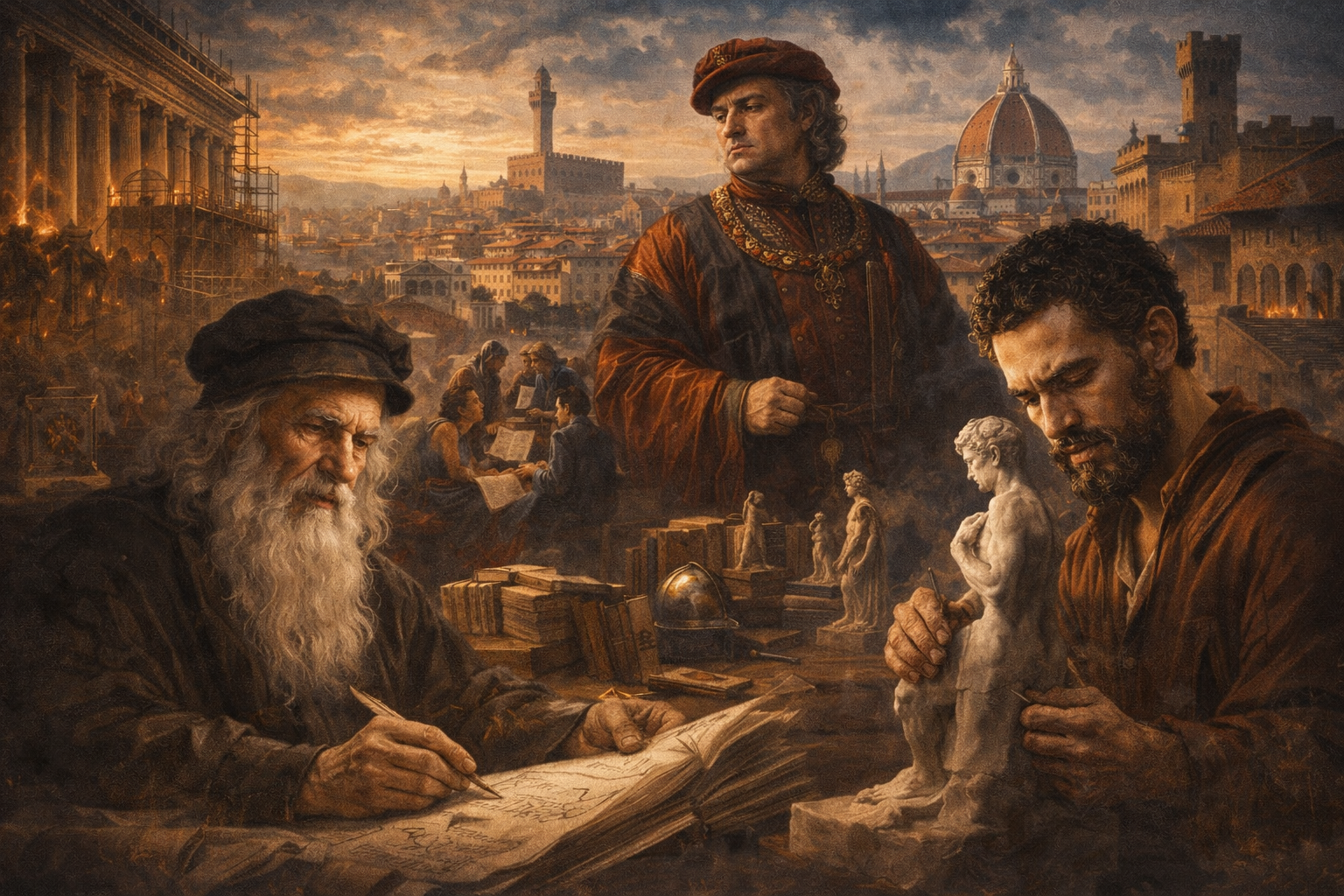
Italy’s City-States, Humanism, and the Patronage Arms Race
“Spark” is the wrong shape for the story. The Renaissance did not begin with one dramatic event. It began when a cluster of pressures in Italy made new learning and new art pay off—socially, politically, and financially.
The decisive window runs roughly from the mid-1300s into the mid-1500s, with Florence as the early engine and other Italian courts and cities building the system out.
The central tension was simple and ruthless: classical knowledge was scarce, expensive, and slow to copy, but it could be turned into status, legitimacy, and influence. In a peninsula of competing states, culture became a tool of rivalry as much as a search for beauty.
Humanism was important because it changed what educated people read, wrote, argued, and praised. But humanism alone did not create a Renaissance. It needed patrons, institutions, and a market for prestige to keep it fed.
The story turns on how political fragmentation turned money into cultural competition and competition into a self-reinforcing machine.
Key Points
The Renaissance was a long shift in learning and culture, beginning in Italy in the 1300s and peaking in the late 1400s and early 1500s.
Its early centre was Florence, where urban wealth, literacy, and civic politics created steady demand for visible excellence in art and scholarship.
A major turning point was the spread of humanist education—grammar, rhetoric, history, poetry, and moral philosophy—built around classical texts and new standards of Latin and, later, Greek.
Another turning point was the rise of large-scale secular patronage by city governments, courts, and the papacy, using art and architecture as propaganda and civic pride.
The most significant constraint was information flow: books were rare, copying was slow, and access to Greek learning was limited until networks of scholars, libraries, and later printing widened supply.
What changed most was the social value of learning styles and technical skills; what stayed the same was dependence on patrons and unequal access to education.
The clearest legacy is institutional: the humanities curriculum and the idea that culture can function as a form of statecraft, later amplified by print.
Context
In the centuries before the Renaissance became decisive, Italy was not a single kingdom. It was a dense patchwork of city-states, courts, and the papacy, with wealth concentrated in towns that lived on trade, banking, manufacturing, and administration.
Europe already had universities, law courts, and a powerful Church. Intellectual life was often organised around formal debate and inherited authorities, and most people never touched a book. Literacy and leisure were elite advantages, and manuscripts were luxury objects.
Italy’s difference was not that it produced more talent than elsewhere. It was that its political economy rewarded display: visible buildings, public rituals, commissioned images, and learned language that signalled competence and rank.
Events were primed to move because rivalry was constant, legitimacy was fragile, and money could buy prestige faster than it could buy security.
The Origin
The cleanest origin lies in early- to mid-1300s Italy, where scholars began treating antiquity as a living resource rather than a distant ornament. Humanism emerged as an educational programme built around classical texts and a new ideal of eloquence and moral seriousness, not as a single doctrine.
The early innovators did not believe they were launching a named historical era. They were trying to write better, persuade better, govern better, and claim a lineage to Rome that strengthened their city’s status.
What made these developments possible was a fit between supply and demand. The supply was classical material—fragile, scattered, and partly forgotten, but recoverable through libraries, copying, and scholarly networks. The demand was political: cities and patrons needed symbols of authority that looked older, grander, and more universal than today’s quarrels.
This early phase also sat under a rigid ceiling. Epidemic shock, unstable politics, and slow communications limited how fast ideas could spread, even when appetite was strong.
The Timeline
1300–1370: First humanists, first signals
During these decades, there was a shift in the way elites valued language and the past. Classical models became targets to imitate, not just authorities to cite. On the ground, this created new careers: secretaries, chancellors, tutors, and scholars whose status came from style and learning.
The mechanism was educational and bureaucratic. City governments needed literate administrators, and the skills humanists prized—clear Latin and persuasive rhetoric—were practical political tools.
The constraint was scarcity. Manuscripts were limited, travel was slow, and plague-era disruption could wipe out networks and labour. The carry-over was a new prestige ladder: learned style became a form of power.
1370–1450: Florence and the patronage engine
Florence and its peers turned culture into public competition. Buildings, sculptures, paintings, and civic spaces became arguments in stone and paint about who deserved authority.
The mechanism was patronage with purpose. Governments and leading families commissioned work that broadcast civic pride and political messages, and rivalry between many Italian states kept demand alive.
The constraint was legitimacy. City politics were factional, and patrons needed art that could stabilise reputation and knit coalitions. The carry-over was institutional: workshops, contracts, and public commissions standardised innovation by making it employable.
1450–1494: Libraries, courts, and deeper antiquity
Humanism expanded from city offices into courts, academies, and ambitious papal projects. Classical learning became a system with pipelines: collecting, copying, teaching, commenting, and displaying.
The mechanisms were investment in knowledge infrastructure—libraries, schools, and patronised scholars—and a widening appetite for Greek learning as part of elite distinction.
The constraint was access. Greek texts and teachers were limited, and scholarship still moved at the pace of handwriting. The carry-over was a thicker intellectual toolkit that artists and thinkers could draw on, and a larger audience trained to value it.
1494–1527: High Renaissance, high stakes
In the late 1400s and early 1500s, the scale rose. Major patrons competed for work that looked not merely beautiful, but definitive—art as proof of supremacy.
The mechanism concentrated commissioning power in courts and Rome, pulling top talent into a few intense hubs. Artistic practice was increasingly treated as knowledge, with mathematics and observation shaping technique.
The constraints on artistic practice were caused by war and political shocks. Italy’s fragmentation made it culturally dynamic but strategically vulnerable; instability could abruptly end careers and projects. The carry-over was reputational: styles and names became exportable models for Europe.
1527–1600: Diffusion and transformation
As ideas spread beyond Italy, they changed shape. Renaissance learning mixed with local politics, religious division, and different institutions.
The mechanism that widened the reach was printing. The cost of copying decreased significantly, leading to a multiplication of books that surpassed the capabilities of manuscript culture.
The constraint became control—censorship, orthodoxy, and the pressures of confessional conflict. The carry-over was durability: once knowledge and styles lived in cheap, portable texts, they could survive patron collapse and political swings.
The single hinge was the conversion of culture into competitive statecraft inside a fragmented Italian state system.
Wealth mattered, but wealth alone did not guarantee a Renaissance. What changed the trajectory was that multiple governments and courts treated art and learning as public instruments—civic pride, propaganda, legitimacy—then competed with one another in a way that sustained demand over generations.
Realistic alternatives existed. Patrons could have spent more on mercenaries, fortifications, or private luxury with little public footprint. They often did. But public cultural spending delivered something those options could not: a durable story of authority that outlived any single election, coup, or alliance.
Once that logic took hold, the system became difficult to switch off.
Consequences
Immediately, the Renaissance reorganised elite work. New roles multiplied—teachers, secretaries, editors, architects, and artists—tied to written style, technical skill, and visible output.
It also altered politics and reputation. Rulers and city governments learnt to govern through symbols—buildings that staged power, images that fixed memories, and public spaces that disciplined civic life.
In the long run, the benefits were of secondary importance. Print accelerated the spread of classical texts and humanist habits of reading and criticism, widening participation beyond a handful of Italian cities.
The Renaissance also helped reset the relationship between learning and authority. It did not abolish religion or tradition, but it strengthened the idea that careful study of texts, languages, and nature could generate prestige and sometimes pressure institutions to adapt.
What Endured
Patron dependence endured. Artists and scholars still needed funding, protection, and networks, and that shaped what could be said and made.
Inequality endured. Access to education, time, and books remained sharply stratified, even as print slowly widened the gate.
Political fragmentation endured in Italy, sustaining rivalry but also making the peninsula vulnerable to larger powers.
Religious authority endured, even when challenged. Much Renaissance work was commissioned for churches and framed in Christian terms, and later religious conflict set limits on what spread where.
Disputed and Uncertain Points
Historians still argue about how much the Black Death caused the Renaissance versus accelerating changes already in motion. The balance between disruption and opportunity remains contested.
The fall of Constantinople in 1453 is often treated as a clean trigger through an influx of Greek scholars and texts. It mattered for Greek studies, but it cannot explain a movement already underway in Italy by the 1300s and works better as an amplifier than an origin.
There is also debate over labels. Terms like “civic humanism” are later scholarly constructs, useful for analysis but not fixed realities experienced by contemporaries.
Finally, start and end dates remain fuzzy. Many changes began earlier and lingered longer than the classic peak narrative suggests.
Legacy
The Renaissance’s most concrete legacy is institutional habit. The humanities curriculum—grammar, rhetoric, history, poetry, and moral philosophy—still underpins how many societies train leaders, lawyers, and writers.
Its visual legacy is equally durable: perspective, anatomy, realism, and the idea that technique is a form of knowledge, not mere craft. Its political legacy is the normalisation of culture as soft power—states and cities still compete through monuments, museums, and cultural branding in recognisably Renaissance ways.
Print made that legacy portable. Once books could be produced in large numbers, ideas could survive distance, censorship battles, and the collapse of individual patrons.
What sparked the Renaissance, in the end, was an incentive system: rival states, hungry elites, scarce knowledge, and the discovery that learning could buy legitimacy.
