Why Were the “Dark Ages” So Dark?
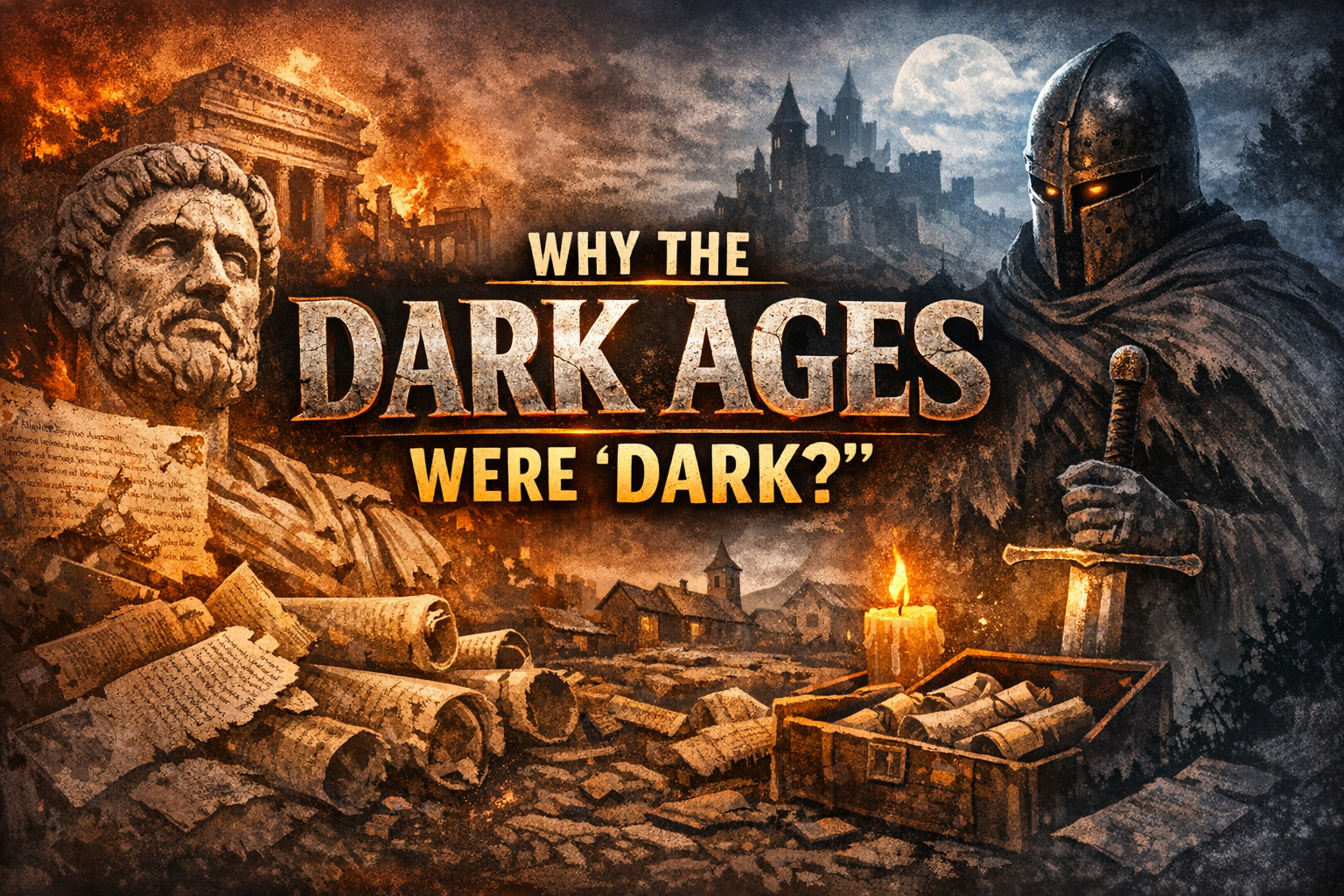
People living in the mediaeval period did not use the term "Dark Ages" to describe themselves. It is a later judgement, coined to make the centuries after Rome look like a fall from “light” into “shadow”.
To make the question answerable, the decisive window is Western Europe, from roughly the mid-fifth century to around 1000. In that zone, the structures of the Western Roman Empire broke down, and no replacement state could match Rome’s reach for centuries.
The “darkness” has two meanings that often get mashed together. One is rhetorical: Renaissance-era writers framed themselves as a rebirth after a long lull. The other is practical: fewer surviving written records make the period harder to see in detail, even when a great deal was happening.
The result was not a continent-wide blackout. Some regions kept stronger institutions, some built new ones quickly, and whole neighboring worlds were thriving. The label sticks because it flatters later ages and because the evidence is uneven.
The story turns on how the collapse of an imperial tax-and-paperwork machine made both life and the historical record smaller, more local, and harder to track.
Key Points
“Dark Ages” mostly reflects later bias and patchy evidence, not a literal end of progress.
The label was popularized by Renaissance humanists, who contrasted their “revival” with a supposedly dim post-Roman past.
A real turning point was the Western Empire’s loss of revenue, armies, and administrative reach in the fifth century, which weakened cities, trade networks, and records.
A second turning point came in the sixth–seventh centuries as shocks hit already-fragile systems.
A major counterpoint is the Carolingian push for schools, copying, and standardized writing, which briefly brightened the record and strengthened institutions.
The most significant constraint was capacity: slow travel, limited surplus, and weak state revenues made durable central control difficult.
The clearest legacy is institutional: the Latin Church, monastic scriptoria, and post-Roman kingship practices shaped European governance and learning long after 1000.
Context
Late Roman Western Europe had a large fiscal state. Taxes, much of them monetized, fed a professional army, paid officials, maintained roads, and kept cities functioning as administrative hubs. The empire also produced paperwork at scale: laws, letters, accounts, and church writing tied local life to a wider system.
That system was never frictionless. Distance was expensive, communications were slow, and frontiers were challenging to secure. Still, when a government can move money, orders, and soldiers across a continent, it can stabilize markets and enforce rules in a way that smaller successor kingdoms struggle to replicate.
By the fourth and early fifth centuries, external pressure and internal political strain were already forcing trade-offs. More resources were pulled toward war and security, and Roman power on the edges was more brittle than it looked from the center.
Events were primed to move because Rome’s Western system depended on revenue and coordination; once those were disrupted, the failure cascaded through cities, armies, and the habit of writing things down.
The Origin
The “Dark Ages” idea begins as a story later writers told, but the conditions that made it plausible began earlier: the Western Empire’s shrinking ability to tax, pay, and enforce. When central authority faltered, local elites sought security and status through new power arrangements rather than imperial office.
Actors in the fifth and sixth centuries were often trying to preserve familiar things: legitimacy, order, land rights, Christian worship, and the prestige of Roman titles. They could not yet see how hard it would be to keep continent-scale systems running without Rome’s fiscal engine and administrative density.
The conditions that made this break possible were structural. Slow transport has limited enforcement. Fragmented military power raised the price of security. Declining state revenue made coin use, long-distance provisioning, and professional administration harder to sustain. When the paperwork thinned, the historian’s view dimmed too.
The Timeline
After the fall of Rome in the West (c. 450–550), power became fragmented and records became scarce.
On the ground, Western Europe shifted from imperial provinces to successor kingdoms and contested frontiers. Violence did not vanish, but its organization changed: fewer large standing forces, more localized coercion, and more reliance on personal bonds and land.
The mechanism was fiscal. When the center cannot reliably collect and redistribute revenue, it cannot reliably maintain the same kind of army, roads, or bureaucracy. Administration becomes thinner, more negotiable, and more dependent on local magnates and bishops.
The constraint was bandwidth. Messages, officials, and supplies move slowly, and the cost of enforcing decisions rises fast when power is decentralized. What becomes locked in is a smaller political horizon.
A changing money-and-market world (c. 500–700): fewer coins, fewer simple connections
Daily life became more regionally varied. Some towns shrank; some places reoriented around fortified sites, monasteries, and new political centers. Long-distance exchange did not end, but it became more selective and fragile.
Coinage and monetized taxation narrowed in much of the West. This was not cultural decay but a shift in what states and markets could support under new constraints.
The constraint was trust and liquidity. Coinage, standardized weights, and predictable taxation make trade easier. When those weaken, exchange moves toward local arrangements and in-kind payment. Fewer transactions generate durable written traces.
Not a blackout: long-distance links still exist
Even in periods that look “dark” in narrative histories, connections persisted where incentives remained strong. Coastal and river routes still moved people and goods, and some regions stayed plugged into wider worlds.
Archaeology complicates the story. Imported goods and material traces show that contact did not vanish everywhere, even where Roman administration had ended.
The constraint is survival of evidence. Pottery outlasts parchment. The record can look emptier simply because the medium and institutions that produced writing changed.
Sixth–seventh century shocks (c. 536–700): stress on a fragile system
Some regions faced compounding pressure. Evidence points to climate volatility beginning in the mid-sixth century, increasing harvest risk and straining resilience.
Disease adds another layer, but its impact is debated. Written sources describe repeated outbreaks, yet historians disagree on how catastrophic the demographic and economic effects were across different regions.
The constraint is causality. Climate and disease can intensify hardship, but they interact with politics, war, and supply in complex ways. Recovery was uneven.
The Carolingian push (c. 750–900) focused on rebuilding capacity through the establishment of schools and the promotion of script.
Parts of Western Europe saw renewed attempts at central coordination. Rulers invested in education, administration, and standardized writing as tools of governance.
The mechanism was institutional focus. Schools, copying programs, and clearer scripts made administration more legible and durable.
The constraint was fragility. These gains depended on elite backing and relative security. They could be interrupted by political fragmentation and violence, but their effects endured.
Towards 1000: fragmentation, then clearer recovery
The ninth and tenth centuries mixed renewed localism with early signs of growth. Where recordkeeping and urban functions revived, the historical picture brightened.
The mechanism is capacity again. Stronger revenue and improved enforcement lead to the creation of more documents. When institutions write more, historians see more.
The constraint remained surplus. Agriculture still set the ceiling on armies, cities, and literacy. Europe moved forward through many competing centers rather than a single empire.
The hinge was the West’s loss of Rome’s fiscal and administrative machine. Without continent-wide taxation and professional bureaucracy, armies shrank, cities weakened, and routine writing declined. That made governance harder and history harder to see.
Successor rulers could imitate Roman titles and law, but rebuilding Rome’s scale required resources and logistics that early medieval societies could not easily supply.
Consequences
In the short term, power fragmented. Authority rested on land, loyalty, and negotiation rather than uniform rule.
Economic life became more regional. Markets survived but operated differently, shaped by seasonality, trust, and local networks.
The Church gained relative influence by preserving organization, literacy, and legitimacy across borders, even as it competed with secular rulers.
Over time, these centuries produced the foundations of later Europe: new kingdoms, regional identities, and blended administrative traditions.
What Endured
Geography endured. Rivers, coasts, and mountains still shaped power.
The agrarian base endured. Food surplus continued to limit everything else.
The Latin Church endured as a continent-spanning institution.
Roman prestige endured. Law, titles, and memory remained political assets long after imperial rule ended.
Disputed and Uncertain Points
How severe was economic decline? Some interpretations stress sharp loss of complexity; others emphasize adaptation and regional variation.
How decisive were climate and disease? Evidence supports major stresses, but their overall demographic and economic impact remains debated.
How useful is “Dark Ages” at all? Some reject it as misleading, while others use it narrowly to describe thin sources rather than cultural failure.
Legacy
The “Dark Ages” persist as a story because they are tidy. The reality was uneven and practical. Western Europe rebuilt governance with fewer resources, smaller states, and institutions that worked locally rather than imperially.
By around 1000, writing, administration, and growth were again more visible. The darkness was never a single night. It was the shadow cast when a vast bureaucracy stopped writing, and new societies learned to govern with less.
