Top 10 Reasons the Roman Empire Collapsed
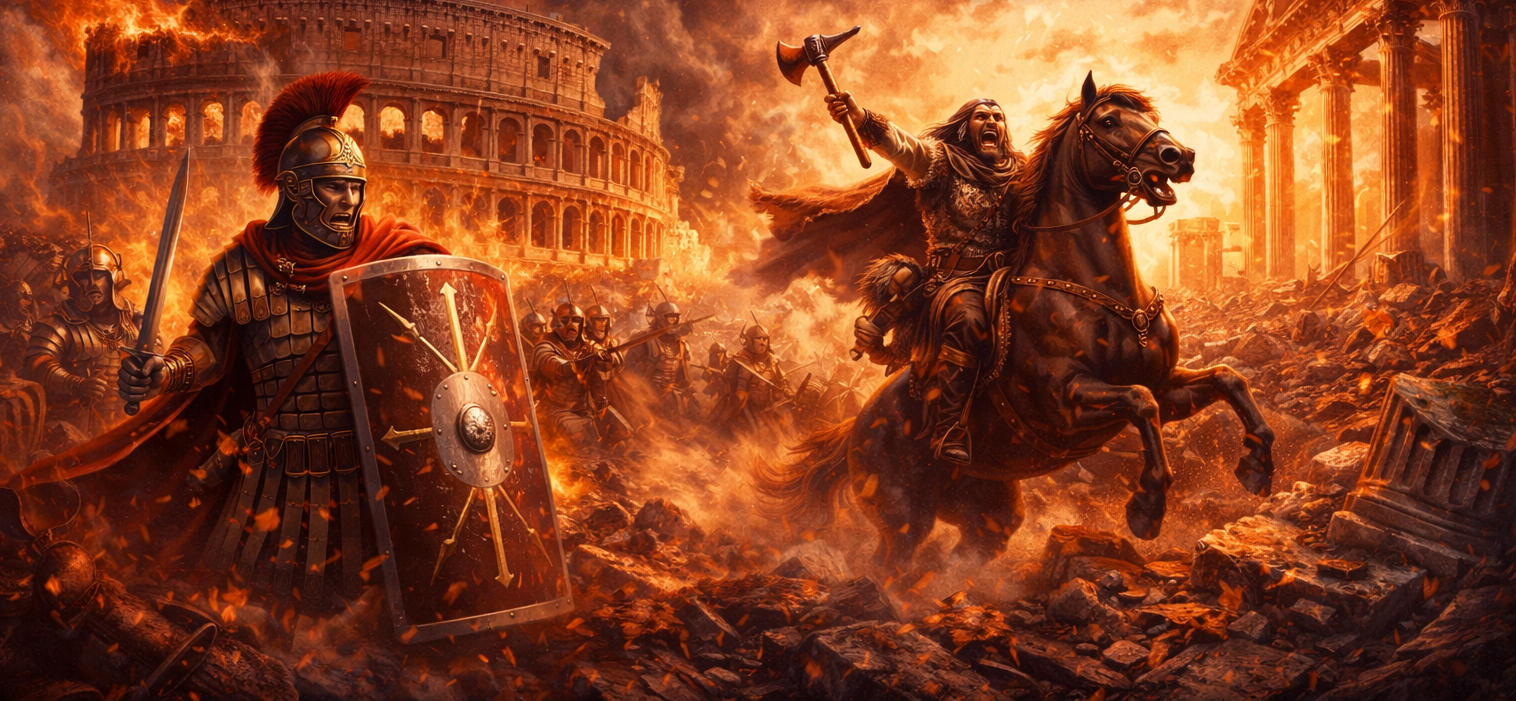
Western Rome’s Slow Unraveling (c. 235–476)
The Western Roman Empire existed from c. 235 to 476, while the Eastern Empire continued to survive.
“Rome fell” is shorthand for a long failure of control in the western half of the empire. The decisive window runs from the third-century breakdown of imperial stability to the removal of the last western emperor in 476. The West did not vanish in a single disaster. It lost the ability to keep armies paid, borders staffed, and provinces loyal at the same time.
The central tension was brutal: the West needed an expensive security machine to hold a vast territory, but its political system kept turning that machine inward. Civil war was not background noise. It was a repeatable way to win power, and it steadily consumed the resources needed for defense.
External pressure mattered, but it hit a state already strained by its incentives. Migration, war, and opportunistic raids compelled swift decisions across a continent. In an era of slow communication and fragile supply, a few wrong moves could lock in losses for a generation.
The story turns on how a fiscal-military system broke when politics made violence cheaper than cooperation.
Key Points
The “collapse” was the loss of central control in the Western Roman Empire, culminating in 476, while the eastern empire continued for centuries.
The crisis becomes decisive in the third century, when rapid emperor turnover and civil wars turned armies into political prizes.
Late Roman reforms stabilized parts of the system but raised permanent costs and tightened dependence on reliable tax collection.
The biggest constraint was money: shrinking and fragmented revenues could not sustain large, mobile field armies for long.
The hinge moment was the loss of North Africa in the 430s, which stripped the West of a core revenue base.
The legacy is institutional: successor kingdoms and later European states inherited Roman law habits, taxation logic, and the prestige of written administration.
Context
At its height, Roman power rested on coordination: taxes, paperwork, cities, ports, and disciplined armies tied to a single political center. The West’s problem was not ignorance. It was a rising cost of security paired with a political system that repeatedly redirected soldiers and revenue into internal competition.
By the third century, rivals on the Rhine and Danube were larger and more organized, and the eastern frontier faced a peer competitor. War and disruption made local economies brittle. When revenue faltered, emperors leaned harder on coercion and requisition. That made the army more central to politics, not less.
Late Roman reforms bought time, but they also created a heavier state with high fixed costs. Once provinces doubted the center’s protection, they had an incentive to keep taxes at home and bargain with whoever could deliver security now.
Ranked from most decisive to least, ten pressures did the most damage, and each one reinforced the rest.
Reason 1: Succession instability and civil war turned armies into kingmakers and made internal war routine.
Reason 2: Fiscal strain and a shrinking tax base left the state short of cash when it most needed speed and mobility.
Reason 3: Payment problems and currency instability made supply and loyalty harder to maintain.
Reason 4: Manpower limits reduced the pool of trained, long-service troops the West could replace quickly.
Reason 5: Reliance on federates brought armed groups inside the system with their leaders and leverage.
Reason 6: Frontier shocks and mass migration forced negotiated settlement when crushing victories were no longer achievable.
Reason 7: Command breakdown in the West made strategy dependent on court factions and strong generals.
Reason 8: Provincial fragmentation redirected taxes and allegiance away from the center, making reconquest unaffordable.
Reason 9: The loss of North Africa removed a key stream of grain and revenue that funded western recovery.
Reason 10: Legitimacy erosion made emperors look like hostages of their courts, accelerating defection.
The Origin
A decisive early phase begins in 235, when succession became violently unstable and emperors rose and fell through military backing. Leaders framed their wars as “restoration,” but each round trained armies to see politics as a battlefield and provinces as a wallet.
The underlying conditions were structural: the empire was too large to run without delegated military power, and delegated power created rivals. Messages moved at the speed of horses and ships, so rumor and local ambition often outran orders. Money tied the system together, and civil war disrupted money first.
The Timeline
Crisis and militarization (c. 235–284)
The frontiers became increasingly volatile, and internal order began to deteriorate. Usurpers fought rivals while communities endured requisition, raids, and insecurity. The mechanism was blunt: commanders marched on Rome and funded armies by squeezing provinces. The constraint was logistics and credibility; when pay and supply lagged, coercion filled the gap. The carry-over was a political culture that treated emergency measures as normal.
Reforms and higher fixed costs (c. 284–337)
Stability improved through stricter taxation and more layered administration. Military structures shifted toward a mix of border forces and mobile field armies. The mechanism was institutional redesign that made the state more present in daily life. The constraint was cost: a bigger system needs steady revenue and steady compliance. The carry-over was a government that could survive shocks, but only if provinces stayed locked into the fiscal loop.
Settlement politics after 376 (376–395)
Large groups crossed into imperial space seeking safety and land. Mismanagement turned resettlement into war, and defeats exposed how hard it had become to destroy major enemy groups on Roman soil. The mechanism became negotiated force: treaties that traded land and status for service. The constraint was time; integration takes years, but crises demand troops now. The carry-over was a dangerous precedent: armed groups inside the borders could bargain as collectives.
Western breakdown and lost initiative (395–418)
Western politics splintered into court factions and strong generals, and field armies were pulled between frontier defense and internal rivalry. The sack of Rome in 410 did not end the state, but it signaled weakness to allies and enemies alike. The mechanism was civil conflict under foreign pressure. The constraint was coordination; a divided command cannot concentrate force fast enough to restore provinces. The carry-over was fragmentation, as local elites cut deals with whoever could protect them.
The hinge: losing North Africa (429–455)
The single biggest trajectory shift was the loss of North Africa, capped by the seizure of Carthage in 439. This was not just lost land. It was lost revenue and lost capacity to pay and move armies. The mechanism was fiscal collapse through territorial loss, followed by failed or unaffordable attempts at reconquest. The constraint was naval and financial: recovery required ships, money, and sustained coordination the West no longer had. After Africa, every later crisis landed on a poorer, weaker center.
Rump empire and replacement (455–476)
Italy remained Roman in law and language, but real military power sat with commanders who led mixed armies. Emperors became appointments, not rulers, and provinces that still used Roman administration did so locally. The mechanism was substitution: successor kings and Roman elites ran hybrid regimes without a western emperor at the top. The constraint was force-backed legitimacy; titles alone could not command revenue or soldiers. The carry-over was the end of the western imperial court in 476, while “Rome” as a political identity lived on in the eastern empire and in western institutions.
Consequences
The immediate outcome was fragmentation. The West became a patchwork of kingdoms, local Roman elites, and military strongmen, often using Roman law and tax habits to rule. Central taxation weakened, long-distance state logistics contracted, and large field armies became harder to sustain. When a state cannot pay for mobility, it loses the option to punish defection at scale.
Economic life adjusted to the new incentives. In many regions, urban investment and mass-produced goods declined while local production mattered more. This decline was uneven, not universal, but it reduced the connective tissue that had made the western Mediterranean a single administrative space.
What Endured
Geography endured: the Alps, the Rhine, the Danube, and the Mediterranean kept shaping trade and war. Landed wealth endured because land stayed productive and rulers still needed local cooperation. Written administration endured because orders, courts, and tax records remained the most efficient way to extract resources. Cities endured unevenly, often as religious and regional centers. The limitations of war persisted: food, pay, and discipline continued to determine the outcome, regardless of the flag's colour.
Disputed and Uncertain Points
476 is a convention, not a clean cliff. Roman identity and administration persisted in pockets, and the eastern empire continued as Rome in its terms.
How “catastrophic” the change was varies by region. Some areas show sharp material decline, while others show more continuity of settlement and institutions.
The role of Christianity is often overstated. Religious conflict shaped politics and identity, but it did not replace the fiscal and military mechanisms that determined whether the West could enforce orders.
Climate, disease, and environmental harms are real but challenging to weight precisely for the western collapse. They likely acted as stress multipliers that tightened food supply and weakened resilience, rather than as a single trigger.
Popular single-cause stories are shaky. Lead exposure and other toxins existed, but turning them into the main explanation requires more certainty than the evidence can support.
Legacy
Western Rome’s collapse reshaped Europe’s political grammar. Power became more regional, but rulers borrowed Roman tools: law codes, taxation logic, titles, and the prestige of Rome itself. The Latin Church carried literacy, recordkeeping, and a shared institutional language across successor kingdoms.
The most concrete legacy is administrative habit. Later European governments inherited the Roman instinct to govern through documents, courts, and taxes and to argue legitimacy in legal terms.
Subscribe on Spotify, or explore more articles for more compelling insight.
