The History of New Year’s Eve Celebrations: From Ancient New Year Festivals to the Midnight Countdown to What The Future Holds…
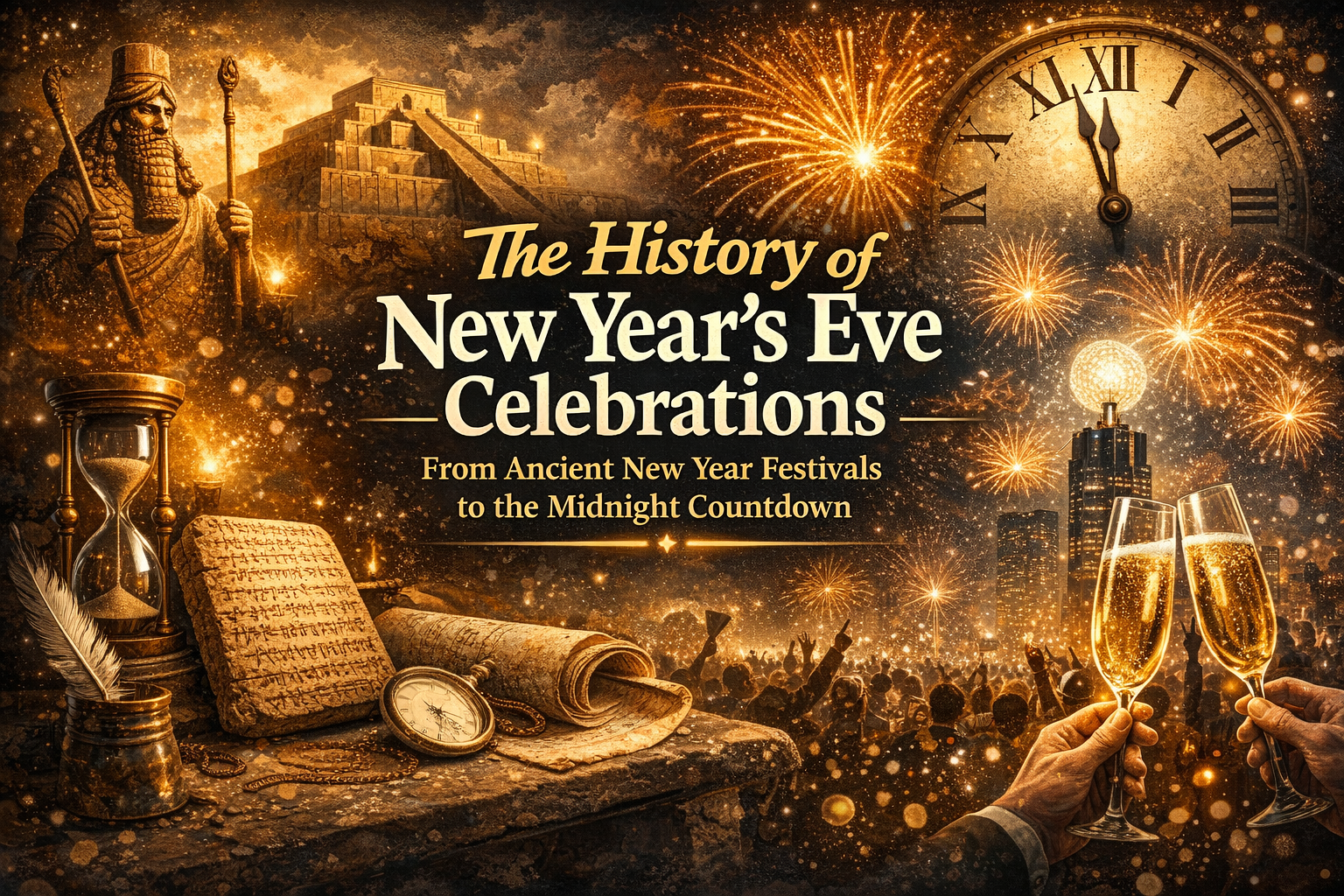
New Year’s Eve looks like a simple idea: a final night, a clean break, and a toast at midnight. In practice, it is the product of two hard-won agreements—what counts as a “year”, and who gets to say when it ends.
This history covers the long road from the earliest recorded New Year festivals in ancient Mesopotamia to the modern December 31 ritual tied to the January 1 civil calendar.
The tension is constant. People want renewal, forgiveness, and luck. States and institutions want a date that can close contracts, reset offices, collect taxes, and coordinate work across distance.
New Year’s Eve becomes powerful when the calendar stops being local and flexible and becomes standardized, enforceable, and shared across borders. Precision timekeeping then turns “midnight” into a moment that can be counted down, broadcast, policed, and sold.
Some details in this story remain uncertain, especially in the ancient world, where evidence is thin and later writers flatten complex regional practices into a single “origin”.
The story turns on how the calendar moved from nature to authority—and how the clock turned that authority into a shared global deadline.
Key Points
New Year’s Eve is the final night of the civil year in the January 1 calendar system; it only becomes universal once that system spreads.
The earliest known record of New Year festivals dates to around 2000 BCE in Mesopotamia, where rites were tied to lunar timing and seasonal renewal rather than December 31.
Rome helped push January 1 as a civic reset, linked to public office and state administration, with strong symbolic framing around beginnings.
Medieval Christian Europe often rejected January 1 as the year’s start, preferring religious anchor dates; the “year” could begin in different months depending on place and law.
The major constraint was coordination: trade, law, and bureaucracy needed a single date and later a single time standard to reduce confusion across regions.
What changed most was standardization—first of the calendar, then of the clock—turning a local rite into a synchronized event watched in real time.
The clearest signal of legacy is institutional: legal-year rules and standard time made the midnight transition a predictable, repeatable, commercialized global ritual.
Context
Before there was a “New Year’s Eve,” there were many new years. Agrarian societies experienced the year through planting and harvest, floods and dry seasons, and the return of stars and light. A new year was less a number on a page than a moment when survival prospects changed.
Rulers and priesthoods had a separate problem. They needed legitimacy and predictability. A calendar could coordinate obligations, set festival cycles, and stabilize power by telling people when renewal should happen and what it meant.
Once writing, taxation, and state administration expand, a year-end becomes more than symbolism. It becomes an accounting boundary, a staffing boundary, and a legal boundary. The celebration aligns with the boundary, rather than the opposite.
The Origin
The earliest clearly documented New Year festivals come from Mesopotamia, where New Year rites were linked to seasonal renewal and political order. In Babylonia, the Akitu festival was associated with springtime rebirth and the reaffirmation of kingship under divine authority.
The actors in these early festivals were not “counting down to midnight.” They were managing risk. A new year threatened disorder: crops could fail, enemies could raid, and rulers could lose legitimacy. Rituals offered a framework for restoring order and setting expectations about duty, loyalty, and the coming season.
The conditions that made these origins possible were institutional and technological: temples with administrative capacity, scribal systems that tracked time and obligation, and a political theology that tied public order to cosmic order.
The Timeline
Seasonal New Years Before a Standard Date (c. 2000 BCE–200 BCE)
In the ancient world, the ground truth was seasonality. New Year rites clustered around moments of natural transition—often spring renewal—because those were the points when food security and social stability could swing sharply.
The mechanism was religious-administrative. Festivals were not private parties. They were public systems: processions, offerings, ritual reenactments, and formal reaffirmations of social order.
The constraint was variability. Lunar timing, local climate, and local authority produced different “New Years” in different places. A single global date was not even a meaningful concept.
The carry-over was the template: New Year as renewal, purification, and recommitment—an emotional logic that later societies keep even when the calendar date changes.
Rome Turns the New Year Into a Civic Switch (c. 200 BCE–late antiquity)
Rome helps shift the new year toward state function. By the second century BCE, January 1 was recognised as the start of the Roman civil year, which is connected to the assumption of office and the administration of public life.
Political scheduling facilitated this mechanism. When office terms and legal duties align, the date becomes real in everyday life. The symbolism followed: January’s association with Janus framed the transition as a doorway between states of being—ending and beginning, past and future.
The constraint was cultural persistence. Older rhythms did not vanish overnight, and Roman practice still sat alongside other local calendars and religious timings across the empire.
The carry-over was the idea of the year-end as administrative closure. That concept later becomes central to New Year’s Eve, which thrives when the “end” has real consequences.
Christian Europe Fractures the Start of the Year (5th–16th centuries)
As Christian institutions gain power, January 1 becomes contested. The problem is not astronomy. It is meaning and authority. A year that begins on a date tied to Roman civic tradition can look like a rival claim over time itself.
The mechanism is legal-religious practice. Different regions begin the year on different dates, including March 25 and other religious anchor points. The “year” becomes a jurisdictional choice, not a universal fact.
The constraint is fragmentation. Without shared standards, merchants, courts, and governments can be talking about the same week while living in different “years”. That is manageable locally, but it grows costly as trade networks thicken.
The carry-over is a split between private ritual and public time. People still mark transition nights, but the date is not yet locked to a single civil year-end.
Calendar Reform and the Rise of the Civil Year-End (1582–1800s)
Early modern calendar reform marks a decisive shift toward standardisation, but its adoption is uneven and politicised. The calendar becomes a technical fix with enormous political meaning, because it signals whose authority is accepted.
In Britain and its territories, legal reform eventually moves the civil year’s start to January 1 and aligns recordkeeping with the modern calendar. This locks December 31 into place as the year’s final day in law and administration.
The mechanism is governance. Once the year ends with taxes, contracts, rents, offices, and recordkeeping, the culture that gathers around it hardens.
The constraint is inertia. People do not rewrite habits instantly, and older customs persist in pockets. But the civil year becomes increasingly difficult to ignore.
The carry-over is the foundation for a recognizable New Year’s Eve: a last night of the year that is widely agreed upon, even if not yet universally celebrated the same way.
The Hinge: The Clock Standardizes Midnight (late 1800s–early 1900s)
This is the single hinge that most changed the trajectory. A year-end date is powerful, but a year-end moment becomes magnetic only when it can be synchronized.
Standard time and time zones emerge to solve practical confusion created by railways and rapid communication. Communities that once kept local solar time now need uniform time to run schedules and coordinate across distance.
The mechanism is infrastructure. Rail timetables, telegraph signals, and national standards turn midnight into a measurable, shared boundary. It becomes possible to say not just “tonight” but “now,” in a way that can be repeated and enforced.
The constraint is politics and geography. Time zones are organisational simplifications layered over messy borders, and governments bend them for convenience. But the broad effect is the same: midnight becomes an agreed signal.
The carry-over is the modern countdown. New Year’s Eve stops being only a local rite and starts becoming a synchronized performance.
Mass Spectacle, Media, and the Global Template (1900s–2020s)
Once people can share midnight, the public spectacle expands. Cities compete to stage the transition in a way that feels official, safe, and memorable. Countdown rituals, fireworks, and landmark moments become repeatable templates.
Fireworks become a standard language of transition because they are visible at scale and carry older meanings—light against darkness, noise against fear. Over time, they also become regulated, insured, and planned.
The mechanism is broadcast and commerce. Radio and television turn local midnight into a shared national ritual. Tourism, nightlife, and sponsorship contribute to the development of a New Year’s Eve economy. Social media then makes the ritual participatory: people perform New Year’s Eve to one another, not just for themselves.
The constraint becomes cost and risk: crowd safety, policing, weather, and environmental impact. These pressures increasingly shape how the night is staged.
The carry-over is a more managed New Year’s Eve. In many cities, quieter displays, drone light shows, and restricted zones now sit alongside older traditions.
Consequences
In the short term, the standardized New Year’s Eve created a reliable social reset. It gave people a sanctioned night for release and reflection, while giving institutions a predictable boundary for records and planning.
In the longer run, the celebration helped build a shared global civic rhythm. Even where religious or cultural calendars remain central, the January 1 civil year has become a common scheduling language for governments and business.
Second-order effects followed the infrastructure. The more the event becomes synchronized, the more it becomes securitized. When midnight is a mass gathering and a broadcast moment, organisers gain capacity and control, while spontaneity narrows.
A parallel consequence is environmental and public-health pressure. Fireworks are dramatic, but they externalise costs: air quality impacts, debris, noise stress, and fire risk. That pushes New Year’s Eve toward substitution rather than disappearance.
What Endured
Across eras, New Year’s Eve keeps returning to the same functions.
It marks liminality. The night is treated as a threshold where normal rules loosen and then snap back into place.
It performs renewal. Even when the calendar’s authority comes from law, people use the boundary to restart personal narratives—cleaning, forgiving, promising, letting go.
It uses light and sound to signal safety and solidarity. Whether through bells, fireworks, music, or chanting crowds, the message is the same: the group is here, awake, and together.
It closes accounts. Culture frames debts, obligations, and unresolved tensions as things that shouldn't persist, despite reality's often uncooperative nature.
Disputed and Uncertain Points
Ancient “firsts” are difficult to prove. No single culture invented the New Year celebration; multiple societies developed year-start rites tied to different astronomical and religious markers.
In Roman history, January 1’s administrative rise is clear, but the speed and completeness of cultural adoption likely varied by class and region.
In medieval Europe, formal legal definitions of the year often diverged from everyday practice, with communities quietly keeping more than one calendar in use.
Modern origin stories tend to compress decades of gradual change into single symbolic moments, flattening how public countdown rituals actually spread.
Legacy
New Year’s Eve is less a timeless festival than a working agreement. It rests on the authority of the civil calendar and on shared timekeeping that makes midnight feel exact. Those are institutional achievements before they are cultural ones.
By 2050, the most likely version of New Year’s Eve is recognizably familiar but operationally different. Climate pressure, fire risk, and regulation point toward fewer traditional fireworks in dense cities, replaced by drones, projection mapping, and lower-noise displays.
The night will also become more hybrid. More people will experience marquee countdowns through live streams and immersive media while staying local, as travel costs, security, and crowd management tighten.
What will not change is the need the night serves. A shared deadline helps people narrate their lives. It turns a continuous flow of time into a moment that feels owned.
Subscribe on Spotify, or explore more articles for more compelling insight.
