Britain’s Lost 11 Days
Britain’s Lost 11 Days: The 1752 Calendar Switch That Turned Time Into a Political Problem
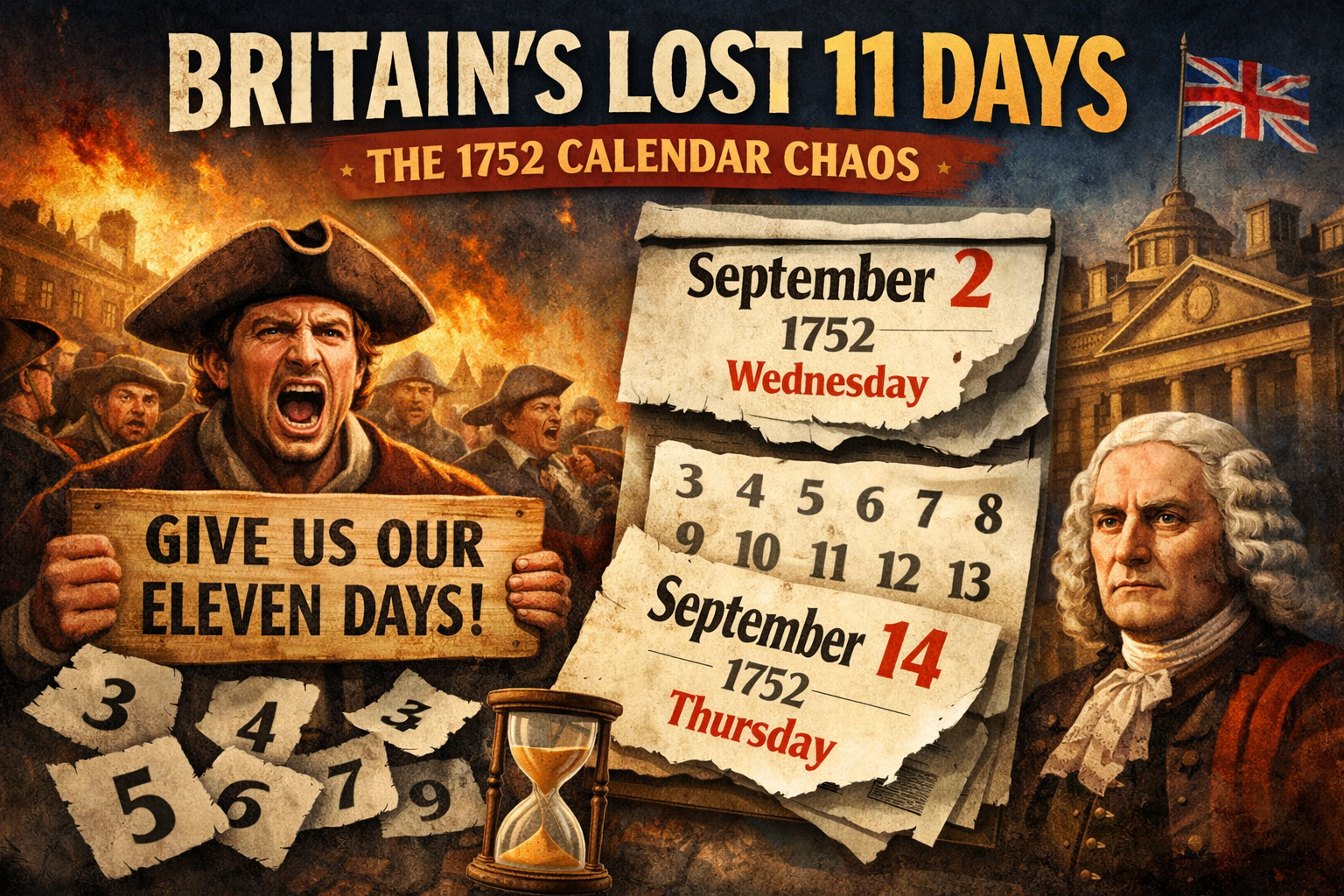
In September 1752, Britain performed a trick that sounded like magic and felt like theft. The day after September 2 was not September 3. It was September 14. Eleven dates vanished from the calendar overnight.
The change was not a prank and not a clerical typo. It was a state decision to stop using the drifting Julian calendar and align with the Gregorian system already used across much of Europe. By the 1750s, the gap had grown to eleven days.
On paper, it was a correction. In real life, it collided with how people measured daily obligations: wages, rent days, court sessions, fairs, parish routines, shipping deadlines, and the simple sense of what “next week” meant.
It also provoked strong emotions. Religion and national identity intertwined with timekeeping, while opponents could weaponise the new calendar's perceived foreignness.
The story turns on how a technical fix for astronomy and administration crashed into the lived economy of dates.
Key Points
Britain adopted the Gregorian calendar in practice in 1752 by legally skipping eleven calendar dates in September.
The reform also moved the legal start of the year in England and Wales from March 25 to January 1, tightening up a long-running source of confusion.
The key shock moment was the jump from September 2 straight to September 14, 1752.
The biggest constraint was legitimacy: Parliament could rename days, but it still had to prevent anyone gaining or losing money through rent, wages, interest, and contract dates.
Popular stories of mass riots are widely treated as myth or exaggeration, with satire and later retellings doing much of the work.
The reform left a concrete administrative afterlife: Britain’s fiscal calendar still carries the imprint of the old quarter-day system and the 1752 shift.
Context
Before 1752, Britain’s civil dating was a patchwork that made sense only if you grew up inside it. The country used the Julian calendar, which treated leap years too generously. Over centuries, that small error pushed calendar dates out of step with the solar year. By the eighteenth century, Britain’s calendar lagged behind the Gregorian system by eleven days.
Just as disruptive was the “year” itself. In England and Wales, the legal new year began on March 25, not January 1. That meant dates in January, February, and most of March could appear to belong to the “wrong” year by modern reckoning. Scotland had already moved the start of the year to January 1 earlier, adding cross-border confusion.
This was an expanding commercial and imperial state trying to run accounts, courts, and correspondence across borders that did not share the same clock or the same date. Pressure to standardise was practical long before it became popular.
The Origin
The immediate origin was parliamentary. Lawmakers bundled two reforms together: redefining when the year officially began and correcting the accumulated calendar drift. The promise was administrative clarity. The cost was a sudden, visible break in the numbering of days.
Supporters framed the change as accuracy and convenience. Britain needed its dates to match those used by trading partners and diplomatic counterparts. Opponents framed it as cultural intrusion. Calendar reform touched church life and festivals, and anything that smelt foreign or Catholic could be turned into a political weapon.
The key enabling condition was confidence in central authority. Parliament believed it could impose a single rule for time itself and then manage the fallout.
The Timeline
Before the Act was passed, people lived according to "Old Style" time.
By the mid-eighteenth century, the costs of misaligned dating were routine. International letters often carried two dates. Officials translated constantly. Ordinary people thought less about calendar systems than about paydays, feast days, and fairs.
Habit kept the system functioning. Parish calendars, local courts, and quarter days made time legible. The constraint was fragmentation. There was no single “official” time in daily life, only overlapping ones.
That fragmentation left reform politically exposed. Any change could be framed as an attack on custom.
The Act and the administrative bargain
The law set two moves. The legal year would begin on January 1. The day after September 2, 1752 would be September 14.
The mechanism was statutory power. The constraint was money. Dates governed rents, wages, interest, and court deadlines. The state had to ensure the calendar change did not quietly transfer wealth from one side to another.
This created a need for guidance, explanation, and adjustment at every level of administration.
September 1752: The people felt the jump.
The famous moment was simple. Tuesday, September 2, was followed by Thursday, September 14. Sunrise, work, and weather continued as before. Only the labels changed.
But labels mattered. They enforced obligations. People worried that missing dates meant missing pay or shortened contracts. Confusion clustered where trust was thin and margins were tight.
Information moved unevenly. Explanations passed through print, employers, clergy, and local officials. Not everyone heard them at the same speed or in the same form.
After the jump: contracts and fairness
The state’s core promise was that no one would lose days in practice, only in name. Recurring obligations were shifted forward so intervals remained intact.
Courts, landlords, and employers adapted rather than rewriting the entire system. Custom proved stubborn. Quarter days did not disappear; they slid.
Old labels lingered. People spoke of “old” dates long after the law had moved on.
Settling into “New Style” time
The reform also locked in the modern leap-year rule, preventing drift from rebuilding. Over time, repetition normalised the change. January 1 became unremarkable.
Memory lasted longer than law. Family histories, local traditions, and record-keeping habits kept translating between old and new styles for decades.
The hinge was the choice of a rigid break rather than gradual convergence. Skipping eleven dates concentrated the disruption into a single moment. It was both administratively efficient and psychologically jarring.
Alternatives existed only on paper. Endless translation imposed permanent friction. Gradual change would have multiplied confusion. The jump created a single sharp problem that the state could address and then resolve.
Consequences
Immediately, Britain’s dates aligned more cleanly with those used across much of Europe. Trade, diplomacy, and administration became less error-prone.
At ground level, adjustment was uneven. Daily life continued. Conflict emerged where dates enforced power: wages, rents, interest, and legal deadlines.
In the longer run, the reform strengthened state capacity. Time became a national standard rather than a local negotiation.
What Endured
Quarter-day logic endured, shaping hiring, rents, and payments even as exact dates shifted.
Religious and civic calendars endured as parallel systems alongside civil time.
Suspicion of foreign reform endured as a political reflex.
Record-keeping habits endured. People kept explaining dates because memory moves slower than statute.
Disputed and Uncertain Points
The famous “calendar riots” remain the biggest dispute. The image of crowds demanding their lost days persists, but evidence for widespread violent riots is thin, with satire and later retellings doing much of the work.
Public resentment is harder to measure. Opposition existed, especially where religion and identity were involved, but dislike does not equal mass disorder.
Claims about the widespread persistence of old-date celebrations vary by place. Some communities did keep old observances for a time, but later writers often overstate their reach.
