Thomas Becket’s Murder: When Church vs Crown Turned Bloody
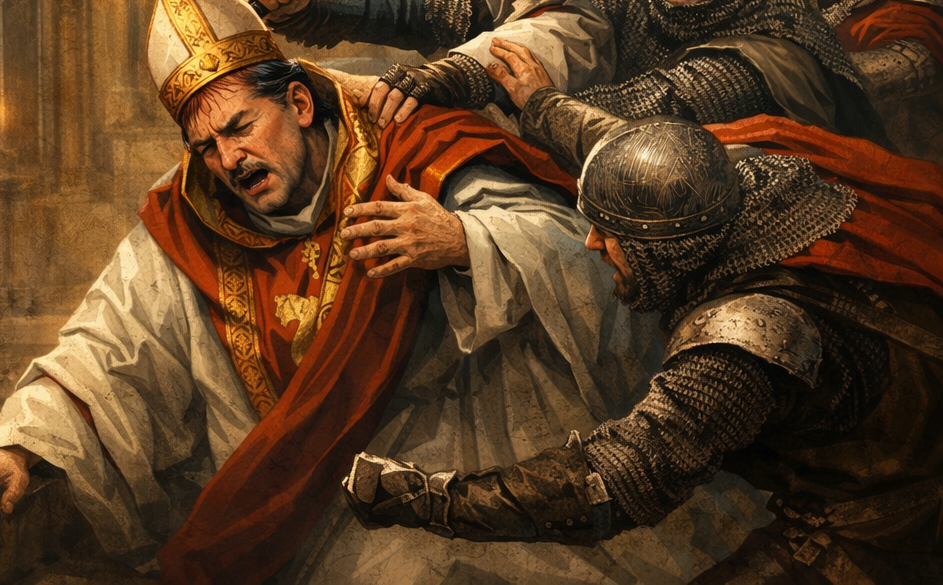
On December 29, 1170, Archbishop Thomas Becket was killed inside Canterbury Cathedral by four knights connected to King Henry II. The murder struck with force, transforming a legal dispute into a royal purge.
The fight was not about abstract theology. It was about jurisdiction: who could judge clerics, who could punish them, and whether the king’s courts could reach into the Church’s protected space.
Henry II was trying to build a sharper, more uniform kingdom. Becket was trying to defend a Church that claimed its own law, its own courts, and its chain of authority that ran past any crown.
The medieval constraint was legitimacy. Kings needed the Church to bless rule, staff administration, and anchor law in a world where literacy and authority clustered around clerics. Archbishops needed the crown’s protection and cooperation in a violent, factional society.
Some details are still debated, especially the exact words Henry said before the knights rode for Canterbury. What is not debated is the result: the state’s problem became a martyr’s story, and a martyr’s story is a weapon that lasts.
The story turns on how an argument over courts became a crisis of authority.
Key Points
Thomas Becket’s murder was the killing of the Archbishop of Canterbury in his cathedral on December 29, 1170, after a long dispute with King Henry II over church autonomy and royal justice.
The conflict sharpened in the early 1160s as Henry pushed to limit clerical privilege and Becket resisted, turning a former royal partnership into an institutional showdown.
A major turning point came with Henry’s effort to formalize limits on church courts; another came when Becket used excommunication as leverage against royal-aligned bishops.
The biggest constraint was legitimacy: neither crown nor Church could simply crush the other without destabilizing the whole system of rule.
What changed most was the political cost of appearing to bully the Church; what stayed the same was the tangled overlap of sacred authority and state power.
The clearest legacy signal was Becket’s rapid sainthood and the transformation of Canterbury into a pilgrimage center that shaped English religious culture for centuries.
Baseline Context
In the mid-12th century, England was rebuilding authority after years of civil war and disputed succession. Henry II’s reign aimed at restoration: tighter justice, clearer administration, and fewer private power centers that could ignore the king.
The Church was not just spiritual. The Church not only ran courts but also managed property, controlled careers, and maintained a direct line to Rome. Clerics could claim the “benefit of clergy”, pulling cases into church courts that often punished differently than royal courts, which irritated a king trying to make law predictable.
Becket began as Henry’s trusted operator. As chancellor, he sat near the center of government. That closeness created expectations: Henry did not just want an archbishop, he wanted his archbishop.
Events were primed to move because the boundary was inherently unstable. Justice, money, and obedience simultaneously flowed through both institutions, and any attempt to establish a rigid boundary threatened someone's authority.
The Origin
The origin sits in 1162, when Henry secured Thomas Becket’s election as Archbishop of Canterbury. The bet was straightforward: put a loyal expert inside the Church’s top English seat and the crown’s reforms would meet less resistance.
Becket’s shift in office is well documented in broad outline, even if motives are argued. What matters mechanistically is that the archbishopric came with tools Henry could not safely command: spiritual sanctions, appeals to Rome, and the aura of sacred law.
By January 1164, the dispute had crystallized around attempts to define church–state relations in England, especially limits on ecclesiastical privilege and the reach of royal justice. Becket’s refusal to accept those limits pushed the conflict into open rupture, followed by legal and political pressure that ended in exile.
The origin was possible because Becket and Henry were close enough for betrayal to feel personal and because the legal overlap was large enough for either side to claim it was defending order.
The Timeline
1162–1164: A royal appointment becomes a constitutional fight
On the ground, the relationship flipped from cooperation to confrontation. Henry’s government pressed for cleaner lines of authority; Becket insisted the Church’s courts and liberties were not a royal grant.
The mechanism was administrative reform: define jurisdiction, standardize procedure, and curb what looked like special pleading by clerics.
The constraint was that reforms required clerical buy-in. The crown needed bishops for governance, and bishops needed the crown to keep peace.
The carry-over was polarization. Once the dispute was framed as “who owns the courts”, a compromise became harder without someone losing face.
1164–1170: Exile, bargaining, and the long reach of Rome
Becket’s exile turned an English power struggle into a European one. Negotiation moved through letters, envoys, and papal pressure, with long delays that made trust brittle and misunderstandings durable.
The mechanism was international leverage. Appeals to the pope and alliances with continental power brokers raised the cost of any blunt English settlement.
The constraint was distance and speed. Communications lagged, and decisions made in one place arrived too late to prevent escalations elsewhere.
The carryover was a hardening of positions. Exile made Becket more symbolic, and symbolism is difficult to domesticate.
June–November 1170: The coronation provocation
Henry had his son, Henry the Young King, crowned in June 1170 by the Archbishop of York, a move read as a deliberate slight to Canterbury’s prerogatives and to Becket personally.
The mechanism was dynastic security: coronation as insurance against succession crisis, even while Henry II still lived.
The constraint was ecclesiastical legitimacy. A coronation did not just anoint a prince; it staged the Church’s blessing of rule, and who performed it mattered.
The carry-over was a showdown on sanctions. Becket returned wielding excommunication as a real, feared instrument in political conflict.
December 1170: Canterbury and the fatal interpretation
When Becket refused demands to back down, four knights confronted him at Canterbury and then returned armed to the cathedral precincts. The killing occurred inside the cathedral, an act that multiplied outrage because it violated the expectation that sacred space was not a venue for royal violence.
The mechanism was court culture. In a household of armed men, loyalty often meant anticipating what the king “really wanted,” even if no formal order was given.
The constraint was control. A medieval king could project power, but he could not fully manage how subordinates performed zeal in his name.
The carry-over was instant reversal. The crown’s push for authority suddenly looked like sacrilege, and the Church gained the stronger story.
1171–1174: Shock, sainthood, and royal penance
Becket’s death produced not just grief but an administrative crisis for the monarchy. The pope moved to formalize Becket’s status as a martyr, and Becket was canonized in 1173, accelerating devotion and pilgrimage to Canterbury.
The mechanism was ritual and recognition. Canonization and cult turned a dead archbishop into a living political constraint.
The constraint was reputational survival. Henry needed to keep governing without appearing to wage war on the Church.
In July 1174, Henry performed public penance at Canterbury, entering barefoot and submitting to a humiliating ritual of contrition at the tomb.
The period from 1174 to 1538 saw the shrine's power and the subsequent attempts to erase it.
Over time, Canterbury became a magnetic site of pilgrimage, wealth, and narrative. Becket’s cult embedded itself in English religious life in ways that outlasted Plantagenet politics.
The mechanism was attention and infrastructure. Pilgrimage routes, offerings, relic culture, and storytelling created a durable economy of meaning around the martyr.
The constraint was that sanctity competes with sovereignty. A saint who symbolizes resistance to kings remains awkward for later kings.
In 1538, Henry VIII’s agents destroyed Becket’s shrine as part of a broader campaign to dismantle old religious authorities and their political implications.
The Hinge
The hinge was not achieved with a single sword stroke. It was the moment royal frustration became actionable in the ears of armed subordinates.
Whether Henry used the famous phrasing or something rougher, the dynamic mattered more than the quotation: a king vented, and men whose status depended on service converted that venting into “mission.”
Realistic alternatives existed, but all were costly. Henry could have slowed the dispute, absorbed the insult of Becket’s defiance, and worked through papal channels. Becket could have tempered sanctions and accepted a partial settlement. Both choices demanded patience in a political culture that rewarded displays of dominance and punishments of disobedience.
Once the knights chose to commit violence in the cathedral, the trajectory of the situation changed dramatically. The dispute stopped being about courts and became about the soul of kingship.
Consequences
Immediately, the murder shocked Latin Christendom and put Henry under intense pressure to distance himself from the act. The Church gained a martyr whose death could be narrated as proof that sacred law outranked royal will.
Politically, Henry’s room to maneuver narrowed. Any further attempt to discipline the Church risked being read through the lens of martyrdom, even when the administrative case for reform remained strong.
Institutionally, the episode bolstered the Church's influence in the short term by increasing the reputational cost of coercion. It also taught the crown a grim lesson: indirect power still generates direct consequences, and deniability does not prevent blame.
In the longer run, the cult of Becket reshaped English religious geography. Canterbury became a center of pilgrimage, money, and memory, with a saint who embodied the idea that there were limits to what kings could demand.
What Endured
Jurisdictional overlap endured. Church courts and royal courts continued to compete and cooperate because both served real needs in governance.
Legitimacy remained the hard currency. Kings still needed sacred approval, and churchmen still needed secular protection and order.
Ritual stayed political. Coronations, excommunications, penance, and pilgrimage functioned as public technologies for shaping obedience.
Violence remained a tool at the edge of politics. Even when condemned, it hovered as a temptation when other levers failed.
Canterbury’s geography endured as well: a specific place where power, worship, and national story could be staged in stone.
Disputed and Uncertain Points
The exact words Henry II spoke before the knights set out are uncertain, and surviving accounts vary. The famous line is best treated as a later crystallization of a real outburst rather than a verbatim transcript.
It is also debated how premeditated the killing was once the knights reached Canterbury. Some narratives emphasize escalation from confrontation to violence; others stress that the men arrived prepared and willing to cross the line.
Becket’s inner motives are argued in tone if not in outcome. Some historians lean toward principled defense of ecclesiastical independence; others emphasize strategy, pride, and the politics of sanctity. The evidence supports pressure and incentives more clearly than private psychology.
Many miracle claims attached to the cult are not verifiable in modern terms. What is verifiable is the rapid spread of devotion and institutional recognition of sainthood.
Legacy
Becket’s legacy is not a slogan about church and state. It is a concrete demonstration that medieval government ran on shared authority, and that violating the boundaries of sacred legitimacy could wound a king more than any rebel army.
The visible residue lasted for centuries: the rise of Canterbury as a pilgrimage center after Becket’s canonization, the ritual memory of Henry’s penance, and the use of Becket as a symbol in later arguments about conscience and power.
When Henry VIII destroyed the shrine in 1538, it proved the point in reverse. Even after 350 years, a dead archbishop still mattered enough to erase.
