The 1914 Christmas Truce: What Happened, What Didn’t, and Why We Keep Retelling It
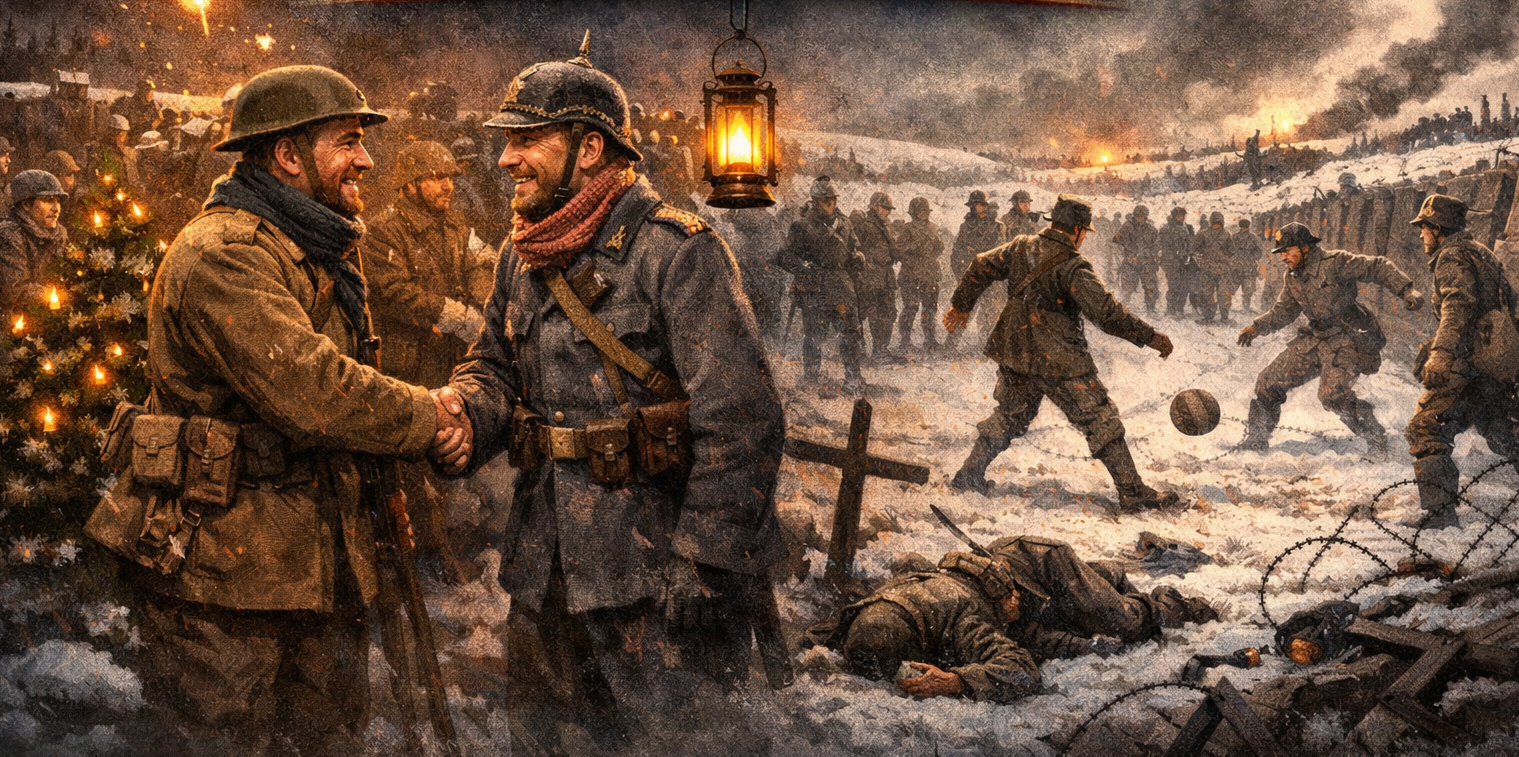
In late December 1914, parts of the Western Front did something that still jars against what the First World War became. Soldiers stopped shooting. Men climbed out of trenches, met in no man’s land, and treated the enemy as human at arm’s length.
This was not a single ceasefire that swept the line. It was a scatter of local truces, different in each sector, shaped by the distance between trenches, the mood of units, the authority of officers on the spot, and what violence had already happened there.
The tension sits inside modern war itself. Armies run on discipline, distance, and the steady conversion of orders into action. A truce runs on the opposite: proximity, mutual restraint, and the shared decision not to exploit a moment of vulnerability.
The truce matters because it shows two truths at once. Ordinary soldiers could recognise the person across the wire. The institutions around them—strategy, command, and the logic of endurance—could still pull them back into killing within hours or days.
Some details are clear: singing, greetings, meetings, and burials happened in multiple places. Other details remain uncertain: how widespread it truly was, how long it lasted in each sector, and how much later retelling has sanded the story into a single, neat scene.
The story turns on how a bottom-up pause collided with a top-down system built to keep the killing going.
Key Points
The 1914 Christmas Truce was a series of unofficial, improvised ceasefires along parts of the Western Front, mainly around December 24–26.
It was uneven: some sectors fell quiet, others kept fighting, and there was no single “front-wide” moment.
The common features of the 1914 Christmas Truce included practical and human elements such as carols and greetings, small exchanges, joint or parallel burial parties, and brief meetings in the middle of the battlefield.
Estimates of scale vary; one widely repeated claim is that it affected a large portion of the British-held sector, but the exact share depends on what counts as a “truce.”.
The biggest constraint was command and credibility: higher leadership could not allow fraternisation to become an expectation, so pressure to prevent repeats came quickly.
Football is the most famous detail, but the tidy, "organised match with a scoreline" version is often overstated; evidence points to occasional informal kickabouts in some places.
The clearest legacy is cultural, not military: the truce became a durable symbol, repeatedly reshaped by memory, media, and the needs of later audiences.
Baseline Context
By December 1914, the war in the West had shifted from movement to entrenchment. The early campaigns had not delivered a decisive outcome. The front had solidified, and daily survival became its own battle.
Trench life was close, wet, loud, and cramped. The enemy was not abstract. In many places, the opposing line was near enough for voices to carry, sometimes near enough to hear routines and jokes. That proximity did not produce peace, but it did create a strange kind of predictability in quieter sectors.
The institution that mattered most was command. Orders flowed down, but the front line still ran on human judgement: when to expose a head, when to waste ammunition, when to retaliate, and when to hold fire because doing so kept you alive.
Events were primed to move because stalemate created routines, routines created patterns of restraint, and patterns made a negotiated pause thinkable in pockets of the line.
The Origin
The truce did not begin as a peace campaign. It began as contact and timing.
In some sectors on Christmas Eve, German troops displayed candles, lanterns, or small trees and sang. British troops answered with carols of their own. Shouting turned from insults to greetings, then to cautious bargaining: shooting would stop for a while, at least while bodies were recovered.
What soldiers thought they were doing, in the clearest cases, was limited and immediate. They were trying to survive Christmas. They were trying to bury the dead. They were attempting to make a difficult night more bearable. What they could not see was how quickly even a short pause threatened the broader machinery of war, where discipline depended on keeping the enemy as enemy.
Several conditions made the origin possible. Trenches were close enough for direct speech. The front had settled into a pattern that could be temporarily interrupted without immediate manoeuvre. Christmas offered a shared ritual that soldiers could try to smuggle into a place designed to erase customs.
The Timeline
Stalemate and familiarity (early to mid-December 1914)
On the ground, the key change was psychological: the front stopped moving, but the danger did not stop. The men learnt the rhythms of their sector. In quieter stretches, constant firing could feel like self-harm, because it invited retaliation.
The mechanism was positional warfare: trench systems, wire, and machine guns made open ground lethal, while artillery punished any visible concentration.
The constraint was proximity without mobility. You could see the enemy line, but you could not cross the space between. That produced a grim incentive in some places to avoid pointless provocation, creating an opening for informal restraint.
The carry-over was recognition. Once soldiers knew the “normal” pattern opposite them, they could also recognise a break in the pattern—and test it.
Christmas Eve: signalling a pause (December 24).
In sectors where a truce formed, it often began with sound and light. Carols carried. Candles could be seen. A decorated parapet signaled— for a moment, that the night was not being used for an attack.
The mechanism was improvisation under pressure. Small groups called out. Other groups replied. Promises not to shoot were floated and, in some places, accepted.
The constraint was trust. Any man climbing onto a parapet risked being shot by the enemy, by a nervous sentry, or by someone enforcing discipline. The pause could only begin where enough people on both sides held fire at the same time.
The carry-over was momentum. Once a few men exposed themselves safely, others could follow, turning shouted greetings into meetings.
Christmas Day: contact in daylight (December 25)
In the clearest accounts, soldiers came out in groups, met in no man’s land, and did the most war-shaped acts imaginable: they buried bodies, marked graves, and repaired positions without being shot at.
The mechanism was mutual benefit. Removing corpses reduced disease risk and restored a measure of dignity. Repairing trenches improved survival. Exchanging small goods cost little and helped stabilise the pause.
The constraint was terrain and exposure. No man’s land was often cratered and wired. In some places it could support cautious gathering; in others it was too dangerous or too visible. This physical reality is one reason the truce appeared as a patchwork rather than a clean line-wide event.
The carry-over was the story. Soldiers took photographs, kept souvenirs, and wrote letters. A brief local moment became portable.
Boxing Day, which is December 26 and the days that follow, marked the return of routine.
In many places, firing resumed quickly. In others, the pause lingered in reduced form—less fraternisation, more quiet, a temporary easing of the worst habits.
The mechanism was the reassertion of the war’s daily systems: sentries back to normal posture, patrols back out, artillery schedules returning, and discipline tightening.
The constraint was command legitimacy. Higher leadership could not allow an unofficial ceasefire to become a precedent. Even officers sympathetic to a pause still had to answer upward, and units could be moved or pressured to break any comfortable relationship across the wire.
The carry-over was suppression and rarity. The moment remained in memory, but the institution learnt from it.
Why it did not repeat at the same scale (1915–1918)
As the war continued, the front became more tightly managed. Raids, sniping, and artillery harassment increased. Surveillance and control improved. And losses changed how men saw the enemy and themselves.
The mechanism was escalation and enforcement: commanders pushed to prevent fraternisation and disrupt any quiet equilibrium.
The constraint was the war’s own hardening logic. The longer the war ran, the less space there was for shared ritual to interrupt it.
The carry-over was unique. The 1914 truce remained vivid partly because the war that followed made it harder to imagine.
The Hinge
The hinge was not the meeting itself. It was the rapid reassertion of discipline afterwards.
From a command perspective, the danger was not an enemy breakthrough. It was expectation. If soldiers began to believe that informal truces were normal or negotiable, the chain linking strategy to violence could weaken.
Realistic alternatives were narrow. Leadership could ignore the truces and hope they faded. Or it could tolerate quiet while forbidding open contact. In practice, the system leaned toward prevention: discouraging meetings, tightening supervision, and making clear that fraternisation was not to become routine.
Consequences
The immediate consequence was relief. Bodies were buried. Trenches were repaired. Men slept. A short pause in killing mattered in a war that ground nerves as much as flesh.
The immediate risk was also real. Any pause could be exploited. Any friendliness could make the next day’s killing psychologically harder. Officers were concerned about maintaining discipline, while some soldiers feared perceived weakness.
In the longer run, the truce produced two lessons pointing in opposite directions. For soldiers, it proved restraint was possible when both sides chose it. For command, it proved restraint could arise from below without permission, which made it something to monitor and contain.
What Endured
Several forces stayed stubbornly in place. State aims did not soften. The trench system remained, with its dependence on fortification, supply, and rotation. The command hierarchy held, even when it temporarily bent at the very front edge. The logic of attrition—pressure through sustained violence—kept its grip.
These enduring structures set the limits of change. A local pause could save lives for a day. It could not, by itself, rewrite alliances, national goals, or the machinery that kept the front running.
Disputed and Uncertain Points
How widespread was it? Evidence supports multiple truces, but the exact breadth varies by definition. A quiet sector is not the same as open meetings in no man’s land, and accounts cluster around certain parts of the British-held front while other sectors fought as normal.
How long did it last? In some places it was hours; in others it appears to have lingered into Boxing Day, and occasionally beyond in reduced form. The strongest evidence concentrates around Christmas Eve and Christmas Day, with wide local variation.
Did they play football? Some contemporary accounts suggest informal kickoffs occurred in some areas, but the popular image of a neat, organised match with clear teams and a reliable scoreline is widely disputed. The safest claim is limited: football happens sometimes, informally, and has been exaggerated into a single central “event”.
Was it an anti-war awakening? The truce can be read that way, but the more defensible explanation is mixed. It was human, yes, but also practical: exhaustion, proximity, routine, and a short window where mutual restraint made immediate sense.
Legacy
The Christmas Truce lasts because it fits the human mind. It has a charged date, a narrow setting, and a sharp contrast: peace inside the machinery of killing. It also has artefacts—letters, photographs, and souvenirs—that make it feel intimate and eyewitnessed.
Over time, the truce became a mirror. Some audiences use it as proof that ordinary people can refuse hatred. Others use it as an indictment of systems that restart violence after a pause. Popular culture often prefers the cleanest symbol—the football match—because it turns chaos into a single, legible scene.
The deeper legacy is not that the war paused. It is that the pause keeps returning in memory, forcing the same question on every retelling: if men could stop firing once, what did it take to make them start again?
