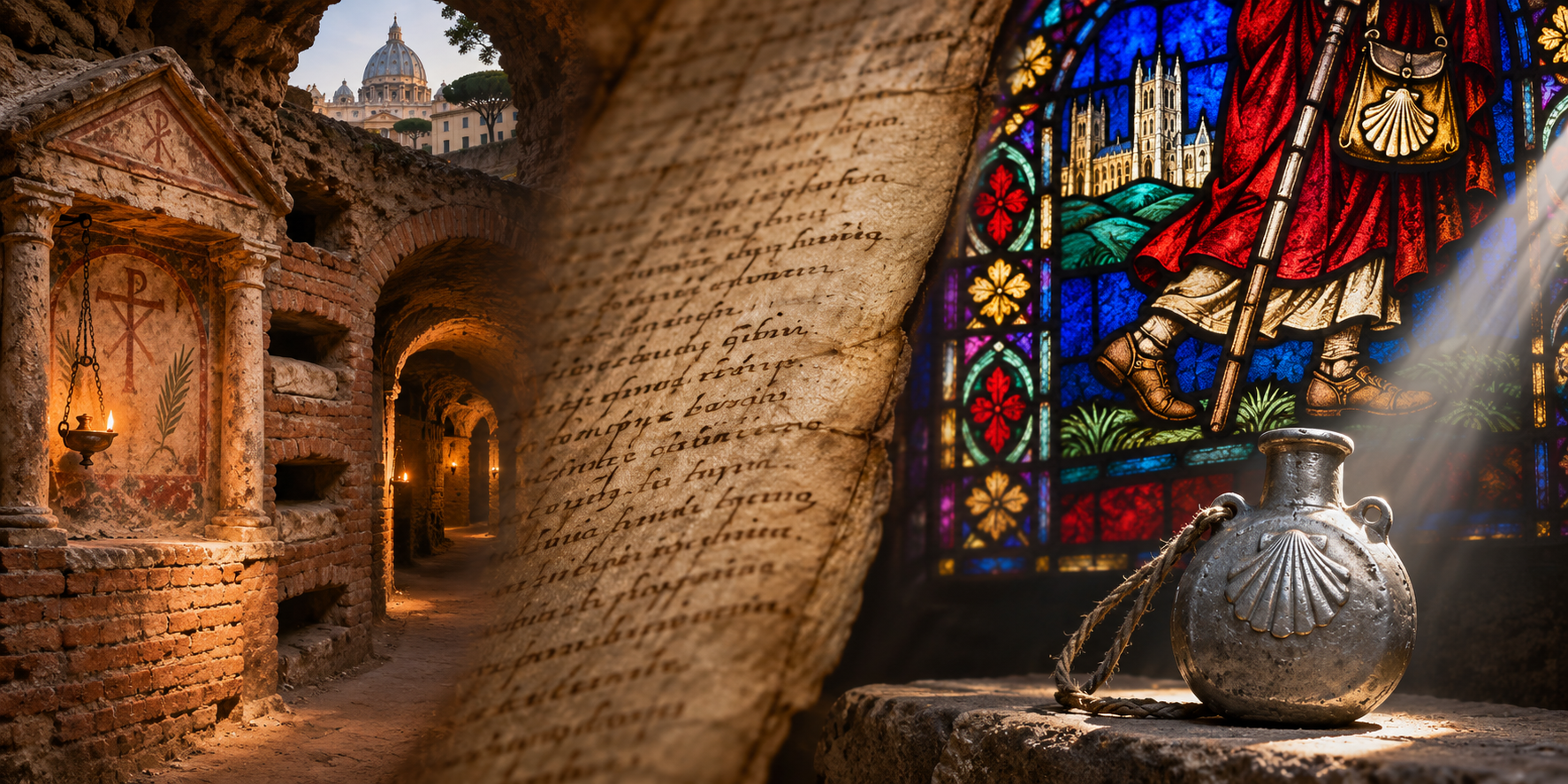
The Prison Diary, the Buried Shrine and the Final Broadcast That Tell the Story of Christianity’s Martyrs
Beneath St Peter’s Basilica, A Small Roman Shrine Helps Explain Why The Church Stands Where It Does.
When the emperor Constantine’s builders began work on the first St Peter’s Basilica in Rome, they had a difficult site to contend with. A cemetery occupied the slope of the Vatican hill. Building a church there meant cutting down parts of tombs, burying others and creating a level platform across uneven ground. One small monument, however, was carefully preserved. Roman Christians believed it marked the burial place of the apostle Peter. The building had to fit the grave.
Few martyrs have left so large a mark on a landscape. Others changed Christianity through a handful of words. Stephen gave it a prayer for one’s killers. Perpetua left an account of what imprisonment cost a young mother. Nearly eighteen centuries later, the Salvadoran archbishop Óscar Romero used a radio broadcast to ask soldiers to disobey orders to kill. Listeners could hear what he believed was worth the danger of saying aloud. The next day, he was dead.
Which of Christianity’s martyrs mattered most depends on what changed because they lived and died. Peter and Paul gave Rome a claim on the affections of Christians far beyond Italy. Polycarp’s congregation helped establish how a martyr should be remembered. Thomas Becket turned a dispute over royal authority into a pilgrimage that drew people across Europe. Their significance can be traced in the decisions of people who survived them, from a prisoner who walked free to a congregation that chose a particular day to meet again.
Stephen and James Show How Uneven the Earliest Record Is
The first person Christian tradition calls a martyr after the death of Jesus was chosen for a job involving food. According to the Acts of the Apostles, Greek-speaking Jewish believers in Jerusalem complained that their widows were being overlooked in the daily distribution. Stephen was one of seven men selected when the apostles called the community together to address the grievance. Before he became famous for the manner of his death, his neighbours had reason to care whether he could be trusted with their dinner.
Acts describes Stephen disputing with opponents, facing accusations concerning Moses and the Temple, and delivering a long speech grounded in the history of Israel. Its setting matters. Stephen and the people arguing with him belonged to a Jewish world. His appeal to Abraham, Joseph and Moses depended on a history his listeners recognised as their own. Centuries of Christian hostility towards Jews make it especially important to read this as an argument among particular people in Jerusalem. Collective blame does violence to the story as well as to its subjects.
As Stephen is stoned, he asks Jesus to receive his spirit and prays that his killers will be forgiven. Readers of Luke’s Gospel would recognise the resemblance to Jesus’ prayers on the cross. Acts also draws attention to someone standing a little way from the violence. The witnesses have left their cloaks with a young man named Saul, who approves of Stephen’s killing. He will become the missionary Paul. A reader encountering both men for the first time meets the future apostle on the side of the people for whom the dying man prays.
A few chapters later, King Herod has James, the brother of John, killed with a sword. This is James the son of Zebedee, one of Jesus’ earliest disciples. Acts gives his execution scarcely a sentence before turning to Peter’s arrest and escape. We have no last speech from James and no account there of how he conducted himself. The difference in space is striking. Stephen became the prototype for the Christian martyr partly because later generations had a scene they could recount. James’s death reminds us how much of early Christian history would look different if another witness had happened to leave a few paragraphs.
Peter and Paul Gave Christians Two Places to Remember in Rome
Visitors familiar with Christian art may feel they know exactly how Peter and Paul died. Peter hangs upside down on a cross. Paul, a Roman citizen, kneels before a sword. Yet the Acts of the Apostles ends with Paul alive, receiving visitors and teaching in Rome. Peter’s execution is absent too. A person could read the entire book and finish without encountering either of the scenes that later artists made famous.
An early Christian letter known as First Clement offers a better starting point. Written in the name of the Roman church to Christians in Corinth, it recalls the sufferings of Peter and Paul and presents their endurance as an example to readers facing divisions of their own. Already these men belonged together in Christian memory. The writer could invoke them before an audience across the sea and expect their names to carry weight. The letter supplies little of the detail a modern biographer would want about their final hours.
Christian tradition places both deaths in Rome during Nero’s reign in the first century. The familiar methods of execution come through later traditions, with the inverted cross especially dependent on a later account. There are good historical reasons to take the Roman association seriously while leaving the precise circumstances open. Early testimony about a death, a later narrative explaining how it happened and a painting made a thousand years afterwards answer different questions.
Rome also preserves evidence of something a text alone could barely convey. By around the end of the second century, a Roman Christian named Gaius could direct someone towards monuments associated with the apostles, one at the Vatican and one on the road to Ostia. Beneath St Peter’s, excavators eventually uncovered the ancient cemetery and the remains of a small funerary monument. Graffiti nearby bear witness to the devotion of visitors. The evidence places people at a particular patch of ground, early enough for their choice to shape what Constantine built there in the fourth century.
Archaeology is much better at establishing the history of that choice than at identifying an individual skeleton. A shrine can be dated through its construction and its relationship to neighbouring walls. Scratched names can reveal whom visitors came to honour. Neither provides the equivalent of a signed burial record. What the excavations give us is remarkable in its own right. Long before anyone could enter the present basilica, people already knew where on a hillside they wanted to stand.
Polycarp and the Congregation That Saved His Bones
Polycarp was bishop of Smyrna, now İzmir in Türkiye, when he was executed in the second century. An account written in the name of his church describes an elderly prisoner offered a way out. He could swear the required oath and speak against Christ. In the exchange as the congregation preserves it, Polycarp looks back over eighty-six years of service and asks what injury Christ has ever done him. His answer has the force of an old man being asked to betray someone he has trusted all his life.
The document was addressed to Christians elsewhere. Its writers had practical questions to settle. What should believers do if officials came for them? Was presenting oneself voluntarily for arrest an act of courage? The letter includes the uncomfortable example of a man who urged others to come forward and subsequently gave way himself. Polycarp had initially withdrawn from danger. In a text destined to make him celebrated for dying, that decision to preserve his life was worth recording.
What happened to his remains mattered almost as much to the congregation as the confrontation with the authorities. The writers say they collected his bones after his body was burned and placed them somewhere suitable. They hoped to gather there on the anniversary of his death. They also took care to explain the difference between their love for a martyr and the worship they owed Christ. Readers sometimes imagine that questions about relics arose much later, after churches had accumulated elaborate shrines. Here the question is already pressing for people describing the recovery of their bishop’s remains.
Polycarp’s lasting influence lies partly in that proposed meeting. A congregation that returned each year could introduce children and newcomers to someone they had never known. Churches receiving the letter could read the account even though they lived too far away to visit the grave. A date, a place and a text gave Christians three ways to keep a person in communal memory. All three are still recognisable in the way churches commemorate the dead.
Perpetua and Felicity Brought the Prison Into View
In Carthage, in present-day Tunisia, a group of Christians was executed in the arena in March 203. Two women among them, Perpetua and Felicity, became especially well known. Perpetua was a young mother from a prosperous family. Felicity was enslaved and pregnant. The account of their imprisonment opens a window seldom available in ancient history. Several passages are written in the first person and attributed to Perpetua herself. An editor frames her account, and another voice describes the execution. The change of voice marks the point beyond which she could no longer tell her own story.
One of Perpetua’s sharpest memories concerns her baby. She describes the distress of separation, the physical difficulty of nursing and the relief when arrangements were made for the child to stay with her. The permission changed how she experienced the prison overnight. Her father’s visits were more painful. He wanted his daughter alive and his grandchild provided for. He pleaded with her to consider what her decision would do to the family. His love made it harder for her to hold her ground, and the text allows a reader to understand his distress even as it invites admiration for hers.
Felicity faced a different predicament. The account says that her pregnancy would delay her execution and that she feared being left behind when her companions died. She gave birth in custody shortly before the games. Another Christian woman took her daughter to raise. That unnamed woman belongs to the history of the martyrs too. The celebrated story ends in the arena, but someone had to feed the infant the next morning and bring her up in the years afterwards.
The two women are commemorated together, yet the surviving account preserves their voices unequally. Readers can follow Perpetua’s reasoning, hear about her dreams and see her father through her eyes. Felicity comes to us chiefly through someone else’s description. Remembering their difference in social position helps explain why it is so precious to have even this much of their shared experience. It also exposes a limit. We know what Perpetua found hardest about those days because a text attributes those observations to her. There are questions about Felicity that no amount of close reading can answer.
Their influence reaches beyond the early history of women in the Church. A general account of Roman persecution might tell us that Christians could face execution for refusing to comply with religious demands. Perpetua’s prison narrative tells us what such a demand could mean for three generations of one family. A grandfather begged, a mother made her decision and a child depended on arrangements made by adults who had little power over what happened next.
Thomas Becket Turned Canterbury Into a Destination for the Sick
On 29 December 1170, four knights killed Thomas Becket in Canterbury Cathedral. The archbishop had once been Henry II’s chancellor and a close associate of the king. As archbishop, he clashed with Henry over the rights of the Church, including the treatment of clergy accused of crimes. A dispute involving courts, jurisdiction and royal power might have remained chiefly the concern of historians of government. Killing an archbishop in his own cathedral gave people across Europe an immediate reason to take an interest.
Whatever Henry intended by his angry words about Becket, the famous line commonly attributed to him cannot safely be treated as a verbatim order. The consequences are clearer. Becket was canonised in 1173, and Henry subsequently came to Canterbury to do public penance. The king who had expected obedience from his former chancellor now had to reckon with people who believed that the murdered man could intercede for them before God.
To see what Becket meant to those people, look past the knights and into the cathedral’s Miracle Windows. Eight survive from an original twelve. Made in the decades after the murder, they draw on accounts of people who sought Becket’s help. Medieval glaziers devoted costly glass, skilled labour and precious space around a major shrine to the illnesses and journeys of ordinary men, women and children. A modern visitor who knows nothing about Henry’s legal reforms can still follow the human problem of getting a sick relative to a place where the family hopes help might be found.
The windows are evidence for what medieval people reported, believed and considered worth depicting. A modern diagnosis or a medical finding about a particular cure lies beyond what coloured glass can establish. Yet the glass preserves something a royal chronicle would be unlikely to record. Families who barely figure in the political history of the reign occupy the centre of scenes commissioned for one of England’s great churches.
Eventually Chaucer could put a varied group of travellers on the road to Canterbury and trust readers to understand what brought them together. Becket’s murder helped give English literature that gathering place. It also changed the rhythm of a real city as pilgrims arrived to pray, seek healing and carry a token of their visit home. The four knights ended a quarrel with one man and left the English crown facing a saint whose visitors came from far beyond the kingdom.
Maximilian Kolbe Took Another Prisoner’s Place at Auschwitz
In 1941, after a prisoner escaped from Auschwitz, the SS selected ten other prisoners to die of starvation in reprisal. One was Franciszek Gajowniczek, a Polish prisoner with a wife and children. Maximilian Kolbe, a Polish Franciscan friar, volunteered to take his place. The substitution was accepted. Kolbe died on 14 August after being given a lethal injection. Gajowniczek survived the camp and lived to attend Kolbe’s canonisation in 1982.
The sequence matters. In the ancient stories, an official sometimes offers a Christian the possibility of survival on condition that the prisoner renounce the faith. At Auschwitz, Gajowniczek had already been selected when Kolbe intervened. The guards made no demand that Kolbe deny Christ. His religious commitment entered the episode through an offer he made on behalf of someone else. Catholic remembrance of him as a martyr of charity gives a name to that distinction.
The existence of a survivor gives the story an unusually exact measure of consequence. We can say whose life the offer spared that day. Gajowniczek still faced the dangers of the camp, and the other men selected for punishment remained condemned. Those facts keep the scale of Kolbe’s act intelligible. Within a system designed to make prisoners powerless over one another’s fate, he found a moment in which his decision changed what happened to one particular man.
Block 11 still stands at Auschwitz I. The cell associated with Kolbe belongs to a preserved site of imprisonment, torture and killing with a history extending far beyond this episode. Remembering the other prisoners restores something easily lost when a story centres on a saint. The nine men who had no volunteer to replace them had families and histories too. The injustice done to all ten is what made the offer of substitution possible in the first place.
Janani Luwum Challenged Idi Amin Over What Was Happening to Ugandans
Janani Luwum was a teacher before he became an Anglican clergyman. His faith took shape in the East African Revival, and his early experience included working as a catechist, teaching Christianity to others. By the 1970s he was an archbishop facing a question with consequences for people well beyond his congregation. What should a church leader do when those accused of violence belonged to the security services of the country itself?
Under Idi Amin, Luwum tried to intervene for victims. Anglican and Catholic leaders worked more closely together, and Muslim leaders joined efforts to respond to conditions in Uganda. On 12 February 1977, Luwum delivered a protest to Amin about violence attributed to the security services. Within days, church leaders were summoned to Kampala. Luwum was taken away and murdered. The regime tried to explain his death as a road accident.
His significance lies partly in the distance between a private intervention and a public protest. Pleading for an individual victim asks someone in authority to make an exception. Presenting a complaint about the conduct of security forces calls the exercise of authority itself into question. An archbishop had access to conversations that many bereaved relatives could never enter. Speaking collectively also made it harder to dismiss those relatives’ experiences as isolated grievances.
Luwum is among the modern martyrs commemorated above the Great West Door of Westminster Abbey. A visitor looking up at his figure sees an Anglican archbishop. The events that brought him there also involved Catholics and Muslims, and the people for whom he intervened did not have to pass a test of religious allegiance. Leaving those relationships in the story gives a fuller account of what his faith required of him in Uganda.
Óscar Romero Asked the Men With Guns to Make a Choice
On Sunday 23 March 1980, Óscar Romero, the Catholic archbishop of San Salvador, addressed members of the armed forces. His homily reached listeners by radio. He appealed to soldiers who might receive orders to kill their fellow Salvadorans and told them they had a duty before God to refuse. On Monday 24 March, a gunman shot him while he celebrated Mass in a hospital chapel.
The radio explains part of Romero’s influence. A soldier did not have to enter the cathedral, risk being seen with a critic of the authorities or wait for someone to smuggle out a written statement. The archbishop’s voice could reach him where he was. Romero spoke to that listener as someone still capable of making a moral decision. Rank might explain who had issued an order. It could never settle what the person holding the weapon ought to do.
Romero’s surviving homilies make it possible to examine what he actually asked of people before his assassination. That is a privilege readers of the earliest martyr accounts seldom have. With Stephen, we hear the speech that Acts gives him. With Perpetua, we have a first-person narrative transmitted inside another writer’s account. With Romero, the words preached on the eve of his death belong to a surviving record of public ministry. His assassination gave that sermon an audience across generations. Its argument was already complete when he stepped down from the pulpit.
Romero and Luwum now stand on the same façade at Westminster, alongside figures including the Lutheran pastor Dietrich Bonhoeffer and the Baptist minister Martin Luther King Jr. The statues were unveiled in 1998. An Anglican church chose to place Christians from several traditions over a door through which its own congregation passes. Centuries after arguments over which martyrs Christians ought to honour, the choice of neighbours on that wall carries a significance of its own.
What Survives of a Martyr?
Of all the discoveries associated with these people, the easiest to misunderstand is the shrine beneath St Peter’s. Its greatest historical value does not depend on conclusive identification of a bone. People marked a place, other people came looking for it, and eventually an emperor’s builders went to extraordinary lengths to preserve it. Even a reader who reserves judgement about the burial can follow those decisions through the architecture.
Other witnesses bring us closer to an individual life. A young mother remembered the relief of having her baby back. A congregation explained why it wanted its bishop’s bones. A medieval glass painter gave a sick pilgrim a place in a cathedral window. A Polish man lived long enough to attend a ceremony honouring the prisoner who had stood in his place. Each preserves a different kind of knowledge about what a martyr’s death meant to somebody else.
Perhaps the most revealing survivor is the complaint about widows with which Stephen’s story begins. It would have been easy for an account of Christianity’s first martyr to introduce him only at the moment of danger. Instead, we first encounter a community that has failed some of its poorest members and needs people it can trust to put matters right. Before Stephen had a feast day, a speech or a place in a stained-glass window, there was work to be done and somebody put his name forward.
Sources
Acts of the Apostles — Stephen’s speech and death
Acts of the Apostles — The execution of James
First Clement — The Roman church remembers Peter and Paul
St Peter’s Basilica — The tomb and early memorial to Peter
St Peter’s Basilica — Excavating the Vatican necropolis
The Martyrdom of Polycarp — The letter from the church at Smyrna
Fordham University — The Passion of Saints Perpetua and Felicity
Canterbury Cathedral — Becket’s Miracle Windows and the people depicted in them
British Museum — Thomas Becket, Murder and the Making of a Saint
Auschwitz-Birkenau Memorial and Museum — Block 11
Westminster Abbey — The life and death of Janani Luwum
Georgetown University Library — Óscar Romero and his final Sunday homily
Westminster Abbey — The modern martyrs above the Great West Door
Next Reads
What Did Moses See When He Asked to See God’s Glory?
What Did Angels Look Like in the Bible? The Truth About Wings, Wheels and Eyes
Why Forty Matters in the Bible, From the Flood to the Forty Days of Lent
