Which Bible Stories Have Evidence Outside the Bible?
A Babylonian Clerk Recorded An Oil Allowance For A King Whose Exile Appears In The Bible.
Near the end of the Second Book of Kings, a young ruler loses Jerusalem, surrenders to the Babylonians and spends the next part of his life in captivity. His name is Jehoiachin. We might expect the best evidence for his fate to come from a royal monument. One of the most revealing pieces comes from a clerk who needed to account for some oil.
A clay tablet from Babylon records an allocation for the king of Judah and his entourage. Read alongside a Babylonian chronicle of Jerusalem’s capture, it gives us an unusually good answer to the question of which parts of the Bible have been shown to be true. Independent records confirm that Judah lost its king to Babylon in 597 BC. The ration list then places that king at the Babylonian court. We can follow a man across a change of country, title and circumstance.
Other discoveries establish that a people called Israel lived in ancient Canaan, that Judah’s royal family was known as the House of David, that the Assyrian king Sennacherib invaded Hezekiah’s kingdom and that Pontius Pilate governed Roman Judaea. Archaeologists have also recovered ancient words of scripture on silver and parchment. The strength of each discovery depends on precisely which biblical claim we ask it to carry.
The Pharaoh Who Recorded Israel While Claiming To Have Destroyed It
Around 1208 BC, the Egyptian pharaoh Merneptah had his victories commemorated on a slab of black granite. Most of the text held little promise for anyone looking for the origins of biblical Israel. It celebrated an Egyptian king in the language Egyptian kings preferred. Towards the end, however, the writer listed enemies in Canaan. One of the names was Israel.
The decisive detail is a sign an Egyptian reader would have understood without pronouncing it. Egyptian scribes used signs called determinatives to indicate what kind of thing a written name represented. Ashkelon and Gezer received signs identifying them as places. The scribe classified Israel as a people. By the late thirteenth century BC, someone writing for the Egyptian court recognised a population in Canaan by that name.
Merneptah claimed to have laid Israel waste. The later history of the name gives us good reason to treat his boast of annihilation cautiously. Yet exaggeration about the victory scarcely diminishes the value of the identification. A king who wanted credit for defeating an enemy needed an enemy his audience could recognise. An incidental detail in a boast can be more dependable than its central claim.
For readers of Exodus and Joshua, the inscription sets a deadline that any historical reconstruction must respect. Israel was already a recognisable name in Canaan by about 1208 BC. The stone gives no account of how the population formed, whether some of its ancestors came from Egypt, who led them or how many people travelled. It supplies something more modest and quite firm. By this point, Israel had entered the written record of a neighbouring power.
How Close Have We Come To Finding King David?
In 1993, excavators at Tel Dan in northern Israel found a piece of inscribed stone reused in an ancient wall. Two more fragments emerged the following year. Together they preserve part of a ninth-century BC victory monument written in Aramaic. Its author boasted of victories over neighbouring rulers. Among the damaged lines survives a reference widely read as the “House of David”.
The wording matters because a dynasty can be identified by its founder long after his death. An enemy referring to Judah’s rulers in this way provides substantial evidence that David was remembered as the founder of a historical royal house. The inscription is particularly valuable because it comes from outside Judah. Whoever commissioned it had victories of his own to publicise and little reason to promote the prestige of a rival’s ancestry.
How much of the story in Samuel follows from those words? David’s fight with Goliath, his relationship with Saul and the extent of the territory he ruled are separate historical questions. A ninth-century ruler could have known the dynastic name without knowing how its founder acquired Jerusalem a century earlier. Equally, the fact that the monument was erected after David’s traditional lifetime is precisely what makes it evidence for the survival of his name as a political identity.
One distinction often gets lost when the find is described as proof of King David. A relatively small kingdom could produce a dynasty remembered for centuries. So could a powerful one. The same royal name fits either possibility. To judge the reach of David’s government, archaeologists need evidence of what people administered, built and supplied during his lifetime. Three fragments of a younger monument have answered the question they are capable of answering.
The Biblical Invasion We Can Examine From Both Sides
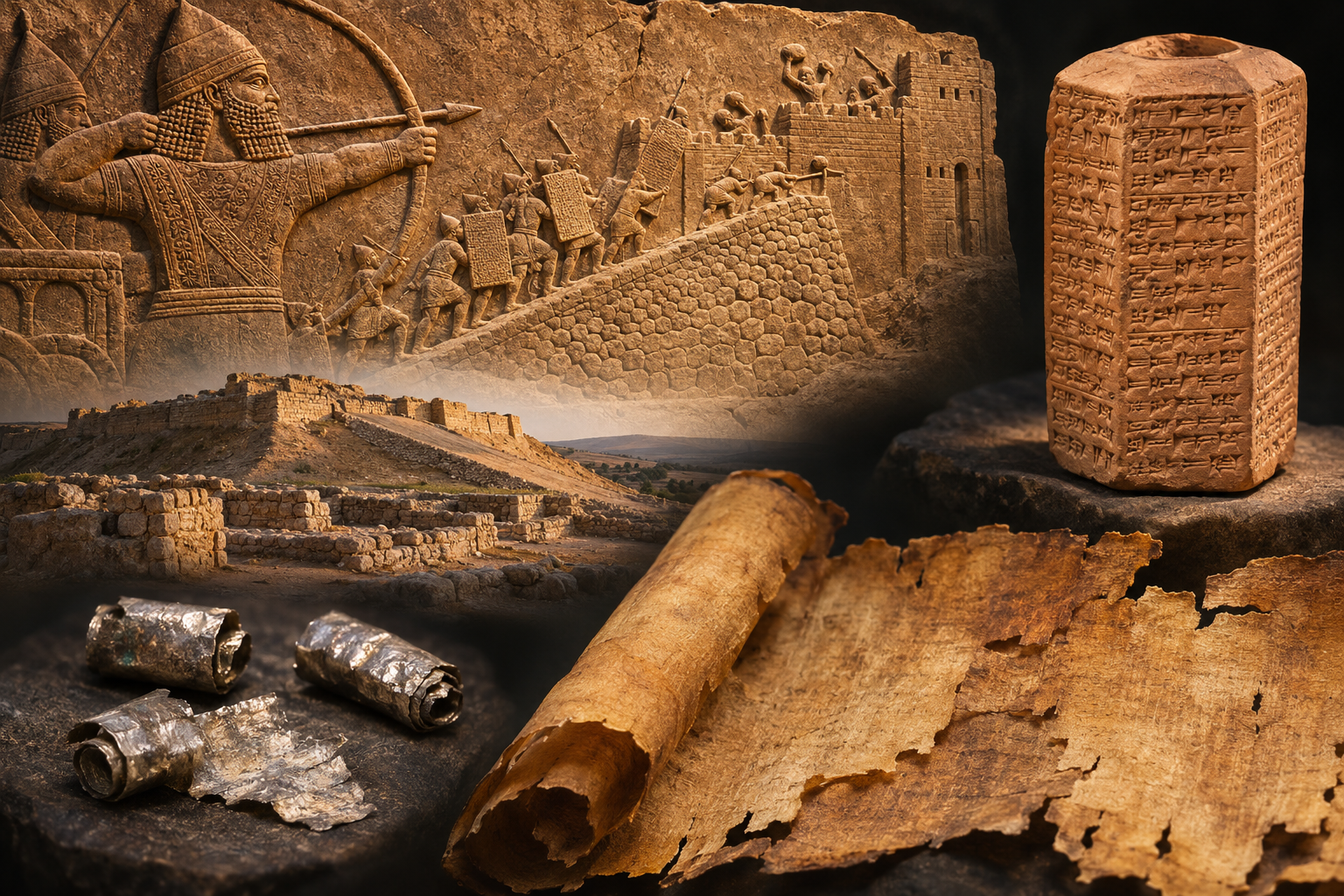
In 701 BC, Sennacherib of Assyria campaigned against Judah. Second Kings describes the loss of fortified towns, Hezekiah’s offer of tribute and the threat to Jerusalem. Sennacherib also left an account. An inscribed clay prism made in 691 BC names Hezekiah, describes him confined in his royal city and presents the campaign as a demonstration of what happened to rulers who resisted Assyria.
The two accounts overlap on the things most open to independent checking. They identify the same opponents, in the same kingdom, with Jerusalem as Hezekiah’s seat and tribute as part of the outcome. The Assyrian king had an obvious interest in describing Hezekiah’s humiliation. Even so, he stopped short of claiming to have captured Jerusalem. Given his readiness to claim victories elsewhere, that is a meaningful omission. It leaves open the question of why Jerusalem survived. The angelic intervention described in Second Kings belongs to the biblical explanation of the outcome.
For the people of Lachish, another fortified city in Judah, the outcome was much worse. Sennacherib commissioned carved scenes of its capture for his palace at Nineveh, in present-day Iraq. At Lachish itself, excavators identified the remains of the ramp the attackers built towards the south-western defences. Opposite it, inside the wall, the defenders reinforced the threatened position with a counter-ramp.
It is worth pausing over that second ramp. A palace artist could glorify an attack, and a royal scribe could inflate the number of captives. Neither could create a mound inside an enemy city by writing about it. The defenders themselves left evidence of where they thought the wall might give way. Put the palace carvings beside the excavated defences and the biblical references, and the campaign becomes one of the best-attested military episodes in the Hebrew Bible. We can even identify a stretch of ground where people on opposite sides tried to solve opposite engineering problems.
What Happened To Jerusalem’s Captured King?
A little over a century later, Judah faced a different imperial power. The Babylonian Chronicle records that Nebuchadnezzar marched west, captured the city of Judah, took its king prisoner and appointed a ruler of his choosing. Its dating puts the capture in 597 BC. Second Kings supplies the personal names. Jehoiachin surrendered. His uncle became king and ruled under the name Zedekiah.
This first capture is easy to confuse with Jerusalem’s later destruction. The distinction matters to the lives of the people involved. In 597 BC, Babylon still wanted someone to govern Judah on its behalf. Jerusalem continued as a royal capital under the replacement king. The destruction of the city and its Temple came about a decade later, in 587 or 586 BC. The Babylonian Chronicle entry for 597 cannot be used as an eyewitness record of that later catastrophe.
Jehoiachin’s oil allowance adds a dimension the campaign record could never supply. From the Babylonian administration’s point of view, a deposed king remained someone whose household needed provisions. A fragment recording the issue of oil names the king of Judah among people maintained at Nebuchadnezzar’s court. An accountant preserving the old title makes it possible to recognise the captive after his political career had apparently ended.
Second Kings closes with a later Babylonian ruler releasing Jehoiachin from prison and granting him a regular allowance. The ration tablet belongs to Nebuchadnezzar’s administration, so it cannot certify that later act of favour or tell us exactly how freely Jehoiachin lived. Its achievement is considerable all the same. The man who disappears from Jerusalem in one record becomes visible in Babylon in another, still known by the title of the kingdom he had lost.
Two Silver Scrolls Preserve A Prayer People Still Say
In 1979, excavation of a burial site at Ketef Hinnom in Jerusalem brought to light two tiny rolls of silver. Someone had scratched Hebrew words into thin sheets before rolling them up. Once the metal could be opened and the incisions read, scholars recognised language familiar from one of the most enduring passages in Numbers, the priestly blessing asking God to bless, keep and grant peace to the person addressed.
Usually dated to around 600 BC, the amulets are among the oldest surviving physical witnesses to wording found in the Bible. Their scale gives them a significance an inscription on a palace wall could never have. A blessing that Numbers places in the mouths of priests also existed in a form small enough for an individual to carry. What survives from ancient Jerusalem includes the words through which someone sought protection.
What, exactly, had been written by then? The silver establishes the antiquity of the blessing. It cannot tell us when the whole Book of Numbers acquired its present form. A familiar prayer can circulate independently before a writer incorporates it into a longer work. It can also be excerpted from an existing text. The amulets preserve too little to decide on their own which route these particular words took.
If by a biblical relic we mean an authentic ancient object bearing a recognisable passage of scripture, the answer is yes. We have two. Their connection to the words can be inspected directly, without having to accept a tradition about who once owned them. That is a much stronger position than we occupy with most objects attributed to a named biblical individual.
Pontius Pilate Left His Name On Stone
For centuries, readers knew Pontius Pilate principally through texts. The Gospels place the Roman governor at the trial of Jesus. Ancient writers outside the Christian tradition also knew of him. Then, in 1961, excavators at Caesarea on the Mediterranean coast found a damaged Latin dedication on a block that had been reused in the theatre.
Enough of the lettering survived to identify Pontius Pilate and reconstruct his formal title as prefect of Judaea. The inscription belongs to his period in office, around AD 26 to 36. Its reference to a dedication associated with the emperor Tiberius places Pilate in a recognisably Roman relationship. Here was a provincial official publicly acknowledging the emperor under whom he served.
Caesarea is an important part of the discovery. The Gospel narratives draw readers towards Jerusalem because that is where the trial takes place. The dedication directs attention back to the coast, where Rome had its administrative headquarters. Pilate had duties, an official residence and a public career beyond the few days for which Christians remember him.
The stone establishes the historical official behind the Gospel name. It says nothing about a particular prisoner or what Pilate said during a hearing. Historians have strong grounds for accepting Jesus’ crucifixion under Pilate, drawing on early Christian testimony and later ancient accounts. The dedication contributes one exact piece to that judgement. A man with the right name actually held the relevant Roman office at the right time.
A Crucifixion Nail That Really Was Found In Jerusalem
One of the most affecting discoveries from the world of the New Testament concerns a different man. In a Jerusalem burial, archaeologists recovered a heel bone pierced by an iron nail. The inscription on the ossuary, a stone container used for human bones, has led scholars to identify the man as Yehohanan. His remains provide rare physical evidence of crucifixion in the region around the time of Jesus.
A nail displayed on its own presents an almost impossible historical problem. Thousands of ancient nails had ordinary uses. This one retained its connection to the part of the body it pierced. The burial also establishes something relevant to readings of the Passion narratives. In at least one case, a crucified person’s remains entered a Jewish burial place. We therefore know that execution in this manner could be followed by burial and the later collection of the bones.
Yehohanan deserves to be remembered in his own right. The injury belongs to him. It gives no warrant for assigning the same nail position, posture or burial arrangements to every victim. Nor has a nail been securely identified as one used in the crucifixion of Jesus. The difference between those claims lies in a single missing connection. The Jerusalem find preserves a nail physically joined to its victim. No proposed nail of the Passion comes with comparable evidence connecting it to Jesus.
Which Famous Biblical Relics Have Been Authenticated?
The Dead Sea Scrolls offer perhaps the clearest yes. The Great Isaiah Scroll preserves the whole Book of Isaiah on a manuscript more than seven metres long, copied before the time of Jesus. It is possible to compare an ancient scribe’s wording with the Hebrew text transmitted through later centuries. That comparison reveals both extensive continuity and differences in the copying of individual passages. A reader can ask how a particular verse was written and look at the place where a scribe actually wrote it.
The scroll authenticates a stage in the history of Isaiah. It does not identify its scribe as the prophet or establish the fulfilment of a prophecy. This is why an authentic manuscript can be of immense religious and historical importance even when scholars disagree about the meaning of the words on it. Both have the same ancient wording to account for.
The Shroud of Turin presents a different question. Three laboratories tested material from the linen in 1988. The published radiocarbon result placed the sampled material between AD 1260 and 1390 at 95 per cent confidence. Debate has continued over how representative the sampled area was. That debate has produced no secure identification of the cloth as the burial shroud of Jesus. Even a first-century date, if one were ever convincingly established, would still leave the identity of the person to be demonstrated.
Claims for fragments of the True Cross face a similar difficulty. A laboratory could potentially identify a species of wood and estimate when the tree grew. Neither result would identify the execution in which that wood was used. And there is no generally accepted archaeological identification of the Ark of the Covenant. The silver amulets and the Isaiah manuscript offer an instructive reason why some relics fare better than others. They carry a substantial part of their own identifying evidence in words that can still be read.
What Discovery Would Change Biblical History Most?
An Egyptian archive naming an early Israelite community would transform the discussion of Exodus. Imagine a set of securely excavated records identifying a group, its place of work, its dealings with officials and its departure. Several dated entries containing related personal and place names would be far more informative than an isolated reference to labourers from western Asia. They might allow historians to reconstruct an experience that contributed to the Exodus tradition. The scale of the departure, its route and its relationship to the later biblical account would still need to be established separately.
A royal archive from tenth-century BC Jerusalem could answer the most consequential question left by the House of David inscription. Which settlements actually answered to the capital? Deliveries, tax demands and letters between officials would begin to draw a map of political authority. Even a handful of accounts from securely dated buildings could distinguish between a ruler collecting produce from nearby villages and one drawing revenue from a substantial territory. An archive containing no royal biography at all might tell us more about David’s kingdom than a statue bearing his name.
An independently dated first-century record naming Jesus of Nazareth would have extraordinary value, especially if its place of discovery and administrative context could be established. A contemporary letter mentioning his followers might change our understanding of where the earliest movement spread. An official record of an execution could strengthen the chronology or identify the wording of a charge. The surrounding entries would matter almost as much as the famous name. They could show who kept the record, for what purpose and how easily another individual with the same name could be ruled out.
The discovery most likely to attract worldwide attention would probably be a candidate for the Ark of the Covenant. It might also be among the hardest to authenticate. An ancient ceremonial chest, even one made from suitable materials, would begin an investigation. A dated inventory naming it, an inscription connecting it with a particular sanctuary and a documented archaeological setting would give investigators a route from resemblance to identification. The least photogenic object in the room might turn out to be the one that settled the argument.
What Are Researchers Actually Investigating Now?
As of November 2026, one of the most promising investigations concerns a basic question about the Dead Sea Scrolls. We know the caves in which many manuscripts were found. Where were they written? A scroll could have travelled between its production and its deposit in a cave. Establishing that journey would help historians understand whether manuscripts found together also belonged to the same scribal world.
An international project called Tracing Scribes and Scrolls, led by Mladen Popović at the University of Groningen, has European Research Council funding to investigate more than 250 fragments. The plans bring together handwriting analysis, chemistry and the study of writing materials. The University of Pisa expects materials for its part of the analysis in 2027. Researchers plan to examine tiny samples from the edges of selected fragments, where the collagen in parchment can yield information about the animals whose skins the scribes used.
An earlier project developed a model called Enoch, combining radiocarbon evidence with features of ancient handwriting to estimate manuscript dates. The distinction between a measurement and a prediction matters here. A radiocarbon test measures material taken from a particular object. A handwriting model estimates the age of another manuscript from patterns it learned using dated examples. That makes it possible to investigate more pieces while preserving fragile material, provided the uncertainty goes with the estimate.
The question now is whether several kinds of evidence will point in the same direction. Two fragments that look alike might share a writing tradition. Similarities in the preparation of their parchment or the composition of their ink could give researchers additional grounds for grouping them. Differences might reveal that scribes trained in comparable styles were working with materials from different places. The 2027 analyses are planned work. Their conclusions remain open.
There is a pleasing reversal in where this search has led. A pharaoh tried to announce Israel’s destruction and preserved an early record of its people. A clerk accounting for oil kept a defeated king visible to history. Someone rolling up a prayer in Jerusalem preserved words still spoken thousands of years later. The next discovery may already be in a collection, at the edge of a damaged manuscript, in the few millimetres its ancient scribe left blank.
Sources
The BAS Library — The Merneptah Stela: Israel Enters History explains how the Egyptian inscription identifies Israel as a people.
The Jewish Museum — The Tel Dan Stele describes the ninth-century monument naming the House of David.
The Israel Museum — The Assyrian Campaign in Judah as Told in the Sennacherib Prism sets out Sennacherib’s account. The excavated siege ramps at Lachish show the physical evidence from the city.
Livius — The Jerusalem Chronicle gives the Babylonian campaign chronology. Berlin State Museums’ ration tablet records provisions for the captive king.
The Israel Museum — “Priestly Benediction” on Amulets documents the silver inscriptions. A Voice from the Desert describes the complete Isaiah manuscript.
Center for Online Judaic Studies — Pontius Pilate’s Tiberium Inscription explains the Caesarea dedication. Pointe-à-Callière’s exhibition on crucifixion describes the burial of Yehohanan.
Radiocarbon — Dating the Turin Shroud: An Assessment examines the published radiocarbon dating result.
University of Pisa — The Origins of the Dead Sea Scrolls details the funded research and planned analyses. The European Research Council’s account of Enoch explains the earlier dating study.
Next Reads
What Did Moses See When He Asked to See God’s Glory? — A close reading of what Exodus says Moses experienced on Sinai, including the detail the passage leaves undescribed.
The Bronze Age Collapse Explained: Drought, Sea Peoples and Kingdoms Around 1200 BC — The eastern Mediterranean world in which Egypt first recorded the name Israel.
Why Forty Matters in the Bible: The Flood, the Wilderness and the 40 Days of Lent — How biblical writers used a recurring span of time to shape accounts of journeys, waiting and survival.
