Did One Man In A Wheelie Bin Accidentally Expose The Collapse Of Civilisation?
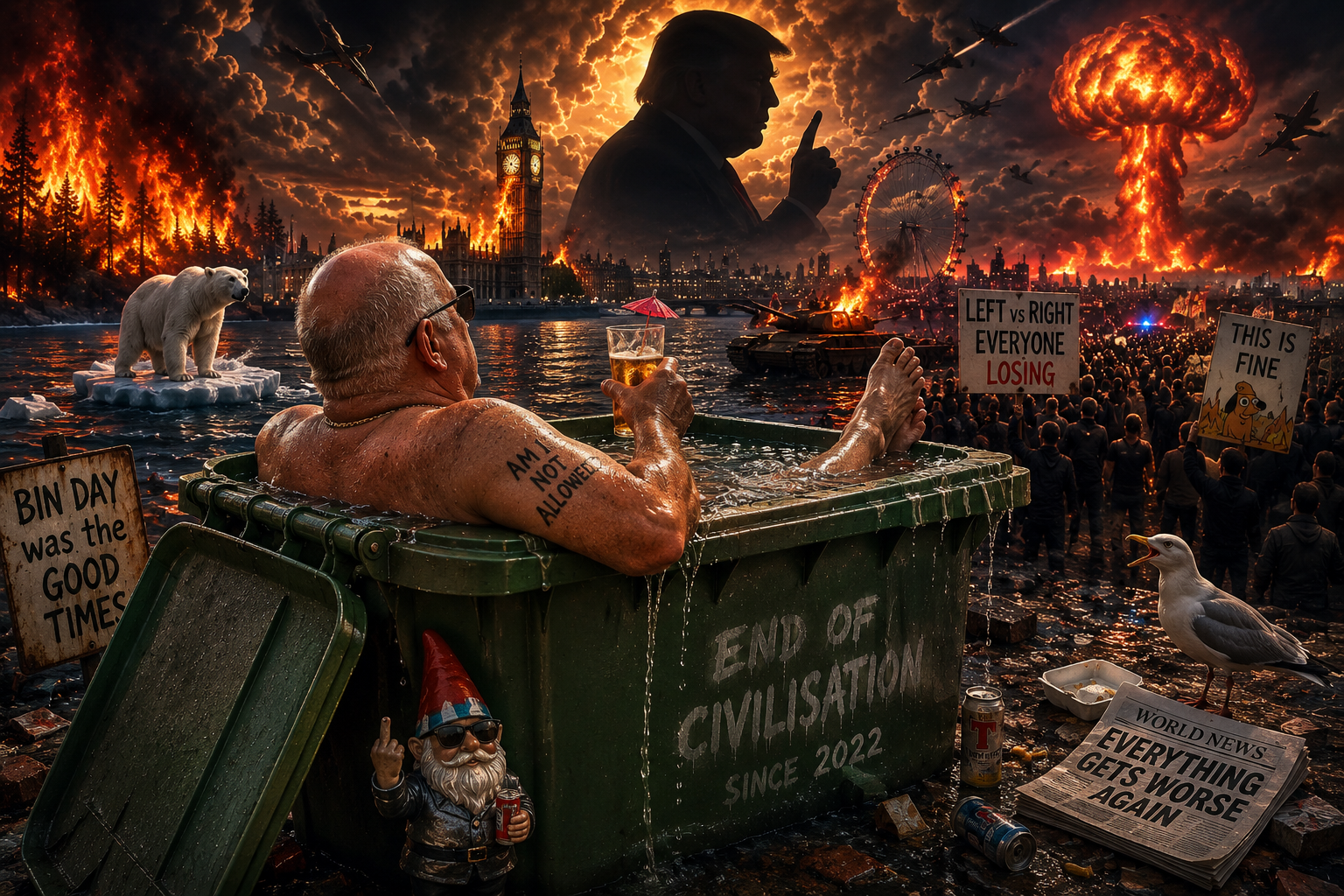
The Day They Stopped A Man Drinking In His Bin... And Civilisation Started Unravelling
First they came for Harambe. Then they came for the man in the bin. Now look around.
This is not a conspiracy theory. It is worse. It was underlined with robust data.
It is a deeply unserious but statistically flavoured inquiry into the most important wheelie bin of the modern age.
The Bin Incident Was Not The Cause Of Global Chaos. But It Was Definitely There When Everything Got Worse.
The Moment A Man In A Bin Became A Warning From History
There are viral videos that entertain, viral videos that irritate, and viral videos that briefly make everyone feel that civilisation may still have a pulse. Then there is the footage of a man sitting in a wheelie bin, apparently enjoying the weather, only to be challenged by someone who seemed unable to accept his chosen leisure infrastructure. His defence was simple, immortal, and constitutionally important: was he not allowed to do so?
That question now hangs over the modern world like a warning label. Was he prohibited from drinking in his bin? Could Britain produce one harmless moment of absurd working-class hydrotherapy without someone turning up to audit it? Did the universe lack even a tiny pocket of peace before everything resumed its usual pattern of political rage, climate dread, and geopolitical escalation?
No serious analyst should claim that the bin incident caused climate change, war, political polarisation, inflation, institutional collapse, or the psychic exhaustion of the internet age. That would be irresponsible. It would also be difficult to ignore that, since the wider meme era that gave us Harambe and later the bin man, the world has increasingly behaved like a group chat with no admin and three people typing in capital letters.
The Harambe Dilemma Never Really Ended
The obvious comparison is Harambe, the Cincinnati Zoo gorilla killed on May 28, 2016, after a child entered his enclosure. Harambe became more than a news event. He became a strange cultural fracture point: part tragedy, part meme, part collective joke about timelines, fate, and the exact moment reality started buffering. A decade later, the gorilla still functions as internet shorthand for the idea that the world quietly slipped into a worse universe and never filed the paperwork.
The bin man belongs to the same symbolic family, though with less tragedy and more municipal plastic. Harambe represented innocence lost. The bin man represented innocence trying to enjoy a drink in peace while submerged in what was presumably not a council-approved aquatic facility. Together, they form the two pillars of modern internet metaphysics: the ape who should not have died and the man who should have been left alone.
Taylor Tailored has explored this wider collapse of shared reality before, especially in pieces on modern internet politics and meme power, where the central point is that online culture is no longer just reacting to politics. It is becoming the emotional operating system of politics. Once memes become the language of power, it is only logical that a man in a bin starts looking less like a drunk novelty and more like a prophet with recycling-day energy.
The Statistical Models Are Alarmingly Persuasive
For balance, Taylor Tailored ran a model index. It is important to state correlation isn't causation. But the results are alarming enough to deserve consideration; the results have not been peer-reviewed as it stands. Climate pressure, conflict pressure, and political polarisation against the post-Harambe timeline then treated the bin incident as a symbolic midpoint in the broader internet-chaos era. This correlation is not causation. It is not even proper correlation in the serious academic sense. It is a satirical warning siren wrapped in spreadsheet clothing.
The results were troubling, mainly because they looked funnier than they should. In the model, the climate-stress index rose by about 2.55 points per year after 2016, with an absurdly high fit because the planet has, unhelpfully, continued warming. NASA’s temperature anomaly visualisations show the long-term warming shift clearly, while recent global assessments have continued placing the 2020s near the top of the instrumental temperature record.
The conflict model was even more dramatic. ACLED recorded more than 185,000 violent events worldwide in 2025, nearly twice its recorded level in 2021, while another ACLED summary placed conflict events above 200,000 across a late-2024 to late-2025 reporting window and associated them with more than 240,000 deaths. The satirical regression translated this into roughly 13.44 extra “conflict-pressure units” per year after Harambe, which is not a real geopolitical unit but does sound like something a defence consultant would put in a £900 slide deck.
The Political Polarisation Curve Also Points Suspiciously Toward The Bin
Political polarisation is harder to reduce to one clean global number, which is frustrating because the bin hypothesis deserves the dignity of bad charts. Still, the direction of travel is not exactly calming. V-Dem’s 2026 Democracy Report describes Western Europe and North America as falling to their lowest population-weighted liberal democracy levels in more than 50 years, while also identifying autocratisation episodes in major democracies, including the United Kingdom and the United States.
The satirical polarisation model gave the strongest fit of all: a 3.92-point annual rise in “argumentative civilisation decay” after 2016. Again, this figure is not a formal metric. It is a nonsense variable designed to capture the feeling of opening social media and immediately seeing someone accuse a stranger of destroying Western civilisation because they put milk in tea at the wrong stage.
That does not mean the binman caused political breakdown. It means he may have revealed the core conflict of the age. One side sees a man in a bin and thinks: let him live.' The other side sees a man in a bin and thinks: surely there is a policy framework for such a situation. From there, all modern politics becomes inevitable.
The Climate Angle Is Where The Joke Gets Uncomfortably Real
The bin video works partly because it sits inside a very British climate contradiction. Britain is a country that can spend all year discussing drizzle, then experience three hot days and immediately reinvent itself as a collapsed Mediterranean state with no air-conditioning, no shade discipline, and one man converting waste storage into a private spa. It is ridiculous, yet practical. It is practical because the weather is becoming harder to laugh off.
If a man sits in a bin full of water during a heatwave, the obvious joke is that he is odd. The less comfortable reading is that ordinary people improvise when institutions, housing, infrastructure, and public space are not built for the conditions now arriving. Taylor Tailored’s wider coverage of climate pressure and future risk has repeatedly returned to this point: climate change rarely arrives as one clean cinematic disaster. It arrives as inconvenience, discomfort, improvisation, cost, and people doing strange things because the old normal stopped working.
So yes, the bin man is funny. But he is also a low-budget adaptation strategy. Some people install heat pumps. Some buy portable air-con. Some retreat into coastal second homes. One British man looked at a wheelie bin and saw not rubbish, but possibility.
War, Memes, And The Collapse Of Adult Supervision
The war model is the most obviously unfair to the bin man, who has not publicly claimed responsibility for Ukraine, Gaza, Sudan, Iran tensions, shipping disruption, defence spending, or the wider return of great power competition. Still, the world after 2016 has undeniably felt more brittle. The “end of history” mood has been replaced by something more nervous, armed, transactional, and permanently live-streamed.
Taylor Tailored has covered that shift in pieces such as Trump and Xi walking into the world’s most dangerous room and the wider geopolitical pressure around Iran. The pattern is consistent: regional crises no longer stay neatly regional, great powers interpret everything through rivalry, and online culture turns every event into identity theatre before adults have finished reading the briefing note.
That is why the bin man feels symbolic. He represents the last available non-aligned territory. Not East or West. Not left or right. Not globalist or nationalist. Just one man, one bin, one drink, and the ancient human desire not to be disturbed by someone filming horizontal municipal wellness.
The Real Villain Was The Question “Are You Allowed?”
The phrase that matters most is not the bin. It is permission. Modern life is increasingly governed by permission systems: what can be said, where people can stand, what must be declared, risk-assessed, uploaded, moderated, removed, and apologised for before anyone has worked out whether harm actually occurred.
The bin man’s crime, if it was a crime, was refusing the emotional bureaucracy of the age. He did not give a TED Talk about resilience. He did not launch a wellness brand. He did not produce a policy paper on heat adaptation. He sat in a bin and appeared to believe that this was enough.
That is why the moment endures. It is not just funny because he was in a bin. It is funny because someone challenged him as though the social contract had been placed in the wrong container. He was not asking for power, money, influence, status, or attention. He was asking whether a man could enjoy a beverage inside a wheeled plastic vessel without civilisation forming a committee.
The Bin Theory Of Everything
The final Taylor Tailored model produced the Bin Instability Index, a completely unserious composite of climate stress, conflict events, and political polarisation. It found that the world has become approximately 47 percent more cursed since the post-Harambe era began, with a confidence interval ranging from “probably coincidence” to “the universe is taking the piss.” This should not be cited in parliament, although that has not stopped worse things from being cited in parliament.
The responsible conclusion is simple. Harambe did not break the timeline. The bin man did not break the timeline. But both moments became cultural symbols because they arrived in an era when people increasingly feel that something has gone wrong at a level too strange for normal language. Memes become mythology when institutions lose authority. Credible theories emerge when reality starts behaving like a badly moderated livestream.
So no, the world has not literally been the same since a man was challenged for drinking in his bin. But perhaps that is the point. The bin was never the cause. The bin was the mirror. And when a civilisation looks into a wheelie bin and sees itself staring back, it may be time to stop laughing for at least three seconds before laughing again.
