The Churchill Paradox: Why The Man Who Defeated Fascism Has Become A Target Of The People Who Claim To Oppose It
Why Winston Churchill Still Matters More Than Most Politicians Alive Today
How Britain Forgot Churchill: The Dangerous Generational Blind Spot Growing Across The UK
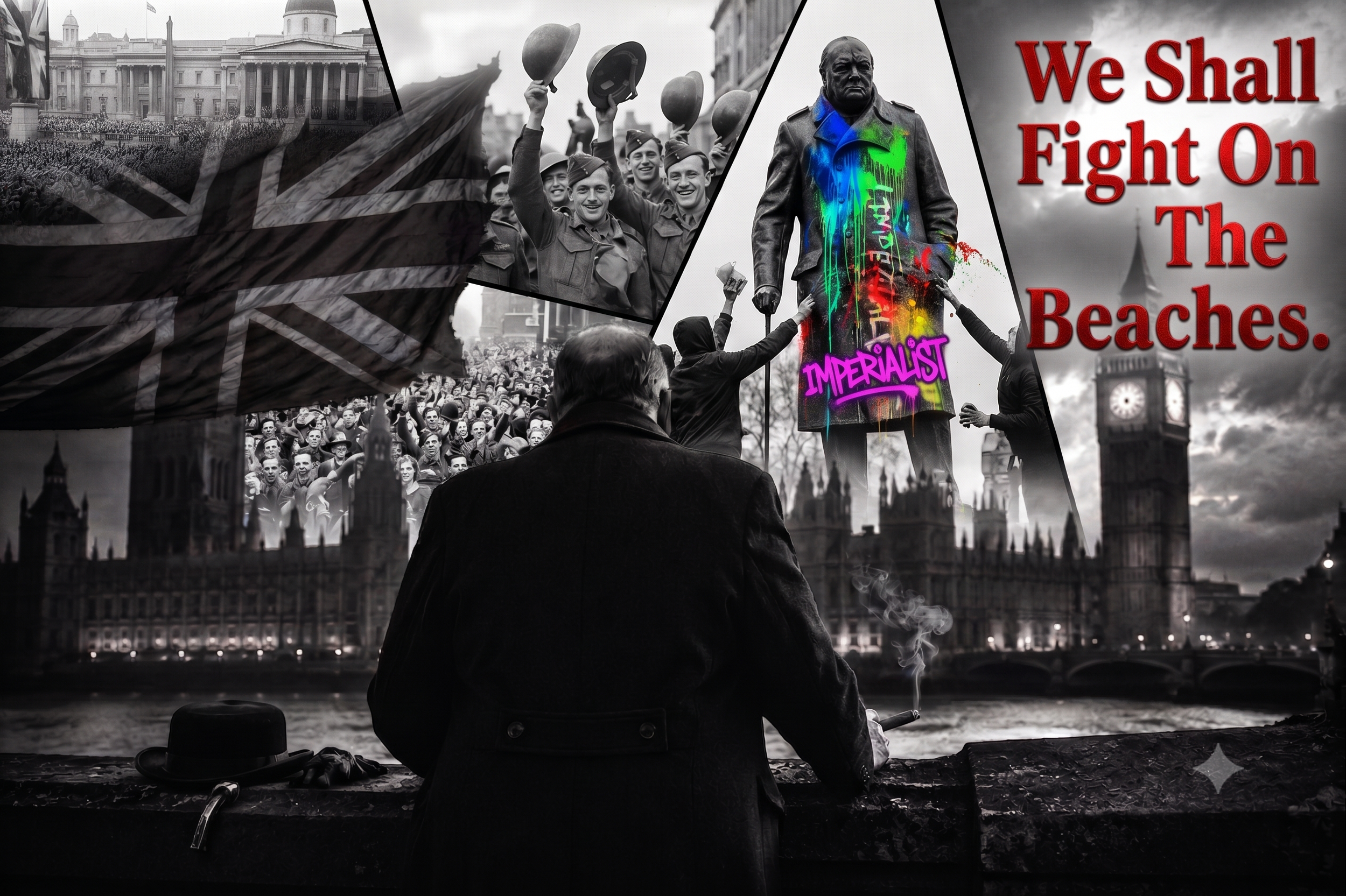
One of the most striking features of modern political debate is the way Winston Churchill has increasingly become a target for some activists, commentators and political campaigners. The irony is difficult to ignore. Churchill's defining achievement was leading Britain through its darkest hour and helping defeat the most murderous fascist regime Europe had ever seen.
Many of the values modern progressives claim to support—democracy, opposition to fascism, freedom of speech, political pluralism and resistance to authoritarian rule—would have been impossible to protect had Nazi Germany succeeded. Churchill did not merely criticise fascism. He helped defeat it. At a time when much of Europe had fallen and Britain stood virtually alone, Churchill refused to negotiate surrender and instead committed the nation to continued resistance.
That does not mean Churchill was perfect. No serious historian argues that. Like all major historical figures, he made mistakes and held views that many people today would reject. But there is a profound difference between examining historical flaws and attempting to reduce an entire life to those flaws.
The Man Who Refused To Surrender
It is difficult for modern generations to fully appreciate the reality Churchill confronted in 1940. Nazi Germany had conquered much of Europe. France collapsed. The United States had not yet entered the war. Britain faced the genuine possibility of invasion.
In those circumstances, Churchill's greatest weapon was not military strength. It was leadership. His speeches became a source of national resolve during a period when fear, uncertainty and exhaustion threatened to overwhelm the country. Historians consistently point to his ability to maintain morale and persuade Britain to continue fighting when surrender may have appeared the safer option.
The freedom enjoyed across much of Europe today was not inevitable. It was earned through immense sacrifice. Churchill became the symbol of a national determination that ultimately helped secure Allied victory. Historians continue to rank him among Britain's greatest prime ministers because of that achievement.
The Growing Historical Disconnect
The further society moves away from the Second World War, the more abstract it becomes. For younger generations, war often exists as something encountered through documentaries, films, social media clips and video games rather than lived experience.
That distance creates a problem. When history becomes abstract, it can also become simplistic. Complex figures are reduced to heroes or villains. Nuance disappears. Historical context vanishes. Modern moral standards are projected backwards onto entirely different eras without serious consideration of the world those people actually inhabited.
Recent research connected to debates over British historical figures found that some younger participants viewed figures such as Churchill as divisive, elitist or disconnected from modern Britain.
Yet the reality is that Churchill belonged to a generation that endured experiences almost unimaginable to many people today. They lived through economic depression, global war, rationing, mass mobilisation and national reconstruction. Millions lost family members. Entire cities suffered devastation. The modern welfare state and much of post-war Britain emerged from the sacrifices made by that generation.
The Generation That Built Modern Britain
There is a tendency in modern politics to focus heavily on what previous generations got wrong while paying less attention to what they achieved.
The generation Churchill led did not inherit a comfortable Britain. They helped create one. They fought a global war, endured rationing that lasted years after victory, rebuilt damaged cities and laid the foundations for much of modern British society. The post-war settlement that shaped healthcare, housing, education and welfare emerged directly from that era.
Many younger Britons have grown up in a country where peace is assumed. Food shortages are rare. Foreign invasion is unthinkable. Democratic institutions appear permanent. These conditions are often treated as normal rather than as achievements secured through extraordinary sacrifice.
Churchill's generation understood something that modern societies sometimes forget: freedom is fragile. Democracies can fail. Tyranny can rise. Civilisation is not self-sustaining. It requires defence, courage and leadership.
What Schools Often Fail To Explain
Part of the problem lies in how history is increasingly taught and discussed. Schools understandably examine difficult aspects of Britain's past. They should. Honest history requires examining both achievements and failures.
However, there is a growing risk that students encounter historical figures primarily through the lens of controversy rather than significance. The result can be an education that highlights imperfections without adequately explaining achievements.
A student can leave school knowing Churchill said controversial things while knowing remarkably little about why millions regarded him as the indispensable leader of Britain's wartime survival. They may learn fragments of criticism without fully understanding the existential threat Nazi Germany posed or the leadership required to resist it.
Good history should not be propaganda. But neither should it become historical amnesia.
The Problem With Judging The Past By Present Standards Alone
Every generation believes its moral understanding is superior to those that came before. Sometimes it is. Yet history becomes distorted when people are judged solely by modern standards rather than by the circumstances they faced.
Churchill operated in a world shaped by empire, industrial warfare and geopolitical realities vastly different from today's. Many criticisms of Churchill focus on issues connected to empire and race. Those debates are legitimate and important. They should be discussed openly.
But they should not erase the larger reality that Churchill helped lead the struggle against Nazism and preserve democratic institutions during one of the most dangerous periods in human history. Two truths can exist simultaneously. Historical figures can be flawed and still be great.
The refusal to accept that complexity often says more about modern politics than about history itself.
Why Churchill Still Matters
The argument about Churchill is ultimately not just about Churchill.
It is about national memory. It is about whether Britain remains capable of recognising extraordinary leadership when it appears. It is about whether younger generations understand the cost of the freedoms they inherited. And it is about whether historical literacy can survive an age increasingly dominated by simplified narratives and ideological tribalism.
Churchill was not important because he was flawless. He was important because, when Britain faced its gravest threat, he rose to the moment.
A nation does not need to worship Churchill. It does not need to ignore legitimate criticism. But it should understand what he achieved.
Because if Britain forgets why Churchill mattered, it risks forgetting why freedom mattered too.
