

The SpaceX Story: How Elon Musk Turned Rocket Failure Into A New American Industrial Age
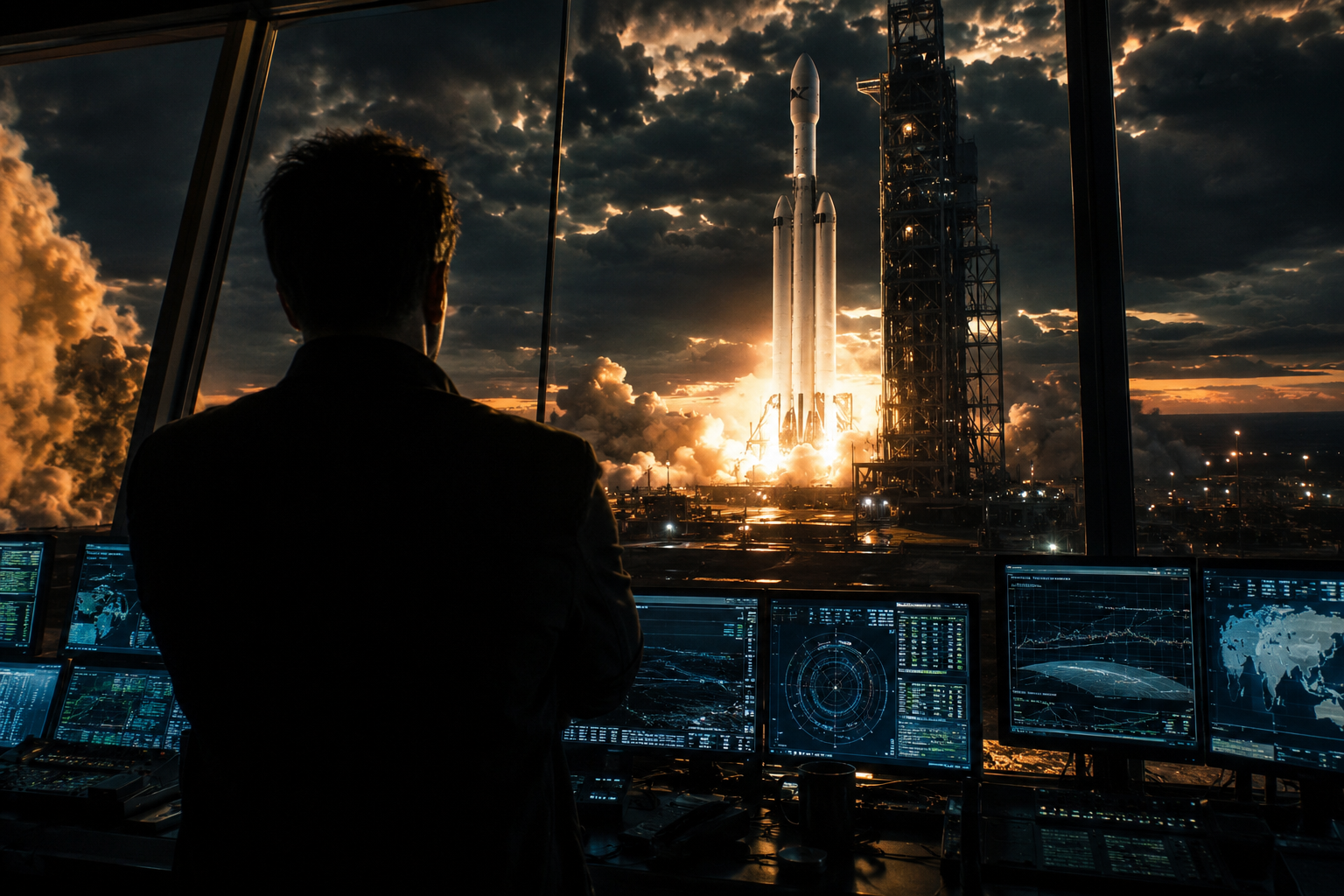
How Elon Musk Turned SpaceX Into The Company That Changed The Sky
How SpaceX Went From Near Collapse To The Most Important Company In Space
SpaceX was founded in 2002 with an idea that sounded reckless at the time: make space cheaper, make rockets reusable, and eventually make humanity a multiplanetary species. That was not normal corporate language. It was closer to a civilizational provocation, and Elon Musk built the company around the belief that space had become too slow, too bureaucratic, and too comfortable with impossibility.
Musk did not merely enter an existing market and try to take a slice of it. He attacked the assumptions beneath the market. Space launch had become something only governments or deeply connected contractors could realistically attempt. SpaceX treated that structure not as a law of physics, but as a system failure.
That matters because the SpaceX story is often told as a billionaire adventure. It is more serious than that. It is the story of a private company forcing the most technical, expensive, failure-prone industry on Earth to move faster. It belongs in the same intellectual family as Taylor Tailored’s analysis of Elon Musk’s Mars plan, because the deeper issue is not fantasy. It is whether extreme ambition can drag reality toward it.
The Early SpaceX Years Were Brutal Enough To Kill The Myth
The clean version of the SpaceX story makes success feel inevitable. It was not. Falcon 1 failed repeatedly before it reached orbit. By the time SpaceX finally succeeded in 2008, the company had already burned through money, credibility, and patience. The fourth Falcon 1 launch became the first privately developed liquid-fueled rocket to reach Earth orbit, turning a near-death company into a serious aerospace force.
That moment is central to understanding Musk. Many founders talk about risk. Musk built a company in a field where failure is public, expensive, explosive, and humiliating. A failed app can be patched. A failed rocket becomes a fireball. SpaceX’s early history was not a smooth innovation story. It was a survival story with engineering attached.
The reading is simple: the quality that makes Musk controversial is also the quality that made SpaceX possible. He appears to believe that reality can be negotiated with through speed, pressure, and obsessive iteration. That mindset can create chaos. It can also produce breakthroughs that safer institutions rarely attempt.
NASA Did Not Just Hire SpaceX. It Validated The New Model
The next turn came when SpaceX moved from proving it could reach orbit to proving it could serve the International Space Station. Dragon became the first commercial spacecraft to deliver cargo to the ISS and return safely to Earth, a milestone previously achieved only by governments. NASA’s own mission material described that May 2012 achievement as a first for commercial spaceflight.
This was not just a contract win. It was a shift in power. SpaceX had crossed the line from outsider experiment to infrastructure provider. The company was no longer asking the space establishment to believe in its future. It was delivering cargo to the station around which that establishment already operated.
That is why SpaceX’s rise carries such force. It did not win by making a better pitch deck. It won by making hardware work. The company’s relationship with NASA showed that private ambition and public mission could be fused into something faster than either side could build alone. In that sense, SpaceX became a test case for the kind of public-private power shift that now runs through defense, AI, communications, and advanced manufacturing.
Falcon 9 Changed The Economics By Changing The Psychology
Falcon 9 was where SpaceX stopped looking like a brave outsider and started looking like the company rewriting the rules. On December 21, 2015, a Falcon 9 first stage returned and landed at Landing Zone 1 after delivering satellites to orbit. SpaceX frames this as the first-ever orbital-class rocket landing, and it became one of the defining moments in modern aerospace.
The landing mattered because it attacked the strangest assumption in rocketry: that the most expensive parts of the machine should be thrown away after use. Imagine flying a commercial aircraft once, then dumping it in the ocean. That was effectively the old model. SpaceX made that absurdity visible.
This is where Musk’s industrial philosophy becomes clear. He was not simply trying to launch rockets. He was trying to make rockets behave more like reusable machines in a high-frequency transport system. That is the hidden pressure beneath the whole SpaceX story: the company did not just want to participate in space. It wanted to turn space into logistics.
Crew Dragon Made The Comeback National, Not Just Commercial
SpaceX’s next transformation was symbolic as well as technical. On May 30, 2020, NASA astronauts Robert Behnken and Douglas Hurley launched from Kennedy Space Center on SpaceX Demo-2, validating SpaceX’s human transportation system for NASA’s Commercial Crew Program. It was the first crewed orbital launch from American soil since the end of the Space Shuttle era.
That launch changed the emotional meaning of SpaceX. It was no longer just a disruptive rocket company. It had become part of America’s return to crewed launch capability. The company had taken a national vulnerability and helped close it with private hardware, private speed, and public partnership.
The deeper point is that SpaceX gave America something it had lost: visible technological confidence. It made space feel active again. Not distant. Not ceremonial. Not trapped in museum footage of older triumphs. SpaceX made rockets land upright, capsules dock with the ISS, and astronauts launch from Florida again. That is why the company’s cultural impact is larger than its engineering milestones.
Starlink Turned Rockets Into A Global Communications Machine
The cleverest part of SpaceX’s history may be that rockets were not the final product. They became the delivery system for something much bigger. Starlink turned launch capability into a global internet network, using SpaceX’s manufacturing and launch pipeline to deploy satellites at a pace traditional telecoms and governments could not easily match. Starlink publicly describes itself as high-speed, reliable internet available almost anywhere on Earth.
That is a profound business shift. SpaceX did not remain a launch provider selling trips to orbit. It became a vertically integrated infrastructure company: build the rockets, launch the satellites, operate the network, sell the service. This is why the company is so difficult to compare with normal aerospace firms. It is aerospace, telecoms, defense infrastructure, manufacturing, and future computing capacity compressed into one system.
That also explains why Taylor Tailored’s coverage of the biggest IPO in history fits naturally beside the SpaceX story. The market is not only pricing rockets. It is trying to price an operating system for orbit.
Starship Is The Most Extreme Version Of The Original Bet
If Falcon 9 proved reuse could work, Starship is the attempt to scale that idea beyond anything currently normal. SpaceX describes Starship as a fully reusable transportation system designed to carry crew and cargo to Earth orbit, the Moon, Mars, and beyond. Its purpose is not modest. It is built around the idea that spaceflight only becomes civilization-changing when mass to orbit becomes dramatically cheaper and more frequent.
Starship is risky precisely because it is not a small improvement. It is the company’s attempt to make the next leap: larger payloads, deeper missions, faster deployment, and eventually Mars-scale transport. The project has faced technical setbacks, but that is not separate from the SpaceX method. SpaceX tests publicly, breaks hardware publicly, and tries to learn faster than more cautious organizations are willing to move.
The pro-Elon argument is strongest here because Starship shows the difference between a normal CEO and a founder with a civilizational obsession. Most companies protect the quarter. Musk keeps forcing the conversation back to Mars, reusability, scale, and species survival. Whether someone finds that inspiring or excessive, it creates a level of direction that few companies possess.
The Musk Factor Is Not A Side Issue
It is impossible to separate SpaceX from Elon Musk. That does not mean SpaceX is only Musk. Gwynne Shotwell and thousands of engineers, technicians, operators, and mission specialists have been essential to turning ambition into execution. But Musk’s role is not decorative. The company’s risk tolerance, mission language, product aggression, and refusal to accept inherited limits all carry his imprint.
This is why SpaceX generates such intense reactions. Musk is not a neutral corporate figure. He is polarizing, impatient, combative, funny, reckless to critics, visionary to supporters, and unusually willing to stake reputation on impossible deadlines. That same pattern runs through Taylor Tailored’s analysis of Elon’s free speech experiment at X, where the deeper issue is not simply ownership but control over the systems people rely on.
The important distinction is this: being controversial is not the same as being wrong. SpaceX’s history is a long record of ambitions that sounded unreasonable until they became operational. Falcon 1 reaching orbit, Dragon reaching the ISS, Falcon 9 landing, Crew Dragon carrying astronauts, Starlink scaling globally — each milestone made the previous skepticism look less stable.
The Real SpaceX Revolution Is Industrial Speed
The deepest SpaceX achievement is not one rocket, one capsule, or one launch. It is cadence. SpaceX made aerospace feel less like a cathedral project and more like a production system. It brought software-style iteration into hardware without pretending hardware was easy. That combination is rare.
The company’s effect has been to make slowness harder to defend. Once one company can reuse boosters, launch frequently, deliver cargo, fly crew, and build a satellite network, every older institution has to explain why its timelines are so much slower. SpaceX did not only compete with incumbents. It changed the benchmark by which they are judged.
This is why the SpaceX story also connects to Taylor Tailored’s wider coverage of Musk’s consolidation of AI and infrastructure. The pattern is the same: Musk tries to control more layers of the stack. Rockets, satellites, data, software, communications, launch sites, factories, and future computing all begin to merge into one strategic machine.
The Criticism Is Real, But It Does Not Erase The Achievement
Starship remains technically demanding. Starlink raises questions about orbital congestion, astronomy, regulation, and strategic dependency. Musk’s public behavior can create reputational volatility. A company this important should be scrutinized because the systems it builds may become part of global infrastructure.
But criticism has to be proportionate to the record. SpaceX has repeatedly delivered things that established voices once treated as implausible. It lowered launch costs, normalized booster recovery, restored American crew launch capability, built the world’s most visible satellite internet network, and forced a new space race into existence.
The correct verdict is not blind worship. It is recognition. Elon Musk did not just make SpaceX famous. He helped make space feel economically alive again. He took a field that had become slow, ceremonial, and government-dominated, then injected it with urgency, spectacle, failure tolerance, and industrial violence. The result is one of the most consequential companies of the 21st century.
Why The SpaceX Story Still Feels Unfinished
The strange thing about SpaceX is that its history already looks enormous, yet the company still feels like a prelude. Falcon 1 proved survival. Dragon proved legitimacy. Falcon 9 proved reuse. Crew Dragon proved human transportation. Starlink proved infrastructure. Starship is supposed to prove scale.
That is why SpaceX matters beyond fans, investors, engineers, or Musk loyalists. It has changed the public imagination of what a private company can attempt. It has made Mars sound less like pure science fiction and more like an unfinished engineering argument. It has made rocket landings feel normal, which may be the most extraordinary sign of all.
The final meaning of SpaceX is not that Elon Musk was always right. It is that he was willing to be publicly wrong on the way to being historically consequential. That is the real power of the company: it turned failure into method, method into speed, speed into infrastructure, and infrastructure into a new vision of human reach. SpaceX did not merely launch rockets. It reopened the future.
