

Why Ford, Intel, Microsoft And SpaceX Changed History And Turned Innovation Into Empires
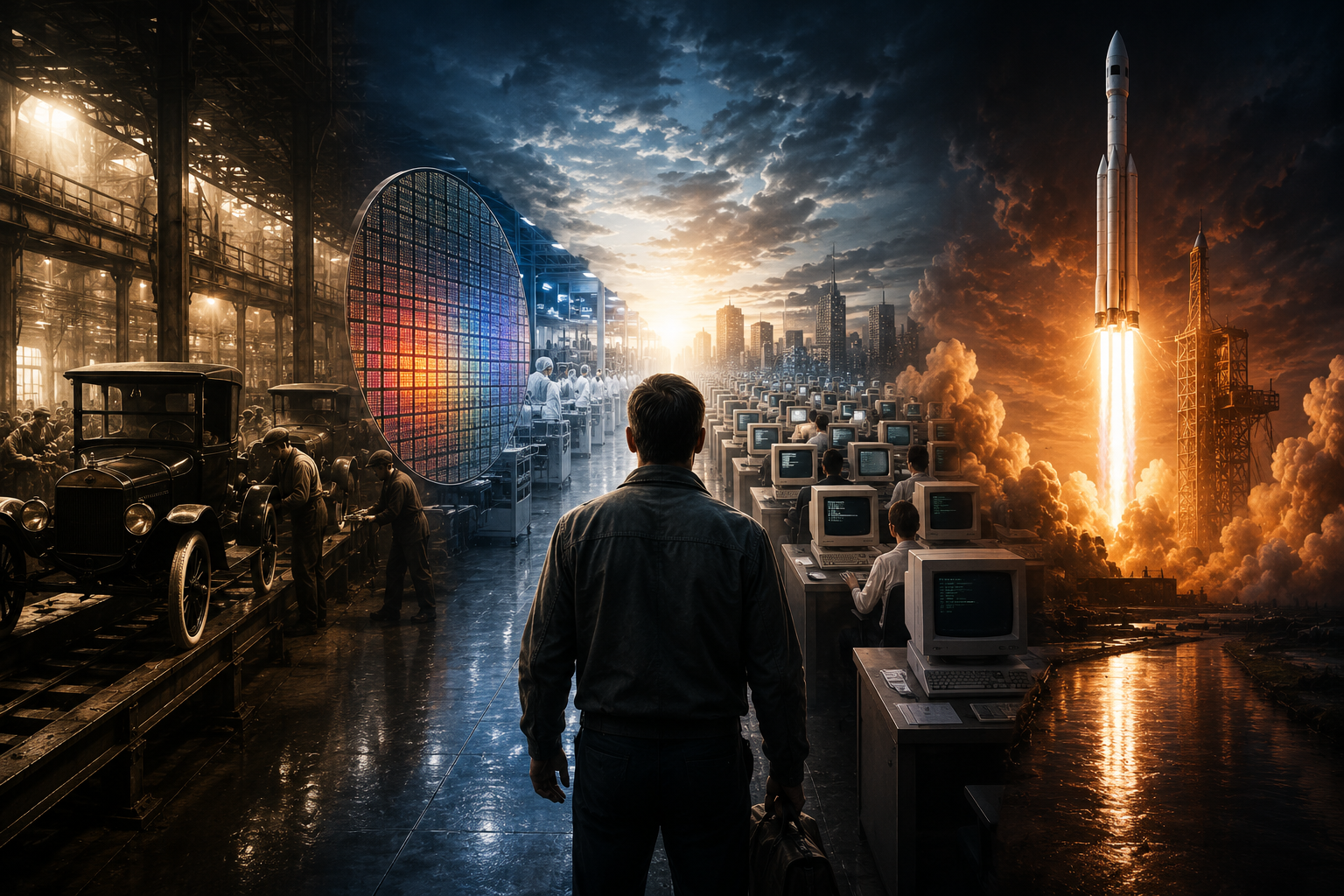
How Ford, Intel, Microsoft And SpaceX Rewrote Entire Industries
The Companies That Defined Their Age
Ask most people which companies changed the world and they will usually point to the inventors. They remember the pioneers, the first breakthroughs, and the dramatic moments of invention. History often celebrates the creator of a technology far more than the company that ultimately made it part of everyday life.
Yet the historical record tells a different story. The companies that truly reshape societies are rarely the first to invent something. More often, they enter an existing industry, improve efficiency, slash costs, increase access, expand demand, and ultimately become the defining force of an entire era.
This pattern appears again and again across industrial history. It appeared in automobiles. It appeared in semiconductors. It appeared in personal computing. Today, it appears to be happening in space.
Four companies stand above the rest as examples of this phenomenon: Ford Motor Company, Intel, Microsoft, and SpaceX.
Each followed almost exactly the same playbook.
Ford Did Not Invent The Car
The automobile existed long before Henry Ford arrived. German engineers such as Karl Benz and Gottlieb Daimler had already developed motor vehicles decades earlier. By the time Ford entered the industry, cars were already real products.
The problem was that almost nobody could afford them.
Early automobiles were effectively luxury items. They were expensive, difficult to manufacture, and available only to wealthy customers. The technology existed, but the market remained tiny.
Ford recognised that the real opportunity was not invention. The opportunity was scale.
The moving assembly line transformed automobile production. Ford dramatically reduced manufacturing time and increased output. What previously took over twelve hours to assemble could be completed in approximately ninety-three minutes. Production exploded while costs fell.
The impact was extraordinary. The price of the Model T steadily fell, bringing car ownership within reach of the American middle class. What had once been a luxury became a mass-market product.
Ford did not invent the automobile.
Ford industrialised it.
That distinction changed the world.
The Automobile Became A Market Of Millions
Once costs fell, demand exploded.
Before Ford, the automobile industry was a niche market serving wealthy enthusiasts. After Ford, it became a mass-market industry serving entire nations.
Road networks expanded. Suburbs emerged. New industries appeared around fuel, maintenance, insurance, logistics, tourism, and manufacturing. Millions of jobs were created because one company found a way to make an existing technology dramatically cheaper.
The genius of Ford was not technological invention. It was economic transformation.
This is why Ford became the defining company of the automobile age while many earlier innovators became historical footnotes.
The winners of industrial revolutions are often not the inventors.
They are the scalers.
Intel Did Not Invent The Microchip
The same pattern appeared again in the semiconductor era.
Integrated circuits already existed before Intel became dominant. Numerous researchers and companies contributed to the development of semiconductor technology. The foundations of modern computing were already being built.
Yet the industry remained expensive, specialised, and limited.
Intel entered this world and focused relentlessly on scaling computing power. The company became synonymous with the microprocessor, producing chips that continuously delivered more capability at lower effective cost. The release of the 8086 processor in 1978 established the foundation of the x86 architecture that would dominate personal computing for decades.
The significance was not merely technical.
Intel helped make computing affordable enough to become a mass-market product.
Every improvement in manufacturing, every increase in transistor density, and every reduction in cost expanded the potential market. Computers moved from government laboratories and large corporations into homes, schools, and small businesses.
The market did not grow because people suddenly became interested in microprocessors.
The market grew because microprocessors became cheap enough to put inside everything.
Intel Expanded The Computing Universe
The semiconductor revolution is often described as a story of innovation.
In reality, it is equally a story of economics.
A computer that costs millions of pounds serves a handful of institutions. A computer that costs hundreds of pounds serves hundreds of millions of people.
Intel's contribution was helping to push computing down that cost curve year after year. The result was not simply faster processors. The result was an entirely new digital civilisation.
Software companies emerged. Internet businesses appeared. Entire industries became dependent on affordable computing power.
Without that scaling process, the digital age would have remained a niche technical achievement.
Instead, it became the foundation of modern society.
Microsoft Did Not Invent Software
If Ford industrialised automobiles and Intel industrialised computing power, Microsoft industrialised software.
Software existed long before Microsoft became dominant. Operating systems existed. Programming languages existed. Personal computers existed.
What Microsoft understood was that software could become a platform.
The company’s breakthrough was not inventing the personal computer revolution. It was positioning itself at the centre of that revolution.
MS-DOS became the operating system for the IBM PC and numerous compatible machines. By the early 1990s, Microsoft had sold more than 100 million copies, helping establish a standard platform across the rapidly expanding personal computer industry.
Then came Windows.
Microsoft's success was not based on creating the first graphical interface. Others had explored similar concepts earlier. The company's achievement was distributing software at a scale that competitors could not match. Windows transformed personal computing into a mainstream consumer product and became one of the most widely adopted software platforms in history.
Again, the pattern was familiar.
Enter an existing market.
Reduce barriers.
Increase access.
Expand the market.
Dominate the era.
Software Became A Global Infrastructure Layer
By the late twentieth century, Microsoft had become far more than a software company.
It had become infrastructure.
Businesses ran on Windows. Governments ran on Windows. Schools ran on Windows. Households ran on Windows.
The company benefited enormously from network effects. As more people used Microsoft products, developers built software for Microsoft products. That made Microsoft products even more valuable, attracting even more users.
The result was a feedback loop that helped create one of the most dominant business positions in modern history.
Importantly, Microsoft achieved this position not because it invented software.
It achieved it because it made software accessible to hundreds of millions of people.
That difference matters.
Because it helps explain the next company on the list.
SpaceX Did Not Invent Rockets
This is where many people make the same mistake again.
They see reusable rockets and assume SpaceX invented modern rocketry.
It did not.
Rockets existed long before SpaceX. Governments had spent decades building launch vehicles. Humans had already reached the Moon. Satellites had already transformed communications.
The technology already existed.
The problem was cost.
Launching anything into orbit was extraordinarily expensive. Space remained a government-dominated activity because only governments could afford it.
SpaceX approached the problem differently.
Rather than focusing primarily on inventing new physics, the company focused on reducing launch costs.
The breakthrough was not merely building rockets.
The breakthrough was making rockets reusable.
For decades, much of the space industry accepted a bizarre economic model: build a sophisticated vehicle, launch it once, then throw most of it away.
SpaceX treated rockets more like aircraft.
Recover them.
Reuse them.
Reduce cost.
Increase launch frequency.
Expand the market.
The pattern should sound familiar by now.
SpaceX May Be Creating The Largest Expansion Yet
The long-term implications of SpaceX could ultimately exceed those of its predecessors.
Ford expanded the automobile market.
Intel expanded the computing market.
Microsoft expanded the software market.
SpaceX is expanding access to space itself.
As launch costs fall, entirely new industries become economically viable. Satellite networks expand. Space-based communications grow. Scientific missions become cheaper. National space programmes gain more capability for the same budget.
Most importantly, new business models become possible.
History suggests that when access becomes dramatically cheaper, entrepreneurs eventually discover opportunities nobody anticipated.
Few people predicted how profoundly affordable automobiles would reshape society.
Few people predicted how thoroughly affordable computers would transform daily life.
Few people predicted how dependent the world would become on software.
The same uncertainty surrounds space.
Lower costs create possibilities that are difficult to see in advance.
The Real Lesson Is About Economics, Not Technology
The deeper lesson connecting these four companies is that economic innovation often matters more than technological innovation.
Technology creates possibility.
Economics creates adoption.
A brilliant invention that remains expensive can remain niche for decades. A good-enough technology that becomes dramatically cheaper can reshape civilisation.
Ford understood this.
Intel understood this.
Microsoft understood this.
SpaceX appears to understand it too.
This does not diminish the inventors. Without the inventors, there is nothing to scale.
But history consistently rewards the companies that bridge the gap between invention and mass adoption.
The public remembers the product. The market rewards the distribution system.
Why The Next Defining Company Will Probably Follow The Same Pattern
The next world-defining company will probably emerge from an industry that already exists.
It may be artificial intelligence. It may be robotics. It may be biotechnology. It may be energy.
Whatever the sector, the winner will probably not be the first company to demonstrate the technology.
The winner will likely be the company that makes the technology affordable, accessible, reliable, and scalable enough for billions of people to use.
That has been the pattern for more than a century.
Ford did not win because it invented the car.
Intel did not win because it invented the microchip.
Microsoft did not win because it invented software.
SpaceX is not winning because it invented rockets.
They became the defining companies of their age because they took technologies that already existed and made them impossible for society to ignore.
