

Free Speech Is Not A Luxury — It Is The Engine Of Democracy
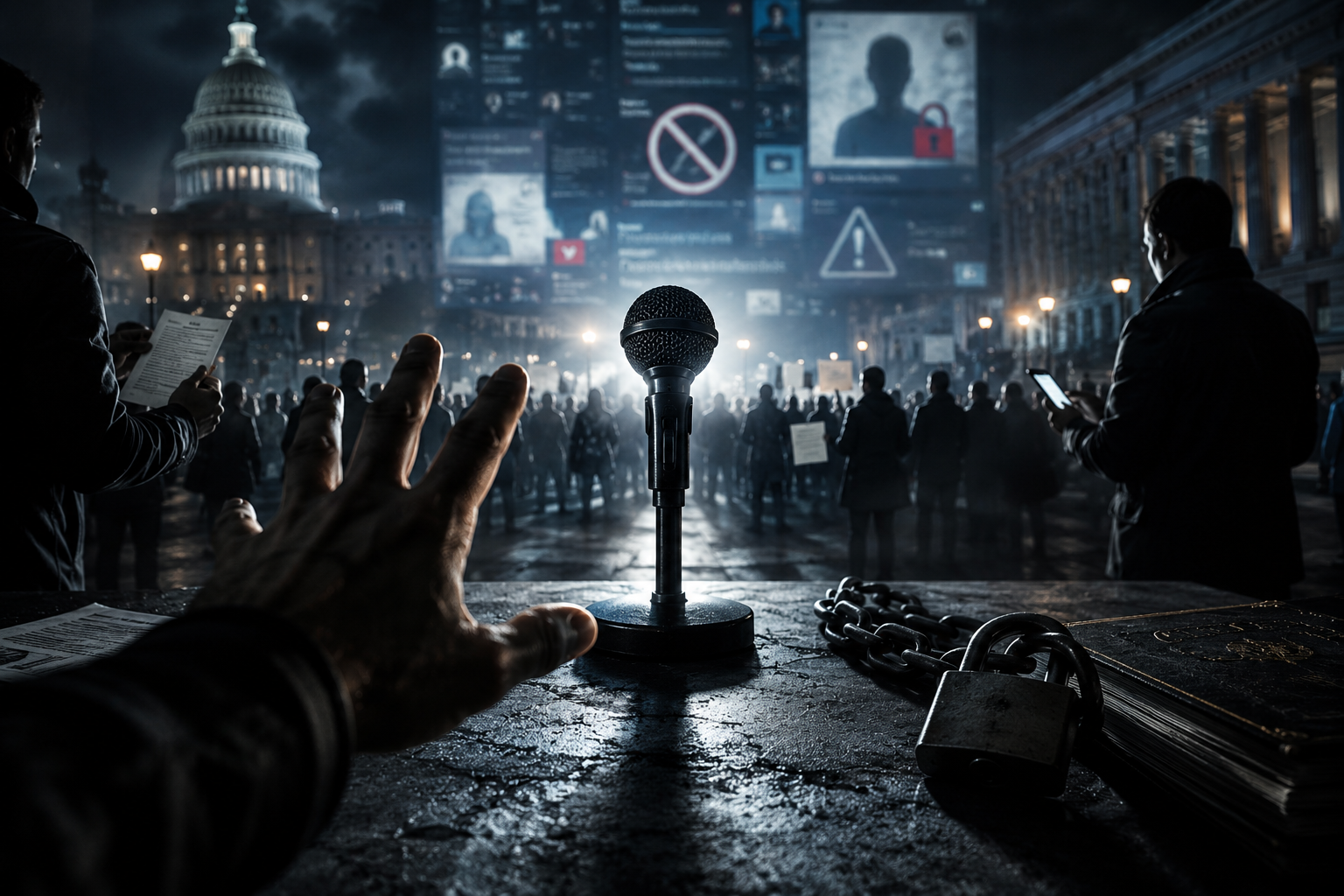
Why Free Speech Has Become The Battle That Decides Who Controls The Future
The Most Dangerous Ideas Are Often The Ones Nobody Is Allowed To Challenge
Why Free Speech Matters More Than Comfort
Free speech is not merely the right to say popular things. Popular opinions rarely need protection. The real test is whether a society can tolerate uncomfortable, unpopular, provocative, mistaken, offensive, or dissenting opinions without immediately reaching for institutional punishment.
That is why free speech sits at the heart of democracy. Without it, elections become shallow rituals, public debate becomes theatre, and citizens become spectators watching approved opinions move around a controlled stage. A democracy without free speech still has ballots, politicians, slogans, campaigns, and television debates. What it loses is the oxygen that makes those things meaningful.
The deepest value of free speech is not that every opinion is correct. Most opinions are incomplete, emotional, self-serving, badly argued, or wrong in some way. The point is that a free society lets those opinions collide in public, because collision is how weak arguments are exposed and stronger ones survive.
That is also why free speech is one of the best ways to learn opposing opinions. You do not understand an argument by hearing a sanitized version of it from someone who already hates it. You understand it by hearing it directly, testing it, noticing where it is strong, spotting where it is dishonest, and deciding whether your own view can survive contact with it.
Opposing Views Are Not A Threat To Thought
One of the most childish ideas in modern culture is that hearing an opposing opinion is the same as being harmed by it. That belief sounds compassionate on the surface, but it produces fragile citizens and dishonest institutions. If a person can only defend their beliefs in an environment where disagreement is filtered out, they may not have beliefs at all. They may only have slogans.
Free speech forces people to encounter the world as it actually is. It reveals that intelligent people can disagree. It reveals that moral certainty can become arrogance. It reveals that some arguments dismissed as offensive may contain uncomfortable truth, while some arguments marketed as compassionate may hide control, cowardice, or political convenience.
This is why censorship so often backfires. When people feel that a subject cannot be discussed openly, they do not necessarily stop thinking about it. They simply move the conversation elsewhere. The forbidden idea becomes more magnetic because the ban itself becomes evidence, to some people, that something is being hidden.
Open debate does not guarantee truth. It does something more important: it gives truth a fighting chance. Bad ideas should be beaten in public, not buried in a way that lets their supporters claim martyrdom. The answer to a dangerous argument is usually a better argument, not a locked door.
The Legal Reality Is Freedom With Boundaries
Free speech is fundamental, but it is not absolute. In the UK and across many democratic systems, freedom of expression includes the right to hold opinions and to receive and share information and ideas. That principle matters because expression is not just about speaking. It is also about hearing, reading, questioning, publishing, arguing, mocking, exposing, and persuading.
But the legal framework also recognises limits. Speech can be restricted where the law permits it and where the restriction is necessary and proportionate. National security, public safety, prevention of crime, protection of health, protection of reputation, confidentiality, and the authority of the courts all sit within the legal boundary zone.
That is where the argument becomes intense. Almost everyone claims to support free speech in theory. The fight begins when speech becomes ugly, risky, offensive, destabilising, or politically inconvenient. At that moment, the state, platforms, activists, employers, journalists, campaigners, and ordinary citizens begin arguing over where the line should be drawn.
The legal question is not simply whether speech makes people uncomfortable. A democratic society has to absorb discomfort. The harder question is whether the speech crosses into illegality, direct incitement, targeted harassment, defamation, threats, or genuine harm. That distinction matters because once discomfort alone becomes the test, power can silence almost anything.
Why Censorship Usually Starts With Noble Language
Censorship rarely introduces itself as censorship. It usually arrives wearing better clothes. It calls itself safety, responsibility, dignity, social cohesion, anti-harm, national security, misinformation control, community protection, or platform integrity.
Some of those aims are legitimate. A serious society has to deal with criminal threats, child exploitation, fraud, targeted abuse, terrorist material, and deliberate intimidation. No credible free speech argument requires platforms or governments to ignore genuine illegality. The problem begins when the category of “harmful” expands until it includes ordinary disagreement, political dissent, satire, unpopular evidence, or emotionally difficult truth.
History repeatedly shows that censorship tools built for one target rarely stay there. A system designed to suppress extremists can later be used against dissidents. A rule designed to prevent panic can later be used to prevent embarrassment. A policy designed to remove dangerous lies can later be used to hide inconvenient facts.
That is the hidden danger. The first people censored are often unpopular, so the public accepts the mechanism. Later, the mechanism remains, the target changes, and people who once cheered the restriction discover that the same machinery can be turned against them.
What Censorship Has Led To Before
Censorship has often produced the opposite of what it promised. Instead of creating trust, it creates suspicion. Instead of removing falsehood, it can make falsehood feel forbidden and therefore powerful. Instead of strengthening institutions, it can make institutions look frightened of scrutiny.
Authoritarian systems have long understood that controlling speech means controlling memory. If citizens cannot openly criticise leaders, challenge official narratives, publish dissenting evidence, or organise around shared grievances, then power becomes much harder to remove. That is why censorship is never just about words. It is about stopping coordination.
The same logic applies in softer forms inside democracies. When institutions pressure people not to ask certain questions, not to discuss certain policy failures, not to criticise fashionable assumptions, or not to challenge approved narratives, they may avoid short-term embarrassment. But they purchase that calm with long-term distrust.
The result is cultural pressure. People begin self-censoring. Writers soften arguments. Employees hide views. Academics avoid research topics. Comedians pull jokes. Journalists internalise boundaries. Ordinary citizens learn that some questions are not illegal, but they are professionally dangerous. That is not the same as a police state. But it is not intellectual freedom either.
Why This Is Such A Heated Topic Now
Free speech is heated now because the internet turned every citizen into a potential publisher. In the old world, speech was mediated by editors, broadcasters, institutions, and professional gatekeepers. In the new world, a phone can publish to millions. That changed the balance of power almost overnight.
Governments now worry about disorder, extremism, misinformation, foreign influence, child safety, election interference, and social fragmentation. Platforms worry about regulation, advertiser pressure, user trust, legal liability, and reputational damage. Citizens worry that speech rules are being used selectively, often depending on which side of politics or culture benefits.
This is why the debate feels so explosive. It is not simply about whether one post should stay up or come down. It is about who gets to make that decision, under what law, with what transparency, and with what appeal process. The argument is really about whether the digital public square belongs to citizens, governments, corporations, activists, regulators, or algorithms.
The modern censorship debate is also emotionally charged because people no longer agree on what counts as truth. Some believe speech must be controlled because false information spreads too quickly. Others believe speech must remain open precisely because official institutions have themselves made major mistakes. The more trust collapses, the more each side sees the other as dangerous.
Elon Musk And The Digital Town Square
Elon Musk’s embrace of free speech through X has made him one of the central figures in this fight. His argument is simple, provocative, and powerful: the public square should allow a much wider range of lawful speech, even when that speech is unpopular, messy, offensive, or politically inconvenient.
That stance is why his takeover of X became bigger than a business story. It became a cultural referendum. To supporters, Musk represented a direct challenge to a platform culture that had become too comfortable with ideological filtering, selective enforcement, and elite-approved debate. To critics, his approach risked turning a major platform into a louder, rougher, less moderated arena.
The pro-Elon case is strongest when it focuses on first principles. A society cannot learn from opposing views if those views are removed before they can be tested. A democracy cannot function if the digital spaces where citizens gather are quietly narrowed by opaque moderation, political pressure, or corporate fear.
X is imperfect, chaotic, and often brutal. But that is partly the point. A real public square is not a seminar room. It contains anger, stupidity, brilliance, propaganda, jokes, whistleblowing, bad faith, courage, cruelty, evidence, rumour, satire, and truth. The challenge is not to pretend that open platforms are clean. The challenge is to decide whether messy openness is still better than controlled silence.
The Democracy Test Nobody Can Avoid
The central question is not whether speech can cause harm. It can. The question is whether giving authorities broad power to decide acceptable opinion causes a deeper harm. A society that cannot tolerate disagreement eventually stops being democratic in substance, even if it remains democratic in branding.
Free speech is democracy’s stress test. It shows whether citizens are trusted to think, whether institutions are strong enough to be criticised, whether leaders can survive mockery, and whether truth is allowed to compete with power. When speech is free, bad ideas are visible. When speech is controlled, bad ideas may become invisible while the machinery of control grows stronger.
The answer is not total anarchy. Laws against threats, harassment, incitement, defamation, fraud, and criminal content matter. Children should be protected. Platforms need rules. But those rules must be narrow, transparent, proportionate, and accountable. The presumption should remain on the side of expression, because every society that gives up that presumption eventually discovers how hard it is to win back.
Free speech matters because it is how societies learn. It is how citizens discover opposing arguments, expose weak ideas, challenge official narratives, test their own beliefs, and resist the arrogance of power. The people most eager to control speech often claim they are protecting democracy. But democracy does not survive by hiding from dangerous opinions. It survives by proving, again and again, that free citizens can face them.
