

The Forgotten Inventions That Arrived Centuries Too Early Ranked
The Ancient Machines That Should Have Changed The World
The Genius Machines History Was Not Ready For
The Future Does Not Always Arrive In OrderHistory is usually told as a neat staircase. First humans discover fire, then farming, then writing, then machines, then electricity, then computers. It feels clean, logical, and comforting, as if civilization simply unlocks one level after another.
The truth is much stranger. Some ideas appeared centuries before the world had the materials, markets, factories, institutions, or imagination to use them properly. These inventions were like smartphones appearing in a village with no electricity. Brilliant, real, and almost useless because everything around them was still missing.
That is what makes forgotten early inventions so fascinating. They do not just show human intelligence. They show how fragile progress really is. A genius idea is not enough. It needs an ecosystem.
Number One: The Antikythera Mechanism
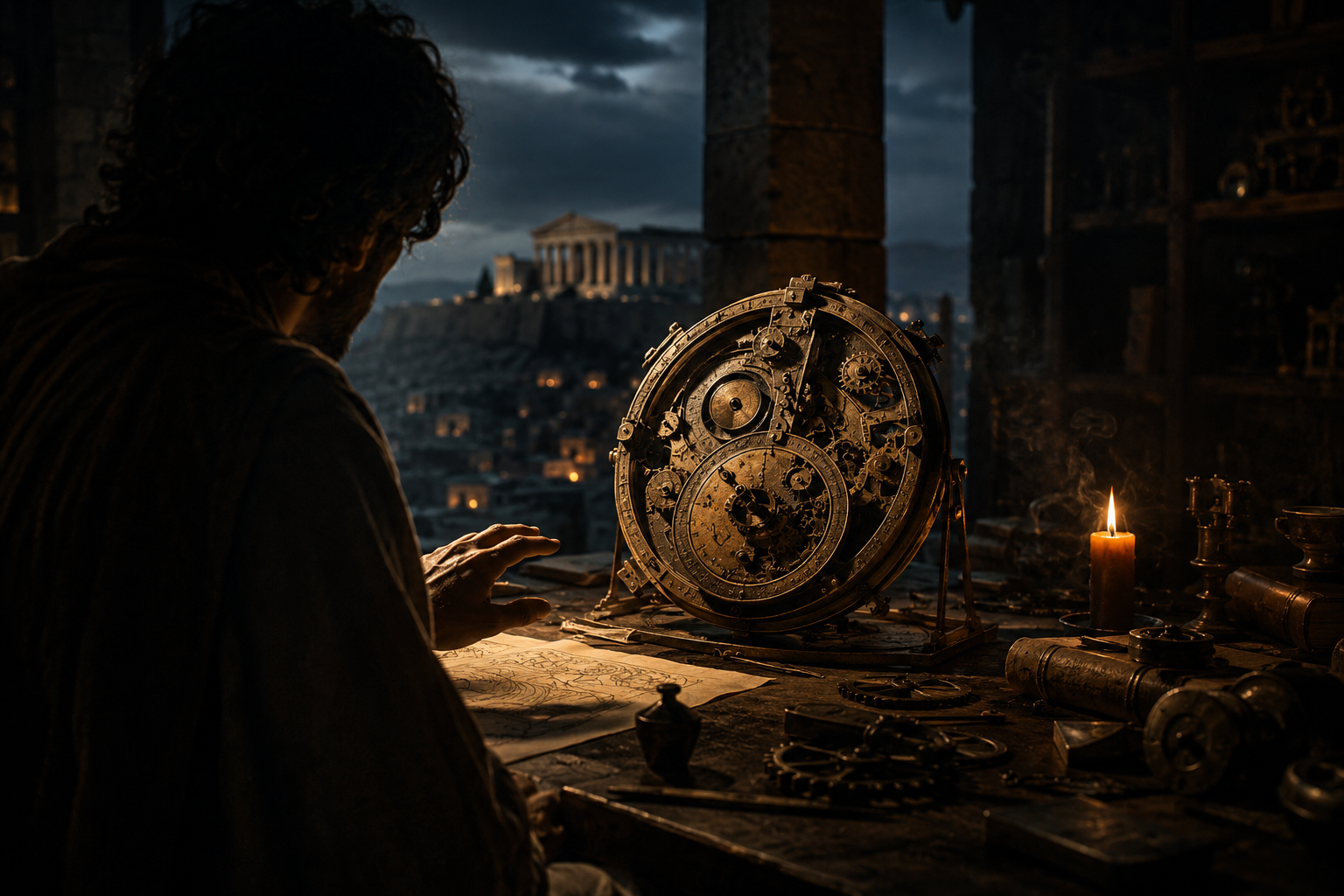
The Antikythera mechanism deserves the top ranking because it feels the most like a message from the future. Recovered from a shipwreck near the Greek island of Antikythera, it is generally dated to around the first century BCE and is understood as an ancient Greek mechanical device for calculating and displaying astronomical information. It used gears to model the sky, a bit like a bronze laptop built for the heavens.
For a normal reader, imagine opening a Roman-era chest and finding something that behaves like a mechanical calendar, planet tracker, and eclipse predictor. That is the shock. The device was not a simple tool like a hammer or wheelbarrow. It was abstract machinery, designed to represent invisible patterns in time.
What makes it so powerful is the gap between the invention and the world around it. Mechanical clockwork of this sophistication would not become common for many centuries. The Antikythera mechanism was not just early. It was embarrassingly early. It suggests ancient engineers could build far more complex machines than most people imagine.
Its tragedy is that it did not become the beginning of a mechanical computing age. It remained an island of brilliance. Like a single electric car appearing before roads, batteries, charging stations, and mass manufacturing, it showed what was possible without creating the world needed to make it normal.
Number Two: Hero’s Steam Engine
Hero of Alexandria’s aeolipile is one of history’s strangest almost-moments. In the first century AD, Hero described a device in which steam made a hollow sphere rotate. In simple terms, it was the first known machine to turn steam into rotary motion.
That sounds small until the analogy becomes obvious. Steam power later helped drive the Industrial Revolution. It pumped mines, moved trains, powered factories, and changed the balance of global wealth. Hero had the ghost of that future in his hands nearly two thousand years earlier.
But the aeolipile did not become a steam locomotive, factory engine, or power plant. It was closer to a demonstration than an industrial machine. The ancient world had slavery, limited precision manufacturing, different economic incentives, and no surrounding machine culture ready to turn steam into mass production.
This is why it ranks so highly. The idea was not wrong. The timing was wrong. Hero’s steam device was like discovering jet propulsion in a world that still has no airports, aluminium industry, fuel supply chain, or reason to build an air force.
Number Three: Zhang Heng’s Earthquake Detector
Zhang Heng’s seismoscope ranks third because it took an invisible disaster and tried to turn it into a signal. Zhang Heng, a Chinese scientist born in 78 CE, is associated with a seismoscope that reportedly used a cylindrical form with dragon heads and balls, with a ball dropping into a frog’s mouth when an earthquake occurred.
The simple analogy is a smoke alarm for the ground. It did not stop earthquakes, and it was not a modern seismograph that could produce detailed measurements. But the deeper idea was extraordinary: nature could be detected by instruments before ordinary human senses understood what had happened.
That mindset is modern. Today, entire societies rely on instruments to detect threats humans cannot see directly: radiation, pressure, disease, climate patterns, aircraft movement, and financial risk. Zhang Heng’s machine belonged to that same family of thought.
It arrived in a world without electronic sensors, satellite networks, automated alerts, or modern disaster infrastructure. That makes it both brilliant and limited. The device could signal something, but the wider system for prediction, response, and public warning had not yet been born.
Number Four: The Archimedes Screw
The Archimedes screw ranks fourth because it is one of the rare early inventions that did not simply disappear. Traditionally associated with Archimedes, it uses a helix inside a pipe or cylinder to raise water from one level to another. In everyday language, it is like a spiral staircase for water. Turn the screw, and water climbs.
Its genius is easy to miss because it looks simple. But that simplicity is exactly why it mattered. Moving water upward is one of civilization’s basic problems. Farms, cities, drainage systems, ships, and irrigation all depend on controlling water.
Unlike some other inventions on this list, the Archimedes screw did find practical use and still appears in modern forms. That slightly weakens the “forgotten” label, but strengthens its importance. It proves that some ancient engineering ideas were not curiosities. They were durable solutions.
It ranks below the Antikythera mechanism and aeolipile because it was less conceptually shocking. But in terms of practical usefulness, it may be one of the most successful early technologies ever made. It was not a failed future. It was a future that quietly kept working.
Number Five: Bi Sheng’s Movable Type
Movable type is one of the great examples of an invention appearing before the conditions were right for its global explosion. Around 1041–1048, Bi Sheng in China is credited with creating movable type using baked clay pieces, arranging individual characters so they could be reused for printing.
The modern analogy is obvious. Movable type is like turning writing into a reusable keyboard. Instead of carving or copying everything again and again, you create repeatable pieces that can be rearranged. That is a powerful leap from hand production toward information technology.
Yet its early impact was constrained by context. Chinese writing uses thousands of characters, making movable type more complex than alphabetic systems with fewer letters. The invention was real, but the surrounding language, economics, demand, and production systems shaped what it could become.
This is why “too early” does not always mean nobody understood the idea. Sometimes the invention works, but the environment makes it hard to scale. Movable type needed not only clever materials, but the right combination of literacy, markets, scripts, institutions, and distribution.
Number Six: Pascal’s Mechanical Calculator
Blaise Pascal’s Pascaline ranks sixth because it was an early machine for outsourcing mental arithmetic. Designed around 1642, it used wheels to add and subtract numbers, with digits displayed in windows.
For a normal reader, imagine a cash register before the modern office existed. It did not think like a computer, but it took a repeated human task and moved part of it into a machine. That is one of the deepest patterns in technological history.
The Pascaline was not a mass consumer calculator. It was expensive, mechanical, and limited. But the idea underneath it was huge: numbers did not have to live only in the human mind or on paper. They could be processed by engineered objects.
That makes it a direct ancestor of the modern computational world. The distance from Pascal’s wheels to laptops and smartphones is enormous, but the psychological leap is similar. Once calculation becomes mechanical, intelligence itself starts to look partly machine-readable.
Number Seven: The Baghdad Battery
The so-called Baghdad Battery is the most controversial item on this list, which is why it cannot rank higher. The object is commonly described as a ceramic pot containing copper and iron components, discovered in Iraq in the twentieth century and often claimed to date from the Parthian or Sasanian periods. Its purpose remains disputed, and claims that it was used as an electrical battery or for electroplating are widely challenged.
That uncertainty matters. It would be irresponsible to present it as proven ancient electricity. A better way to understand it is as a historical warning label. Sometimes modern people see familiar shapes in old objects and rush to a spectacular conclusion.
Still, it belongs in the ranking because the debate around it reveals something important. The possibility of a simple galvanic cell feels irresistible because it would mean electricity was glimpsed long before the electrical age. A pot, a metal tube, and a rod suddenly become a symbol of a future that may or may not have existed.
Its real value may not be as a confirmed lost battery, but as a reminder that mystery is not the same as proof. Not every strange artifact is suppressed technology. Sometimes the most honest answer is also the most dramatic: we do not fully know.
Why These Inventions Did Not Automatically Change Everything
The common mistake is to imagine that once an invention exists, history should immediately bend around it. That is not how progress works. An invention is only one piece of a much larger machine.
A steam engine needs metalworking, fuel supply, economic demand, labour incentives, maintenance skills, and a reason to replace existing systems. A calculator needs bureaucracy, commerce, numeracy, and users who can afford it. A printing system needs readers, texts, distribution, and institutions hungry for replication.
This is the hidden lesson. Technology does not succeed simply because it is clever. It succeeds when the surrounding world becomes ready to absorb it. The invention is the spark, but society is the oxygen.
That is why “ahead of its time” can be a curse. An idea that arrives too early can be misunderstood, underused, treated as a novelty, or lost completely. It may have all the brilliance of the future and none of the infrastructure.
The Darker Lesson Hidden In Forgotten Genius
These inventions also challenge the modern ego. People today often assume the past was simple and the present is uniquely intelligent. The Antikythera mechanism, Hero’s aeolipile, Zhang Heng’s seismoscope, and Bi Sheng’s movable type make that assumption look lazy.
Ancient and early modern people were not stupid versions of us. They were humans with sharp minds, intense curiosity, and real engineering ability. What they often lacked was not intelligence, but accumulated systems: precision industry, mass education, electrical grids, global markets, and scientific institutions.
That distinction matters because it changes how we see our own age. We may also be surrounded by inventions that are too early. Artificial intelligence, genetic engineering, quantum computing, longevity science, and brain-computer interfaces may all be waiting for the wider world to catch up.
The uncomfortable possibility is that the future is not a straight road ahead of us. It may already be scattered around us in fragments, prototypes, ignored papers, failed companies, and strange machines that look useless only because the rest of civilization has not arrived yet.
The Real Ranking Is About Timing
The forgotten inventions that arrived too early are not just historical curiosities. They are proof that genius can appear before the market, before the culture, before the supply chain, before the politics, and before the public imagination.
Ranked by sheer future-shock, the Antikythera mechanism stands first because it looks most like a machine from another era. Hero’s steam engine follows because it touched the edge of industrial power without triggering it. Zhang Heng’s seismoscope showed the logic of sensor civilization. The Archimedes screw proved practical engineering could outlive empires. Bi Sheng’s movable type anticipated mass information. Pascal’s calculator pointed toward mechanical thought. The Baghdad Battery remains last because its story is powerful but uncertain.
The deeper point is sharper than the ranking. History is not short of genius. It is short of alignment. The right idea, born into the wrong world, can vanish for centuries. And somewhere in the present, the same thing is probably happening again.
