History of the Ukraine–Russia War: Russia's Borders, NATO, and the Road to War
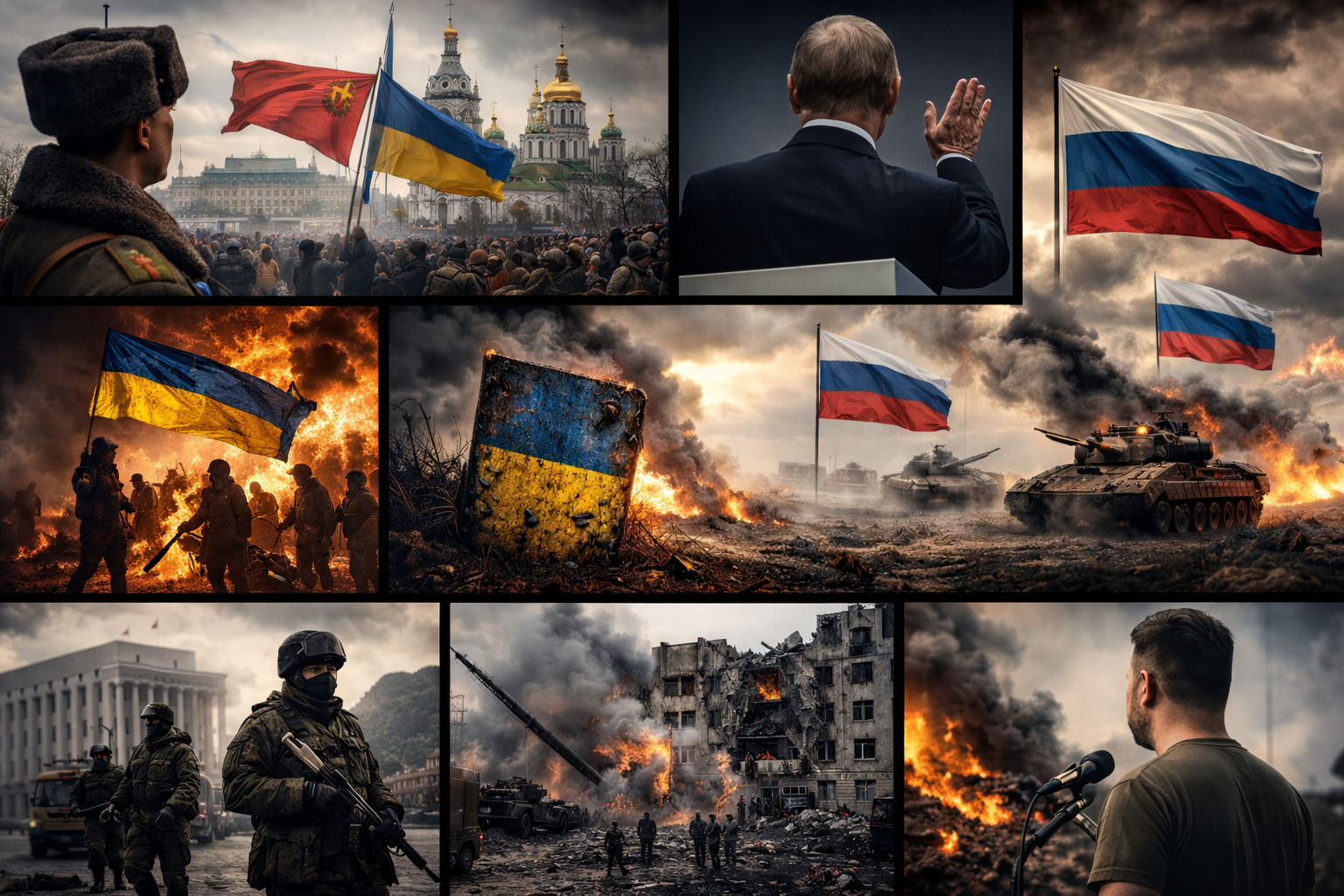
From Post-Cold War Promise to Rising Tension
From the Collapse of the Soviet Union to Building Tensions…
A full-scale invasion looks like a single decision. But the Ukraine–Russia war is better understood as a slow-building collision between borders, security alignments, and a leader’s belief that time was running out.
The War Continues. Russia still occupies roughly a fifth of Ukraine’s territory, while Ukraine has preserved its state survival and denied Moscow the quick victory it sought.
NATO sits in the middle of the story because it is both hardware and symbolism. For Ukrainians, NATO is the clearest route to credible protection after 2014. For the Kremlin, NATO is the institutional face of an American-led order that has been pushing closer for decades.
The story turns on whether any future ceasefire can be enforced automatically enough to change Russia’s incentives.
Key Points—the control fight hiding inside the headlines
The modern conflict’s hinge year is 2014: Russia seized and annexed Crimea, and war ignited in eastern Ukraine, creating a pattern of territorial control backed by force and contested in diplomacy.
NATO’s 2008 Bucharest pledge that Ukraine “will become” a member created a durable signal: reassurance for some, threat perception for Moscow.
Putin’s core framing ties NATO expansion, U.S. military infrastructure, and “missile defense” fears to Russia’s security and status, most explicitly in his 2007 Munich speech and his 2022 invasion address.
The United States shapes the war’s balance not only through weapons and sanctions but also by anchoring the coalition that makes long-term security promises credible.
Putin’s relationships with other states function as a support network: strategic cover and trade with China, munitions with North Korea, drone/technology links with Iran, and operational support from Belarus.
“Winning” is not clean: Ukraine is winning survival; Russia is winning occupation; the deciding contest is endurance—industrial production, external supply chains, and political cohesion.
How Broken Assurances Became a security cliff
Ukraine’s geography makes it both a bridge and a buffer: a large state between Russia and the NATO/EU space, with Black Sea access and a long historical entanglement with Moscow. That geography magnifies every security choice Ukraine makes, because those choices are read by Russia as changes to Russia’s own “strategic depth.”
In 1994, Ukraine gave up the nuclear weapons left on its territory and accepted political assurances in the Budapest Memorandum. The memorandum matters today less as a legal shield and more as a psychological scar: it shows the difference between an assurance and a binding defense guarantee.
In the same era, NATO expanded eastward. NATO framed this as sovereign states choosing alliances. Russia increasingly framed it as a narrowing ring of U.S.-aligned military capacity. You do not need to pick a moral side to see the mechanical tension: alliances move borders of obligation, and obligations change risk calculations.
The 2008 NATO Bucharest declaration is the turning signal. NATO said Ukraine and Georgia “will become members,” while deferring the practical path and timing. That created a long, ambiguous corridor: enough promise to shape Ukrainian aspirations, enough uncertainty to keep Russia probing what it could prevent.
In late 2013 and early 2014, protests known as Euromaidan followed President Viktor Yanukovych’s decision not to sign an EU association agreement. The crisis ended with political rupture and Yanukovych leaving Ukraine.
Then came 2014’s hard break. Russia seized Crimea and later annexed it. The UN General Assembly passed a resolution that affirmed Ukraine's territorial integrity and noted that Ukraine had not authorized the referendum in Crimea. Putin’s Crimea address presented a historical and strategic justification, insisting Russia was correcting a wrong and defending compatriots.
War also ignited in eastern Ukraine in parts of Donetsk and Luhansk, with Russia-backed separatist forces. The Minsk agreements reduced violence at moments but did not settle sovereignty. They became a partial valve, not a solution.
After 2014, Ukraine’s NATO trajectory hardened into laws and constitutions. That mattered because it made the question less negotiable: not just a government’s preference, but a state’s declared direction.
By December 2021, Russia published draft “security guarantees” documents aimed at halting NATO expansion and constraining NATO deployments. When Russia did not get the legal rollback it sought, it launched the full-scale invasion in February 2022.
The mechanism trap: deterrence, encirclement, and endurance
The sovereignty trap: when “neutral” stops being neutral
Ukraine’s stake is sovereignty in the plain meaning: the right to choose its alliances, government, and future without external coercion.
Russia’s stake, as expressed by the Kremlin, is security plus leverage. Even when Russia speaks in the language of history, the policy demand tends to be control over Ukraine’s orientation—keeping it from locking into Western security systems.
That is why “neutrality” is unstable. If Ukraine is neutral but Russia can still punish it by force, neutrality is not protection. Russia portrays any attempt by Ukraine to align for protection as a threat. Either path triggers risk.
NATO’s feedback loop: deterrence signals that can trigger preemption
From the Western view, NATO is a deterrence machine. It clarifies commitments and raises the cost of aggression.
From the Kremlin’s view, NATO is a moving line that can bring planning, logistics, surveillance, and strike options closer. The Kremlin often treats NATO less as a treaty text and more as a pipeline that connects a neighbor into U.S.-led military infrastructure.
This is the feedback loop: the more insecure Ukraine feels after 2014, the more it seeks Western security ties; the more it seeks those ties, the more Russia claims it is being boxed in; the more Russia acts to prevent the ties, the more Ukraine seeks them.
The 2008 Bucharest “will become members” language is the prime feedback signal: it created expectation without closure, and uncertainty tends to produce worst-case planning.
The U.S.-based timeline fear: missiles, minutes, and strategic panic
When people say “Putin fears U.S. bases,” the serious version is not about a literal American flag on a Ukrainian base tomorrow. It is about timelines: how quickly certain systems could, in theory, detect, target, or strike—and whether Russia believes it would have warning and room to respond.
Putin’s 2007 Munich speech explicitly attacked the idea of expanding missile-defense elements in Europe, arguing it would disturb Russia and feed an arms race logic. The speech matters because it shows the mental frame: even “defensive” systems are read as part of a changing strike-and-response equation.
You can disagree with the fear. You can also see how it becomes useful. It is a strategic argument to the outside world and a mobilizing story at home: "We acted because we were cornered.”
The escalation boundary: nuclear risk and the limits of maximal aims
Both sides face ceilings that keep “total victory” hard.
Ukraine cannot trade away territory easily because territory is not just land. It is people, ports, resources, and precedent. If borders become negotiable under force, Ukraine’s long-term survival becomes conditional.
Russia cannot retreat easily because the war has been fused with regime legitimacy. A retreat can be framed as failure, and authoritarian systems fear failure because it changes elite loyalties.
NATO states face their own ceiling: sustaining Ukraine militarily while avoiding direct NATO–Russia war. That creates a bounded-support paradox: enough to prevent collapse, not enough to remove escalation risk.
The result is an attrition war where outcomes are shaped by production, supply chains, and political endurance as much as battlefield brilliance.
Putin’s regime-security lens: why humiliation stories become policy
You cannot diagnose Putin from a distance. But you can map recurring drivers in his own public framing and in the demands Russia has put on paper.
One driver is status. Putin has repeatedly criticized a U.S.-dominated “unipolar” order and argued that Russia’s interests were ignored after the Cold War. The Munich speech is the clearest early public expression of this worldview.
A second driver is regime security: fear that Western influence and mass protest dynamics can destabilize states on Russia’s perimeter and eventually Russia itself. In this frame, Ukraine’s political drift westward is not merely foreign policy; it is an existential governance threat.
A third driver is closing-window pressure. The December 2021 draft “security guarantees” were structured like a last attempt to rewrite the board—seeking constraints on NATO enlargement and deployments. That looks like a leadership belief that waiting would produce a worse strategic position.
Together, these drivers help explain why the Kremlin can simultaneously speak about history and act with cold strategic logic. The story is identity; the mechanism is leverage.
The speech-to-action chain: how public narratives lock leaders in
Three moments are especially important because they lock incentives and narrow exit ramps.
Munich 2007: Putin articulates a worldview of U.S. overreach, NATO expansion anxiety, and missile-defense concerns in Europe, framing Russia as pushed into resistance.
Crimea, March 2014: Putin frames Crimea as historically Russian and strategically essential and casts Western responses as hypocritical. It is a justification speech, but it also signals something colder: Russia is willing to change borders by force and absorb punishment.
February 24, 2022: Putin’s invasion address frames NATO expansion and “military infrastructure” in Ukraine as unacceptable and portrays invasion as necessary for Russia’s security. Whatever one thinks of the claims, the speech demonstrates how the Kremlin wants the war understood: as a defensive necessity, not elective aggression.
These speeches are not just propaganda. They shape bargaining space. When a leader publicly frames a war as existential defense, compromise becomes politically harder, because compromise can be described as surrender.
The production bottleneck: drones, shells, and the industrial race
In 2026, “winning” is often decided by whether systems show up on time: air-defense interceptors, drones, artillery ammunition, spare parts, repair capacity, and power-grid resilience.
Reuters reporting in late February 2026 highlights the drone-dominated character of the battlefield and how it constrains movement and raises casualty risk.
Russia’s endurance is also shaped by external supply relationships. Public reporting has repeatedly pointed to North Korea as a major munitions supplier and to Iran-linked drone pathways, while China provides economic ballast and strategic cover without necessarily wanting an uncontrolled escalation.
Ukraine’s endurance is heavily dependent on sustained Western support and the coalition politics behind it—especially the credibility of long-term commitments that survive election cycles.
The “winning” illusion: maps that move slowly until they don’t
If “winning” means achieving maximal political aims, neither side has won.
Ukraine has won the survival contest so far: the state holds, the government functions, and sovereignty is preserved in law and identity.
Russia has won the occupation contest so far: it still controls significant territory and has shown the capacity to sustain long war pressure.
So the better question is, who is closer to breaking the other side’s coalition?
Ukraine’s coalition is tested by time, infrastructure attacks, fatigue, and the sheer scale of reconstruction needs.
Russia’s coalition is tested by costs, sanctions pressure, and the dependence on partners and workarounds that can tighten or fray.
Neither test resolves quickly. That is why the war can look static until a supply shock, political shift, or operational surprise changes the timeline.
What Most Coverage Misses
The hinge is simple: a ceasefire without automatic enforcement is not peace; it is a reload window.
Mechanism: if Russia expects violations to produce slow debate, uneven penalties, and delayed support deliveries, probing becomes rational. If Russia expects violations to trigger immediate costs—sanctions snapback, tightened enforcement against war inputs, accelerated arms delivery schedules—then violation becomes less attractive.
Signposts to watch: whether any proposed monitoring includes credible verification and pre-agreed consequences, and whether key backers lock in multi-year production and delivery schedules that are difficult to reverse quickly.
What Happens Next—the bargain space only exists if enforcement is automatic
The short term is still about capacity: protecting energy systems, sustaining air defense, and keeping the war economy alive on both sides. Recent reporting shows continued heavy strikes targeting Ukraine’s energy infrastructure and ongoing pressure across multiple regions.
The medium term is about coalition durability: Ukraine’s ability to keep external support aligned and Russia’s ability to keep its economy and partner network functioning under pressure. On the fourth anniversary, the Kremlin publicly framed the conflict as a broader confrontation with the West, which signals a willingness to extend the timeline rather than rush a compromise.
Plausible outcomes cluster into four paths.
One: a monitored ceasefire that freezes lines, paired with a security package for Ukraine short of NATO membership but stronger than political assurances. The pressure point is enforcement design: verification, guarantees, and what happens on the first violation.
Two: a long frozen war with periodic spikes, where talks manage violence but do not settle sovereignty. The pressure point is production: drones, shells, interceptors, and the financial plumbing that keeps them flowing.
Three: renewed major escalation, driven by perceived windows of advantage or fear of losing momentum. The pressure point is sudden shifts in mobilization, strike intensity, or external supply quality and quantity.
Four: gradual Ukrainian recovery over years, if Western support remains steady and Russia’s capacity or willingness to pay erodes. The pressure point is Russia’s partner network and the internal political need to reframe “victory.”
Real-World Impact—daily life as infrastructure, prices, and fatigue
In Ukraine, the war is often felt through routine failure: disrupted electricity, heating, and water, and the constant recalculation of risk around work, school, hospitals, and travel. UN human rights monitoring in early 2026 emphasizes the civilian impact and the effects of attacks on energy infrastructure during freezing conditions.
Across Europe, the conflict functions as a defense-and-energy “war tax”: higher military spending, industrial reprioritization, and political fights over sanctions, aid, and migration.
Globally, the war adds uncertainty premiums—insurance, shipping risk, commodity volatility—and pushes governments and firms to rethink supply resilience, especially for energy and defense inputs.
Diplomatically, the war sorts relationships. Some states align with sanctions and support them, while others hedge or deepen ties with Russia to leverage trade for resources.
The next-decade fork—enforceable peace or recurring war cycles
The deepest question is not whether one side takes a town this season.
It is whether the U.S., Europe, and Ukraine can build a security architecture that reduces Russia’s incentive to try again while giving Ukraine a future that is not permanently conditional on the next crisis.
If enforcement is strong, a ceasefire can become a transition toward stability, because the incentives change. If enforcement is weak, any ceasefire risks becoming a pause that sets up the next round.
Watch the concrete signposts: verification design, automatic penalties, multi-year industrial commitments, and the political staying power behind them.
The historical significance is that the post–Cold War European premise—borders are not changed by force—is being tested in real time, and the result will shape how other powers calculate risk for years.
