How Britain’s Covid Response Became One Of The Most Expensive Failures In History
How Lockdown Britain Burned Through Billions
The Covid Bill Britain Is Still Paying For
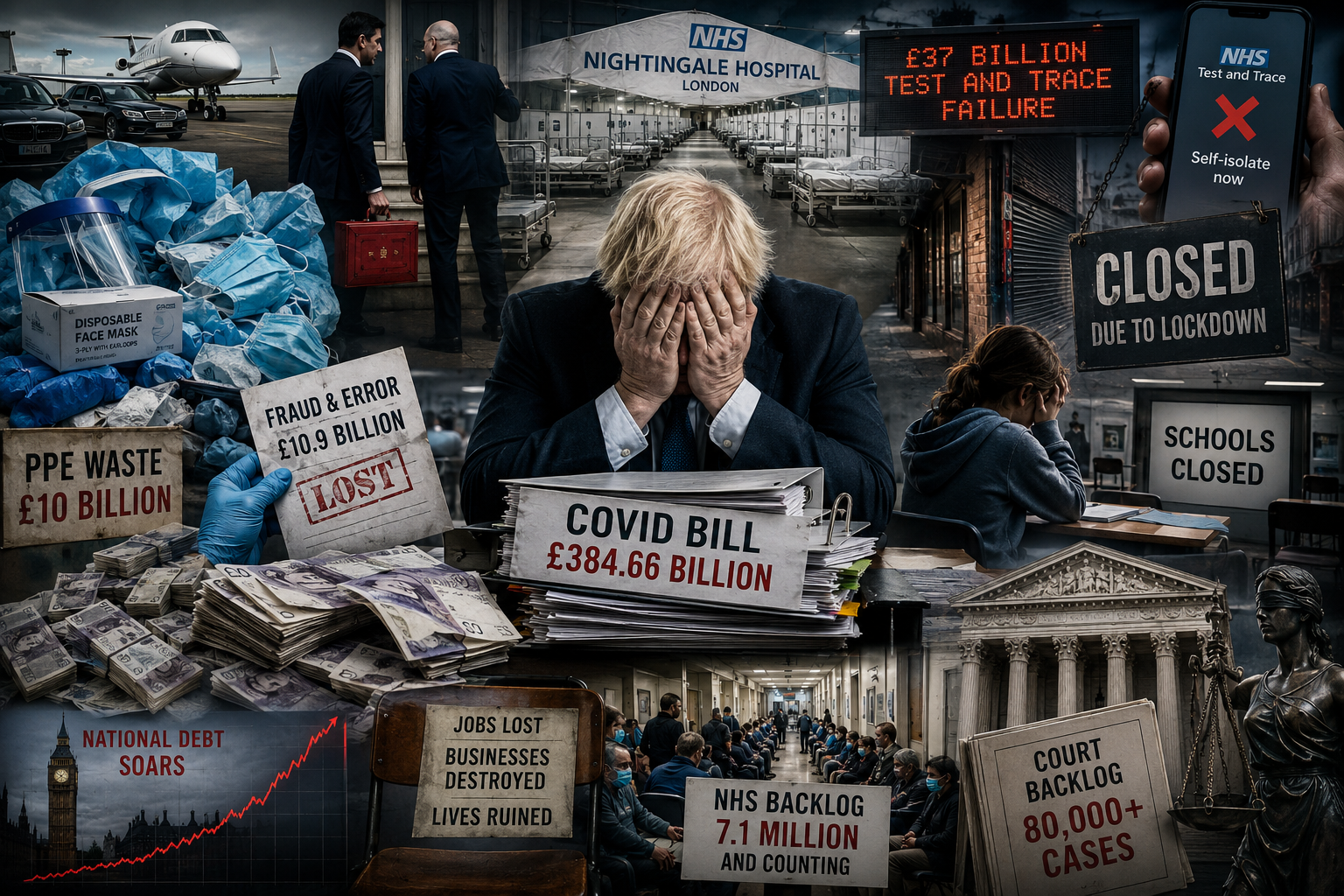
Britain Spent Like The Future Had Been SuspendedBritain’s Covid response has left behind one of the largest public spending questions in modern history. HM Treasury’s 2026 Covid Cost Tracker estimates the lifetime cost of UK government pandemic measures at £384.66 billion, with around £380 billion already spent and about £5 billion still expected across active measures. That is not a rounding error in the national accounts. It is the kind of spending shock that reshapes debt, taxation, public services, and political trust for a generation.
The basic defence is obvious: Covid was a genuine emergency, hospitals were under pressure, ministers had to act quickly, and some spending was unavoidable. The harder question is whether Britain protected the country or whether it used emergency conditions to suspend normal judgement. When a state spends nearly £385 billion and still emerges with NHS backlogs, court backlogs, damaged education, fraud losses, failed procurement, and a weaker economy, the issue is not whether Covid was real. The issue is whether the response became a financial bonfire.
The PPE Disaster Became The Symbol Of Panic Government
The most visible waste was protective equipment. Official accounts showed nearly £10 billion of PPE spending was written down because items were defective, unsuitable, expired, unwanted, or worth far less than the government paid during the scramble for supplies. That matters because PPE was not a side programme. It was one of the most morally protected areas of pandemic spending, sold as the urgent shield for frontline workers.
Some emergency overpayment was inevitable during a global supply crisis. But the scale of the write-off reveals something deeper: once panic becomes the operating system, price discipline collapses. The country did not just buy masks and gowns. It bought at emergency prices, through emergency routes, with emergency tolerance for weak oversight. That is how a crisis becomes a market for opportunists, middlemen, political contacts, and suppliers who would never normally have been trusted with such vast public money.
The corruption question cannot be brushed aside either. Transparency International UK identified more than £15 billion of Covid contracts carrying corruption "red flags", including politically connected awards, VIP-lane issues, opaque pricing, and contracts with inexperienced suppliers. A red flag is not the same as proof of criminal corruption, but it is more than a minor paperwork concern. It is evidence that Britain’s emergency state created conditions in which public money moved faster than accountability.
Test And Trace Was The £37 Billion Promise That Failed Politically
NHS Test and Trace became another defining example. The Public Accounts Committee said the programme had been allocated £37 billion over two years and failed to deliver the central promise of averting further lockdowns. That does not mean every pound was literally stolen or useless. It does mean Britain spent an extraordinary amount on a system whose public justification was far stronger than its proven effect.
The deeper failure was strategic. If Test and Trace had worked well enough, Britain could have moved faster toward targeted isolation, local outbreak control, and normal life. Instead, vast spending existed alongside repeated restrictions, shuttered businesses, confused rules, and public fatigue. The programme became a symbol of a state that could purchase capacity but not always deliver competence.
This is where the anti-lockdown argument becomes strongest. Lockdowns were presented as unavoidable, but the state also spent billions on systems that were supposed to make lockdowns less necessary. If those systems failed, then the public paid twice: once through taxation and borrowing, and again through closed schools, closed firms, postponed treatment, damaged mental health, and lost liberty. That wider pattern sits alongside Britain’s broader problem of expensive systems that struggle to deliver, a theme visible in Britain’s Most Expensive Mistakes.
Furlough Saved Jobs But Also Hid A Huge Waste Problem
Furlough and self-employment support were the largest emotional defence of the pandemic economy. The schemes cost £96.9 billion, with £68.9 billion paid through furlough and £28.1 billion through self-employment grants. They covered millions of jobs and prevented an immediate employment collapse, but official parliamentary reporting also placed estimated error and fraud at £4.5 billion.
The uncomfortable point is that furlough was both necessary and excessive. It made sense to protect workers when the state itself had ordered large parts of the economy to close. But the longer restrictions continued, the more the scheme became compensation for policy damage. A government cannot shut businesses, restrict movement, discourage social life, and then present the bailout as generosity. Much of the bill was the cost of decisions ministers made.
The same logic applies to business grants. Local authority Covid business support grants reached around 1.4 million businesses and provided about £23 billion, but the National Audit Office warned that delays and weak follow-up made recovery of wrongly paid money harder and left the overall value-for-money judgement open. That is the problem with emergency subsidy: once money has gone out quickly, the state often lacks the data, will, or administrative grip to recover it.
Loans, Fraud, And The Front Door Left Open
The pandemic loan schemes created a second wave of losses. The government’s 2026 tracker raised the estimated lifetime cost partly because of higher expected credit losses in the Bounce Back Loan Scheme. Separately, the government response to the Covid Counter Fraud Commissioner stated that £10.9 billion had been lost to fraud and error across Covid support schemes, with only £1.8 billion recovered.
That is not just a financial scandal. It is a political insult to ordinary taxpayers who were told restrictions were a collective moral duty. Millions of people followed rules, lost income, missed family events, postponed medical care, and watched children fall behind. Meanwhile, parts of the emergency support architecture were vulnerable to abuse because speed was prioritised over basic protection.
The phrase "fraud and error" can sound sterile, but the public meaning is simple. Some money went to people or firms that should not have had it. Some may never come back. Some of it will be paid for through higher taxes, weaker services, or future restraint. Britain did not merely borrow through Covid. It borrowed badly.
Nightingale Hospitals Showed The Difference Between Theatre And Capacity
The Nightingale hospitals were designed to show visible emergency readiness. They also exposed the gap between building space and creating usable healthcare capacity. Reports around the Covid Inquiry placed the cost of Nightingale hospitals at around £358 million, while the hospitals were largely unused, partly because physical beds are not the same as staffed intensive care capacity.
This was not simply waste in the narrow sense. It was political theatre under emergency pressure. The images reassured the public that the state was building something dramatic, but the real bottleneck was always trained staff, oxygen, logistics, and the ability to run safe care. Britain bought symbols of surge capacity while the underlying NHS fragility remained.
That fragility still matters. The NHS waiting list for hospital treatment rose to a record 7.7 million in September 2023 and was still around 7.1 million in March 2026. The 18-week treatment target has not been met since 2016, but Covid turned a serious backlog into a national wound that still has not healed.
The Lost Money Was Not Only In Contracts
The biggest Covid waste was not only what government bought. It was what government destroyed, paused, postponed, or made less productive. Closing businesses meant lost output, lost tax revenue, weaker balance sheets, disrupted careers, and a generation of firms forced to survive by debt, subsidy, or luck. Social distancing rules may have been more defensible early in the pandemic, but blanket restrictions became harder to justify once vaccines, immunity, testing, and risk stratification changed the situation.
Schools are the clearest moral cost. The Institute for Fiscal Studies warned in 2021 that most children across the UK were likely to miss more than half a year of normal in-person schooling, with long-run effects on productivity, earnings, public finances, health, and happiness. Later evidence still shows lost learning as a serious legacy, even where England performed better than some comparable countries.
This is why the lockdown debate cannot be reduced to "lives versus money." Money is hospital capacity, education, policing, courts, housing, defence, and future opportunity. A pound wasted on failed procurement is not an abstract accounting loss. It is a pound unavailable for cancer diagnostics, special educational needs, court sitting days, or tax relief for workers.
The Court Backlog Shows The Legacy Is Still Alive
The court system also shows how Covid’s institutional damage did not end when restrictions were lifted. At the end of March 2026, there were 80,061 open Crown Court cases in England and Wales, with the median age of an open case reaching a series peak of 196 days. The backlog had stabilised slightly compared with the previous quarter, but it remained far above pre-pandemic levels and still represented justice delayed on a national scale.
That matters because delayed justice is not just an administrative inconvenience. It weakens victims, defendants, witnesses, police credibility, and public faith in the legal system. Courts were already under pressure before Covid, but pandemic disruption made a strained system worse. Britain is still living with the consequences.
The same pattern runs through health, education, justice, debt, and productivity. Covid did not create every weakness, but it accelerated them. It gave the state an excuse to spend at wartime speed without wartime discipline. Now the country is left with peacetime consequences: higher borrowing, greater service pressure, and a public that can see the bill but not always the benefit.
A Defensible Estimate Of The Waste Is £110 Billion
The cleanest estimate is this: Britain wasted or avoidably lost around £110 billion during Covid. That figure is not an official audit number. It is a reasoned political estimate built from known waste, fraud, poor value, and avoidable policy damage. It includes roughly £10 billion in PPE write-downs, £10.9 billion in fraud and error, several billion in loan losses and unrecovered misuse, a large share of Test and Trace that failed to deliver its core anti-lockdown promise, poorly targeted business support, unused emergency capacity, and tens of billions in avoidable economic damage from prolonged blanket restrictions.
That estimate is deliberately lower than the full £385 billion Covid cost because not all pandemic spending was waste. Vaccines, core NHS support, some furlough spending, and emergency help for viable firms had real justification. But it is also higher than narrow fraud figures because the real loss was not just theft or defective equipment. It was bad policy at scale.
Put against wider government spending, the scale is brutal. UK public sector spending is projected at around £1.347 trillion in 2025/26, while social protection accounted for £384 billion, health £242 billion, education £119 billion, and economic affairs £87 billion in 2024/25. A £110 billion waste estimate is therefore close to an entire year of UK education spending and larger than annual defence resource spending.
Britain Will Not Recoup This Quickly
Britain will not truly recoup the wasted Covid money. Some fraud will be recovered, some loans will be repaid, and some emergency assets may be sold, but the broader losses are embedded in national debt, lower productivity, service backlogs, and weakened public trust. The realistic recovery period is not five years. It is closer to a decade or more, and even that assumes stronger growth, tighter fraud recovery, better public sector productivity, and no further major shocks.
The real tragedy is that the country learned how easily emergency government can become expensive government. Lockdowns created costs that were then used to justify further spending, which created new waste, which created future pressure on public services. That is the loop Britain still has not fully confronted.
The pandemic required action, but it did not require every mistake that followed. The final verdict on Britain’s Covid spending should be blunt: the emergency was real, but so was the waste. And the people who will pay longest are not the ministers who signed the cheques, but the children who lost learning, the patients still waiting, the victims stuck in court queues, and the taxpayers asked to fund the bill long after the fear has faded.
