COVID-19 Conspiracies That Actually Turned Out To Be True
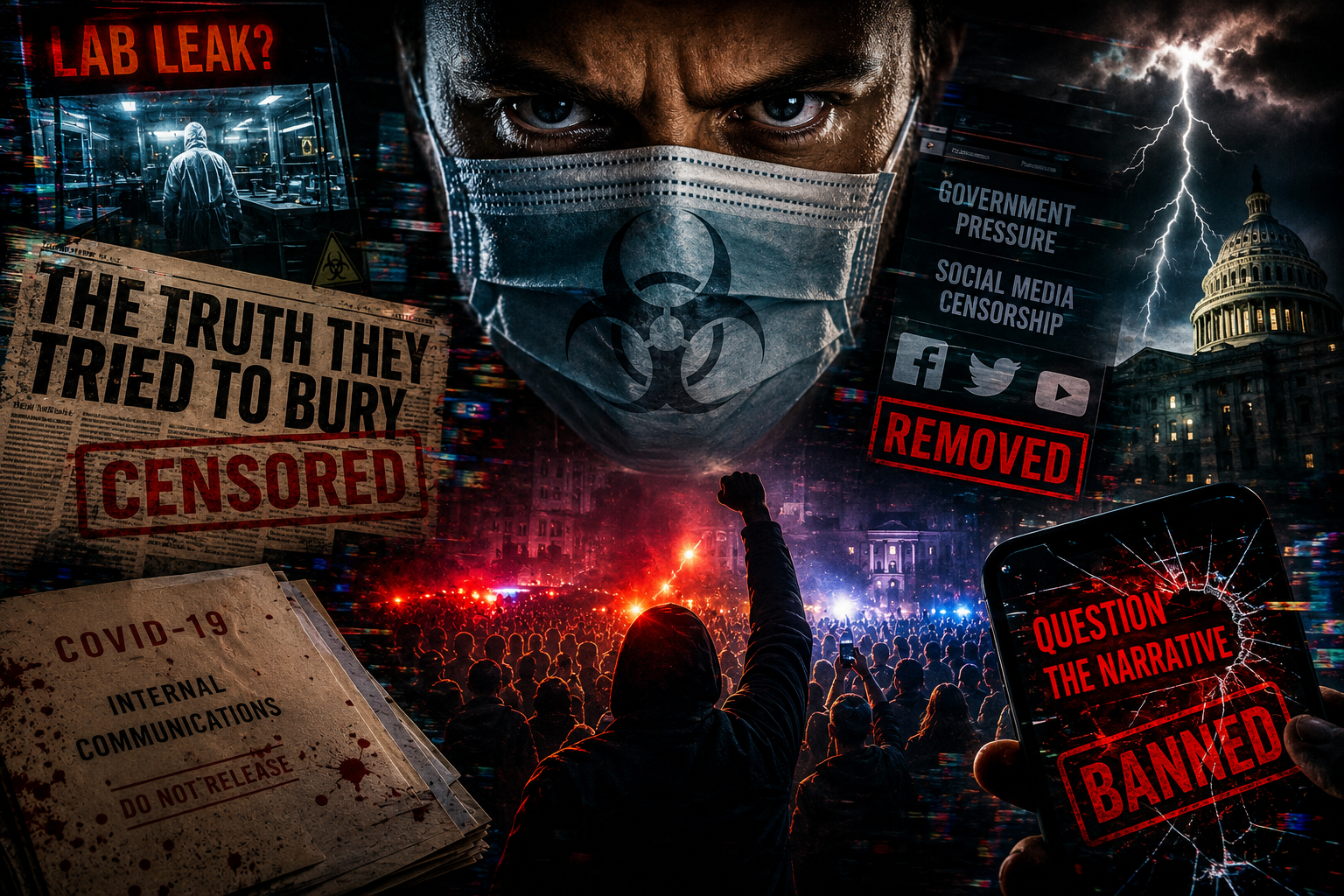
The COVID Conspiracies That Stopped Sounding Crazy
How The Pandemic’s Most Ridiculed Claims Became Impossible To Ignore
The Dangerous Difference Between A Lie And A Forbidden QuestionNot every COVID conspiracy theory turned out to be true. Many were fantasy, panic, opportunism, or political performance. The claims about microchips, 5G towers, fake hospitals, mass depopulation plans, and miracle cures did not become respectable simply because some official narratives later cracked.
But another category existed. These were not clean “conspiracies” in the cartoon sense. They were disputed claims, uncomfortable questions, minority scientific views, or politically inconvenient warnings that were treated as dangerous misinformation before the evidence became more complicated. That is where the real damage sits: not in the idea that every outsider was right, but in the fact that too many insiders pretended uncertainty did not exist.
The pandemic became a test of institutions under fear. Governments wanted compliance. Public health bodies wanted simple messages. Social media platforms wanted to avoid blame. Scientists wanted to protect trust in science. The result was a brutal mistake: uncertainty was often flattened into certainty, and disagreement was often treated as contamination.
The Lab Leak Question Was Never Proven, But It Was Never Insane
The most explosive example remains the origin of the virus. Early in the pandemic, suggesting that SARS-CoV-2 may have emerged from a laboratory-associated incident was widely ridiculed as xenophobic, anti-science, or conspiratorial. The safer public line was that the virus almost certainly came from a natural spillover event, likely linked to animals and the wildlife trade.
That natural-spillover theory remains plausible. The lab-origin theory is not proven. But the crucial point is that official assessments later accepted that both a natural exposure and a laboratory-associated incident remained plausible explanations for the first human infection. The U.S. intelligence community’s declassified assessment stated that agencies continued to assess both hypotheses as possible, while the available evidence had not resolved the question.
That matters because the early ridicule did not simply attack bad claims. It helped create a taboo around a legitimate question. If the virus came from wildlife trade, the world needed a serious reckoning with markets, animal surveillance, and zoonotic risk. If it came from a laboratory-associated incident, the world needed a serious reckoning with biosafety, risky research, oversight, and political transparency. Either way, the origin question was too important to be morally policed out of discussion.
The damage is obvious: years later, the world still does not know with certainty how the pandemic began. The absence of a final answer is not proof of a lab leak. But it is proof that early institutional confidence was excessive. The conspiracy was not that the virus definitely came from a lab. The deeper scandal was that asking whether it could have done was treated as a disgrace before the evidence justified that certainty.
Government Pressure On COVID Speech Was Not Imaginary
Another claim that aged far better than its reputation was that governments pressured social media platforms over COVID speech. During the pandemic, many people argued that official pressure was shaping what could and could not be said online. At the time, that was often dismissed as paranoia from people who simply wanted to spread misinformation.
Later, the record became harder to dismiss. In 2024, Meta’s Mark Zuckerberg wrote that senior Biden administration officials repeatedly pressured Meta teams for months to censor certain COVID-19 content, including humor and satire. He said Meta made choices it would not make again in hindsight and that government pressure was wrong.
This does not mean every removed post was true. It does not mean platforms had no right to moderate harmful medical misinformation. It does mean that the clean public story, where private platforms independently enforced neutral rules while governments merely defended truth, was incomplete. There was pressure. There was coordination. There was a blurred line between public-health persuasion and state-backed message control.
The consequence was catastrophic for trust. Once people learned that some pandemic debate had not merely been contested but pressured, suppressed, or algorithmically buried, it became easier to reject later guidance altogether. The public was told censorship was a conspiracy. Then the record showed that government pressure over speech was real enough to require explanation.
Vaccinated People Could Still Catch And Spread COVID
One of the biggest public-health messaging failures was the idea that vaccination created a clean social divide between the safe and the dangerous. The early vaccine rollout came with strong confidence that vaccinated people were far less likely to get infected and transmit the virus. That was partly grounded in early evidence, especially before later variants changed the landscape.
The problem was the certainty. People who warned that vaccinated individuals could still catch and spread COVID were often treated as anti-vaccine, reckless, or politically motivated. Later, breakthrough infections became impossible to deny. During the Delta period, CDC reporting documented a Massachusetts outbreak in which most reported cases occurred among fully vaccinated people, and it stated that high viral loads suggested a risk of transmission from vaccinated individuals.
This does not mean the vaccines were useless. That is a false conclusion. COVID vaccines significantly reduced severe disease, hospitalization, and death, especially in vulnerable populations. But they were not sterilizing vaccines that reliably stopped infection and transmission in the way many people were encouraged to believe.
The damage was twofold. First, policies built around vaccine status often overpromised what vaccination could do in transmission terms. Second, when people saw vaccinated friends, colleagues, politicians, and public figures catching COVID anyway, the credibility gap widened. Overselling vaccine performance gave anti-vaccine voices a weapon they should never have been handed.
Natural Immunity Was Real And Politically Inconvenient
Another claim that was often treated with suspicion was that prior infection produced meaningful immune protection. This should never have been controversial. Infection-acquired immunity is not a fringe concept; it is basic immunology. The real debate should have been about how strong that protection was, how long it lasted, how it compared with vaccination, and how it changed across variants.
Instead, natural immunity became politically awkward. Public-health authorities feared that acknowledging it too strongly would encourage people to seek infection or refuse vaccination. That fear was understandable, but the communication strategy became too rigid. Many people who had recovered from COVID felt treated as if their immune status was irrelevant because it did not fit a clean compliance model.
CDC analysis later recognized that previous infection provided protection against reinfection, while still emphasizing that vaccination remained the safer way to build protection because infection itself carried serious risks. That was the honest balance that should have been communicated from the start: natural immunity was real, but deliberately acquiring it was dangerous.
The consequence was avoidable bitterness. Mandates and institutional rules that ignored recent infection looked less like pure science and more like bureaucracy. The public can tolerate hard rules when the reasoning is honest. It becomes far less forgiving when rules appear to deny reality for political convenience.
Airborne Spread Was Underplayed While Hygiene Theater Took Over
Early pandemic life became obsessed with surfaces. People wiped groceries, disinfected parcels, avoided touching benches, and treated the virus as though it were lurking primarily on objects. Meanwhile, some aerosol scientists and indoor-air experts warned that the bigger danger was what people were breathing in enclosed spaces.
That warning aged extremely well. The CDC later emphasized that COVID spreads when infected people breathe out droplets and very small particles containing the virus, and its scientific brief described inhalation of fine respiratory droplets and aerosol particles as a principal exposure route. It also recognized that surface transmission was possible but generally low risk.
The ridicule came partly from institutional inertia. Surface and droplet frameworks were familiar. Ventilation was expensive, technical, and hard to turn into a simple slogan. “Wash your hands” was easy. “Re-engineer indoor air, measure ventilation, improve filtration, and rethink crowded indoor spaces” was much harder.
The damage was misdirected attention. Cleaning surfaces had some role, but public culture became dominated by visible rituals of safety while the invisible air problem remained under-addressed. Schools, offices, restaurants, care homes, and public buildings could display cleaning schedules more easily than they could fix ventilation. The pandemic exposed a hard truth: societies often prefer safety theater they can see over risk reduction they cannot.
School Closure Harms Were Real, Severe And Predictable
During the pandemic, anyone warning that prolonged school closures would seriously harm children risked being portrayed as selfish, anti-teacher, anti-science, or indifferent to death. The moral pressure was intense. Closing schools was treated as the cautious position. Reopening them was often framed as reckless.
The later evidence made that framing impossible to sustain. School closures damaged learning, mental health, safeguarding, social development, nutrition access, and long-term opportunity. The World Bank, UNESCO, and UNICEF estimated that pandemic-related school closures could cost the affected generation of students close to $17 trillion in lifetime earnings.
This was not evenly distributed pain. Affluent children were more likely to have quiet rooms, fast internet, parental support, private tutoring, and stable home environments. Poorer children were more likely to lose structure, food support, social protection, and direct access to adults who might notice neglect, abuse, or mental-health deterioration.
The damage was not just educational. It was moral. Children bore enormous costs despite being at relatively low personal risk from severe COVID compared with older adults. A society can make emergency sacrifices, but it should be honest about who is paying. During COVID, children often paid for adult fear, adult institutional caution, and adult political failure.
Mask Certainty Was Stronger Than The Evidence
Masks remain one of the most poisoned COVID debates because both crude extremes are wrong. The claim that masks can never work is false. High-quality respirators, fitted properly and used consistently in high-risk indoor settings, can reduce exposure. But the claim that broad public mask mandates were backed by airtight real-world evidence was also overstated.
The problem was not the existence of masks. The problem was certainty. Masking became a tribal loyalty test, not merely a public-health intervention. To question the strength of mandate evidence was often treated as a moral failure rather than an empirical question.
The most careful later reading is that mask quality, fit, setting, compliance, ventilation, duration, and risk level all matter. A well-fitted respirator in a crowded hospital is not the same as a loose cloth mask worn badly in a low-risk setting. Policy flattened those differences. Culture then turned that flattening into status, shame, and political identity.
The damage was social corrosion. Instead of having a mature debate about which masks worked, where they mattered most, and when mandates made sense, the issue became a public ritual of obedience or defiance. That made the public less capable of hearing nuance when nuance mattered most.
Risky Research Oversight Was A Legitimate Concern
The final major example is the scrutiny of risky research networks, grant oversight, biosafety, and coronavirus experiments. Early questions about research connected to Wuhan were often treated as attempts to blame scientists or launder political conspiracy theories. Some claims in that space were indeed sloppy or exaggerated. But the underlying issue was legitimate: who monitors research that may create or enhance dangerous pathogen risks?
Later developments made that concern harder to dismiss. U.S. authorities took action against EcoHealth Alliance and Peter Daszak after congressional scrutiny, including debarment for five years. That does not prove SARS-CoV-2 came from a lab. It does prove that oversight failures and accountability questions were not imaginary.
This distinction matters. A responsible article cannot claim the pandemic was caused by a specific research program without proof. But it can say that the pandemic exposed a dangerous governance problem. Research designed to prevent future outbreaks can also create public concern if oversight is weak, records are incomplete, and institutions appear defensive rather than transparent.
The damage is long-term. Science depends on public trust, but trust depends on accountability. When experts seem more interested in protecting the scientific establishment than exposing its weak points, they do not defeat anti-science politics. They feed it.
Why The Ridicule Happened So Fast
The ridicule was not random. It came from a mixture of fear, politics, institutional self-protection, and social-media incentives. COVID created a world where being wrong in public felt dangerous, so institutions often chose overconfidence.
The Trump factor also mattered. Once Donald Trump or pro-Trump voices raised a claim, many media, academic, and political institutions instinctively treated it as contaminated. That was a profound analytical failure. A claim can be politically useful to someone and still be partly true. Judging evidence by who benefits from it is not science; it is tribal reflex.
There was also a genuine misinformation problem. False claims were everywhere, and some of them were dangerous. But the existence of bad misinformation became an excuse to suppress hard questions. Instead of separating nonsense from uncertainty, institutions too often threw both into the same bin.
The deeper motive was control. Public health wanted compliance. Governments wanted order. Platforms wanted safety from blame. Experts wanted trust. But trust cannot be manufactured by narrowing what people are allowed to ask. It has to be earned by telling the truth before the truth becomes unavoidable.
The Consequences Went Far Beyond COVID
The most serious consequence was not that some people were mocked unfairly. It was that public trust was burned at scale. Millions watched as claims moved from “dangerous misinformation” to “plausible,” “partly true,” or “more complicated than we admitted.” That shift did not come with enough humility from the institutions that had enforced the earlier certainty.
This damaged science itself. Science is supposed to be a method for testing reality under uncertainty. During COVID, it was often presented as a fixed list of approved positions. That made ordinary people feel that “science” had become a political brand rather than a process.
It also damaged future emergency response. In the next pandemic, authorities will need public trust quickly. They will ask people to accept risk, uncertainty, vaccines, restrictions, trade-offs, and changing guidance. But people remember being patronized. They remember being told that reasonable questions were dangerous. They remember when yesterday’s conspiracy became tomorrow’s cautious official position.
The brutal lesson is not that every conspiracy theorist was right. They were not. The lesson is that institutions can be wrong while sounding authoritative, defensive while claiming neutrality, political while claiming purity, and censorious while claiming to protect truth. COVID did not just expose a virus. It exposed how fragile public trust becomes when power decides that managing belief is easier than admitting uncertainty.
