Why Did Scientists Use a Particle Accelerator to Read a Medieval Prayer Book?
A Medieval Priest Wrote His Prayers Sideways Across the Work of Archimedes.
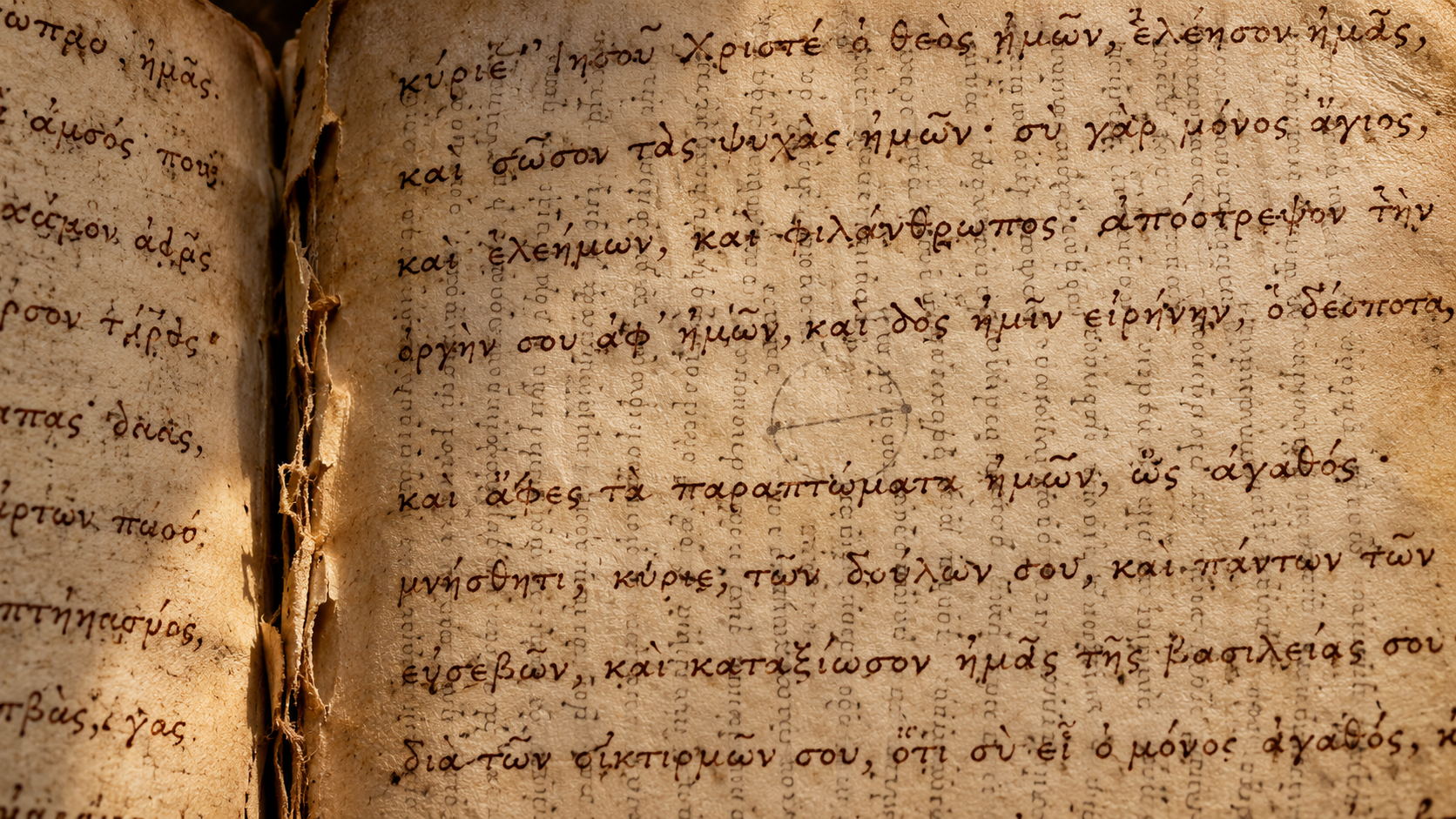
Turn a page of the Archimedes Palimpsest so that the prayers run the right way up and, in places, a second set of lines runs vertically through them. Turn the book a quarter turn and the older writing comes into position. A mathematician once needed the page that way round. Centuries later, a priest needed it the other way. The crease down the middle belonged to the priest, which meant that some of the mathematics disappeared into the binding.
The priest finished his Greek prayer book on Saturday, 14 April 1229, probably in Jerusalem. Its parchment came from several older manuscripts, including a tenth-century copy of works by Archimedes. Someone had erased the old writing well enough to use the sheets again. Enough traces of ink remained, however, for scholars to recover passages centuries later. Among them was an extraordinary letter in which Archimedes explained to another mathematician how he found answers to problems he had yet to prove.
That is what the prayer book preserved. We have no manuscript in Archimedes’ own handwriting. What we have is a medieval copyist’s record of his words, on animal skin that survived because someone had another use for it. Reading those words again would require a catalogue entry, a set of old photographs and, for some of the most stubborn passages, a particle accelerator.
Why Was a Book of Mathematics Turned Into a Prayer Book?
Archimedes lived in Syracuse in Sicily during the third century BC. By the time a Byzantine scribe copied his treatises onto this parchment, roughly twelve centuries had passed since his death. That scribe set out the Greek in columns and copied geometric diagrams alongside the arguments. A reader could follow the letters assigned to points in a figure and return to the corresponding passage to see what Archimedes claimed about them.
By 1229, the sheets were available for a different commission. Parchment was prepared animal skin, a material that took considerable work to produce and could withstand an attempt to remove its writing. A used sheet therefore had value even to someone with little use for its contents. A manuscript made by erasing earlier writing and writing over it is called a palimpsest.
The people who made this one took apart older books, cleared the sheets, turned them and folded them to produce a smaller volume. They wrote a euchologion, a Greek service book containing prayers for use by clergy. The priest who signed it gave his name as Johannes Myronas. His inscription dates the completion of the new book with unusual precision. It tells us considerably less about how the books used for parchment were chosen, or what anyone involved knew about the rarity of their contents.
The change in format explains an otherwise puzzling feature of the surviving object. An ancient argument can run straight across the fold between two prayer-book pages. To read it continuously, a scholar needs a view of the whole unfolded sheet. Opening the bound book wider sounds like the obvious solution, until the skin at the fold is so fragile that the act of opening it could destroy the missing words.
What Survived Beneath the Prayers?
Scholars identified portions of seven works by Archimedes. Four concern the equilibrium of planes, spirals, the measurement of a circle, and the sphere and cylinder. The remaining three give this particular manuscript its exceptional place in the history of mathematics. Each survived in a different sense.
On Floating Bodies was already available through a medieval Latin translation. The palimpsest supplied the only surviving manuscript of the work in Greek. A translation can carry an argument across centuries with considerable accuracy. Having the Greek as well gives editors a way to check a difficult term, reconsider a sentence or see how the wording relates to a diagram. For a work concerned with why objects float and how they settle in a fluid, a small distinction about position or balance can matter.
The Stomachion survives here in a tantalising Greek fragment. There is also evidence in Arabic for the geometrical puzzle associated with it. The fragment lets scholars ask what interested Archimedes about a square divided into fourteen pieces, although too little survives to settle every question about his purpose.
Then there is The Method of Mechanical Theorems. For this work the prayer book is our sole surviving manuscript source. Open most accounts of Archimedes and you meet a man famous for particular answers. Open The Method and you meet him writing to a colleague about what to do when you do not yet know the answer. That is a much rarer encounter.
How Do You Weigh a Shape That Exists Only on Paper?
Archimedes addressed The Method to Eratosthenes, the scholar associated with Alexandria who is remembered for estimating the circumference of the Earth. Archimedes thought his correspondent might use the approach to make discoveries of his own. To explain it, he brought a familiar piece of machinery into an unfamiliar setting. He asked what would happen if geometrical figures could be put on a balance.
Think of a small weight on the long arm of a lever holding up a larger weight close to the pivot. If you know the distances from the pivot and one of the weights, the fact that the bar balances tells you something about the other weight. Archimedes saw a way to use the same relationship on figures whose areas or volumes were difficult to calculate directly.
One example concerns a region bounded by a parabola and a straight line drawn across it. Picture the curved region with a triangle fitted inside, sharing its base and height. The triangle’s area is straightforward to calculate. The awkward part is the extra space between the straight sides of the triangle and the curve. How much does that add?
Archimedes considered the straight lines that cut through the figures. He worked out how their lengths would balance at specified positions on an imagined lever. Bringing those comparisons together gave him a relationship between whole areas. The region bounded by the parabola and the straight line has four-thirds the area of the inscribed triangle. If the triangle covers twelve square units, the curved region covers sixteen. A question about the shape of an edge had yielded to an argument about balance.
Archimedes distinguished this way of finding a result from the geometrical proof he believed it required. Knowing which relationship to prove gave him a considerable advantage. Faced with a blank page, why would anyone pick four-thirds as the ratio worth pursuing? The balance supplied a reason. The survival of the letter means we can still see the point in his thinking at which a promising answer became available.
There is a family resemblance here to integral calculus, in which a mathematician can find a whole by considering its small parts. The resemblance is clearest in the question both approaches ask. What can a succession of cross-sections tell us about an entire figure? Archimedes gives his own answer in the language of Greek geometry and mechanics. The lever deserves to stay in the story. It was the instrument that let him think his way into the problem.
What Was Archimedes Trying to Do With Fourteen Puzzle Pieces?
The Stomachion brings the reader down from imaginary balances to a square you could cut out on a kitchen table. Divide it according to the ancient design and you have fourteen angular pieces. Mix them up, then try to rebuild the square. Finding one solution takes some spatial imagination. A second question arises as soon as the last piece drops into place. How many other solutions are there?
Reviel Netz, Fabio Acerbi and Nigel Wilson argued that the surviving Greek is consistent with Archimedes investigating the different arrangements. On that reading, the puzzle belongs to the history of combinatorics, the mathematics of counting possibilities. The distinction matters because a person who can put fourteen pieces together once has solved a different problem from a person who can establish that every possible arrangement has been counted.
A modern computer investigation by William Cutler found 536 distinct ways to assemble the square under the counting conventions used. That number belongs to the modern investigation. No surviving sentence gives us a final tally from Archimedes. The fragment leaves us with something more open-ended and rather appealing. A game that looks finished when a child fits the last piece can be just beginning for a mathematician.
How Did Anyone Recognise the Faint Greek?
In 1899, the scholar Athanasios Papadopoulos-Kerameus catalogued manuscripts in the Constantinople collection of the Metochion of the Holy Sepulchre. He could see earlier writing beneath the prayers in manuscript 355 and transcribed a few lines. Including that sample in a catalogue entry gave someone who had never handled the book a chance to recognise it.
The lines came to the attention of Johan Ludvig Heiberg, a Danish scholar who had edited Archimedes. He recognised material from On the Sphere and Cylinder. In 1906 he travelled to Constantinople, now Istanbul, to examine the manuscript. An already familiar work had provided the clue that led him to the unfamiliar ones.
Heiberg read what he could, had photographs taken and returned in 1908. His findings informed a new edition of Archimedes published between 1910 and 1915. The photographs acquired a value he could scarcely have anticipated. During the twentieth century the manuscript suffered mould damage, and someone added imitation religious paintings over several pages. For certain passages, researchers working nearly a century later had a clearer view in an early photograph than they could get by looking at the parchment in front of them.
The book’s movements after Heiberg saw it remain incompletely documented. It resurfaced publicly at auction in New York in 1998. The private buyer deposited it at the Walters Art Museum in Baltimore, where conservators, specialists in ancient Greek and imaging scientists could work on the same leaves. Their first difficulty was the fold that the prayer-book makers had put there in the thirteenth century.
Why Did Taking the Book Apart Take Nearly Five Years?
At the Walters, conservator Abigail Quandt began disbinding the manuscript in February 2000. She finished in November 2004. The binding concealed parts of the older text, but freeing a leaf meant working against adhesives as well as the damage that damp and mould had already done to the skin. Where two surfaces adhered, pulling them apart could leave the surface carrying the ink attached to the wrong sheet.
Conservation determined what the scientists would ever get to see. A camera could be tried again with a different exposure. A piece of lettering lost when a fragile fold came apart was gone from the object for good. The years spent releasing the leaves allowed the imaging team to photograph the older columns across what had been the gutter of the prayer book.
The researchers then photographed the same areas under different kinds of illumination, including ultraviolet light. Bare parchment and traces of old ink respond differently to light at different wavelengths. Under ultraviolet illumination the parchment can fluoresce, making a faded stroke stand out against its surroundings. By comparing and combining exposures, the team could give a scholar a much clearer distinction between the two sets of handwriting.
Some processed images show the old writing in a conspicuous artificial colour. That colour is a reading aid. It represents differences the equipment detected and makes them easier for a human eye to follow. The scholar still has to decide whether a stroke belongs to a particular Greek letter, a geometrical figure, a prayer on the other side of the leaf or a damaged patch of skin.
How Could Scientists Read Through a Painting?
The twentieth-century paintings posed a harder problem. Changing the illumination could bring up faded ink on exposed parchment. Opaque paint put another material directly in the way. At the Stanford Linear Accelerator Center in California, researchers used a technique called X-ray fluorescence to look for iron in the ink.
A narrow X-ray beam scanned the parchment. Where the beam excited iron atoms, they emitted X-rays with energies characteristic of iron. Recording the strength of that signal at successive positions produced a map. Where enough iron remained along the strokes of a letter, its shape could emerge through material that defeated an ordinary photograph.
An iron map has its own ambiguities. Ink on either side of a leaf can contribute to the signal, and both medieval scribes could have used ink containing iron. Here the decision to rotate the parchment in 1229 became an unexpected advantage. When two lines crossed, a reader knew which direction to follow for the mathematics and which would lead into a prayer.
One of the most satisfying readings concerned Johannes Myronas himself. X-ray imaging helped recover the inscription giving his name and the day he completed the prayer book. The same investigation that brought back passages of On Floating Bodies let the medieval priest sign his work again.
What Can You See for Yourself?
In 2008, the project publicly released its images and data. A reader can now compare views of the same leaf, turn an image through ninety degrees and look for a line that continues across the old binding. The sheets also yielded writing by other authors, including speeches by the Athenian orator Hyperides and a commentary on Aristotle’s Categories. Whoever gathered the parchment had drawn on a small collection of books whose identities gradually emerged from a single service book.
It is easy to look at the dark prayers and wish the priest had found some fresh parchment. Yet the history of ancient books offers little reassurance about what would then have happened to the old mathematical volume. Its chances depended on someone keeping it, copying it or finding another use for it. The larger problem of what it took to keep Greek works in circulation runs through the history of Alexandria’s library.
On this occasion, we know the particular use that carried the parchment forward. Someone wanted a book of prayers ready in April 1229. Across the grain of those prayers we can still read a letter from one mathematician to another, offering an idea about a lever in the hope that his friend might find something new.
Sources
The Archimedes Palimpsest Project — About the Manuscript describes the prayer book, its construction and the seven Archimedes treatises.
The Archimedes Palimpsest Project — History of the Manuscript traces the catalogue clue, Heiberg’s visits and the gaps in the book’s later history.
The Method of Archimedes, translated by Thomas Heath includes the address to Eratosthenes and the argument about the parabolic segment.
Netz, Acerbi and Wilson — Towards a Reconstruction of Archimedes’ Stomachion examines the fragment and the case for a counting problem.
ETH Zurich — Stomachion explains the puzzle and William Cutler’s modern count.
The Archimedes Palimpsest Project — Conservation records Abigail Quandt’s work to release the leaves for imaging.
Stanford Linear Accelerator Center — The Archimedes Palimpsest Project explains the imaging campaign and the use of X-rays.
Uwe Bergmann and colleagues — Chemical Mapping of Ancient Artifacts and Fossils reproduces the iron map revealing the priest’s dated inscription.
Library of Congress — From Decayed Parchment to ‘Bit Rot’ documents the public release of the project’s images and data.
Next Reads
What If the Library of Alexandria Had Survived? explores what it took to keep an ancient text alive across generations of readers and copyists.
Did the Dead Sea Scrolls Change the Bible? What the Great Isaiah Scroll Shows follows the evidence down to a single word preserved in an ancient manuscript.
666 Explained: Why the Number of the Beast Probably Meant Nero and the 616 Variant examines how a handful of surviving characters can preserve a centuries-old disagreement.
