What 5,511 Stone Artefacts Reveal About Life Beside Arabia’s Lost Lake
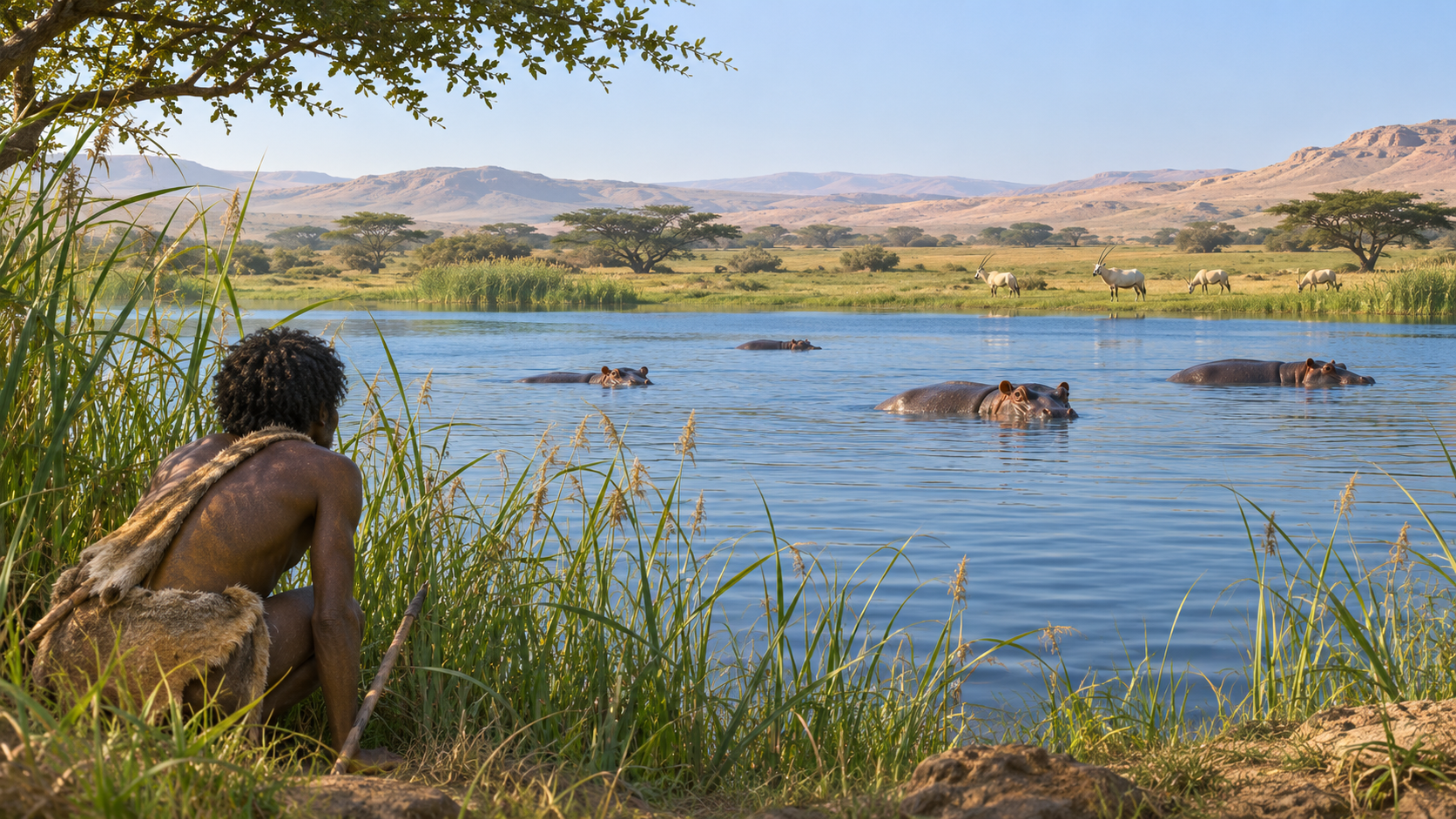
Hippos Once Swam In Arabia’s Empty Quarter.
Twenty-four pieces of flint picked up beside a vanished lake in southern Saudi Arabia fit back together. Someone had worked the stone there, striking off one flake after another. Enough of the pieces stayed near one another for archaeologists to recover part of that sequence thousands of generations later. On the same ancient shore, the team found the teeth and bones of animals that would struggle to survive there today.
Around 125,000 years ago, people arriving at the Mundafan basin would have found fresh water, grazing animals and plants they could turn into useful equipment. Hippos occupied the lake. Gazelles, oryx and giant long-horned buffalo lived in the surrounding grasslands. What archaeologists have now recovered at Uruq al-Julaybah, on the old shoreline, includes thousands of stone artefacts and microscopic traces of the wood, fibres and animal tissue those stones touched.
It is an unusually intimate record of work in a place now known chiefly for its dunes. It also raises a question on which archaeologists differ. How securely can the age of an ancient lake be attached to objects collected from its eroding shore?
How Big Was the Lake in the Empty Quarter?
At its greatest reconstructed extent, Lake Mundafan covered about 340 square kilometres and reached a maximum depth of roughly 29 metres. For people travelling across southern Arabia during the last interglacial, a warm interval between ice ages, this would have been a substantial geographical feature. A traveller could reach the water at one point and still have kilometres of shoreline to explore in either direction.
Researchers mapped the shape of the basin using satellite terrain data. On opposite sides, they identified sediment layers that sloped towards the former lake centre. They also traced an outlet through which water could escape when the basin filled. Those features helped them reconstruct where the water stood. To establish what kind of water it was, they turned to some of the smallest creatures in the study.
Molluscs and tiny shelled crustaceans preserved in the deposits included species associated with fresh water. Their remains helped distinguish a lake that persisted from a hollow that filled briefly after rain. At the other end of the scale was a juvenile hippopotamus. More than 50 pieces of its skeleton lay within an area of about a square metre and a half. So many remains from one animal, close together, make more sense as a local deposit than as bones swept in separately from a distant watercourse.
What 5,511 Pieces of Stone Can Tell Us
Researchers collected 5,511 stone artefacts larger than two centimetres in the main survey area. More than 98 per cent were flint. That count includes material discarded during manufacture. For anyone trying to understand what happened on the shore, the discarded pieces are among the most informative things a toolmaker could have left behind.
Consider a single finished point. Someone might have made it on the spot, carried it for days or picked it up after another person left it. The place where it finally came to rest tells us little about where the work began. A group of matching flakes gives a different answer. Their edges and surfaces can fit together, allowing researchers to work backwards through a series of blows. At Mundafan, one reconstructed sequence ended with the removal of a point.
The toolmakers used an approach archaeologists call Levallois. It involved shaping a piece of stone, known as a core, so that the surface already influenced the form of the flake that would come away. By matching pieces, the team could recognise decisions made before the final blow. The shoreline was somewhere people stopped long enough to do that work. Precisely how many visits the debris represents remains open.
The Plants That Survived on Stone Edges
Some of the most revealing tools had toothed edges. Under magnification, researchers found plant fibres and wear consistent with sawing or shredding vegetation. Across the collection they identified traces of bark, palm leaves, reeds, wood and underground plant parts. These finds give the grass and vegetation around the lake a place in the human story beyond providing food for grazing animals.
A length of cord would have had a poor chance of surviving on an exposed shore for so long. A flint used to work the fibres could endure, with a minute fragment still caught on its edge. That difference in survival can distort our impression of what people owned. A collection laid out in a museum drawer might look overwhelmingly like stone equipment even if much of what its makers handled each day was perishable.
Mundafan offers a way to recover some of that missing work. Fibres on a toothed cutting edge suggest an action. Fibres and resin together at the base of a point suggest that part of the stone had once been attached to something else. Cord and containers are among the possible products of plant working, although no finished example recovered here allows researchers to identify what an individual craftsperson set out to make.
Did People Hunt Hippos at Mundafan?
One damaged stone point carried animal fats and protein near its tip. At the opposite end, researchers identified traces of resin and plant fibre. The distribution matters. The materials associated with attachment occurred where a shaft would have met the stone, while the traces of animal contact occurred at the working end. Fractures at the tip added a further clue that the point had struck something with force.
Together, those observations make a good case for a hunting implement. Chemical traces on some points also led the researchers to propose that hunters used toxic plants. That interpretation is more tentative. A surviving compound can establish contact with plant material more readily than it can establish someone’s intention in putting it there.
And the hippos? Their remains establish that these animals lived at Mundafan. Animal fossils and stone artefacts also clustered in parts of the site, and the researchers interpret some of the activity as carcass processing. Even so, the evidence falls short of connecting a particular point to a particular hippo. The young animal whose bones survived in a small patch of ground could tell us a great deal about the lake without ever having encountered a hunter.
Why the Date Is Easier to Establish for the Lake
Buried sand grains retain a signal that researchers can use to estimate how long it has been since sunlight last reached them. Samples from the Mundafan shoreline gave overlapping age estimates around 125,000 years. Analysis of fossil hippo teeth provided a separate check on the chronology. Together, the results place a substantial freshwater lake here during a wetter phase of Arabian history.
The stone artefacts present a harder problem. Wind has stripped sediment from the shore, leaving objects exposed at the surface. Archaeologist Jeffrey Rose, who was independent of the study, pointed out that the team collected the tools from that surface. In his reading, the age of the underlying deposits gives a maximum age for the tools. People visiting later could also have left flint on an older shore.
The research team’s case rests partly on how much pattern survived erosion. Flakes still fit one another. Fossils remained in tight groups. Delicate residues clung to working edges. The authors interpret the site as the accumulated record of repeated activity around the ancient lake, with some movement of material after burial. A future discovery of tools sealed within an independently dated layer would help resolve the disagreement. It would be particularly valuable for judging how far back the evidence for hunting with toxic plants truly reaches.
Who Were the People on the Shore?
The researchers consider Homo sapiens a plausible maker of the tools. Our species had already reached parts of south-west Asia during this broad period. No human fossil was recovered at Uruq al-Julaybah, however, and the Levallois method was shared widely enough that a flint point cannot identify the species or birthplace of the person who made it.
Mundafan answers a more local question about early journeys through Arabia. A map can show where people might have travelled when rainfall opened routes across the peninsula. It takes a different kind of evidence to explain why they might have stayed somewhere along the way. Here there was stone to work, vegetation worth cutting and a dependable body of water that drew animals to its margins.
When conditions grew drier, the opportunities along that shore changed. Where its visitors went next is unknown. Of all the things they left, those matching flakes offer perhaps the closest encounter with an individual. We cannot follow the toolmaker away from Mundafan. For part of one working day, though, we can follow the order in which the stone came apart.
Sources
Science — The original study of hunting, plant use and megafauna at the Mundafan lakeshore
King Abdullah University of Science and Technology — Mapping the lake and surveying the site
Griffith University — What the stone points and plant residues revealed
Live Science — Independent archaeological assessment of the dating evidence
