Why Eagle Talon Marks on Adult Baboon Skulls Matter for Human Evolution
The Baboons Sounded An Alarm When Two Eagles Flew Over.
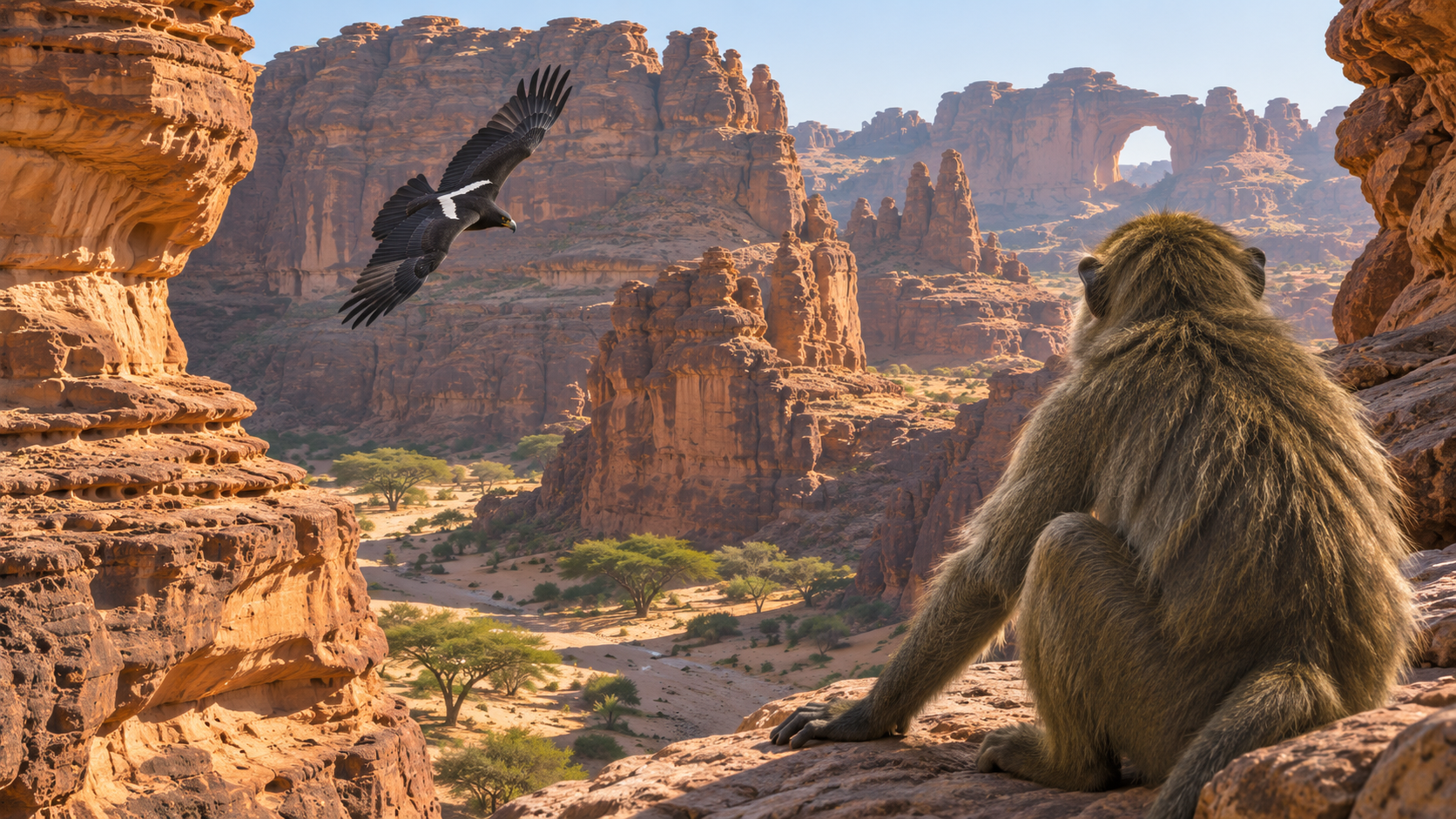
When a pair of Verreaux’s eagles swept over the cliffs of northern Chad, the olive baboons called out and dropped to shelter. The researchers watching had seen the same monkeys remain relaxed around other large birds of prey. Something about these eagles warranted an alarm. In the eye sockets of adult baboons, the team found a possible reason.
Could eagles have hunted early human relatives? For one child who lived about 2.8 million years ago, an eagle attack is already a leading explanation for its death. The discovery in Chad raises a different possibility. Some of our relatives may still have been vulnerable after they grew up. One adult male baboon with injuries consistent with eagle talons had an estimated body mass of 26.2 kilograms. That puts him within a few kilograms of Lucy, one of the best-known adults in the human fossil record.
What the Researchers Found on the Ennedi Plateau
The Ennedi Plateau rises from the Sahara in a series of sandstone cliffs. Water collects in rocky pools known as gueltas, and an isolated population of olive baboons lives among the outcrops. The same terrain suits Verreaux’s eagles. From a baboon’s perspective, a ledge that puts a steep climb between it and a predator on the ground offers little shelter from a bird approaching across the gorge.
The bones at the centre of the study came from this modern population. During fieldwork in February and March 2025, researchers recovered remains from nine baboons. Eight were adult males. Two males had punctures in their eye sockets, and one shoulder blade bore a series of scraping marks. A thigh bone associated with one male allowed the team to estimate that he weighed 21.8 kilograms in life. He accounts for the rounded figure of 22 kilograms in the title of the study, published on 18 November 2026 in the American Journal of Biological Anthropology.
The larger figure came from a return visit. In June 2026, the researchers recovered the skull and part of the skeleton of another adult male. They estimated his weight at 26.2 kilograms, or nearly 58 pounds. Again they saw punctures consistent with talons and heavy scoring across the shoulder blades. Two visits had now yielded the same unusual combination of injuries in a place where the researchers could also watch the birds and baboons encounter one another.
Can a Skull Distinguish a Hunter From a Scavenger?
A shoulder blade is a broad, relatively thin bone. An eagle gripping or pulling at a carcass can score its surface as it feeds. Those marks help identify what handled the body. Establishing when the bird arrived is harder. An eagle could leave feeding marks on a baboon it killed itself or on one it found dead at the foot of a cliff.
The punctures around the eyes carry more weight in the researchers’ interpretation. Their position and severity fit the forceful grip an eagle uses to subdue prey. An adult male with both cranial punctures and scored shoulders therefore preserves evidence consistent with two stages of an encounter. In the team’s reconstruction, the eagle seized the baboon by the head and subsequently fed on its body. That sequence would account for both kinds of damage.
The baboon’s condition immediately beforehand remains unknown. An animal already weakened by injury could be easier to overpower than a healthy male of exactly the same size. An eagle taking such an opportunity would tell us something different about life on the plateau from a bird regularly singling out the strongest adults in a troop. The field team witnessed the alarm response. The deaths represented by the skulls took place out of sight.
An Eagle Could Kill More Than It Could Carry
Before the Chad study, the researchers placed the upper end of confirmed primate prey for birds of prey at around 13 kilograms. It is easy to picture this as a problem of flight. Could a bird weighing only a few kilograms get airborne with an adult baboon in its feet? Yet the most demanding part of that imagined scene is also the part the evidence never requires. An eagle could feed where an animal fell or carry away a portion. The weight it could lift would tell us little about the injury it could inflict while both animals were on a ledge.
That distinction gives the comparison with Lucy its force. Lucy belonged to Australopithecus afarensis and lived in what is now Ethiopia about 3.2 million years ago. One estimate puts her weight at around 28 kilograms. Allowing for the uncertainty in reconstructing body mass from a skeleton, she and the largest Ennedi male were remarkably close in size.
Lucy’s bones supply no evidence here about how she died. What changes is the basis for assuming that an adult of her size had outgrown the danger. If an eagle could bring down a baboon weighing roughly 26 kilograms, then a few more kilograms offer little grounds for declaring an early human relative safe. The strongest evidence that an eagle actually took a member of our family comes from a different skull, thousands of kilometres to the south.
The Clue Beneath the Taung Child’s Eyes
In 1924, quarry workers in South Africa recovered the skull that became known as the Taung Child. It belonged to Australopithecus africanus. Its first permanent molars were just emerging, and the development of its teeth puts its age at death at about three years and four months. The skull became famous for what it revealed about human origins in Africa. The delicate bone beneath its eyes also held a clue to what happened to this particular child.
Researchers recognised punctures in the floors of the eye sockets resembling damage eagles leave on monkeys today. The remains found alongside the child strengthened that interpretation. They included small baboons, tortoises, rodents and other animals, some with injuries associated with birds of prey. An eagle gathering food could account for both the punctures and the otherwise curious company in which the child’s skull was found.
At Taung, scientists have an actual member of the human family with a plausible eagle injury, but the individual was very young. At Ennedi, they have evidence involving fully grown primates and can observe the local birds and monkeys interacting. The missing piece is an adult early human relative with comparably persuasive injuries. That is what makes the modern baboon skulls worth studying alongside a fossil child.
Why Were So Many of the Baboons Male?
Eight adult males in an initial sample of nine baboons is a striking imbalance. It is also a difficult one to interpret without knowing which baboons died elsewhere on the plateau or whose bones were easiest to find. A collection of remains could contain mostly males even if an eagle had never chosen between a male and a female standing side by side.
One possibility involves defence. In some primates, large males approach or charge an eagle to drive it off, a behaviour known as mobbing. A male that closes the distance might be the individual most exposed if the bird turns on him. Another possibility concerns a male travelling alone between troops. He would lack the extra pair of eyes that might spot a bird early enough to sound an alarm. These explanations lead to quite different things to look for in the field. Was the male alongside others when the eagle approached? Did he move towards it? Or did the bird encounter him when he was already alone?
For the history of our own family, that alarm on the cliff may ultimately prove as informative as the weight of the largest male. A heavy adult could benefit from another animal spotting an eagle first, even if successful attacks on adults were rare. And for anyone examining an adult hominin skull, the Chad findings suggest a particular place to look. A puncture in the thin floor of an eye socket, considered alongside the other bones recovered with it, could tell us whether one of our relatives had reason to heed the same warning.
Sources
Catherine Hobaiter and colleagues — Signs of Eagle Predation on a 22-kg Adult Primate — The original study documents the Ennedi remains, the body-mass estimates and the additional male recovered in June 2026. lifescience.net
University of St Andrews — Eagles preying on human-sized baboons upend existing evolutionary defense theory — The researchers describe the troop’s response to two Verreaux’s eagles and explain why the adult males surprised them. phys.org
Smithsonian Human Origins Program — Taung Child — The specimen record includes a close-up of the eye-socket damage, the dental age estimate and the evidence from animals found alongside the child. humanorigins.si.edu
Live Science — Eagles hunt baboons weighing up to 60 pounds, raising questions about whether birds of prey hunted ancient humans — Independent specialists assess the possibility of opportunistic attacks and the difficulty of establishing that an eagle killed a healthy adult. Live Science
Next Reads
Hidden Hominins in the Modern World? Unraveling the Mystery — Meet the small-bodied human relatives whose remains expanded the known range of our family tree.
Ancient Teeth And Betel Nut: The Evidence For Humanity’s Earliest Habitual Drug Use — How distinctive marks on teeth helped researchers test an explanation for behaviour in the deep past.
Ancient DNA Britain Is Rewriting Early Britain—But Not the Way People Think — Why the individuals whose bones survive can shape the conclusions scientists draw about a whole population.
