If the USSR attacked while Hitler invaded France
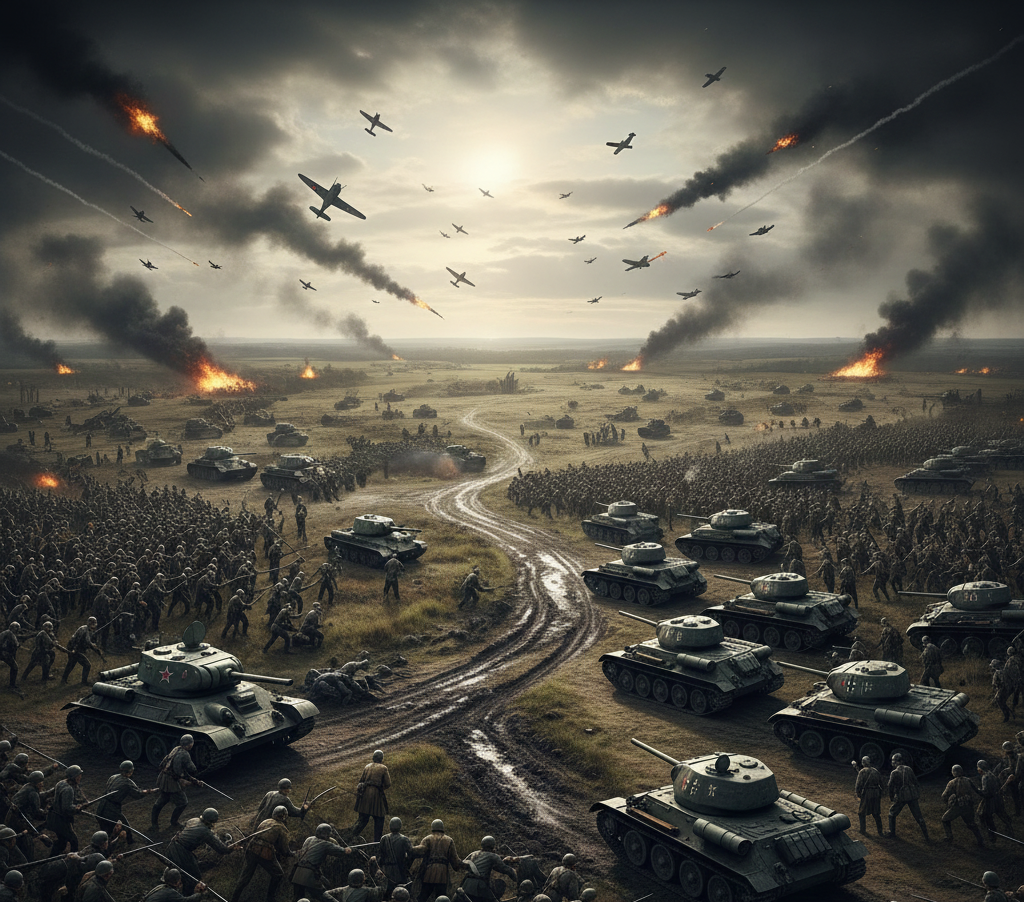
Germany launches its western offensive in May 1940. The gamble works in our timeline because Berlin pours attention, aircraft, fuel, and its best mobile units into one direction. France is beaten fast because the Germans keep the tempo, keep the skies contested, and keep their armoured thrusts fed.
Now change one thing. Stalin attacks in the east while that western punch is still moving.
The war stops being a sprint to Paris and becomes a scramble for time.
The shock in Berlin
The first effect is psychological. Germany expected a clean run in the west. A Soviet strike turns it into a two-front crisis overnight. Hitler’s system depends on tight coordination, quick decisions, and the ability to move units by rail like chess pieces. A second front in the east doesn’t just add fighting. It adds chaos.
Everyone in the German chain of command starts asking the same question: are we still winning if we can’t finish France quickly?
Where the USSR would hit
A Soviet attack in 1940 has a few obvious directions.
One is East Prussia, a German pocket that is politically important and awkward to defend. Another is through the Polish corridors towards the Oder and Berlin, aiming to cut rail lines and force Germany to defend its heartland. A third is pressure southwards that threatens Romania, because Romania is tied to Germany’s fuel lifeline. You can win battles without oil. You can’t win the war.
Stalin’s best strategic move is the one that makes German planners lose sleep: anything that jeopardises fuel and rail.
What happens to the invasion of France
Germany’s May 1940 victory is about concentration. Break the front, keep moving, and turn the Allied response into a series of late reactions. If the USSR attacks, Germany has to make choices that it never wanted to make mid-gamble.
Does it keep driving west, trying to finish France, while accepting danger in the east?
Or does it slow the western advance to stabilise the east?
Either decision costs Germany the one thing it used like a weapon in 1940. Time.
Even small diversions matter. If fighter cover is shifted east, the Luftwaffe can’t lean as hard on the skies over France. If fuel and spares are redirected, armoured units lose momentum. If mobile formations are pulled to plug holes in the east, the famous sickle-cut becomes less of a guillotine and more of a grinding push.
And a grinding push is exactly what France and Britain needed. Not heroism. Not brilliance. Just time to reorganise.
The Red Army problem
A Soviet attack sounds terrifying, but 1940 is not 1944. The Red Army has numbers and depth, yet it is still blunt in the way it uses them. Command is uneven. Coordination is shaky. Logistics are heavy and slow. The recent war with Finland has exposed real weaknesses.
So the USSR can hit hard, especially at the start. But sustaining a clean, fast advance is difficult. Soviet losses could be huge. A bold early push might still stall once Germany stops panicking and starts improvising.
This creates a strange balance. The USSR is strong enough to force Germany into hard decisions, but not yet polished enough to guarantee a decisive breakthrough.
Germany’s two ugly options
Hitler is forced into one of two paths.
First path: finish France at all costs. That means keeping the western thrust moving and treating the eastern threat as a fire to be contained later. It is high risk, because it relies on Soviet momentum being disorganised enough not to crack Germany’s eastern defences before France is beaten.
Second path: stabilise the east immediately. That means dragging resources away from the western offensive. The cost is obvious. The western campaign becomes slower, messier, and less certain. France may not fall quickly. The British may not need a desperate, last-chance evacuation. The Allies may even manage coherent counterattacks instead of a series of retreats.
In both paths, the clean German victory becomes harder.
The oil lever that changes everything
The most dangerous Soviet pressure is not a straight line towards Berlin. It is anything that threatens the supply routes tied to Romania’s oil. Germany’s war machine is hungry. Tanks, trucks, aircraft, rail transport, industry. Everything consumes fuel.
If oil becomes scarce or uncertain, the western invasion loses bite. If oil is threatened long-term, Germany is forced into a strategic panic. It can win battles while its engine is running hot. It cannot run forever if the tank is draining.
That is why a Soviet move in the south is the most frightening version of this scenario. It also risks widening the war across the entire region, because no side can afford to treat it as a sideshow.
The most likely shape of the new war
There are a few plausible outcomes, but the most realistic one is not an instant collapse of Germany or an instant Soviet triumph. It is a slowed, dirtier 1940.
France lasts longer. The British position becomes less desperate. Germany still fights brutally, but it no longer controls the calendar. The western front turns from a lightning catastrophe into a struggle with breathing space.
In the east, the USSR may gain ground early, then pay for it in blood and confusion. Germany will counterattack where it can, using rail and concentrated armour once it stabilises the crisis.
The result is a war that becomes fully continental earlier than anyone planned. A two-front grind begins in 1940, not 1941.
What it means in human terms
Cities in the east burn sooner. Refugee columns start earlier. Governments make harsher choices faster. Britain becomes more confident, because Germany looks less unstoppable. The Soviet Union looks both aggressive and vulnerable at the same time, because its attack reveals strength, and also reveals the limits of its readiness.
Most of all, the myth of a neat German master-plan cracks. The Nazi war machine was terrifying, but it was not infinite. It relied on momentum. A second front steals momentum like a thief in the night.
What If?
If Stalin attacks during the invasion of France, Germany’s greatest advantage in 1940 is weakened. The most likely change is not an immediate, clean reversal. It is that France survives longer, Britain gets more room to breathe, and Germany is dragged into an earlier two-front strain.
The war becomes longer, uglier, and less predictable, a full year sooner.
If you want, I can write this as a tight, cinematic timeline with dated beats, from the first Soviet shells to the moment the western advance either stalls or scrapes through.
