What If the Dunkirk Evacuation Failed: The Day Britain’s War Could Have Ended
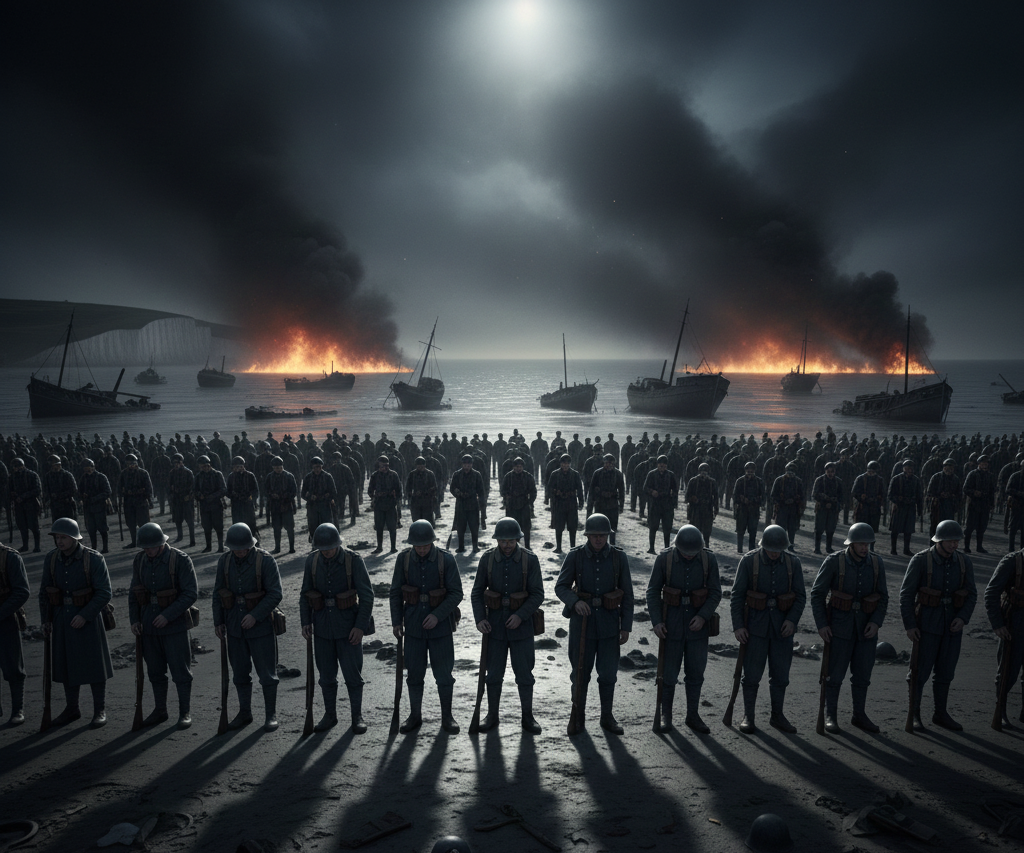
In any alternate history of World War II, a Dunkirk evacuation failed scenario sits near the top of the list of true hinge moments. In late May and early June 1940, Britain did not just try to rescue troops from a beach. It tried to rescue the core of its trained army, its confidence, and its ability to keep fighting.
If the evacuation collapses—if the ports are smashed, the ships are sunk, and the trapped forces are captured—the shock lands in London like a physical blow. The question stops being “How do we fight on?” and becomes “Can we even survive the summer?”
This piece walks through what would likely change first, what would change later, and what might not change at all. It looks at politics, military reality, economics, and public morale, and it separates the plausible from the cinematic.
The story turns on whether Britain could replace a shattered army faster than Germany could force a political collapse.
Key Points
The Dunkirk evacuation saved roughly 338,000 Allied troops in 1940; a failure would mean mass capture of Britain’s most experienced soldiers and a steep loss of equipment.
Britain might still fight on, but it would do so with a hollowed-out army, tighter home defense, and a sharper fear of invasion.
The immediate political battle in London would intensify: resist at all costs versus explore terms before the country bleeds out.
Germany’s strategy could shift from breaking Britain’s air power to exploiting panic, sabotage fears, and diplomatic pressure.
The longer the war continues without the Dunkirk survivors, the more Britain’s global position—empire logistics, alliances, and industrial output—gets strained.
A failed evacuation would not guarantee a German victory, but it would raise the odds of a negotiated settlement or a leadership change in Britain.
Background
By late May 1940, German forces had driven deep into France and the Low Countries, cutting off large Allied formations. The British Expeditionary Force (BEF), alongside French units, was pushed back toward the Channel coast. Dunkirk became a shrinking pocket under air attack, with the sea as the only exit.
Operation Dynamo—the evacuation—ran from May 26 to June 4, 1940. Warships, merchant vessels, and hundreds of small civilian craft moved men off the beaches and out of the harbor under constant pressure. Most heavy equipment was left behind. What made the outcome decisive was not the hardware. It was the survival of trained manpower: officers, NCOs, technical specialists, and battle-tested infantry who could form the backbone of any rebuilt army.
A “failed Dunkirk” can mean several things, and each has a different knock-on effect. It could be a sudden disaster—one or two days of concentrated air and naval losses that shut the evacuation down early. Or it could be a slower collapse, where evacuation continues but only at a fraction of the historical rate. The darkest version is simple: the pocket falls before large-scale evacuation is possible, leading to the capture of hundreds of thousands of troops.
Analysis
Political and Geopolitical Dimensions
A failed evacuation instantly raises the temperature inside Britain’s wartime leadership. In real history, the argument over whether to seek terms or fight on was already present. Remove the returning soldiers, and the “fight on” camp loses its most powerful emotional evidence: the visible proof that Britain can absorb a blow and keep moving.
Three political paths become plausible.
In the first, Britain stays the course under hardline leadership. The argument is stark: surrender now means subjugation later, and the country’s navy and empire still give it strategic depth. This path is possible, but it becomes more brittle. Every air raid, every rumor of invasion, every shipping loss has more leverage over public confidence.
In the second, Britain explores negotiations. Not because leaders suddenly admire Germany, but because they fear a rapid military endgame with no army to stop it. Even limited “feelers” would be politically explosive. They could fracture a government, trigger resignations, or produce a change at the top.
In the third, Britain sees a leadership reshuffle framed as national survival. In a crisis, elites often choose “stability” over “defiance,” especially if they believe time is not on their side. That does not guarantee capitulation. But it can steer strategy toward a ceasefire attempt, a mediator, or terms that freeze the conflict.
Internationally, a failed evacuation changes what other capitals believe about Britain’s staying power. Neutral states hedge more aggressively. Friendly states become cautious. And the United States, still outside the war at that point, reads Britain’s situation through a colder lens: is this a future partner, or a sinking ship?
Economic and Market Impact
War economics is confidence economics. A failed evacuation is not just a military loss. It is a signal that Britain may have to spend immediately on emergency defense, while also losing access to equipment and supply lines in Europe.
Insurance rates for shipping risk would surge. Merchant losses matter more because Britain’s survival depends on imports—food, fuel, raw materials, and munitions components. If Britain feels invasion is imminent, it also diverts labor and materials into coastal defenses, air raid protection, and rapid training programs. That is productive in one sense, but it is not the same as building long-run combat power.
There is also a painful human-capital problem. The men captured are not easily replaced. Britain can train recruits, but training time is not the only constraint. Experience is. The country would lean even harder on older reservists, teenagers, and accelerated officer courses, and it would do so while trying to expand aircraft production and keep ships afloat.
Over time, this could produce a war economy that is larger but less efficient—more urgent, more improvised, more exhausted.
Social and Cultural Fallout
Dunkirk became a national story of escape, endurance, and improvisation. Remove that story, and the cultural tone shifts.
A failed evacuation means a nation grieving at scale without the catharsis of “they’re home.” Almost every town would feel it. Families would live with uncertainty about prisoners, missing men, and conditions in captivity. Rumors would multiply: betrayal, incompetence, fifth column plots, secret deals. In wartime, those rumors do not stay private. They shape behavior.
Public morale is not a single number. It is a web of small beliefs: that leaders are competent, that sacrifice is shared, that tomorrow is survivable. A catastrophe at Dunkirk snaps several strands at once.
Paradoxically, it could also harden a portion of society into grim determination. People can become more stubborn after trauma. The question is whether that stubbornness translates into political stability, or into anger at leadership and a demand for a “different plan.”
Technological and Security Implications
With the army gutted, Britain’s defense posture becomes more lopsided. Air power and naval power carry more weight, because there is less ground force capacity to absorb a landing or crush a foothold.
That shifts priorities. Britain would pour even more resources into fighter aircraft, radar integration, anti-aircraft guns, and coastal surveillance. Home defense units would expand faster, often with uneven training and equipment. Intelligence and counterintelligence would also become more central, because fear is a weapon: fear of parachutists, saboteurs, and internal collapse.
Germany, meanwhile, might find new leverage. Instead of betting everything on a clean invasion, it can escalate pressure through air attacks, mining sea lanes, and psychological warfare designed to convince Britain that continued resistance is hopeless.
A failed evacuation does not automatically make invasion succeed. Amphibious operations are brutally complex. But it does make Britain’s margin for error thinner. One bad week matters more.
What Most Coverage Misses
The overlooked factor is not the beach. It is the training pipeline.
Even if Britain refuses to negotiate, it still needs time—time to train formations, time to equip them, time to build the institutional muscle that turns civilians into units that can fight together. Dunkirk’s survivors were not just bodies. They were the cadre that could turn new recruits into a functioning army. Without them, Britain may still raise forces, but the quality curve shifts downward for months.
The second overlooked factor is the empire’s double edge. Britain can draw on global resources and manpower, but doing so requires shipping, escorts, and political buy-in across multiple regions. If the home islands look close to defeat, that buy-in becomes harder to sustain. Allies and dominions support strength. They worry about weakness.
Why This Matters: If the Dunkirk Evacuation Failed
In the short term, the people most affected would be British households, coastal communities, and the industrial regions tasked with emergency production. A failed evacuation would sharpen rationing pressures, expand civil defense, and intensify the anxiety that the war could arrive at the doorstep.
In the medium term, the biggest change is strategic. Britain’s ability to act offensively would shrink. Instead of thinking about future landings and overseas campaigns, the country would spend more time simply staying alive: keeping trade routes open, preventing invasion, and maintaining political cohesion.
In the long term, the shape of the postwar world could tilt. If Britain leaves the war early through a settlement, Europe’s balance of power changes. If Britain stays in but weaker, it may become more dependent on external support later, with less influence over war aims and postwar planning.
Within 1940 itself, the pressure points would come fast: the fall of France in June, the air battle over Britain in the summer, and the sustained bombing campaign that followed. In this alternate timeline, each stage is heavier because the army is no longer a reassuring backstop.
Real-World Impact
A factory supervisor in the English Midlands faces a brutal production pivot. Skilled workers are pulled into emergency defense roles, while output targets rise. Accidents increase, absenteeism becomes a quiet crisis, and management fights a daily battle to keep machines running.
A small-town pharmacist in coastal Kent watches demand shift overnight. Bandages, antiseptics, and basic pain relief vanish quickly. The fear of invasion changes what people hoard, what they ask for, and how they talk to each other in the queue.
A shipping clerk in Liverpool sees the war become arithmetic. Every loss at sea hits food prices, fuel availability, and the mood on the docks. When convoys are delayed, everything down the line slows, from bread deliveries to factory schedules.
A junior officer in a newly formed home defense unit confronts the hardest truth of the alternate timeline: training is not bravery. It is repetition. And repetition takes time they may not have.
Conclusion
If Dunkirk had ended as a trap instead of an escape, Britain’s war would have entered a more dangerous, more politically unstable phase immediately. The country might still have refused to bow. It might still have fought on with sea power, air power, and sheer national stubbornness. But the loss of trained manpower would have made every decision costlier and every setback louder.
The fork in the road would be simple and brutal: resist and gamble on survival through the air and at sea, or explore terms before military weakness turns into political fracture. Neither path is clean. Both involve trade-offs that would echo for decades.
In this alternate history, the signs that matter are not heroic speeches. They are quieter signals: whether government holds together under pressure, whether shipping losses stay manageable, whether fighter defenses prevent a crisis of confidence, and whether Britain can rebuild an army before fear does the job the enemy could not.
