What If Hitler Failed to Invade France?
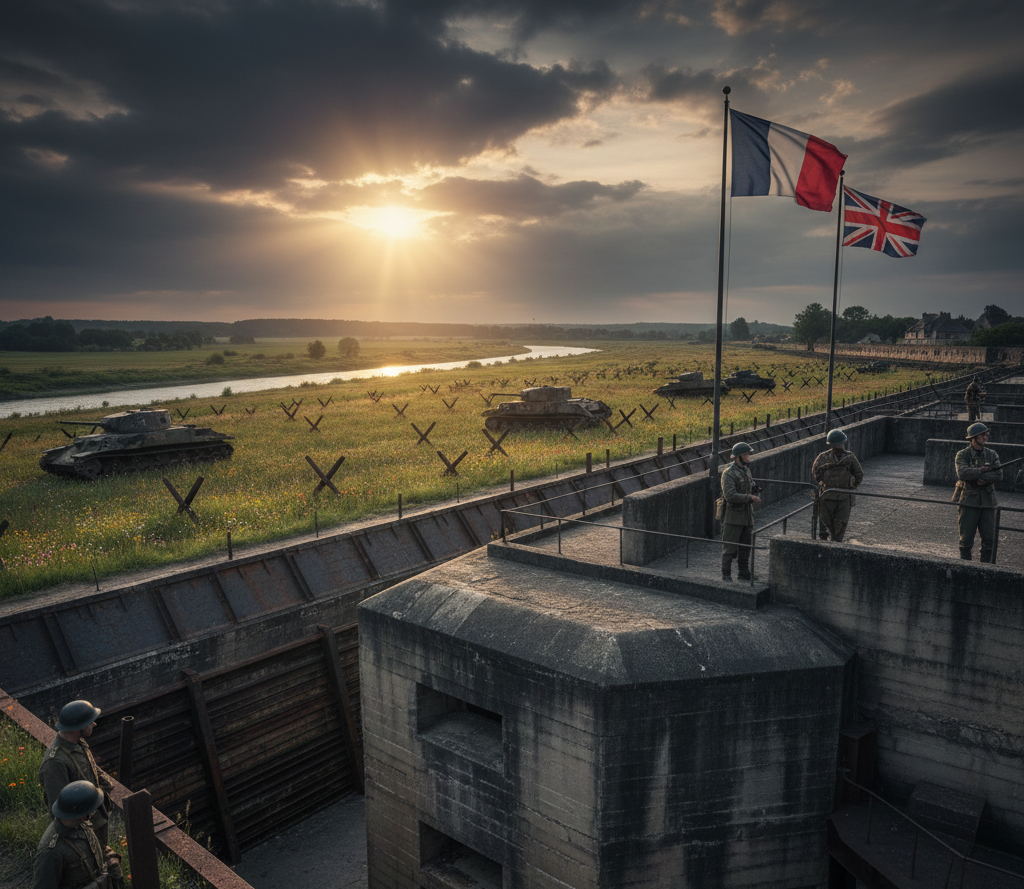
In this alternate timeline, Hitler fails to invade France in May 1940. The German offensive begins, but it stalls fast. The breakthrough that once cracked the Western Front never arrives.
It matters because France falling in 1940 did not just reshape a map. It reshaped the entire war’s tempo, the balance of industry, and the psychology of victory. If the invasion fails, every major player faces a new problem: how to keep fighting when the “short war” promise collapses.
This piece lays out a plausible chain of consequences, starting in the first 72 hours after the offensive bogs down. It then follows the pressure outward: politics in Berlin and Paris, the strategic choices in London, and the knock-on effects for the Soviet Union and the United States.
The story turns on whether Germany can recover initiative before its enemies turn survival into momentum.
Key Points
A failed invasion of France would likely create a grinding Western Front in 1940, not a quick collapse. That changes strategy from bold raids to industrial endurance.
Britain’s position improves immediately because it keeps a major ally in the fight on the continent. The “alone” moment never quite arrives.
Germany faces a crisis of credibility at home and inside the armed forces, where the gamble was sold as certainty. A stalled campaign invites blame, purges, or plotting.
Italy’s incentives shift. Without a clear German victory to join, Rome may hesitate or demand better guarantees before committing.
The Soviet Union gains time and leverage, but also risk. A Germany stuck in the west might delay an eastern war, or lash out later with even more preparation.
The war’s center of gravity moves toward production, logistics, and air power, rather than a single decisive maneuver.
The most likely “next move” is not peace but a second attempt, fought under worse conditions and tighter resources.
Background
In spring 1940, Germany’s plan for France depended on speed, surprise, and a rapid break that would split Allied forces and destroy coordination. The historical outcome made Germany look unstoppable. But the plan contained real fragilities: narrow corridors, exposed supply lines, and a dangerous reliance on communication, timing, and local initiative.
A failure can happen without changing history into fantasy. It might be a delayed crossing that jams armor on limited roads. It might be a French counterattack that hits the spearhead’s flanks at the right moment. It might be air power disrupting bridges, fuel, and movement so that “fast” becomes “stuck.” Or it might be Allied commanders interpreting the threat correctly and refusing to be pulled out of position.
In this scenario, the German attack meets resistance it cannot quickly rupture. Within 24–72 hours, the first truth spreads through headquarters: the war did not just start. It stalled.
Analysis
Political and Geopolitical Dimensions
A failed invasion of France produces an immediate political scramble, because modern wars are fought twice: once in the field, and once inside cabinets. In Paris, the government’s first task is psychological. Survival is not enough. It has to be framed as proof that Germany can be stopped. That buys political unity, at least temporarily, and strengthens the argument for total mobilisation.
In London, the strategic picture changes from evacuation planning to reinforcement planning. Britain’s leaders no longer face a single cliff edge. They face a hard road, but with an allied army still fighting on land. That makes it easier to justify sacrifices, expand conscription, and push industrial conversion without the same sense of panic.
In Berlin, the problem is sharper. The regime’s prestige rests on momentum. When a war sold as quick and decisive becomes a bloody stalemate, the internal logic starts to wobble. The armed forces may seek scapegoats. Party figures may demand harsher control. Hitler may respond by doubling down, widening the conflict, or tightening his grip on command. None of these reactions are stabilising. They are reactions to fear.
Diplomatically, neutral states watch a different movie. A Germany that fails in France looks less inevitable. That shifts calculations in Spain, in Turkey, and across smaller European capitals that once leaned toward caution or accommodation. It does not automatically create a coalition against Berlin, but it makes “wait and see” more attractive than surrendering to the future.
Economic and Market Impact
If France remains in the war, Germany loses the rapid access to French industry, rail networks, and Atlantic coastline that historically strengthened its position. The conflict becomes an economic contest sooner. Steel, oil, rubber, trucks, spare parts, and trained mechanics start to matter as much as tanks.
Britain’s blockade strategy also looks stronger. In a prolonged conflict, restricting German access to imports becomes more meaningful. Germany can respond with substitutes, seizures, and tighter rationing, but those measures come with quality problems and social strain.
France, meanwhile, avoids the sudden dislocation of occupation and the administrative fracture that comes with collaboration regimes and divided territory. That does not mean France is economically comfortable. It means French factories and ports, battered but functional, can still contribute directly to the fight. The Allied production base becomes harder to isolate.
The United States sits behind an ocean, but not behind glass. A longer, more evenly matched war in the west increases demand for American materials, financing, and industrial partnership. The key difference is pacing: instead of emergency aid to a collapsing ally, it becomes sustained support to an active front.
Social and Cultural Fallout
A stalled invasion changes how people interpret the era. In this timeline, the myth of German invincibility never fully hardens. That matters because morale is not a soft factor. It shapes recruitment, resistance, and the willingness of governments to take painful decisions.
In France, the social story becomes one of endurance rather than humiliation. That reduces the political space for defeatism and for movements that argue accommodation is the only rational path. It also changes the lived experience of civilians. Instead of occupation in much of the country, people face air raids, shortages, and conscription pressures, but with their own institutions still intact.
In Germany, the social pressure intensifies. A regime that promises triumph must explain bloodshed without reward. That often produces harsher internal policing and propaganda. But it also creates the conditions for elite fracture. When victory stops looking certain, loyalty becomes more conditional, especially among those who fear being blamed for failure.
Across Europe, a failed invasion of France likely encourages more overt anti-Nazi organising, because hope becomes plausible. People take risks when they believe those risks can matter.
Technological and Security Implications
When maneuver fails, adaptation begins. Both sides would push air power harder, not just for spectacle, but for logistics: bridges, rail yards, fuel dumps, and command nodes. Radio discipline, encryption, and interception become decisive at a higher tempo. The battlefield becomes an information problem.
A prolonged Western Front also accelerates the “systems” side of war: radar networks, integrated air defenses, convoy protection, anti-submarine tactics, and industrial-scale repair. The question shifts from “Who can break through?” to “Who can keep functioning under pressure?”
Security at home hardens, too. Stalemate produces suspicion. Counterintelligence expands. Borders tighten. The regime’s instinct is control, and control grows fastest when certainty dies.
What Most Coverage Misses
Most counterfactuals fixate on the obvious headline: no fall of France, no dramatic evacuation narrative, no sudden pivot to an island war. The deeper hinge is time.
Time changes the quality of decisions. It gives governments space to learn, correct, and coordinate. It also gives dictators space to entrench, punish, and radicalise. A longer war does not automatically produce a better moral outcome. It produces more opportunities for both resistance and atrocity, depending on who holds power and how that power responds to stress.
The second overlooked factor is institutional survival. If France stays in the fight, French military and civil institutions remain active participants rather than fragments under occupation. That continuity affects everything from intelligence sharing to colonial policy to how quickly a postwar order could be built. The shape of the future is often decided by which institutions stay standing.
Why This Matters
In the short term, a failed invasion of France would likely mean a grimmer, longer war in Western Europe starting in summer 1940. Casualties rise without decisive outcomes. Civilian life bends under rationing, air attacks, and mobilisation.
In the long term, the war’s endpoint becomes less predictable. Germany might attempt another offensive in late 1940 or 1941, but under tighter constraints and with the Allies better prepared. Alternatively, Germany might turn its focus elsewhere to regain momentum, risking wider conflict without securing the west. Britain and France might push their own offensives once production catches up, attempting to turn stalemate into rollback.
Concrete moments to watch in this timeline would include: the first renewed German attempt to break the front (likely within months), the scale of American material support as 1940 turns into 1941, and the Soviet Union’s posture once it becomes clear the west will not collapse quickly.
Real-World Impact
A factory manager in northern France sees the war stay close but not catastrophic. Instead of losing the plant to occupation administrators, he runs double shifts under state direction, juggling shortages and air-raid nights while trying to keep skilled workers from being drafted away.
A dockworker in Liverpool experiences a different kind of fear. Not the fear of imminent invasion, but the fear of endless strain. Convoys still matter, but now they feed a continental ally as well as an island fortress. The work becomes constant. The losses still sting.
A German conscript in the Ruhr writes home about mud, delays, and orders that change by the hour. The early swagger fades. The war feels less like destiny and more like a machine that keeps demanding bodies.
A Polish exile in London watches the shift in tone. France still fights. That keeps the idea of liberation alive, not as a distant dream, but as an operational goal that planners can argue about at real tables.
What If?
If Hitler failed to invade France, the war would not become smaller. It would become longer, heavier, and more uncertain. The core change is not a single battle outcome. It is the loss of a shortcut.
The fork in the road would be brutal. Germany could gamble again for a decisive victory and risk deeper exhaustion if it fails. Or it could settle into a war of production and blockade, a contest it did not design itself to win quickly. The Allies, meanwhile, would have to decide whether to trade lives for time, or time for lives, while building the capacity to strike back.
The signs that would show which way this timeline breaks are simple and cold: whether Germany can restore operational momentum within a year, whether Allied coordination improves faster than German adaptation, and whether political stability holds when the promise of a “fast win” dies in the mud.
