Serfdom Explained: The System That Trapped Millions of Britons Before Freedom Had a Name
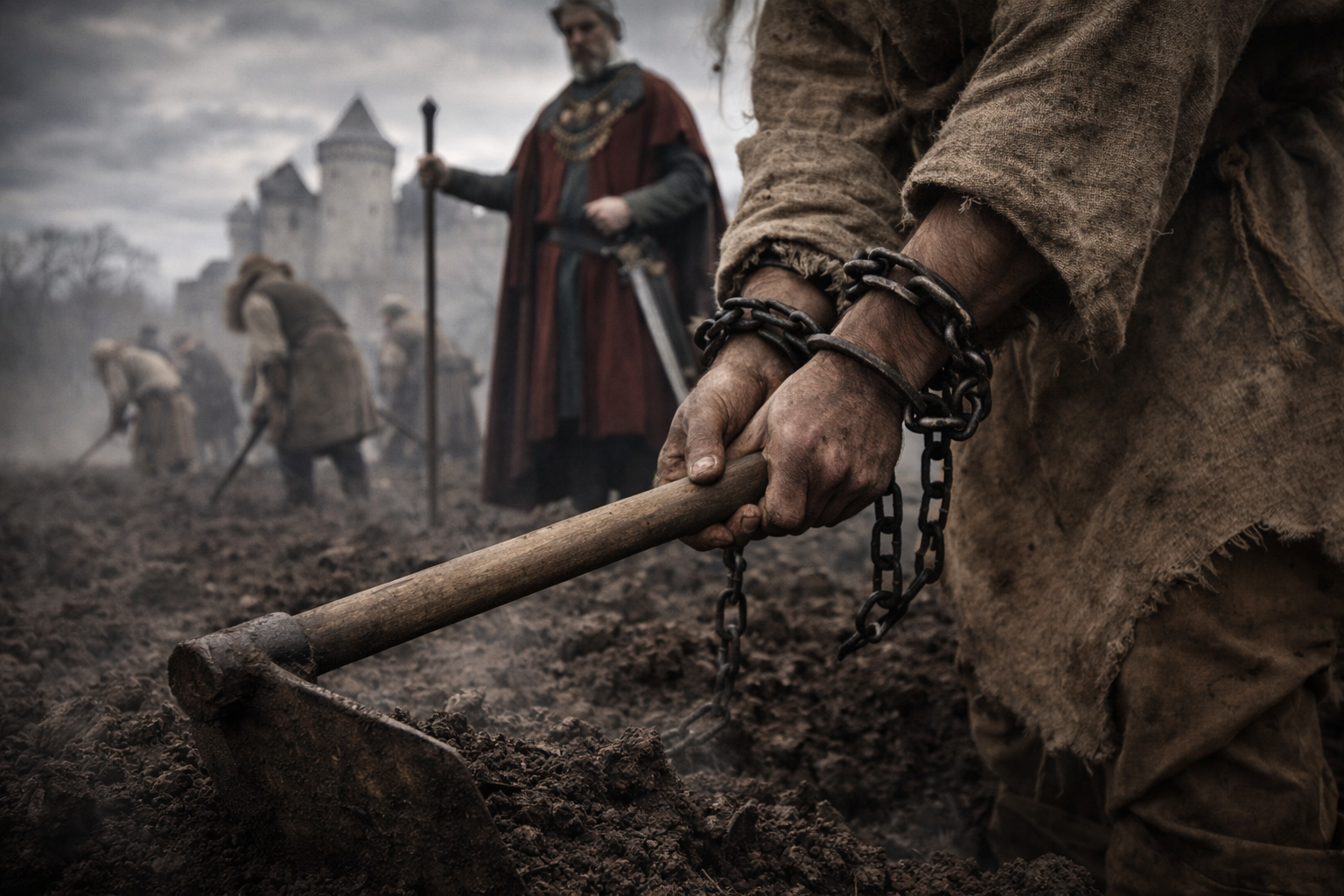
Serfdom explained: How England’s medieval unfree system worked, what ended it, and why most families likely have serf ancestors.
Approximately eighty-five to ninety percent of Modern English people have at least one medieval serf ancestor
Serfdom was a control system, not a job.
In medieval England, huge numbers of rural people lived under rules that made leaving, bargaining, or remaking your life legally risky. The whole point was to keep labor attached to the land when landowners needed predictable harvests and obedience.
Was it basically slavery? It was not slavery in the strict sense of "people as movable property". But it could still be coercive, hereditary, and humiliating in daily life.
This piece narrows to late medieval England, from the high Middle Ages through the early modern fadeout, when serf status was clear enough to enforce and then weak enough to dissolve.
The story turns on how bargaining power shifted.
Key Points
Serfdom (often called villeinage) was a legal status that bound a tenant to obligations and restrictions under a lord, usually tied to a specific holding of land.
It was not chattel slavery: in principle the defining feature was attachment to land, not the free buying and selling of individuals as standalone property.
Many obligations were enforced locally through manorial custom and courts, not by a modern police state.
The hinge shock was demographic: after the Black Death, labor scarcity raised workers’ leverage while elites tried to freeze wages and limit movement.
One major response was national labor regulation (the Ordinance and Statute of Labourers), aimed at pushing workers back into pre-plague terms.
Serfdom in England was never cleanly abolished by one grand act; it withered unevenly as labor services turned into cash rents and status became harder to prove.
A firm anchor for scale: estimates suggest roughly two hundred thousand serf families around the turn of the fifteenth century, falling to only a few hundred families by around fifteen hundred.
There were no national reparations; where freedom was purchased, money often flowed from the unfree person to the lord, not the other way round.
Background
England’s medieval economy ran on land, grain, and timing. When harvest comes, it comes for everyone, and whoever controls labor at that moment controls survival.
Lords needed revenue, legitimacy, and reliable production. Peasant households needed access to land, predictable rules, and enough stability to get through winter.
Manorial systems translated that tension into routine. Local custom defined duties, fees, and penalties, and manorial records made those duties legible and enforceable over time.
Those paper-and-custom mechanisms explain why the system could feel permanent until it suddenly didn’t.
The Origin
Serfdom in England took shape as a status inside manorial society: a household held land by custom, but key freedoms were limited by law and local practice.
The enabling conditions were practical. Land was the main asset, courts were local, travel was slow, and information moved badly. If you could restrict movement and lock obligations into “what we have always done,” you could keep labor from drifting to better terms.
Over time, that status could become hereditary, which turned a labor constraint into a self-replacing social category.
Once the rules were normal, the next big change could only come from a shock strong enough to rewrite incentives.
The Timeline
The system hardens into routine (High Middle Ages)
On the ground, the distinction that mattered was not “rich versus poor” but “free versus unfree,” because status decided what choices were legally available.
The mechanism was local enforcement: custom, manorial courts, and the threat of penalties for exit or refusal. The constraint was administrative: control had to be cheap enough to run village by village.
Capacity sat with landowners because land access set the terms of survival.
That balance set up the next phase: a system that looked stable because it was constantly being reaffirmed.
Pressure builds before the shock (Early fourteenth century)
Population and land constraints tightened margins. When households are near subsistence, small changes in rents, dues, or harvest outcomes can feel like punishment.
The mechanism was extraction under strain: landlords sought reliability, households sought side income, wage work, or better holdings. The constraint was food security and seasonal bottlenecks.
Capacity began to shift quietly as more people learned how to navigate courts and customs to defend their position.
Then the demographic floor gave way.
The hinge: plague, labor scarcity, and state coercion (Mid-fourteenth century)
After the Black Death, labor became the scarce resource. That flips bargaining power fast: workers can demand higher pay, better conditions, or simply leave.
The mechanism of elite response was law. National labor rules tried to freeze wages and restrict mobility, forcing a return to older terms. Alternatives were limited because elites needed harvests secured and feared wider disorder.
The constraint was enforcement capacity: a rule on parchment is not the same thing as control on every road and in every village.
From this point on, the old logic gradually unravels.
The long unwind: cash rents, negotiated custom, and fading status (Late fourteenth to fifteenth centuries)
Once labor services can be commuted into money, compulsion loses its edge. If a lord can lease land or hire labor, binding families to a plot becomes less profitable than it looks.
The mechanism was conversion: fewer compulsory labor days, more cash payments, and more tenures that looked contractual even when they were still “customary.”
The constraint was path dependence. Local practice varied, and some places held onto servile incidents longer than others.
What followed was not a victory parade but a drift: status becomes harder to assert, harder to prove, and less worth the fight.
The last pockets and the early modern fade (Sixteenth century)
By the early modern period, only remnants remained. Where they survived, they could purchase freedom through manumission, and political attempts at formal abolition did not always yield success.
The mechanism was the shrinking utility of the status itself: maintaining it brought friction, while the economy increasingly ran on cash rents and wage labor.
A useful anchor for scale is that some estimates place serf families at large numbers around the turn of the fifteenth century, dropping to only a few hundred by around fifteen hundred.
What remained was inequality without the old legal label.
Consequences
Immediate outcomes were practical: wider mobility, stronger wage leverage, and more room for households to negotiate, relocate, or diversify income.
Second-order consequences mattered more. Landowners adapted by reorganizing estates around leasing, cash flow, and hired labor, which strengthened monetization and changed how rural power was administered.
Was it unfair? By modern standards, obviously. In its time, it was still an intentionally unequal legal regime built to constrain one class’s choices for another class’s stability and revenue.
Descendants are the hardest question to quantify. A reasonable probabilistic estimate is that a large majority of modern English people with deep English roots before the early modern era have at least one medieval serf ancestor, often many times over. A headline-friendly range is roughly eight in ten to nine in ten, but no archive can “count” that nationally.
The next question is why England got no neat emancipation moment and why that matters now.
What Most People Miss
Serfdom worked because it was legible. Records and local courts turned lives into categories that could be enforced cheaply: who owed what, who could leave, and whose children inherited what status.
That’s why the decline was also administrative. Once obligations were commuted, status stopped being asserted routinely, and local enforcement slackened, the system stopped reproducing itself at scale.
The deeper lesson is uncomfortable: legal unfreedom can disappear while economic compulsion remains.
Next comes what stayed stubbornly the same even after the label faded.
What Endured
Land remained the fundamental asset, and unequal access to it continued to shape power.
Local governance endured: custom, records, and court culture kept influencing rural life long after “serf” became a relic.
Agriculture kept its constraints: seasonality, weather risk, and dependence on timely labor did not vanish.
Hierarchy endured, too. Losing a legal case does not guarantee gaining real leverage.
That sets up the final problem: where the history is clear and where it remains arguable.
Disputed and Uncertain Points
The share of rural people who were unfree at any given moment varies by region and by how historians classify borderline statuses, so national percentages come with wide bands of uncertainty.
How harsh serfdom felt in practice varied dramatically by manor: some places relied more on routine obligations, others on punitive incidents and tighter controls.
Debate surrounds the decisiveness of political flashpoints: while revolts and legal disputes played a significant role, long-term economic incentives also played a significant role.
The “modern descendants” percentage cannot be measured directly; any percentage is an inference from medieval demographics and the mathematics of ancestry rather than a countable statistic.
The legacy sits less in a single event and more in how institutions outlast labels.
Legacy
Serfdom’s legacy in England is concrete and bureaucratic: the long afterlife of customary tenures, the centrality of local records, and the way law can encode inequality without needing constant violence.
It also serves as a contemporary caution: systems can terminate without any apology, reparations, or a clear moral conclusion, simply by ceasing to pay the individuals enforcing them.
The term "serfdom" in this article refers to medieval English villeinage as a legal and customary status within manorial law. It is distinct from chattel slavery as defined in later Atlantic and colonial legal systems, particularly in that serfs were generally bound to land and obligations rather than owned as transferable personal property. Estimates of how much of the population is related to modern descendants are based on available demographic records and methods of studying family history, rather than on proof from individual family trees. Regional variation was significant, and no single national act of abolition or compensation applied uniformly across England.
