

The Day Humanity Nearly Vanished: How a Tiny Breeding Network Survived Near-Extinction That Rewrote Evolution
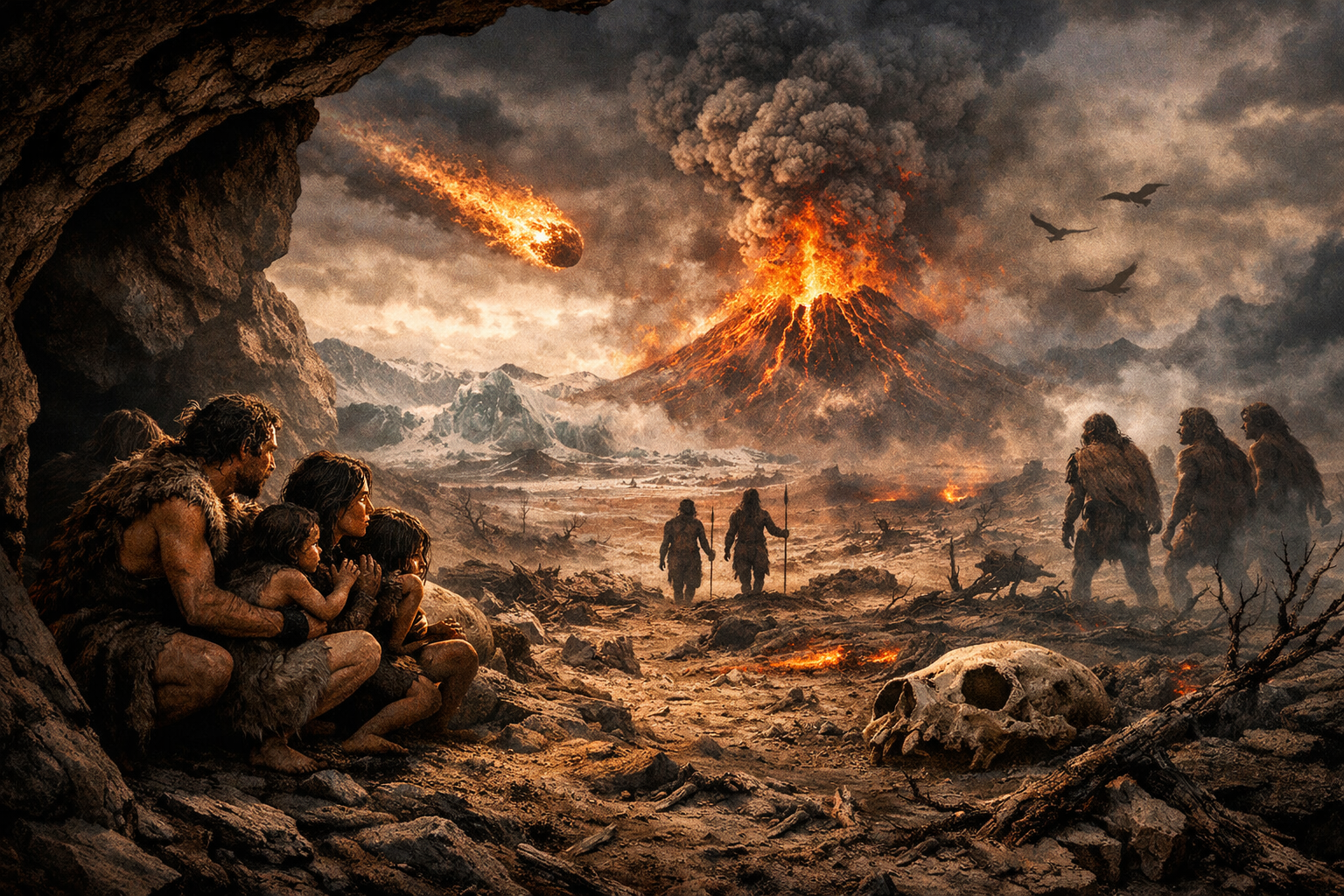
The Day Humanity Nearly Vanished: How a Tiny Breeding Network Survived Climate Collapse
Around 70,000 years ago, humanity may have shrunk to a tiny breeding network. Here’s how we survived climate collapse and reshaped evolution.
The Great Human Bottleneck: When We Were Almost Gone
How Humans Survived the Two Thousand-Person Bottleneck: The Late Ice Age Squeeze, the “Cognitive Revolution,” and Our Genetic Legacy
A species doesn’t need an army to go extinct. Sometimes it only needs a terrible decade, a shrinking map of edible plants, and one unlucky winter too many.
It is best to interpret the "two thousand people" bottleneck as a genetic warning signal: at one point, the number of individuals successfully passing on genes may have been as low as a few thousand. The breeding network, not the entire population on Earth, played a crucial role in determining what survives in today's genomes.
The tension is simple and brutal: how does a small, scattered set of bands avoid being snuffed out by climate swings, isolation, and bad luck—and then rebound hard enough to populate the planet?
This explains what likely drove the squeeze, how a tiny metapopulation can persist, why the rebound can look like a “cognitive revolution” even without a sudden brain upgrade, and what the bottleneck still shapes in health, ancestry, and evolution.
The story turns on how a small breeding network stayed connected long enough to survive shocks, then expanded fast enough to lock in its genetic signature.
Key Points
A “bottleneck” means a sharp drop in effective breeding population, not necessarily the literal number of living humans at the time.
The most relevant “around two thousand” figure maps onto estimates for the effective founding population(s) that left Africa and successfully seeded later non-African populations.
A second, much earlier “super bottleneck” has been inferred around nine hundred and thirty thousand to eight hundred and thirteen thousand years ago, with an effective breeding size near roughly one thousand two hundred and eighty.
The biggest constraint is not bravery or intelligence; it’s connectivity—keeping enough mate exchange and shared know-how to avoid genetic and cultural collapse.
The hinge is the rebound phase: rapid expansion outside Africa, roughly forty-five thousand to sixty thousand years ago, amplifies innovation and preserves it.
The “cognitive revolution” may describe the visible outcome (a cultural takeoff), but models show demography can create that pattern without a sudden cognitive leap.
The clearest legacy signal today is the global pattern of genetic diversity shaped by serial founder effects—plus the footprint of archaic admixture outside Africa.
Background
Just before the bottleneck becomes decisive, Homo sapiens does not form a single marching tribe. It’s a web of small bands spread across varied African ecologies, with movement, marriage, and information exchange doing quiet survival work.
Outside Africa, other hominin populations already occupy large territories—Neanderthals in western Eurasia and Denisovans in parts of Asia—often in small, fragmented groups with low genetic diversity compared with living humans.
The world’s pressures are plain: climate variability squeezes habitats, distance makes alliances brittle, and low population density makes every death and missed birth matter more.
The systems in motion are not states or armies but social technologies—pair-bonding norms, kin cooperation, food-sharing, and the ability to move and reorganize quickly.
Those pressures set up a filter: not “who was smartest,” but which connected networks happened to persist.
The Origin
The idea that there were "around two thousand people" comes from genetic studies about the Out-of-Africa expansion: the successful spread that contributed most of the ancestry of later non-African populations likely started with a relatively small group of effective founding individuals, with estimates suggesting about one thousand to one thousand five hundred effective founding males and females in some models. This number doesn’t mean there were only one thousand to one thousand five hundred humans alive; it means that the
That number doesn’t mean there were only one thousand to one thousand five hundred humans alive. It means drift, survival, and reproduction played out as if the breeding pool were that small—often because groups were subdivided, unevenly successful, and periodically isolated.
The enabling conditions are a geography of corridors and refuges, plus the social capacity to maintain mate exchange and learning across distance. Once a lineage gets through the filter and begins expanding, its genetic signal can swamp the rest.
That sets up the rebound: when population size and connectivity rise, culture can suddenly look “revolutionary.”
The Timeline
Phase One: Earlier near-misses that prove the concept
Long before Homo sapiens, genomic work has inferred an extremely severe bottleneck in human ancestors around nine hundred and thirty thousand to eight hundred and thirteen thousand years ago, with an effective breeding size of approximately one thousand two hundred and eighty for a prolonged period.
That is survival by the narrowest of margins, and it highlights a recurring mechanism: small breeding pools can persist if they remain a connected metapopulation rather than isolated single bands.
This matters because it normalizes the idea that “nearly gone” doesn’t require a single apocalypse—just sustained demographic fragility.
Phase Two: The late Pleistocene squeeze—small networks, hard constraints
In the later Pleistocene, climate instability and shifting resource maps repeatedly shrink “good” habitat into pockets.
Small groups can survive inside refuges, but they pay a cost: fewer mates, fewer teachers, and fewer backup options when disease, drought, or conflict hits.
The mechanism is demographic filtering: lineages wink out locally, and only some networks keep enough exchange to avoid inbreeding and skill loss.
The constraint is distance—too far apart and cooperation fails; too close and competition intensifies.
This phase locks in the core risk: extinction doesn’t need a villain, only disconnection.
Phase Three: The Out-of-Africa founder filter—why the “two thousand” figure bites
When modern humans expand out of Africa, the genetic signal outside Africa can largely reflect a subset of the African population that successfully expanded and persisted.
A small effective founding size is exactly what you’d expect from repeated founding events, uneven survival, and rapid drift at the frontier.
The hinge here is not a single “decision” but the moment a dispersing network becomes self-sustaining—able to keep reproduction, exchange, and learning going across a widening range.
Alternatives were limited because small pioneering groups either maintained connectivity or vanished.
Once the founder filter is passed, the population’s future stops being fragile and starts being expansive.
Phase Four: Rebound and the “cognitive revolution” effect—density makes ideas stick
A rapid expansion outside Africa is visible in genetic reconstructions roughly forty-five thousand to sixty thousand years ago.
An increase in population leads to an increase in experiments, specialists, and opportunities to ensure that an innovation doesn't disappear due to a single unfortunate death.
This is where the “cognitive revolution” debate arises: an influential argument suggests that demography, specifically population density and connected subpopulations, can explain the timing and uneven geography of "modern behavior" in the archaeological record, without implying a sudden increase in cognitive capacity.
What looks like a mental ignition can be a network effect: when the social graph thickens, culture compounds.
Phase Five: Other hominins as a contrast case—small populations that don’t escape the trap
Neanderthals show how small, fragmented populations can become trapped in inbreeding and low diversity, with genomes revealing close-relative mating in at least some cases.
Modern humans also carry a small percentage of Neanderthal ancestry outside Africa, but much of it is depleted in functionally important regions—consistent with selection removing some deleterious introgressed variants over time.
This contrast is the legacy lesson: survival is not just “having culture” but having enough people, enough movement, and enough exchange to keep both genes and know-how from collapsing.
Consequences
Immediately, a bottleneck amplifies chance.
Genetic drift grows louder than selection, rare variants disappear, and founder effects can make some traits common simply because the founders happened to carry them.
Over the longer run, the consequences are structural.
Outside Africa, serial founder effects can create a gradient of reduced genetic diversity as populations expand farther from source regions.
Bottlenecks also reshape how selection operates: some harmful variants can rise by drift, some recessive load can be exposed, and later population growth changes the balance again.
When populations grow back, the way they interact changes: more people living close together and connecting with each other can help develop advanced skills and complex ideas that are difficult to maintain in small, separated groups.
Those second-order effects set up the modern world’s signature: low diversity relative to many species, but massive geographic spread.
What Most People Miss
The “two thousand people” claim is usually misunderstood as a literal census count.
Effective population size is a genetic lens: it collapses uneven reproductive success, population structure, and repeated founder events into a single number that predicts drift.
That’s why it can be low even when thousands more are alive.
A second miss is the role of connectivity as infrastructure.
In small populations, losing a single expert can mean losing a technique forever.
When networks are thicker—through migration, exchange, and mating ties—skills survive shocks and compound.
That reframes the “cognitive revolution” into a capacity story: not just brains, but bandwidth.
What Endured
Small-band living endured even during expansion; local groups still faced hunger, injury, and seasonal failure with no state safety net.
Geography endured as a constraint: corridors open and close, refuges appear and vanish, and distance still taxes cooperation.
Competition endured, both within and between groups, because scarce resources attract conflict.
And demographic randomness endured: in small populations, luck remains a force as real as selection.
Those constants keep the bottleneck lesson relevant: resilience depends on redundancy—social, ecological, and reproductive.
Disputed and Uncertain Points
The exact timing and depth of the late Pleistocene bottleneck vary across methods and models; “around two thousand” is a shorthand for a range of effective-size estimates, not a settled headcount.
The Toba supereruption is often claimed as a near-extinction trigger, but multiple lines of evidence argue against a simple global bottleneck story.
Whether “modern behavior” requires a sudden cognitive leap remains debated; demographic explanations can reproduce key archaeological patterns, but the balance between cognition, ecology, and population structure is not fully resolved.
The impact of bottlenecks on evolution is unclear: a sharp decrease in population can lead to more harmful genetic traits through random changes, but it can also make hidden traits more likely to be selected; the overall outcome depends on how long the
For other hominins, the extent to which bottlenecks versus competition drove extinction is contested, but genetic evidence clearly shows small population sizes and inbreeding vulnerability in at least some Neanderthal groups.
Legacy
The effects of the bottleneck can be seen in useful methods today: figuring out ancestry, mapping diseases, and the clear signs of repeated founder effects in global genetic diversity.
It also leaves a second, stranger inheritance: outside Africa, fragments of archaic DNA persist as a record of contact and as a reminder that survival wasn’t purity or linear progress but mixing, movement, and selection playing out over millennia.
The final lesson is concrete, not moral: species survive bottlenecks when networks stay just connected enough to keep genes and know-how from collapsing and then grow fast enough to outrun the next shock.
Subscribe on Spotify, or explore more articles for more compelling insight.
