What Happened In 1999?
Three London Communities Were Targeted In Less Than Two Weeks.
Three attacks struck London between 17 and 30 April 1999. The first hit Brixton, the second Brick Lane and the third the Admiral Duncan pub in Soho. The locations connected three communities: Black Londoners, the Bangladeshi community and gay people. Ordinary places to shop, work and meet friends became targets because of the people associated with them.
Three people were murdered and around 140 were injured. Andrea Dykes, one of those killed, was pregnant. Her unborn baby also died. Behind those figures were survivors facing operations, permanent injuries, bereavement and the task of making familiar streets feel safe again.
Surviving the London Nail Bombings returns to that history through eyewitness testimony. Amazon lists the documentary for 17 November 2026 on Prime Video UK, while its distributor describes a 90-minute film produced by Yeti Television. This account examines the documented events behind the programme, rather than offering a review of scenes not independently viewed.
Brixton: Violence In A Shopping Street
Brixton was attacked on Saturday 17 April. A bomb exploded in the Electric Avenue shopping area, beside the Iceland supermarket. Its placement brought deliberate violence into the routines of a neighbourhood with a large Black community.
There was no warning that would have allowed shoppers and traders to move away. People had entered the street for everyday reasons. That is central to understanding the attack: the victims did not need to be politically active, prominent or personally known to the attacker. Being present in a place he associated with a minority community was enough.
The term nail bomb describes an explosive weapon intended to scatter nails as dangerous fragments. Its consequences extended beyond the immediate pressure of the explosion to penetrating wounds caused by material thrown outwards. The important historical fact is its purpose against people in a public space; technical construction details add nothing to understanding their experience.
For those elsewhere in London, Brixton initially presented an urgent but incomplete picture. An explosion had occurred and people had been injured. The full geographical pattern only became visible as further attacks followed. Reading the events backwards can obscure that uncertainty and make the eventual sequence appear more predictable than it was.
Brick Lane: A Second Community Under Attack
Exactly a week later, on Saturday 24 April, the second bomb exploded in Brick Lane. The area was closely associated with London’s Bangladeshi community. Once again, the target was a neighbourhood’s public life.
The device detonated in a car boot after a member of the public had moved the suspicious bag. That detail illustrates how actions taken before the danger was fully understood became part of the history of the attack. It should not be mistaken for a model of how suspicious objects should be handled.
A surviving police appeal, now held by London Museum, offers a different way into the story. The handbill sought witnesses and used several languages. It is a small piece of paper with a practical purpose: reaching people who might have seen something useful.
Such objects help recover what a familiar crime narrative can lose. The investigation depended on communication with the communities under attack. Witnesses were people with different languages, routines and reasons for being on the street. The work of finding an offender required turning their separate observations into usable evidence.
The second explosion also changed the meaning of the first. Brixton could no longer be considered only as a single devastated location. Two neighbourhoods associated with minority communities had been attacked on successive Saturdays, leaving an immediate question about where further violence might occur.
The Admiral Duncan: Remembering Those Killed
The third explosion came on Friday 30 April, inside the Admiral Duncan on Old Compton Street. The pub was an established gay venue in Soho. Unlike the two street attacks, this bomb exploded inside an occupied building.
Andrea Dykes, John Light and Nick Moore were killed. Andrea’s pregnancy means that some commemorative accounts refer to four lives lost, including her unborn baby. The criminal case concerned three murders. These descriptions arise from different ways of recording the same tragedy, rather than evidence of a separate fourth adult victim.
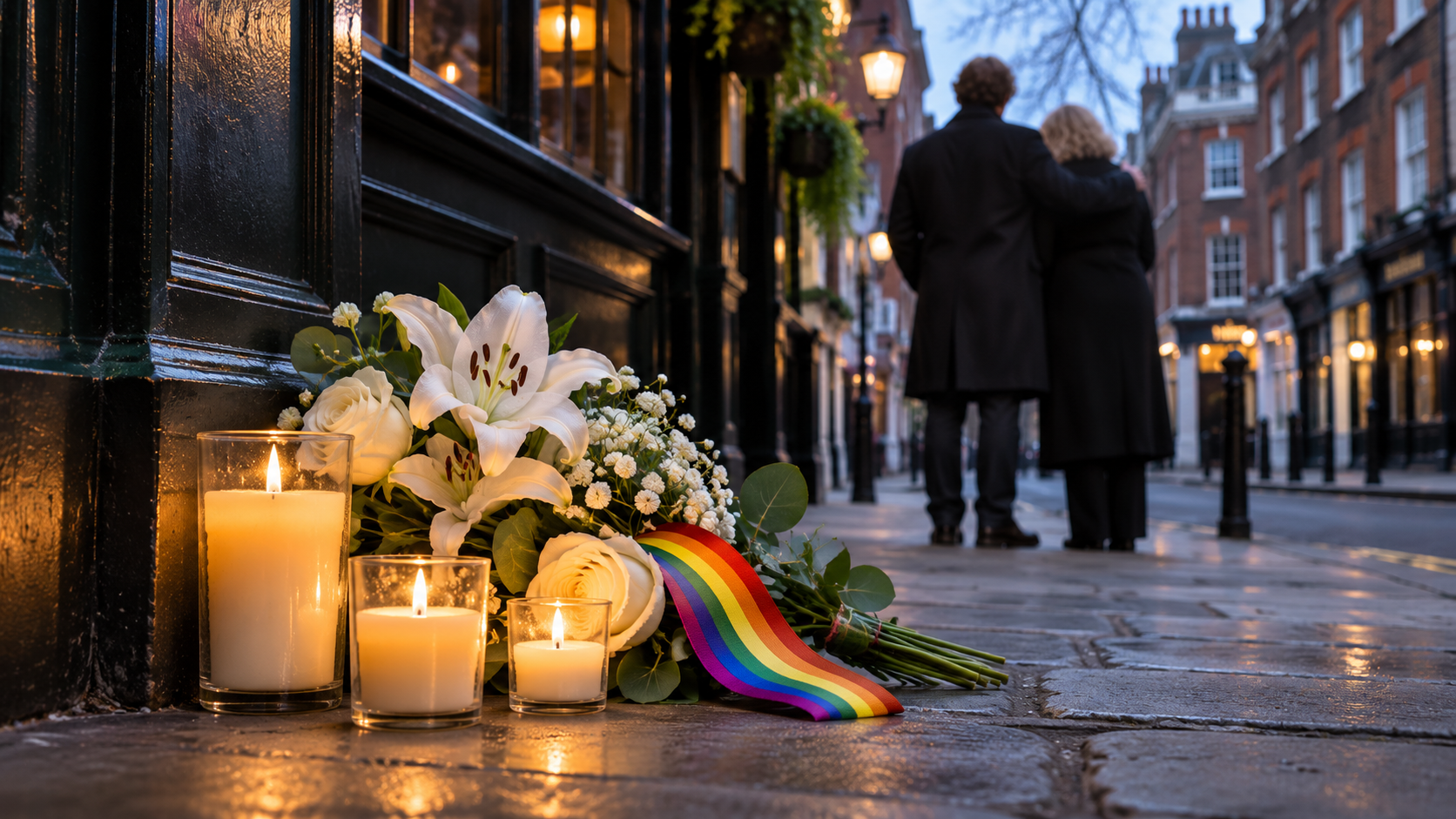
Remembering the names also challenges a misleading abstraction. The attacker selected a venue through his hatred of a community, but those present were individuals with friendships, families and lives that cannot be reduced to the label he assigned them.
The location mattered in another way. A pub can provide a place to meet openly and feel at ease. Attacking a gay venue threatened that freedom beyond the people immediately injured. The intended audience for the violence extended to others who might ask whether going out, meeting a partner or returning to a familiar bar was safe.
What The Hospital Records Reveal
Medical evidence helps explain why the Soho bombing was particularly devastating. A published account of the St Thomas’ Hospital response compared the casualties it treated from Brixton with those from the Admiral Duncan. The authors described much more severe injuries after the explosion in the pub’s confined environment.
The hospital received 27 casualties from Soho. Its report recorded three immediate lower-limb amputations, alongside intensive-care treatment and transfers for specialist burns care. These figures describe that hospital’s experience, not the complete casualty list across London.
That distinction matters whenever historical numbers differ. A hospital counts patients it received; an early emergency report records information available at the time; a later commemoration may use an updated or rounded total. Around 140 injured is a responsible broad description of the campaign without implying that every source gives an identical final number.
For survivors, the consequences were specific. An amputation, a burn and a penetrating wound require different treatment and can alter different aspects of daily life. A single casualty total cannot describe what returning home meant for each person.
Emergency workers also carried memories of the attacks. Mark Davidson, then a trainee firefighter, later recalled attending Soho and helping a doctor at a triage point on Dean Street. His account described concentrating on one task after another.
Triage meant deciding who needed urgent treatment in circumstances where many people required help. Seen from that perspective, the response consisted of repeated practical decisions: reaching someone, assessing an injury and helping the next patient. The eventual historical record rests partly on people who had little opportunity to reflect while the emergency was unfolding.
Surviving Was The Beginning Of A Longer Experience
Surviving an explosion and recovering from it are different experiences. The first describes remaining alive; the second may involve changes that continue long after a hospital discharge or a criminal trial.
Survivor Jonathan Cash has described lasting psychological trauma following the Admiral Duncan bombing. Physical injury figures cannot capture the full aftermath.
Gary Reid, another survivor, spoke publicly in 2021 about the effect on families as well as those physically present. At that time, he said he had returned to the pub only once since the attack. His comments accompanied his participation in the earlier documentary Nail Bomber: Manhunt.
That earlier film should not be confused with Surviving the London Nail Bombings. They concern the same historical events, but testimony associated with one production cannot automatically be presented as a scene or interview in the other.
Reid’s account also complicates the familiar language of resilience. A survivor need not revisit a building, speak publicly or turn suffering into a campaign to demonstrate strength. Returning may matter deeply to one person; keeping a distance may matter just as much to another.
How London Has Remembered The Attacks
The anniversary dates have become occasions for remembrance across the three affected areas. Maintaining that connection prevents the history from narrowing to Soho alone because the deaths occurred there. Brixton and Brick Lane were part of the same campaign and deserve their own place in its record.
There were institutional consequences too. The Metropolitan Police says its LGBT+ Independent Advisory Group was formed in the year after the attacks. Its role was to advise on policing issues affecting those communities.
The existence of an advisory group is not proof that every problem of trust was solved. It is evidence of a lasting structure through which community knowledge could enter policing discussions. That is a more concrete legacy than an unsupported claim that the attacks permanently united everyone.
The charity 17-24-30 National Hate Crime Awareness Week has helped sustain remembrance. In discussing the new documentary, it said it had helped producers reach survivors, relatives and friends, and that filming took place at the Soho remembrance event in 2026.
The charity also makes an important distinction about participation: contact details are not passed on without permission, and some people do not want to be approached. A survivor’s right to privacy remains part of an ethical account of the past, even when public interest in the case returns.
Who Carried Out The Bombings?
The man responsible was David Copeland, a 22-year-old neo-Nazi. His targets reflected racist and homophobic beliefs. London Museum’s account records his membership of the British National Party and the National Socialist Movement.
His stated ambition was to provoke racial conflict. The violence therefore had a political purpose as well as immediate human targets: he wanted attacks on minority communities to produce wider hostility and division.
CCTV from Brixton became a crucial part of the investigation. After images were circulated publicly, a colleague recognised Copeland and contacted police. He was arrested in Hampshire in the early hours of 1 May, after the Soho bombing.
The sequence exposes the limits of hindsight. Recognising a face, establishing an identity, locating a person and intervening are separate steps. The eventual arrest should not be rewritten as an interception that happened before the final attack.
In June 2000, Copeland was convicted of three murders and received six life sentences for the murders and bombings. A later ruling set a 50-year minimum term, and his attempt to reduce that term failed in 2011.
The legal outcome established responsibility. It could not restore the lives that had been lost or determine when any survivor should feel recovered. A conviction can conclude a criminal case while leaving its consequences present in homes, relationships and ordinary journeys through a city.
That is why a history organised around survivors has a different endpoint from a manhunt. The continuing question belongs to the people targeted: how to live, remember and retain control over the telling of what happened to them. Twenty-seven years later, their decision to speak, or to remain private, is still their own.
Sources
Amazon — What’s On Prime Video UK In November 2026 — The documentary’s listed release date. Sphere Abacus — Documentary Announcement — Production, duration and intended eyewitness focus. About Amazon UK
Counter Terrorism Policing — 20th Anniversary Of Brixton Market Nail Bombing — Attack dates and convictions. London Museum — Police Appeal: Brick Lane Bomb — The contemporary witness appeal and extremist affiliations. Counter Terrorism Policing
Metropolitan Police — Remembering The Victims Of The London Nail Bombings — Victims’ names, remembrance and the advisory group. Metropolitan Police
Hart And Colleagues — The London Nail Bombings: The St Thomas’ Hospital Experience — Hospital treatment and differences in injury severity. London Fire Brigade — Marking The 25th Anniversary — Emergency response and remembrance of Andrea’s unborn baby. pubmed.ncbi.nlm.nih.gov
Attitude — Nail Bomber: Manhunt — Gary Reid’s previously published testimony. Jonathan Cash — Survivor’s Account — His account of lasting trauma. Attitude
Radio Times — How David Copeland Was Caught — Identification, arrest and stated motive. Inner Temple Library — Sentence Appeal — The unsuccessful challenge to his minimum term. tollbit.radiotimes.com
17-24-30 NationalHCAW — Surviving The London Nail Bombings — Remembrance filming, contact with participants and consent policy. 17-24-30 NationalHCAW
Next Reads
The Flores Massacre: The Fire, The Warnings And The Sole Survivor — Another history in which surviving the initial attack began a much longer struggle.
Brian Wells And The Pizza Bomber Case: Following The Evidence — How investigators reconstructed a separate crime involving an explosive device.
More Than 8,000 Hoax Bomb Threats Hit Europe. Who Is Behind Them? — A different security story examining attribution, public fear and disruption.
