The Wampanoag Leader, the Magazine Editor and the Making of Thanksgiving
Who Brought The Five Deer To The First Thanksgiving?
Ask someone to name the meat served at Plymouth in 1621 and the obvious answer is turkey. Ask the man who was there, and the clearest answer is venison. Edward Winslow, an English colonist, recorded that the Wampanoag leader Ousamequin arrived with about ninety men. They hunted five deer and presented them to the English governor, the military captain and others. Winslow counted the deer. He never identified the birds.
That small detail changes the picture. The Wampanoag supplied a substantial share of the food at the gathering Americans remember as the first Thanksgiving. The turkey at the centre of the modern table owes much of its position to a novelist, magazine recipes and generations of cooks. And the Thursday on which Americans eat it owes something to a president worried about Christmas shopping.
Before Plymouth, There Was Patuxet
The English built Plymouth at Patuxet, a Wampanoag village on the coast of what is now Massachusetts. In the years before the Mayflower crossed the Atlantic, epidemics devastated Indigenous communities along the north-eastern coast. By the time the settlers arrived in 1620, disease had killed much of the population of Patuxet. Ground that appeared available to the newcomers was somebody’s home.
One of the people who knew precisely whose home it was was Tisquantum, often called Squanto in English accounts. An English mariner had kidnapped him years earlier. After travelling across the Atlantic and eventually making his way back, he discovered that his family and much of his community had died. The English he had learned during those years made him a valuable interpreter. His ability to speak to the settlers, sometimes presented in children’s stories as a happy coincidence, had a painful history.
Wampanoag communities already marked the arrival of foods throughout the year. The ripening of strawberries and the green corn harvest each gave people an occasion to give thanks. A calendar understood through the return of particular foods makes sense on its own terms. The first ripe berry after winter and the moment corn becomes ready to eat are different events, each worth noticing.
The English brought several customs of their own. A harvest home marked the completion of agricultural work with food and company. A formally declared day of thanksgiving had a more explicitly religious purpose. A community might set aside time for prayer after relief from a particular danger. Plymouth offers a clear example in 1623, when rain brought relief after a drought. Calling both occasions “Thanksgiving” today can obscure a distinction the people observing them would have understood.
What Happened at the Harvest Gathering in 1621?
Earlier that year, Ousamequin had entered into an agreement of mutual protection with the Plymouth settlers. He had decisions to make about security, trade and the arrival of foreigners in Wampanoag territory. The English, weakened by a punishing first winter, had urgent reasons to cultivate allies who understood the coast and could help them grow food. By harvest time, the two groups already had obligations to one another.
Winslow described the occasion in a letter dated December 1621, published in England the following year. After the harvest, the governor sent four men out to hunt birds. There was enough food for festivities, and the English practised with their firearms. Ousamequin, whom Winslow identified by the title Massasoit, came with his men. The two groups spent three days together.
Winslow was writing to someone in England who wanted news of the settlement. Part of his purpose was to convey how much conditions had improved. After sickness and scarcity, he could tell a correspondent that he wished friends at home could share the plenty. That helps explain both the value and the limits of his letter. It is an excellent source for the provisions that caught his attention. For what Ousamequin thought about the gathering, we need Wampanoag perspectives too.
The letter gives no exact date, records no invitation and offers no seating plan. The familiar illustration of two groups lined up at one long table fills in those gaps with the conventions of a later family dinner. The gift of deer allows a more revealing glimpse of the occasion. Ousamequin’s men were on home ground, able to provision a large gathering and to choose the people to whom they presented their gifts. Children taught that the settlers invited hungry neighbours to dinner have the balance of resources almost exactly backwards.
How a Harvest Feast Became the “First Thanksgiving”
A surprisingly influential moment in the holiday’s history took place at the bottom of a printed page. In 1841, the antiquarian Alexander Young published a collection of early Plymouth records. Reading Winslow’s description, he recognised a resemblance to the harvest dinners familiar in his own New England. In a footnote, he identified the gathering as the first Thanksgiving.
More than two centuries separated the footnote from the feast. Young had the advantage of knowing what Thanksgiving looked like in the 1800s. That was also his disadvantage. Once readers accepted his label, it became easy to imagine the colonists consciously starting a tradition that would continue every November. Nothing in Winslow’s letter asks anyone to commemorate the occasion the following year.
Other events have a claim to being “first”, depending on what the word means. An English expedition led by Martin Frobisher held a religious thanksgiving in the Canadian Arctic in 1578. Indigenous peoples had given thanks in North America long before that voyage. Plymouth stands out for a more particular reason. Its harvest gathering supplied the young United States with a scene that could be retold as a story about the country’s beginnings.
There was a high price to ending the story with three days of hospitality. As English settlements expanded, fences, livestock and claims to land cut Wampanoag communities off from hunting grounds and fishing places. Within the lifetime of people who had known Ousamequin, his son Metacom was fighting the colonists in the conflict remembered as King Philip’s War. The gift of five deer and the later struggle over who controlled the land on which deer could be hunted belong in the same history.
The Editor Who Wanted Americans to Eat Together
When George Washington proclaimed a day of thanksgiving for Thursday 26 November 1789, he had a recent event in mind. The United States had established a government under its new Constitution. Washington invited Americans to give thanks for the opportunity to do that peacefully. Anyone looking to his proclamation for instructions about Pilgrims, roast poultry or an annual family reunion will come away empty-handed.
Presidents could recommend a thanksgiving, and states could appoint their own. Dates differed. So did the significance people attached to the occasion. A household in New England might recognise an autumn turkey dinner as an established family custom while someone elsewhere in the country saw little reason to organise the year around it.
Sarah Josepha Hale understood that getting several generations to sit down to dinner was one thing. Getting households across a continent to do it on the same day was quite another. In her 1827 novel Northwood, she gave readers an extended description of a New England Thanksgiving dinner, complete with roast turkey. Later, as editor of Godey’s Lady’s Book, she had an audience for both halves of her campaign. She could argue for a national observance and give readers practical ideas about what to serve.
A recipe could accomplish something a presidential appeal could scarcely manage. A reader who had never attended a New England Thanksgiving could picture the dishes, decide which ones the household could afford and try making the meal. A child who ate it for several years might eventually remember as a family inheritance something a parent had first encountered in a magazine.
In 1863, during the American Civil War, Hale wrote to Abraham Lincoln urging a common Thanksgiving. On 3 October he issued a proclamation calling for its observance on the last Thursday of November. His words made room for people for whom abundance must have seemed a peculiar subject that autumn. He asked Americans to remember widows, orphans, mourners and others suffering because of the war. Coming from a president who could see no easy end to the fighting, the invitation carried something more demanding than seasonal cheer.
Why Do Americans Eat Turkey at Thanksgiving?
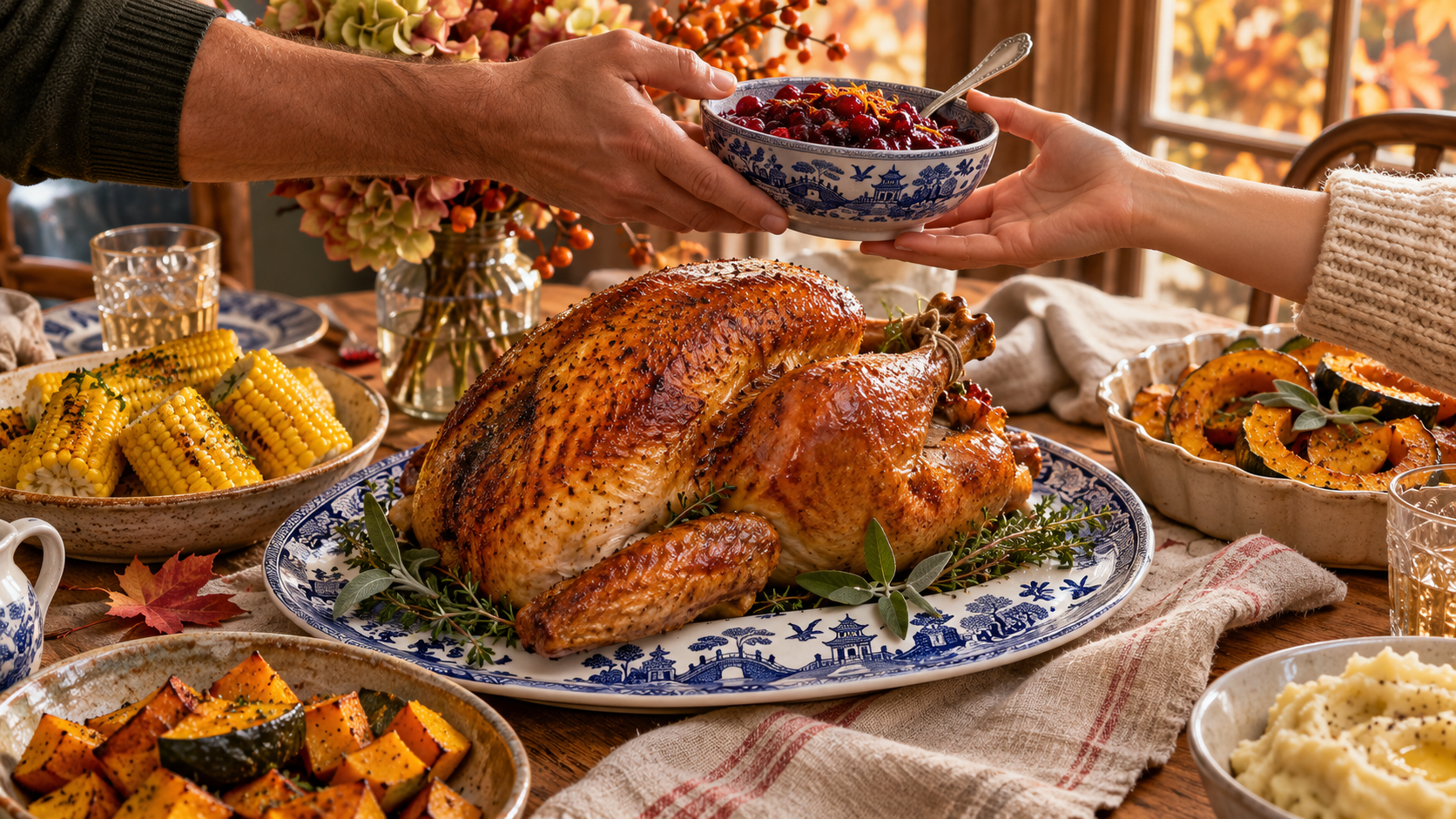
Turkey won its place through a combination of appetite, practicality and publicity. A large bird could feed an extended household and arrive at the table whole, ready to be carved. It was familiar enough for a cook to know what to do with it and impressive enough to justify the trouble. Hale and other writers helped establish the expectation that this was what a proper Thanksgiving dinner looked like.
The strongest case for turkey at Plymouth is circumstantial. William Bradford, the colony’s governor, recalled plentiful wild turkeys that autumn. Winslow said his companions hunted fowl. They may well have eaten turkey during those three days, alongside the venison. The surviving descriptions leave open the possibility of ducks, geese or a mixture of birds. Nor do they give us cranberry sauce, mashed potatoes or pumpkin pie. A pumpkin growing in North America and a sweetened pie cooling in an English-style pastry case are quite different pieces of culinary evidence.
Even the turkey itself had a more international history than its reputation as the all-American bird suggests. Indigenous people in what is now Mexico domesticated turkeys more than two thousand years ago. Europeans took domesticated birds across the Atlantic, and descendants of those birds subsequently travelled back to North America. Some nineteenth-century Americans sitting down to what they understood as a deeply local tradition were eating poultry whose ancestors had crossed the ocean in both directions.
An artist gave the bird an especially durable place in American memory. In Norman Rockwell’s Freedom from Want, published in 1943, a woman lowers a magnificent turkey towards a white tablecloth. Look away from the platter and the picture becomes more interesting. Several diners are looking at one another. One turns towards the viewer, as though there might be a place for us too. Rockwell painted it during the Second World War and had misgivings about displaying such plenty while people in Europe were starving. The title gives the meal a meaning that a recipe never could. The freedom on offer is the security of knowing there will be enough to share.
Why Is American Thanksgiving on the Fourth Thursday?
Lincoln chose the last Thursday in November. The United States now observes the fourth. The difference becomes apparent in a November with five Thursdays, and in 1939 it mattered enough to divide the country.
That year, the last Thursday fell on 30 November. President Franklin D. Roosevelt worried that a late Thanksgiving would leave too little time for Christmas shopping and hurt an economy still recovering from the Great Depression. He moved the observance forward by a week. Some states followed him. Others kept the traditional date. A family deciding where to spend the holiday suddenly had reason to ask which Thanksgiving their relatives meant.
Congress settled the argument in 1941. The House favoured the last Thursday, while the Senate amended the measure to specify the fourth. Roosevelt signed the resolution in December. The result puts American Thanksgiving somewhere between 22 and 28 November. It also explains a coincidence this year. Americans celebrating on 26 November 2026 share a calendar date with Washington’s thanksgiving in 1789, although the rules that brought them to it are quite different.
For a British comparison, consider how Boxing Day acquired its place in the calendar. Families can keep a custom for generations before lawmakers settle which day employers, shops and public institutions should recognise. In America, the weeks of shopping that follow Thanksgiving helped determine the date of the dinner that precedes them.
Why Does Thanksgiving Seem So American When Canada Celebrates Too?
If Thanksgiving means a national holiday with that name, the United States has an obvious neighbour to consider. Canada celebrates on the second Monday in October, a date fixed in 1957. Roast turkey and an autumn family gathering would look familiar to visitors from south of the border. The political history behind the occasion would be less familiar.
Take the Canadian thanksgiving of April 1872. The reason was the recovery of the Prince of Wales, the future Edward VII, from serious illness. An April date makes little sense as a harvest festival. It makes perfect sense as a public expression of relief about the health of the heir to the throne. Canada began observing an annual Thanksgiving in 1879, but the date moved before the October Monday became permanent.
It is tempting to explain the difference with a glance at the map. An earlier autumn feast suits a more northerly country. Geography alone, though, cannot explain a holiday once held in April or the church leaders who campaigned for an annual observance. In Ontario, Protestant clergy borrowed from New England practice while seeking a festival that expressed their own vision of Canadian identity. An idea could travel north without bringing Plymouth, Lincoln or the fourth Thursday along with it.
Britain provides the reverse example. English people took harvest celebrations and days of religious thanksgiving across the Atlantic. Britain still has harvest festivals, and the origins of Bonfire Night lie in thanksgiving for the failure of the Gunpowder Plot. What Britain lacks is the particular sequence of decisions that turned a New England dinner into a national November holiday. A British viewer can recognise a Thanksgiving episode of an American television series immediately and still have an ordinary working Thursday ahead.
Why Some People in Plymouth Observe a National Day of Mourning
In 1970, organisers marking the 350th anniversary of the Mayflower landing invited Wamsutta Frank James, an Aquinnah Wampanoag man, to speak. They asked to see his remarks beforehand. James had written about what the arrival of the English had meant for his people, including the taking of land. The organisers wanted a different speech. He declined to deliver the replacement.
That Thanksgiving, Native people and supporters gathered in Plymouth for a National Day of Mourning. The observance has continued on Cole’s Hill. Its location matters. On the very ground where visitors come looking for the origins of an American holiday, Indigenous speakers can tell the history that a commemorative dinner once tried to edit out.
James’s original speech survives, which makes it possible to read him on his own terms. He spoke as a father as well as a Wampanoag man. Across three and a half centuries, that answers a silence in Winslow’s letter. In 1621 an English correspondent decided which details his readers would hear about the Wampanoag. In 1970 a Wampanoag speaker insisted on deciding what an audience would hear from him. Giving thanks at home and listening to what is said on Cole’s Hill are both choices available to Americans on the same Thursday.
How Will Thanksgiving Change in the Years Ahead?
The gathering itself looks likely to endure. In a nationally representative Pew Research Center survey of 9,609 US adults in November 2024, 91 per cent said they celebrated Thanksgiving. Yet the huge family reunion of popular imagination was only one version. About a quarter of adults expected to eat with more than ten other people. Five per cent planned to eat Thanksgiving dinner alone. A host bringing out a turkey for fifteen and a person putting aside a favourite dish for one were both observing the holiday described by that survey.
One plausible change is that Americans will become more explicit about whom they mean by family at Thanksgiving. Friendsgiving already supplies a name for a meal shared among friends. It can fit around a family visit, give someone working on Thursday another chance to celebrate or provide the main invitation for someone with no family nearby. In each case, the practical decision is the same one every host faces when counting chairs. Who would otherwise be eating on their own?
Menus have room to change for similar reasons. A whole turkey makes excellent sense for a dozen guests and considerably less for two people with a small oven. One household might keep the bird and change every side dish. Another might preserve a grandmother’s stuffing recipe because that is the flavour everyone associates with home, then serve it alongside something entirely different. If a particular dish survives, the best explanation may be as simple as somebody at the table knowing how to make it and a younger relative wanting to learn.
The most substantial change may happen before dinner, in what children learn about 1621. Museums and Wampanoag historians have already made it possible to teach the event through a named place, a political agreement and a letter a pupil can actually read. A teacher can ask who provided the food, why there were English speakers on both sides or how a nineteenth-century footnote came to name a seventeenth-century event. Each question opens a piece of history that the old pageant could scarcely accommodate.
There is an easy place to begin at this year’s table. Ask which animal the eyewitness actually counted. A child who answers “five deer” has learned more than an unexpected item on a menu. They have remembered who brought the food, restored an act of Wampanoag generosity to the story and found a reason to ask what else those three days might tell us.
Sources
Smithsonian National Museum of the American Indian — Treaty and Harvest Celebration — Edward Winslow’s account alongside the perspective of Mashpee Wampanoag historian Paula Peters.
Plimoth Patuxet Museums — Eye-Witness Account of the 1621 Harvest Celebration — The letter and Alexander Young’s influential 1841 footnote.
US National Archives — Congress Establishes Thanksgiving — The presidential proclamations, Roosevelt’s change and the congressional decision that fixed the fourth Thursday.
University of California, Berkeley — How to Think About Thanksgiving Like a Food Historian — The domesticated turkey’s journey between the Americas and Europe.
Dickinson College — Canadian Thanksgiving — Canada’s 1872 thanksgiving, annual observance and October date.
United American Indians of New England — The Suppressed Speech of Wamsutta Frank James — James’s own words and the circumstances of the 1970 commemoration.
Pew Research Center — How Americans Celebrate Thanksgiving — Survey findings on participation, company and the size of gatherings.
Next Reads
The History of Halloween: What We Inherited, What We Invented and What Comes Next — How another autumn festival changed as its customs crossed the Atlantic.
Bonfire Night’s Forgotten Past: Religion, Street Rituals and Whats To Come — The British day of thanksgiving that became a night of fireworks.
Why Is It Called Boxing Day? Christmas Boxes, Servants and St Stephen’s Day — The workers and gifts behind another familiar holiday name.
