Why Is Eleonora of Toledo’s Son Missing From the London Portrait?
By The Time Bronzino Painted Her With Her Son, Eleonora Had Already Governed Florence Three Times.
There is a small boy in the famous Florentine portrait of Eleonora of Toledo. In the version now on display in London, he is gone. Eleonora rests her hands in her lap. A vase stands beside her. Across the top of the painting runs a Latin inscription warning how little beauty can be trusted. The woman wears the same magnificent patterned dress, but someone has changed what the viewer is being asked to remember.
The Wallace Collection has removed a heavily yellowed varnish from its portrait, revealing colours much closer to those of the painting on which it was based. The sitter’s identity was already known. Eleonora was the Spanish noblewoman who married Cosimo I de’ Medici, governed Florence during his absences and bought the palace that became one of the great seats of Tuscan power. The surprise is how much of her life can be recovered by looking closely at the things she chose for other people to see.
What Did Conservators Find Beneath the Varnish?
The London painting is a work from the studio of Agnolo Bronzino, Eleonora’s favourite painter. Painted in oil on a poplar panel, it measures a little under 78 centimetres high. The Wallace Collection dates it to about 1562–1572. Bronzino painted the larger portrait of Eleonora with her son Giovanni, now in the Uffizi in Florence, around 1545. Nearly a generation separates the two pictures.
For its new display, the Wallace Collection treated the London panel, addressing earlier structural repairs as well as removing the discoloured varnish. A yellow layer across a painting affects even those passages the artist intended to appear cool. Here it had also made it harder to judge how faithfully the workshop had followed Bronzino’s palette. With that layer removed, the museum describes a striking closeness between the colours of the two works.
That makes their differences easier to appreciate. In Florence, Eleonora has an arm around a living child. In London, the painter has given that space and attention back to the duchess. The dating offers one reason why. Eleonora died in 1562, at the beginning of the period proposed for the panel. The Wallace Collection considers it likely that the studio produced the portrait after her death. A family image painted while her children were young may have supplied the likeness by which others remembered her.
Who Was Eleonora of Toledo?
Born in 1522, Eleonora was the daughter of Pedro de Toledo, the Spanish viceroy who governed Naples. She grew up with an unusually practical education in what a ruling household looked like. Her father commissioned residences and gardens. The clothes his household wore, the people it received and the places in which it entertained them would all find echoes in her own court.
In 1539, she married Cosimo, Duke of Florence. The match brought the Medici wealth and a connection to the Spanish power represented by her father. Eleonora also brought customs that Florentines could see. She introduced elements of Spanish court etiquette and helped establish fashions she had known in Naples. As duchess, she chose clothes for her children, her ladies-in-waiting and her husband. A visitor encountering the Medici family saw a household dressed, to a remarkable extent, according to her judgement.
Her authority extended into government. By the summer of 1545, when Bronzino was working on the double portrait, Eleonora had already acted as head of state three times while Cosimo was away. She was about twenty-three. Anyone inclined to read her composure in the painting as the artist’s ideal of a young wife should reckon with what she had already been trusted to do.
Why Did Bronzino Paint Giovanni Beside Her?
Giovanni, born in 1543, was Eleonora’s second son. His older brother Francesco was the heir to the ducal title. The distinction matters because it gives the boy in the Uffizi portrait a future of his own. The family intended Giovanni for the Church. An earlier Medici second son of the same name had become Pope Leo X. For a ruling family, a son with a place in the senior ranks of the Church offered a different kind of influence from one who inherited Florence.
Years later, Eleonora chose what Giovanni would wear when he travelled to Rome to obtain his cardinal’s hat. She had done something similar for Francesco. At seven, her eldest son went to Genoa to greet the future Philip II of Spain. His mother chose his wardrobe for that first public mission.
Those two journeys make the portrait easier to read. Dressing a little boy for his first encounter with a future king required someone to judge what would suit his age, his rank and the man receiving him. Eleonora did that work herself. Bronzino gives us the mother with an arm around her child. The wardrobe decisions show how she prepared her sons for the day they would appear in public without her.
What a Florentine Viewer Could See in the Dress
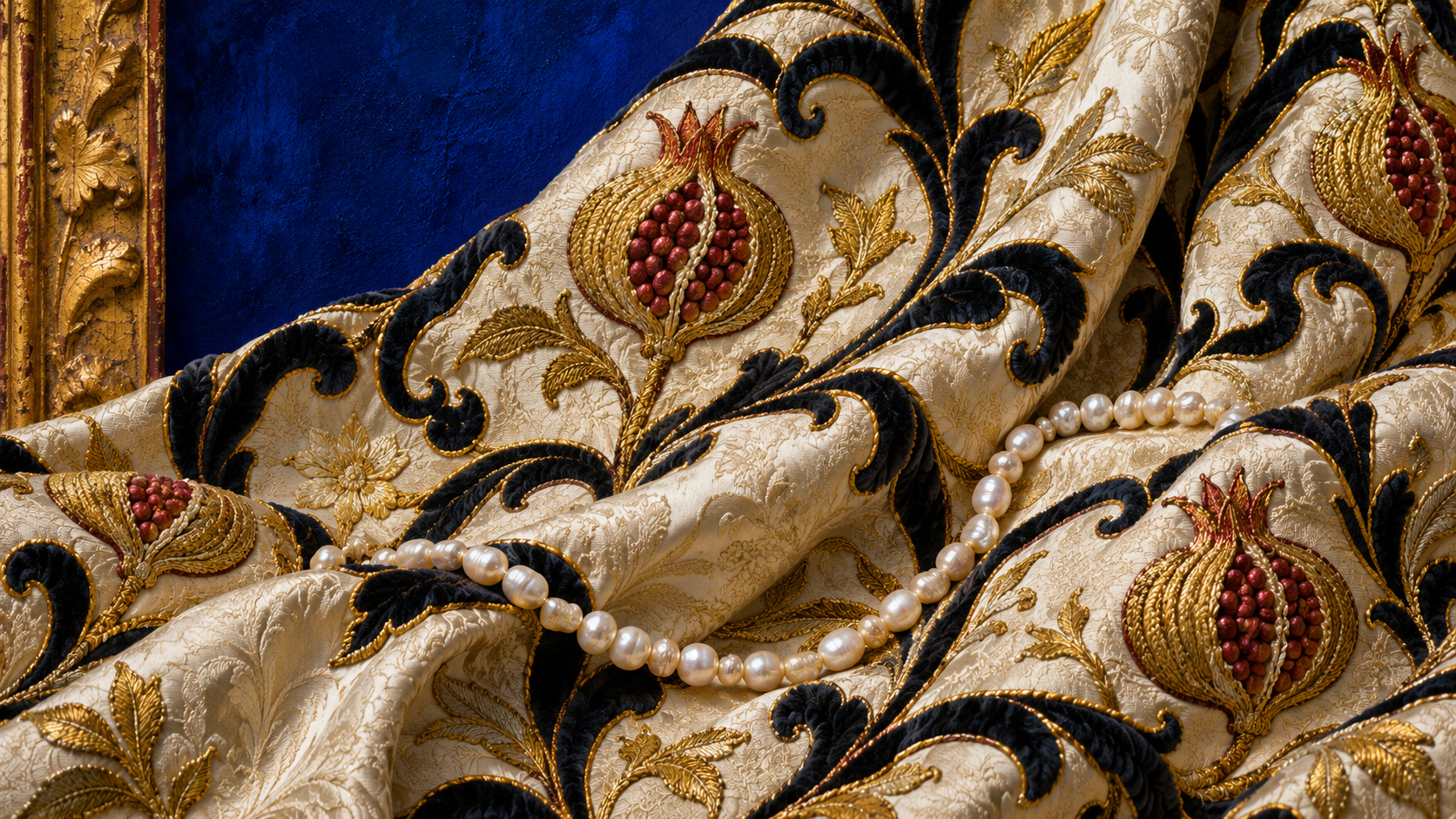
The eye can spend quite a while on Eleonora’s sleeve before returning to her face. Bronzino followed the pattern of the silk over the curve of her arm, allowing the viewer to imagine the weight of the cloth. A broad expanse of blue sets off the pale fabric. In the Uffizi painting, the artist obtained that blue from lapis lazuli, an exceptionally expensive pigment familiar from depictions of the Virgin Mary’s cloak.
The silk carried a local association just as immediate as the religious one. Florence specialised in the production of costly brocade, a fabric whose elaborate pattern is woven into the cloth. A viewer acquainted with the trade could admire the skill of two sets of hands at once. A weaver had to make such material possible. A painter had to work out how a flat wooden panel could persuade the eye that it was looking at raised threads.
The design includes pomegranate and pinecone motifs. The Uffizi’s curators connect them with Christian ideas of regeneration and resurrection, as well as with Eleonora’s fertility. These meanings could sit comfortably together for a contemporary viewer. The duchess had a young son at her side, Florence had a thriving luxury trade, and the same class of costly fabric could dress a member of the ruling family or furnish a church vestment. Bronzino could draw on all three associations without putting an explanatory word into the picture.
The Palace Eleonora Bought Still Bears Another Family’s Name
In 1549, Eleonora bought Pitti Palace. The name belonged to Luca Pitti, the Florentine merchant who had begun it in the previous century. What she acquired was an unfinished building with three large doors and two rows of seven windows across its façade. Anyone who knows the immense frontage in Florence today has to imagine a considerably smaller palace.
Eleonora had already helped turn the Palazzo Vecchio, the old seat of the Florentine republic, into a residence suited to a duke, his family, their servants and visiting dignitaries. At Pitti, she had another possibility. The rising ground behind the building gave her room to develop the Boboli Gardens. She had known ambitious gardens since childhood in Naples and enjoyed spending time at the family’s Tuscan villas, where she and Cosimo fished and hunted.
There was money in her interest in land, too. The Uffizi connects the expansion of Medici estates under Eleonora with the income to be made from cultivating grain. A garden and a grain estate answered different needs. Both required decisions about what land to acquire and what to do with it once it belonged to the family.
Later rulers enlarged Pitti and continued to shape Boboli over centuries. Eleonora’s particular achievement can be dated much more precisely. In 1549, she saw a future residence in a merchant’s unfinished palace and bought it. The Pitti name survives over the door, while one of the most consequential decisions in the building’s history belongs to her.
Why the London Portrait Has a Vase and an Inscription
The London panel preserves a particularly sharp irony. Someone went to considerable trouble to reproduce the beauty of Eleonora’s dress, jewels and complexion, then placed words above her head cautioning the viewer about beauty’s worth. The Wallace Collection identifies the Latin phrase with the Mass for a holy woman. Its presence helps explain why the museum reads the painting as a probable memorial.
The vase is harder to settle. It has been interpreted as a funerary urn and as an emblem of virtue or beauty. The first reading fits a picture made in remembrance. The others fit the inscription’s invitation to consider what a woman ought to be valued for. The evidence leaves room for more than one reading, and the painter’s decision to include the vessel is more certain than any single explanation of it.
Visitors can see the panel in Cosimo I de’ Medici: Art and Dynasty, a free display in the Housekeeper’s Room at the Wallace Collection in London, from 18 November 2026 to 21 March 2027. Nearby, a ceremonial sword associates Cosimo with Hercules. His wife’s portrait rewards a quieter kind of looking. Start with the hands resting in her lap. In another painting, one of them holds Giovanni close. Fourteen years after Bronzino painted the boy, his mother was still deciding how he should appear before Rome.
Sources
The Wallace Collection — Cosimo I de’ Medici: Art and Dynasty — The conservation treatment, comparison with the Florence portrait and London display details.
The Wallace Collection — Eleonora di Toledo — The London panel’s dimensions, studio attribution, proposed date, inscription and interpretations of the vase.
Uffizi Galleries — Portrait of Eleonora di Toledo with her son Giovanni — The child’s identity, Eleonora’s periods in government, and the meaning of the pigment and brocade.
Uffizi Galleries — Eleonora di Toledo and the Invention of the Medici Court in Florence — The exhibition notes document the wardrobes Eleonora chose for her sons, her patronage and her management of land.
Uffizi Galleries — History of Pitti Palace — Eleonora’s purchase in 1549 and the scale of the building before its expansion.
Next Reads
Ozymandias Explained: Why Shelley’s Fallen King Still Speaks to Us — What happens to a ruler’s carefully composed image once later generations get to interpret it?
Who Were the Three Wise Men? What the Bible Really Says About the Magi and the Star — How painters helped turn a few lines of scripture into figures recognisable by their clothes and gifts.
What Happened to the Cross Jesus Died On? The Earliest Evidence for the True Cross — How historians weigh an object’s physical history alongside the words people wrote about it.
