

The 10 Most Persistent 9/11 Conspiracy Theories, Ranked and Explained
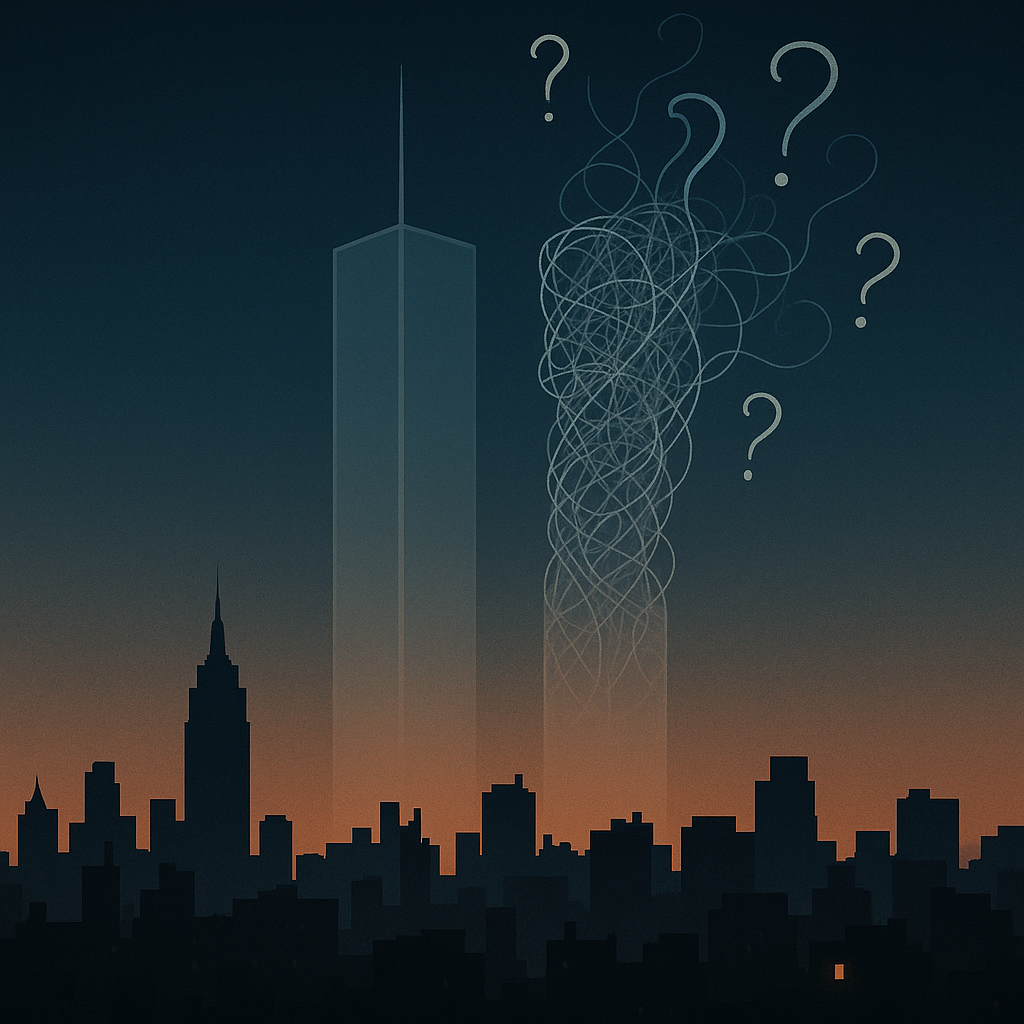
All claims described in this article reflect conspiracy theories circulated online and in public discourse; they are not supported by verified evidence.
More than two decades after the September 11 attacks, 9/11 conspiracy theories still pull in millions of views, comments, and arguments across social media, message boards, and late-night conversations. They ebb and flow with each new documentary, anniversary, or viral clip, but they never quite disappear.
At the heart of this staying power is a clash between two forces. On one side is an event that was shocking, visually overwhelming, and emotionally scarring. On the other is a dense, technical, often slow-moving official record built from engineering reports, aviation data, and intelligence investigations. The gap between how the day felt and how it is documented has become fertile ground for alternative stories.
This article ranks the ten most persistent 9/11 conspiracy theories by their reach, resilience, and cultural impact, not by their credibility. Each entry sets out what believers claim, what is known from evidence-based investigations, and why the theory keeps returning despite repeated debunks.
By the end, the reader will have a clearer map of the 9/11 conspiracy landscape: which stories dominate, where they overlap, how they evolve, and what they reveal about trust, power, and information in the modern age.
The story turns on whether people feel more persuaded by evidence or by narrative.
Key Points
9/11 conspiracy theories cluster around a few core claims: “inside job,” controlled demolition, and hidden foreign masterminds.
The most influential theories are not new; they are constantly repackaged for new audiences and platforms.
Engineering and intelligence investigations have repeatedly contradicted the central claims, but mistrust of institutions keeps the theories alive.
Antisemitic and anti-Muslim narratives are woven into several conspiracy frameworks, often in coded or indirect ways.
Social media algorithms, influencer culture, and polarised politics give fresh oxygen to debunked ideas.
Understanding these theories is less about proving them wrong and more about understanding why they appeal.
Background
On September 11, 2001, four hijacked commercial airliners were used in coordinated attacks against the United States. Two were flown into the North and South Towers of the World Trade Center in New York City, one struck the Pentagon in Virginia, and a fourth crashed in Pennsylvania after passengers resisted the hijackers. Close to 3,000 people were killed.
In the years that followed, multiple official investigations examined how the attacks were planned, how the hijackers were able to act, why the buildings failed the way they did, and how intelligence and security agencies missed warning signs. Detailed engineering studies looked at the structure of the towers and World Trade Center 7, the smaller building that collapsed later that day. Aviation and military timelines were reconstructed.
Alongside this, a parallel story grew online and in certain print and film circles. Early alternative accounts questioned how such a large plot could have gone undetected, focused on visual anomalies from television footage, and seized on mistakes or gaps in early reporting. Grainy screenshots, out-of-context quotes, and misinterpreted diagrams became fuel for a wide range of competing theories.
Over time, the field of “9/11 truth” splintered. Some theorists insist explosives brought down the towers. Others say no planes were involved at all. Some blame shadowy factions inside the US government; others blame foreign intelligence agencies. What unites them is a shared belief that the public has not been told the full truth.
The Top 10 9/11 Conspiracy Theories
1. “Inside Job” and Controlled Demolition of the Twin Towers
This is the flagship 9/11 conspiracy theory. It claims that the Twin Towers did not collapse primarily because of the aircraft impacts and fires, but because explosives or other demolition technologies were secretly planted in advance.
Supporters point to the speed of the collapses, the vertical “pancaking” of floors, and the appearance of dust clouds that they argue resemble known controlled demolitions. They often highlight isolated eyewitness accounts of “explosions” inside the buildings and argue that jet fuel fires alone could not have weakened the steel structure enough.
Engineering analyses have concluded that the combination of impact damage, dislodged fireproofing, and prolonged, intense fires led to structural failure. The towers were not designed to survive that specific pattern of damage indefinitely. No credible physical evidence of planted explosives has been produced.
Despite this, the “inside job” demolition claim remains the anchor myth for many other theories, because it directly supports the idea of deep planning and internal complicity.
2. The “Mysterious” Collapse of World Trade Center 7
World Trade Center 7 (WTC 7) was a 47-story building that collapsed in the late afternoon of September 11. It was not struck by a plane, which made its failure a focal point of suspicion.
Conspiracy narratives argue that WTC 7 fell in a manner too symmetrical and too sudden to be explained by fire alone. They highlight short clips that appear to show a period of near free-fall acceleration and claim this can only result from explosives removing support columns simultaneously.
Detailed investigations have found that uncontrolled fires, fueled by office contents and fed by damaged water systems, burned for hours in WTC 7. The failure of critical interior columns, exacerbated by thermal expansion and structural connections, led to progressive collapse. Again, no hard evidence of demolition charges has been verified.
Because WTC 7 was home to various government and financial tenants, it features heavily in narratives that claim the building was “taken down” to destroy sensitive records.
3. “No Planes” and CGI or Holograms
At the fringe of 9/11 conspiracism is the idea that no commercial airliners actually struck the World Trade Center. Instead, this theory claims that missiles or other weapons did the damage, while the images of planes were created using digital effects, holograms, or broadcast manipulation.
Adherents focus on perceived inconsistencies in camera angles, lighting, or impact physics in video footage. Some claim that eyewitness testimony was orchestrated or misreported.
This theory collides head-on with a vast body of evidence: passenger lists, wreckage, flight data recorders, air traffic control logs, phone calls from onboard, and thousands of independent eyewitnesses who saw the planes. Its persistence shows how far distrust can go once someone concludes that almost every institution and record is compromised.
4. A Missile or Drone Hit the Pentagon
Another major cluster of 9/11 conspiracy theories claims that Flight 77 did not crash into the Pentagon. Instead, the building was supposedly struck by a missile, a smaller military aircraft, or a remote-controlled drone.
Supporters point to early photographs showing a relatively narrow entry hole, limited exterior debris, and damaged grassy areas that they argue are inconsistent with the crash of a large airliner. They question the partial and sometimes low-resolution security camera footage released publicly.
Forensic work at the site identified aircraft debris, passenger remains, and damage patterns consistent with a large aircraft traveling at high speed. The shape of the hole reflected the structure of the building and the way wings and fuselage behaved on impact.
The Pentagon theory remains popular online because it compresses a complex, chaotic crash scene into a simple question: “Where is the plane?” That simplicity makes it sticky, even when detailed answers exist.
5. Flight 93 Was Shot Down
United Airlines Flight 93 crashed in a field in Pennsylvania after passengers fought back against the hijackers. The widely accepted account is one of desperate resistance that prevented another strike on Washington, DC.
The conspiracy alternative is that the aircraft was shot down by the US military and that this was later covered up. Believers point to reports of debris found over a wide area, early confusion about the crash, and passing references to fighter jets being scrambled.
Investigations concluded that the combination of passenger resistance, hijacker actions, and loss of control led to the crash. Debris fields were consistent with high-speed impact, and there is no verified evidence of missile use or gunfire.
The Flight 93 theory speaks to a deep suspicion: that authorities might sacrifice civilians in the name of national security and then hide the decision.
6. Insider Trading and “9/11 Profiteers”
In the days before the attacks, there were unusual levels of trading in certain airline and insurance stocks. This has been woven into a narrative that some investors knew about the attacks in advance and placed “put options” to profit from the coming crash in share prices.
Analyses of the trading patterns found that some of the activity could be explained by broader market conditions or routine hedging strategies. Where individual trades raised questions, subsequent review did not confirm a direct link to the plotters or intelligence leaks about the attacks.
Still, the image of shadowy traders cashing in on catastrophe is powerful. It fits a broader public story about financial elites profiting while ordinary people pay the price, and so the theory endures even when specific claims are shown to be weak.
7. Stand-Down Orders and the “Let It Happen” Theory
This family of theories does not necessarily claim that the US government directly planned the attacks. Instead, it suggests that officials knew something was coming and either failed to act or deliberately stood down air defenses to ensure the plot succeeded.
The argument points to confusion in the air defense response, delayed interception of hijacked aircraft, and earlier intelligence warnings about al-Qaeda and potential hijacking plots. It interprets missed signals and bureaucratic failures as deliberate choices rather than a mix of errors, miscommunication, and structural gaps.
Official inquiries documented serious intelligence and coordination failures, but these were attributed to fragmentation, poor information sharing, and underestimation of the threat rather than intentional inaction.
The “let it happen” framing persists because it appears to offer a tidy moral explanation for a messy institutional story.
8. Foreign Intelligence Masterminds
Another common strand claims that foreign intelligence services — often named as Israeli, Saudi, or other Middle Eastern agencies — either orchestrated or closely guided the attacks. In the most extreme versions, al-Qaeda is treated as a mere front.
Some of these narratives draw on real questions raised about individuals with complex ties to different states, or about the role of foreign funding in extremist networks. Others slide quickly into open antisemitic tropes, portraying an all-powerful hidden hand using the attacks to manipulate US policy.
Investigations have examined alleged links and information failures involving foreign governments. They have not confirmed the idea that a non-state ally or rival designed and ran the operation behind the scenes. The hijackers themselves, and their direct support networks, have been extensively documented.
These theories thrive because they plug into existing prejudices and geopolitical anxieties, wrapping old suspicions in the imagery of a defining modern tragedy.
9. 9/11 as a Manufactured Pretext for War
It is widely accepted that the attacks were used to justify wars in Afghanistan and Iraq and to expand surveillance and security laws. The conspiracy leap is to say that those wars and laws were the true goal all along, and that the attacks were staged or assisted to create a “new Pearl Harbor.”
Supporters cite policy documents from before 2001 that argued for reshaping US military posture, and they point to how quickly certain legislative and military plans moved after the attacks. They frame this as evidence that the crisis was engineered.
A more sober reading is that a real attack created a political environment in which previously marginal or contested ideas — such as wide-ranging counterterror powers or regime-change strategies — gained rapid traction. That is a troubling enough story on its own, but it does not require the attacks to have been fabricated.
This theory remains influential because it taps into anger over the human cost of the wars that followed and the flawed claims that led to them.
10. Exotic Weapons and “Directed Energy” Claims
At the far edge of the 9/11 conspiracy universe are theories that the towers were destroyed not by planes or conventional explosives but by advanced, secret weapons: miniaturized nuclear devices, directed energy beams, or other science-fiction-style technologies.
These claims typically rely on misinterpreted images of dust clouds, misunderstandings of material behavior, or selective use of scientific jargon. They do not fit well with physical evidence collected from the site, from structural remnants to health data on first responders.
Their presence in the ecosystem shows how conspiracy thinking can evolve over time. As more mundane theories are challenged, some believers move further into speculative territory rather than revisiting their assumptions.
Analysis
Political and Geopolitical Dimensions
9/11 conspiracy theories sit at the crossroads of domestic and international politics. They offer simple, emotionally charged answers to complex questions about power: who benefits from war, who shapes foreign policy, who controls intelligence and security agencies.
For some, blaming an “inside job” or foreign intelligence service is a way to express rage at real policy failures and controversial decisions without wading through dense congressional transcripts or intelligence reform debates. Conspiracy narratives compress years of policymaking and conflict into one decisive, hidden act.
Geopolitically, these theories also become tools. Extremist groups may use them to undermine trust in Western governments. Foreign state media sometimes amplify them to highlight hypocrisy or weakness. Within Western societies, different political factions sometimes cherry-pick elements that support their own narratives about elites, deep states, or global networks.
Economic and Market Impact
Direct economic markets are less impacted today by 9/11 conspiracy theories than by broader political or financial news, but the stories still have indirect effects.
The “insider trading” narrative feeds into a wider belief that markets are rigged, that crises are engineered for profit, and that ordinary investors stand no chance against those with secret knowledge. This can push some people toward highly speculative, alternative financial spaces, or toward distrust of mainstream economic analysis.
For industries linked to security, aviation, or construction, the persistence of these theories sometimes surfaces in public consultations, legal claims, or reputational debates. Engineering firms, for example, may still find their work misrepresented in online videos or public forums, which can distort how their expertise is perceived.
Social and Cultural Fallout
Culturally, 9/11 conspiracy theories have become a gateway into a broader conspiratorial worldview. Documentaries, internet forums, and social media channels use 9/11 as an entry point before branching into other topics: vaccines, elections, climate, or other attacks and disasters.
For some communities, these theories function as identity markers: being “awake” to the “truth” becomes a social badge. Offline, this can strain families, friendships, and workplaces, particularly when individuals insist that others “do the research” or accept videos as definitive proof.
Theories that focus on particular ethnic or religious groups — whether antisemitic narratives about hidden masterminds or claims that Muslims as a whole were not really involved — also feed prejudice. They can reinforce harmful stereotypes and deepen social divides long after the dust and smoke of 2001 have cleared.
Technological and Security Implications
The rise and persistence of 9/11 conspiracy theories track closely with the evolution of digital technology. Early websites, email chains, and low-bandwidth video clips helped alternative explanations spread in the 2000s. Today, high-definition edits, algorithm-driven recommendations, and influencer commentary recycle the same core claims for new generations.
This has direct implications for security and crisis communication. Authorities now operate in an environment where any major attack, disaster, or accident will immediately generate alternative narratives, often before facts are confirmed. Photos and videos can be spliced, slowed down, or stripped of context within minutes.
Conspiracy belief can also become a security issue in its own right. When people accept that every major event is staged, it can erode willingness to cooperate with investigations, accept emergency guidance, or support necessary protective measures.
What Most Coverage Misses
Most coverage of 9/11 conspiracy theories focuses on fact-checking: listing claims, presenting evidence, and declaring them debunked. That work is important, but it often misses the emotional and psychological architecture that keeps these stories alive.
For many believers, 9/11 conspiracies are not primarily about steel temperatures or radar coverage. They are about humiliation, fear, anger, and a sense of betrayal — both by attackers and by institutions that seemed unprepared or evasive. The theories offer a narrative that feels more intentional and less random than the idea of a small group of extremists outsmarting powerful states.
Another overlooked point is how these theories interact with genuine, documented failures. Intelligence gaps, misjudgments about threats, and flawed decisions about war are real. When those failings are not addressed in ways that feel honest and accountable, conspiracy narratives rush to fill the gaps. The problem is not just false claims; it is the space that opened up for them to grow.
Why This Matters
The persistence of 9/11 conspiracy theories matters because it reveals deeper fractures in trust — in government, in media, in expertise, and at times in one another. These narratives shape how people interpret new crises, from terrorist attacks to pandemics to natural disasters.
In the short term, they influence how anniversaries are marked, how survivors and families are treated online, and how new generations learn about the day. For educators, journalists, and community leaders, they complicate efforts to teach a clear, evidence-based account.
In the long term, 9/11 conspiracies form part of a broader ecosystem of mistrust that affects elections, public health, and social cohesion. They sit alongside other narratives about “deep states,” “great resets,” and hidden global cabals, often sharing the same channels and influencers.
Signals to watch include the kinds of 9/11 content that go viral each year around the anniversary, the way major platforms enforce (or relax) rules about misinformation, and how public debates handle genuine institutional failures without sliding into total cynicism.
Real-World Impact
Consider a firefighter from a US city who responded to ground zero and later developed serious health problems. In online support groups, he encounters conspiracy content claiming that officials knowingly lied about air quality and building safety. Some of his frustration at slow compensation and recognition gets channeled into broader beliefs about “inside jobs,” making it harder to separate real institutional failings from unfounded claims.
A university student on the other side of the world stumbles onto a long 9/11 “documentary” recommended by a video algorithm. Impressed by the confident tone and dramatic music, she starts questioning not just 9/11, but everything from vaccines to election results. Her trust in mainstream sources erodes, and she begins sharing misleading content with friends and family.
A teacher in a secondary school finds that several students insist that “no planes hit the towers,” having seen clips on social media. Class time that might have gone to broader discussions of history, politics, or ethics is now spent carefully unpacking videos, images, and the difference between evidence and assertion.
An intelligence analyst working on modern counterterrorism has to plan for the fact that any failure — a missed lead, a delayed response, a tragic attack — will immediately generate narratives of deliberate complicity. That shapes how briefings are written, how quickly information is shared, and how public statements are framed.
Legacy
The landscape of 9/11 conspiracy theories is crowded, but its core features are remarkably stable. A handful of big claims — controlled demolition, stand-down orders, hidden masterminds, and secret profits — are repackaged again and again for new audiences and new platforms.
The central tension is not just between believers and skeptics. It is between the human desire for simple, morally clear stories and the reality of complex systems, messy institutions, and imperfect information. Conspiracy theories offer clarity and intention where the official record often offers nuance and uncertainty.
What happens next will hinge on how societies handle new crises and how they talk about past ones. If investigations are transparent, failures are acknowledged plainly, and people are equipped early with tools to question and verify, the space for false narratives can shrink. If not, the next major shock may simply add another layer to an already crowded shelf of alternative histories.
The signals to watch are not only in the archives of 2001, but in the comment sections, classrooms, and living rooms where the meaning of that day is still being argued over, one video at a time.
