

The Abrahamic Religions Explained: How One Ancient Idea of God Changed the World
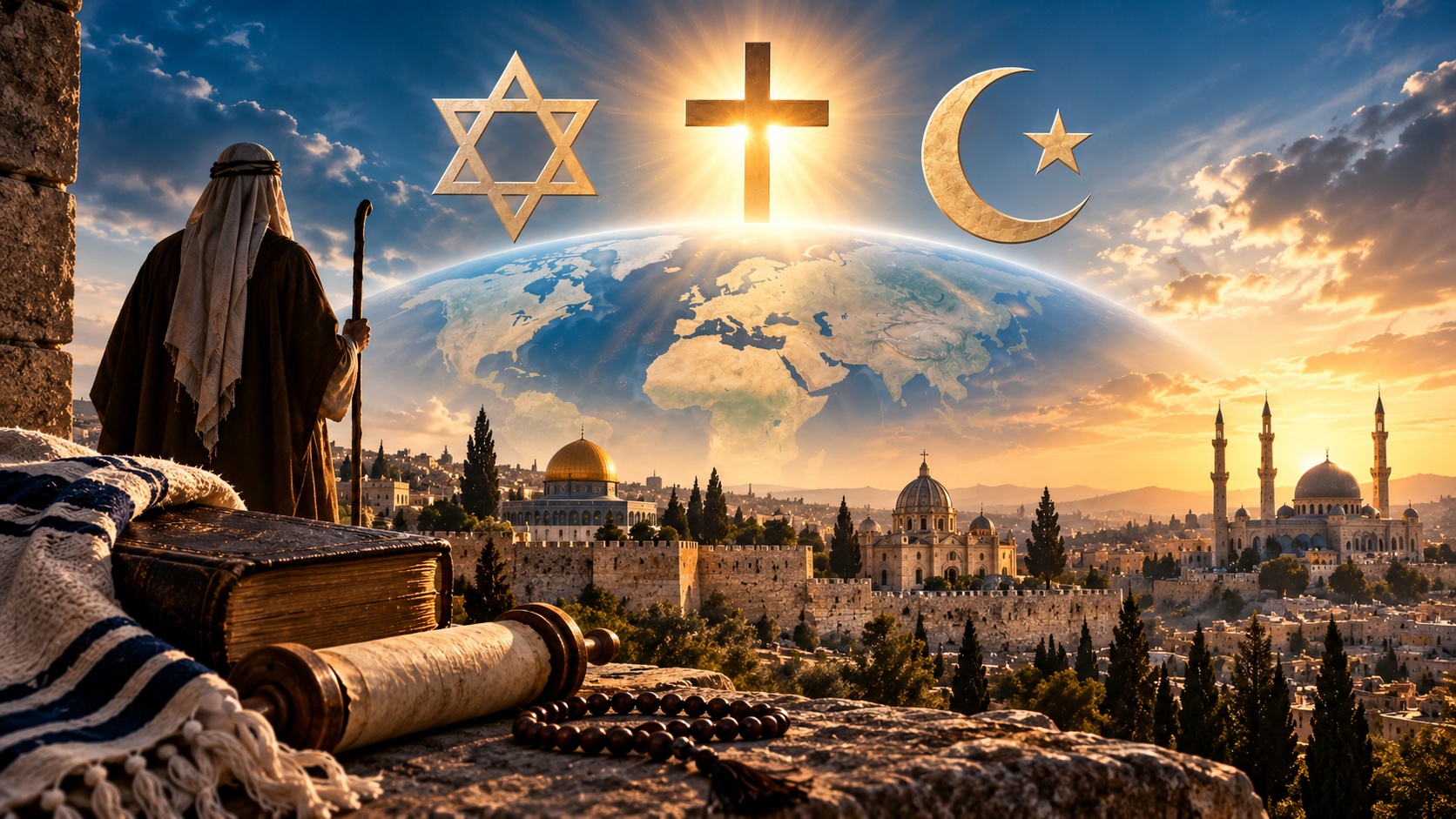
How One Ancient Religious Revolution Created Judaism, Christianity and Islam
The Faiths That Changed History
Judaism, Christianity and Islam together have shaped governments, laws, wars, peace movements, philosophy, family life, morality, art and ideas of life after death for billions of people. Yet their story did not begin with three established religions suddenly appearing in succession. It reaches into an older world of Mesopotamian temples, Canaanite gods, tribal societies, sacrifice, empire and humanity's long attempt to understand whether anything existed beyond the visible world.
The extraordinary part of the story is not simply that three religions trace spiritual ancestry to Abraham. It is that the traditions emerging from this relatively small region survived the destruction of kingdoms, temples and empires, repeatedly reinvented their institutions without surrendering their central claims, and eventually spread across almost the entire planet. Even in an increasingly secular West, the global story is far from one of religion disappearing.
Before Abraham: A World Filled With Gods
Long before Judaism, Christianity or Islam existed, human beings were already religious. Prehistoric burials, ritual objects and sacred spaces indicate that spiritual behaviour predates recorded history, although archaeology cannot tell us precisely what those early people believed. By the time civilisation produced written records, however, organised religion was everywhere.
Mesopotamia offers one of the clearest windows into that earlier world. Cities had patron gods, temples operated at the centre of political and economic life, rulers sought divine legitimacy and priests conducted rituals intended to maintain the relationship between humans and supernatural powers. Surviving records contain thousands of divine names, and gods were often imagined as powerful but recognisably personal beings with desires, rivalries and responsibilities.
Religion and geography were closely connected. One city might be identified with one god while another city elevated another. When political power shifted, divine hierarchies could shift with it. Babylon's growing political importance, for example, was accompanied by the elevation of its patron deity within Mesopotamian religion.
To the west, the religious world of ancient Canaan contained deities associated with storms, fertility, the heavens and the underworld. Texts discovered at ancient Ugarit dramatically expanded modern understanding of this environment, revealing a religious landscape associated with figures including El, Baal and Asherah.
This matters because ancient Israel did not develop in a vacuum.
The people who eventually produced the Hebrew scriptures lived within this broader Near Eastern world. Their language, political structures, stories and religious vocabulary shared features with neighbouring cultures. The crucial transformation was therefore not that religious thought suddenly began with Abraham, but that one strand of ancient Near Eastern religion eventually developed an unusually uncompromising claim: Israel's God was not merely Israel's strongest god. There was ultimately only one God.
Abraham: The Man at the Centre of Three Religions
In the biblical narrative, the decisive turn begins with Abraham.
Genesis presents Abraham as a man called by God to leave his homeland and travel toward Canaan. God promises descendants, land and blessing. Abraham becomes the patriarch of a family through which the history of Israel unfolds, principally through Isaac, Jacob and Jacob's descendants.
For Judaism, Abraham stands near the beginning of the covenantal story that leads toward Israel.
Christianity inherited Abraham from Jewish scripture but interpreted his importance through the life and mission of Jesus. Christian writings turned Abraham into an example of faith whose significance could extend beyond biological descent.
Islam gives Ibrahim, the Arabic form of Abraham, an equally profound position but frames him differently. The Quran presents Abraham as neither Jewish nor Christian, but as an upright monotheist submitting himself to God. Islam therefore does not understand itself simply as a religion invented after Christianity. Within Islamic theology, Muhammad restores the primordial submission to the one God already represented by Abraham and the earlier prophets.
That difference is crucial. Judaism, Christianity and Islam do not merely disagree over what happened after Abraham. They interpret the meaning of Abraham himself through different theological frameworks.
Historically, however, Abraham is much harder to recover.
There is no contemporary inscription identifying the Abraham of Genesis independently of the biblical tradition. The patriarchal narratives contain features that can be situated within the ancient Near Eastern world, but attempts to reconstruct a securely identifiable historical Abraham have remained controversial. Modern scholarship therefore distinguishes between Abraham's immense religious significance and what archaeology can independently establish about him as an individual.
That distinction does not prove or disprove the religious claims surrounding Abraham. Archaeology and faith are answering different questions. History asks what surviving evidence can demonstrate; religion asks what Abraham means within revelation, covenant and the relationship between humanity and God.
Ancient Israel Did Not Begin as Modern Judaism
The next stage is where the history becomes considerably more complicated.
It is tempting to imagine that Abraham founded Judaism, Moses organised it and everything after that was essentially the same religion practised today. Historically, the development was far more gradual.
Ancient Israelite and Judean religion emerged within the wider religious culture of Canaan during the late second millennium and early first millennium BCE. Yahweh became the central deity of Israel and Judah, but archaeological evidence and biblical criticism indicate that at least some Israelites also acknowledged or worshipped other divine figures. Inscriptions and religious remains have fuelled extensive scholarship over the relationship between Yahweh, Asherah and the wider West Semitic pantheon.
This means there is an important difference between the theological story preserved by the biblical writers and the reconstruction attempted by historians.
The biblical tradition repeatedly condemns the worship of other gods. Historically, those condemnations themselves provide evidence that competing religious practices existed. The transition from a world in which Yahweh was Israel's God to the insistence that Yahweh was the only God was therefore a process rather than one moment that archaeology can precisely date.
The command to worship one God also does not necessarily begin as a philosophical declaration that no other spiritual beings could exist. Scholars distinguish strict monotheism from monolatry or henotheism: the exclusive worship of one deity even within a cultural environment where other divine beings were assumed or recognised.
Over centuries, that distinction became increasingly important.
Moses, Exodus and the Religious Constitution of Israel
Within the biblical account, Moses becomes the next enormous figure.
The Israelites are enslaved in Egypt. God commissions Moses to confront Pharaoh. The Exodus liberates Israel, and the covenant at Sinai transforms a rescued population into a people bound by commandments.
The Torah places law at the heart of the relationship between God and Israel. Religion is therefore not confined to belief. Food, worship, sexuality, property, debt, justice, festivals, sacrifice, family relationships and social obligations can all become sacred concerns.
The historical reconstruction of the Exodus remains debated. Evidence has not produced straightforward archaeological confirmation of the biblical narrative in the form later recorded, and scholars continue to disagree about whether the tradition preserves memories of smaller population movements, historical experiences subsequently expanded into national narrative, or something more closely corresponding to the scriptural account.
Its historical influence, however, is beyond dispute.
Liberation from slavery becomes one of the central narrative templates of Western religion. Christianity later interprets salvation through Exodus-like language, while Islam recognises Musa, or Moses, as one of its great prophets.
The deeper story of the Hebrew Bible — creation, Abraham, covenant, liberation, law, monarchy, corruption, destruction, exile and restoration — forms the foundation on which much later Abrahamic thought is built. That larger narrative can also be followed through the story and structure of the First Testament.
Kingdom, Temple and Catastrophe
Ancient Israelite religion became intertwined with monarchy.
Jerusalem eventually acquired exceptional importance, while the Temple became the central institution of Judean worship. Kingship, priesthood, land and divine covenant became bound together.
Then the political structure collapsed.
The northern Kingdom of Israel was destroyed by Assyria in the eighth century BCE. Judah survived longer, but Babylon eventually conquered Jerusalem, destroyed the First Temple and deported sections of the population during the sixth century BCE.
For a religion connected to land, temple and national protection, this was an intellectual and spiritual catastrophe.
If Yahweh protected Israel, how could Israel lose?
One response transformed defeat into theology. National collapse did not demonstrate God's weakness. The prophets and religious writers increasingly interpreted catastrophe as judgment: Israel had broken the covenant.
That move was historically powerful because it made the religion capable of surviving political defeat. The God of Israel no longer depended upon Israel having the strongest army or an intact monarchy.
Empire could destroy Jerusalem without destroying God.
Exile Helps Transform the Idea of God
The Babylonian exile became one of the great turning points in Jewish history.
Identity could no longer depend entirely on independent kingship or possession of a functioning central sanctuary. Text, memory, law, communal practice and covenant assumed still greater importance.
After the Persian conquest of Babylon, Judeans were permitted to return and the Temple in Jerusalem was eventually rebuilt. The centuries that followed are known as the Second Temple period, beginning in the Persian era and ending with the Roman destruction of Jerusalem's Temple in 70 CE.
This period matters enormously because the religious universe encountered by Jesus was richer and more diverse than a simple label such as “Old Testament Judaism” suggests.
Ideas about resurrection, angels, demons, final judgment, messianism and the end of history developed strongly during the centuries before Christianity emerged. Contact with Persian religion, particularly Zoroastrianism, has long been examined as one possible influence on parts of Jewish eschatology, although scholars debate how direct that borrowing was and warn against treating similarity as proof.
Greek conquest added another layer.
Alexander the Great's expansion carried Hellenistic language and culture across the eastern Mediterranean and Near East. Jewish communities increasingly operated in a world where Hebrew traditions met Greek philosophy, political institutions and language.
By the first century CE, Judaism contained competing schools, interpretations and expectations.
Into that world came Jesus of Nazareth.
Christianity Begins Inside Judaism
Jesus was Jewish.
His earliest followers were Jewish. The scriptures they knew were Jewish. Arguments about messiah, resurrection, law, purity, covenant and Israel arose from a Jewish religious environment.
Christianity therefore did not begin as foreigners creating a new religion to replace Judaism. It began as a movement within the complicated world of Second Temple Judaism.
The decisive Christian claim was that Jesus was the Messiah — and eventually, in mainstream Christianity, much more than a human messianic king.
His crucifixion could have destroyed the movement. Instead, followers proclaimed that Jesus had risen from the dead.
That claim changed everything.
The resurrection became the interpretation through which his execution was transformed from defeat into victory. His followers preached that God had acted decisively through Jesus and that his death and resurrection had consequences not merely for Israel but for humanity.
Paul became crucial to that expansion.
Christian communities increasingly welcomed Gentiles without requiring complete adoption of Jewish identity and law. The result was a religion that retained Israel's scriptures, creation story, prophets, Abraham, Moses and moral universe while making extraordinary new claims about Jesus.
This remains the deepest theological divide between Christianity and both Judaism and Islam.
Mainstream Christianity holds that Jesus is divine and understands God through the relationship of Father, Son and Holy Spirit. Judaism rejects Jesus as God and does not accept the Christian Trinity. Islam honours Jesus as al-Masih, the Messiah, and a major prophet, but rejects his divinity and insists upon God's absolute oneness.
Shared characters therefore do not produce shared theology.
Christianity Becomes an Imperial Religion
Early Christianity spread through the Roman world despite periods of persecution.
Its transition from marginal movement to institutional power accelerated dramatically during the fourth century. Emperor Constantine favoured Christianity and convened the Council of Nicaea in 325 as Christians fought over how the relationship between Jesus and God should be understood.
Nicaea became one of the defining moments in Christian doctrinal history. The language that developed through Nicaea and the Council of Constantinople in 381 helped formulate the Trinitarian Christianity that remains foundational for Catholic, Orthodox and most Protestant churches today.
Christianity then travelled through empire, missionaries, monasteries, trade networks, conquest and migration.
But it never remained institutionally united.
Ancient theological disputes created separate churches. The divide between the Latin West and Greek East eventually produced the enduring separation commonly associated with the Catholic and Eastern Orthodox traditions. The Protestant Reformation of the sixteenth century fractured Western Christianity again.
Translation accelerated the process.
Christianity became European, African, Middle Eastern, Asian and eventually global, taking different cultural forms while preserving overlapping scriptures and central beliefs.
Its demographic centre would eventually move again — this time away from the European societies that had exercised extraordinary Christian political power for centuries.
Judaism Survives the Destruction of Its Temple Again
Meanwhile, Judaism underwent another transformation.
Roman forces destroyed the Second Temple in 70 CE. The sacrificial centre of Jewish life was gone.
Yet Judaism survived.
Rabbinic traditions gradually developed structures capable of maintaining religious life without the Temple. Torah study, prayer, interpretation, community and legal reasoning became fundamental mechanisms of continuity. The rabbinic movement developed first within relatively limited scholarly circles before acquiring wider authority over subsequent centuries.
The Mishnah and later Talmudic traditions became central to rabbinic Jewish intellectual life.
This helps explain why Judaism today cannot simply be described as “the religion of the Old Testament.” Judaism evolved after the Hebrew Bible just as Christianity did.
Modern Jewish life subsequently developed multiple traditions and movements, including Orthodox, Conservative and Reform Judaism alongside numerous communities shaped by distinctive regional histories.
The destruction of political independence, dispersion, persecution and the Holocaust made survival itself a recurring theme of Jewish history. The creation of the modern State of Israel in 1948 added another transformation by restoring Jewish sovereignty in part of the ancestral land after nearly two millennia without an independent Jewish state there.
Judaism remained demographically tiny compared with Christianity and Islam, yet its historical influence is extraordinary.
The latest comprehensive global estimates put the Jewish population at roughly 14.8 million in 2020 — about 0.2 per cent of humanity.
Islam Arrives in Seventh-Century Arabia
Roughly six centuries after Jesus, another Abrahamic movement appeared.
Muhammad began preaching in Arabia in the early seventh century. Islamic tradition holds that he received revelation from God through the angel Gabriel, with those revelations forming the Quran.
Islam's theological claim places Muhammad within an existing prophetic history rather than outside it.
Adam, Noah, Abraham, Moses and Jesus belong to the Islamic story. The Quran repeatedly engages with figures and traditions also found in Jewish and Christian scriptures, but it does not simply reproduce either tradition.
Islam holds that the same God has communicated through successive prophets and that Muhammad is the final prophet.
The term “Allah” does not mean a separate Muslim deity competing with the Jewish or Christian God. It is the Arabic word for God and is also used by Arabic-speaking Christians.
Where Islam differs is in its uncompromising doctrine of divine unity, tawhid. God has no divine partners. Jesus is honoured but is not God. Muhammad is a prophet, not divine.
Abraham becomes especially important because Islam can appeal past later Jewish-Christian division to what it understands as an earlier pure monotheism. The Quran explicitly presents Abraham as neither Jew nor Christian but as an upright person who submitted to God.
Islam Becomes a Civilisation
Muhammad's career differed politically from that of Jesus.
Jesus did not govern a state during his lifetime. Muhammad became the leader of a religious and political community centred on Medina.
Following Muhammad's death in 632, disputes over authority contributed to divisions whose consequences remain visible today.
Sunni and Shia traditions developed different understandings of legitimate leadership, religious authority and the succession to Muhammad. Over time, these became complex theological, legal and cultural traditions rather than simply rival political parties frozen in the seventh century.
Islam then spread with extraordinary speed.
Arab-led empires expanded across the Middle East, North Africa and beyond. Later Muslim societies emerged far outside Arabia, stretching through Persia, Central and South Asia, Southeast Asia, Africa and parts of Europe.
This history also destroys one persistent misconception: Muslim does not mean Arab.
Today, most Muslims are not Arabs, and some of the largest Muslim populations are found in South and Southeast Asia.
What Judaism, Christianity and Islam Actually Share
The phrase “Abrahamic religions” is useful because the three traditions genuinely share an enormous religious inheritance.
They insist that ultimate reality is grounded in one sovereign God rather than an endless competition between independent gods.
They place enormous significance on revelation.
They preserve traditions involving Abraham, though their interpretations differ.
They recognise moral accountability.
They believe human behaviour matters beyond immediate material advantage.
They contain traditions of prophecy, prayer, fasting, charity, sacred history and judgment.
They understand history as meaningful rather than merely cyclical.
And each developed powerful systems linking private morality to communal obligation.
This interconnectedness helps explain why religious stories repeatedly echo older sacred patterns. Similarity does not automatically mean simple copying. Religions inherit languages, symbols and questions from the worlds in which they develop, then reinterpret them around different theological claims.
Where the Three Religions Fundamentally Divide
The similarities can become misleading if pushed too far.
Judaism centres on the covenantal relationship between God and the Jewish people expressed through Torah and the vast interpretive tradition built around it.
Christianity makes Jesus the decisive centre of God's relationship with humanity. His identity, crucifixion and resurrection become the key to salvation.
Islam places the Quran and Muhammad's prophetic mission at the climax of a series of revelations stretching through earlier prophets. It accepts Jesus but rejects the Christian understanding of Jesus as divine.
Their scriptures also relate differently to one another.
Christians inherited Jewish scriptures as the Old Testament while adding the New Testament.
Judaism does not accept the New Testament as scripture.
Islam recognises earlier revelation associated with figures such as Moses and Jesus but regards the Quran as God's final authoritative revelation.
Even the statement “they believe in the same God” therefore needs care.
At the level of historical genealogy, all three consciously identify themselves with the God of Abraham.
At the level of theology, their understandings of God's nature diverge dramatically.
Religion Never Stopped Evolving
No major Abrahamic religion today looks exactly like its earliest historical form.
Judaism survived without the Temple and developed vast rabbinic traditions.
Christianity developed creeds, councils, monasteries, a papacy in Western Christianity, Orthodox patriarchates, Protestant churches and thousands of later denominations and movements.
Islam developed Sunni and Shia traditions, schools of jurisprudence, theological schools, Sufi traditions and different relationships between political and religious authority.
Printing changed religion.
Modern science changed religion.
Colonialism changed religion.
Democracy changed religion.
Nationalism changed religion.
Mass education changed religion.
Radio, television and the internet changed religion again.
None of those developments necessarily means that believers think revelation itself changed. The distinction is between revelation and the enormous human institutions that interpret, teach and practise it.
This is why the history of religion is never simply the history of doctrines.
It is also the history of who has authority to interpret them.
Secularisation Is Real — But It Is Not the Whole Future
The modern Western experience created a powerful assumption that economic development would eventually make religion disappear.
Something more complicated is happening.
The most comprehensive recent global analysis estimated that Christians remained the world's largest religious group in 2020 at roughly 2.3 billion people, or 28.8 per cent of humanity. Muslims numbered about two billion, or 25.6 per cent, after growing faster than any other major religious group between 2010 and 2020.
At the same time, religious non-affiliation expanded dramatically.
Approximately 1.9 billion people — 24.2 per cent of the world's population in 2020 — were estimated to have no religious affiliation. Much of the increase came through religious switching, particularly people raised Christian later identifying with no religion.
So two apparently contradictory processes are occurring simultaneously.
Religion is weakening institutionally across significant parts of the wealthy Western world.
Yet the global populations of Christianity and Islam remain enormous, and Islam has continued growing rapidly.
Christianity's Centre Is Moving South
One of the least appreciated changes is geographical.
Christianity is becoming less European.
By 2020, sub-Saharan Africa contained a larger share of the world's Christians than Europe. Roughly 31 per cent of Christians lived in sub-Saharan Africa, compared with about 22 per cent in Europe.
That is an extraordinary historical reversal.
Christianity spent centuries becoming deeply entangled with European empire, monarchy and culture. Its future may increasingly be shaped by African, Latin American and Asian Christians instead.
That could change theological priorities, church politics and the cultural image of Christianity itself.
Western observers who judge Christianity entirely by declining church attendance in Britain, France or parts of northern Europe are therefore seeing only one part of the global picture.
Islam Could Approach Christianity in Global Numbers
Islam's demographic trajectory is equally significant.
Older long-range projections estimated that Muslims could reach something close to numerical parity with Christians around the middle of the twenty-first century if the assumptions behind those projections continued. Those projections should now be treated cautiously because updated 2025 estimates revised the historical baseline and fresh post-2020 long-range projections have not yet replaced the older model.
What can be stated more confidently is what has already happened.
Between 2010 and 2020, the global Muslim population increased by approximately 347 million, reaching around two billion. Muslim growth was driven primarily by demographic structure: globally, Muslim populations were younger and had higher fertility than several other major religious populations.
This is demographic momentum, not evidence of mass worldwide conversion.
That distinction matters.
The Next Religious Revolution May Be Digital
The next transformation may have less to do with a new empire than with technology.
For most of history, religious authority depended heavily on institutions. A priest, rabbi, imam, scholar, monastery, university or local congregation mediated access to teaching.
The internet shattered part of that hierarchy.
A teenager can now compare translations of Genesis, hear Quranic commentary, watch a theological argument, examine an archaeological excavation and encounter atheistic criticism within the same hour.
Artificial intelligence will accelerate that process.
That creates opportunity and danger.
Scripture becomes more accessible. Languages can be translated instantly. Historical context can be explored by ordinary believers at a scale once reserved for scholars.
But authority becomes harder to identify.
Fabricated quotations, decontextualised scripture, synthetic religious teachers and algorithmically amplified extremism could make certainty easier to manufacture while making genuine knowledge harder to recognise.
The question may therefore shift from “Can I access religious information?” to “Who can I trust to interpret it?”
That is an ancient religious problem returning through new technology.
What the Future of the Abrahamic Religions May Actually Look Like
The future is unlikely to be either the triumph of religion or the extinction of it.
It will probably be uneven.
Europe may become more secular while simultaneously becoming more religiously diverse.
Christianity may continue shifting toward Africa and parts of the Global South.
Islam's young demographic profile may continue increasing its global weight.
Judaism will probably remain numerically small but historically, politically and intellectually significant.
Religious identity may also become more selective. People may reject institutions while retaining prayer, belief in God, spirituality or elements of religious morality.
Others may move in the opposite direction, embracing stricter forms of religion precisely because modern society feels unstable, fragmented or morally uncertain.
That tension has existed before.
Empires fall. Temples disappear. Languages change. Political systems collapse. New philosophies challenge old assumptions.
The remarkable feature of the Abrahamic traditions is that each has already survived several worlds that believers once assumed were permanent.
The 4,000-Year Argument Is Not Finished
The history of the Abrahamic religions is therefore not a straight line from Abraham to Judaism, then Christianity, then Islam.
It is a branching history.
Ancient Near Eastern religion supplied the world in which Israelite religion emerged. Israelite religion developed into the Jewish traditions of antiquity. Second Temple Judaism produced the environment in which Christianity appeared. Christianity and Judaism were already centuries into their own development when Islam emerged in Arabia and placed both inside a larger prophetic narrative culminating in Muhammad.
Each tradition remembers that history differently.
For a Jew, the covenant with Israel does not require Christianity or Islam to complete it.
For a Christian, the story reaches its decisive moment in Jesus.
For a Muslim, the line of prophecy culminates with Muhammad and the Quran.
Those claims cannot simply be blended without stripping each religion of what makes it distinct.
Yet beneath their disagreements stands an astonishing historical connection: Abraham, whether approached as patriarch, prophet, theological ancestor or historically elusive ancient figure, became the symbolic father of religious traditions now followed by billions.
The civilisation around him, if he lived in the era traditionally associated with the patriarchs, would have seemed utterly foreign to the modern world. Gods belonged to cities. Empires rose and vanished. Most people lived and died without travelling far from where they were born.
None could have imagined that thousands of years later, humanity would still argue over covenant, prophecy, revelation, sin, salvation, judgment and the nature of the God associated with Abraham.
Modernity has transformed almost everything surrounding those questions.
It has not made the questions disappear.
