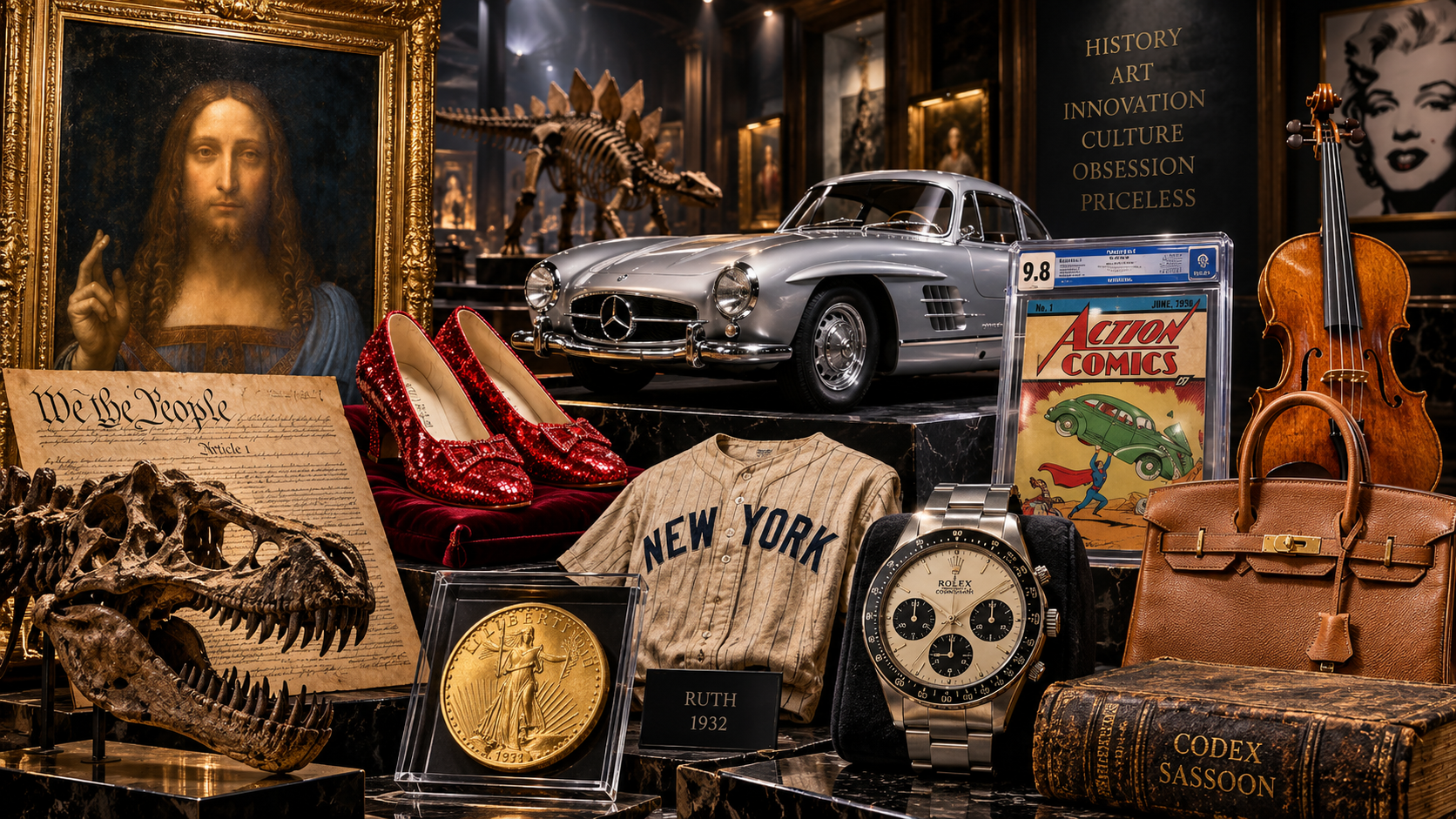
Inside the Billion-Dollar World of Ultra-Rare Collectibles
The Objects Collectors Will Pay Almost Anything to Own
There is expensive, and then there is the strange world of trophy collecting, where a painting can cost more than a skyscraper, an old baseball jersey can command more than £15 million and a pair of film-worn shoes can be worth hundreds of times more than an average British home. At the very top of the market, collectors are not really buying paint, leather, paper, fabric or metal. They are buying something that cannot easily be recreated: provenance.
That distinction matters when comparing the biggest collectible sales in history. A $30 million object bought three decades ago represents vastly more purchasing power than a $30 million sale today, so the figures below have also been adjusted approximately into 2026 US dollars using American consumer-price inflation. A second figure estimates what each object might realistically attract if offered again today, but those valuations are necessarily speculative rather than formal appraisals.
1. Leonardo da Vinci’s Salvator Mundi — $450.3 Million
Sold: $450.3 million in 2017
Inflation-Adjusted 2026 Value: Approximately $613 million
Estimated Auction Value Today: $500 million–$650 million
Nothing else comes particularly close. Leonardo da Vinci’s Salvator Mundi sold for $450,312,500 in New York on 15 November 2017 after a 19-minute bidding battle, establishing the world auction record for any work of art. Fewer than 20 paintings generally accepted as being substantially by Leonardo survive, while virtually all of the others are held in institutional collections rather than being available to private buyers.
In ordinary inflation terms, that $450.3 million is equivalent to roughly $613 million in 2026 money. Yet an actual resale would be harder to predict because debate around the painting’s attribution, condition and restoration has continued. Scarcity is nevertheless so extreme that another serious sale could still create the extraordinary prospect of the first artwork to approach or exceed half a billion dollars for a second time.
Perhaps the most absurd part of the story is its earlier history. The painting was catalogued as a copy and sold for just £45 in 1945 before eventually being restored, studied and presented as Leonardo’s lost work.
2. Pablo Picasso’s Les Femmes d’Alger (Version O) — $179.4 Million
Sold: $179.4 million in 2015
Inflation-Adjusted 2026 Value: Approximately $253 million
Estimated Auction Value Today: $200 million–$275 million
Picasso briefly held the overall auction crown before Leonardo arrived. Les Femmes d’Alger (Version O) sold for $179.365 million in May 2015, making it the most expensive work of art ever auctioned at that point.
Inflation pushes that result to roughly $253 million in today's money, which means the apparent gap between Picasso and more recent trophy sales is smaller than the headline numbers suggest. Its position as the final and most celebrated version of Picasso's 1955 Femmes d’Alger series would give it enormous leverage if it returned to market.
A reasonable modern estimate would be somewhere between $200 million and $275 million. With two determined billionaire collectors, however, masterpieces at this level can simply stop behaving like normal assets.
3. Andy Warhol’s Shot Sage Blue Marilyn — $195 Million
Sold: $195.0 million in 2022
Inflation-Adjusted 2026 Value: Approximately $223 million
Estimated Auction Value Today: $180 million–$240 million
Warhol’s Shot Sage Blue Marilyn sold for $195.04 million in May 2022, establishing a record for a 20th-century artwork at auction.
Inflation takes its 2022 price to approximately $223 million today. Unlike Leonardo, where extreme scarcity dominates the story, Warhol exists within a much larger functioning market, which gives buyers more comparables but also means another Marilyn can sometimes compete for capital.
If this exact work returned to auction in 2026, something around $180 million to $240 million appears plausible. That places Warhol and Picasso extraordinarily close once inflation is considered.
4. Mercedes-Benz 300 SLR Uhlenhaut Coupé — €135 Million
Sold: €135 million, approximately $143 million, in 2022
Inflation-Adjusted 2026 Dollar Equivalent: Approximately $163 million
Estimated Auction Value Today: $170 million–$220 million
If paintings are removed from the equation, this may be the ultimate collectible.
Mercedes-Benz built only two 300 SLR Uhlenhaut Coupés. One was sold in 2022 for €135 million, demolishing the previous world record for a car by more than €90 million.
Its inflation-adjusted dollar equivalent is now around $163 million, but a new auction could potentially produce considerably more. The combination of Mercedes racing history, engineering significance, institutional provenance and a surviving population of two creates almost perfect scarcity.
A speculative $170 million to $220 million range would therefore not be outrageous. If the other Uhlenhaut Coupé were ever offered, the possibility of an even larger price would be one of the most anticipated events in collecting history.
5. Apex the Stegosaurus — $44.6 Million
Sold: $44.6 million in 2024
Inflation-Adjusted 2026 Value: Approximately $47.5 million
Estimated Auction Value Today: $45 million–$60 million
A dinosaur skeleton becoming a luxury trophy sounds ridiculous until somebody pays $44.6 million for one.
Apex, an approximately 27-foot-long Stegosaurus discovered in Colorado, sold in July 2024 for $44.6 million. It became the most valuable fossil ever auctioned and exceeded its pre-sale low estimate by more than eleven times.
Inflation alone brings the figure close to $48 million. A resale today might sit somewhere around $45 million to $60 million, although fossil prices are exceptionally difficult to model because comparable specimens of this quality rarely exist.
Apex demonstrates one of the fundamental rules of extreme collecting: once an object becomes legitimately irreplaceable, its category almost stops mattering.
6. First Printing of the United States Constitution — $43.2 Million
Sold: $43.2 million in 2021
Inflation-Adjusted 2026 Value: Approximately $53.2 million
Estimated Auction Value Today: $50 million–$70 million
In November 2021, an exceptionally rare first printing of the final text of the United States Constitution sold for $43.2 million after an intense bidding battle. It established a then-record for any book, manuscript, historical document or printed text sold at auction.
Adjusted for inflation, the result is now worth roughly $53 million.
Historical documents sit in an unusual position because their financial value is connected directly to national history. There cannot be another American founding, another original Constitution or another equivalent first printing created later.
Were the same copy offered now, a range of roughly $50 million to $70 million would be believable, particularly if institutional or billionaire collectors competed for it.
7. Codex Sassoon — $38.1 Million
Sold: $38.126 million in 2023
Inflation-Adjusted 2026 Value: Approximately $41.8 million
Estimated Auction Value Today: $40 million–$50 million
The roughly thousand-year-old Codex Sassoon became the most expensive book or manuscript auctioned when it reached $38.126 million in 2023. It is one of the earliest surviving substantially complete Hebrew Bibles.
Its inflation-adjusted value is now roughly $42 million. Because its importance comes from history, scholarship, religion and extreme physical survival, its collector base extends far beyond ordinary rare-book buyers.
A present-day value around $40 million to $50 million appears reasonable, although objects this historically significant can exceed estimates dramatically when a buyer decides ownership is a once-in-a-generation opportunity.
8. Dorothy’s Ruby Slippers — $32.5 Million
Sold: $32.5 million in 2024
Inflation-Adjusted 2026 Value: Approximately $34.6 million
Estimated Auction Value Today: $35 million–$45 million
Few objects demonstrate the power of popular culture better than a pair of red shoes.
One surviving pair of ruby slippers worn by Judy Garland as Dorothy in The Wizard of Oz sold for $32.5 million in December 2024. They became the most valuable film memorabilia ever sold at auction.
The price sounds absurd until the provenance is considered. The film dates to 1939, the shoes are immediately recognisable across generations and only a handful of authentic pairs survive.
Inflation alone puts the sale at around $34.6 million today. Given the enormous publicity produced by the auction and the almost universal recognition of the object, $35 million to $45 million seems plausible in another competitive sale.
9. Leonardo da Vinci’s Codex Leicester — $30.8 Million
Sold: $30.8 million in 1994
Inflation-Adjusted 2026 Value: Approximately $69 million
Estimated Auction Value Today: $80 million–$120 million
This is where inflation completely changes the ranking.
Bill Gates acquired Leonardo da Vinci’s Codex Leicester for $30.8 million in 1994. In today's dollars, that is approximately $69 million.
But inflation may significantly understate what the manuscript would now command. It consists of Leonardo's own scientific thoughts and observations, placing it at the intersection of art, science, invention and history.
Since Salvator Mundi demonstrated what scarcity surrounding Leonardo can do to prices, a genuine market return for the Codex Leicester could become a major global auction event. A speculative $80 million to $120 million valuation is defensible, and a genuine bidding war could conceivably take it higher.
That would make it one of the strongest candidates on this list for an object whose market value today could dwarf its original nominal sale price.
10. Babe Ruth’s “Called Shot” Jersey — $24.12 Million
Sold: $24.12 million in 2024
Inflation-Adjusted 2026 Value: Approximately $25.7 million
Estimated Auction Value Today: $25 million–$35 million
Babe Ruth’s jersey linked to Game 3 of the 1932 World Series sold for $24.12 million in August 2024, becoming the world's most valuable sports collectible at the time.
The attraction is not simply that Ruth wore it. The jersey is connected to the legendary “called shot”, when Ruth supposedly indicated where he was about to hit the baseball before sending a home run towards centre field.
Whether every detail of the legend happened precisely as popular memory tells it almost misses the point. Collectibles live on stories, and this is one of baseball's greatest.
Its inflation-adjusted price is roughly $25.7 million, while another sale could reasonably produce $25 million to $35 million.
11. The 1933 Double Eagle — $18.9 Million
Sold: Approximately $18.9 million in 2021
Inflation-Adjusted 2026 Value: Approximately $23.3 million
Estimated Auction Value Today: $22 million–$30 million
The 1933 Saint-Gaudens Double Eagle represents almost the perfect collectible coin: beautiful, famous, extremely rare and surrounded by an extraordinary legal history.
Most 1933 Double Eagles were never officially released into circulation and were ordered destroyed following changes to American gold policy. The privately ownable example offered in 2021 was part of an auction deliberately bringing together three extraordinary treasures.
Its roughly $18.9 million price is equivalent to more than $23 million today.
If resold, $22 million to $30 million is plausible. For coin collectors, there are few objects on Earth capable of competing with its mythology.
12. Paul Newman’s Rolex Daytona — $17.75 Million
Sold: $17.7525 million in 2017
Inflation-Adjusted 2026 Value: Approximately $24.2 million
Estimated Auction Value Today: $20 million–$30 million
Paul Newman's personal Rolex Daytona changed the vintage-watch market when it sold for $17,752,500 in October 2017 following a 12-minute bidding battle.
Inflation transforms that into more than $24 million today.
The watch matters because “Paul Newman Daytona” had already become one of collecting's most famous Rolex descriptions, but this was Newman's actual watch. That circular relationship between celebrity, object and collector mythology makes it almost impossible to replicate.
A price somewhere between $20 million and $30 million today appears realistic. One billionaire Rolex enthusiast wanting the definitive Daytona could push it beyond that.
13. Lady Blunt Stradivarius — $15.9 Million
Sold: Approximately $15.9 million in 2011
Inflation-Adjusted 2026 Value: Approximately $23.6 million
Estimated Auction Value Today: $22 million–$30 million
Antonio Stradivari's instruments already occupy territory somewhere between musical equipment, fine art and historical artefact.
The 1721 Lady Blunt Stradivarius sold for almost $15.9 million in 2011. Once inflation is included, that is around $23.6 million today.
Its exceptional preservation gives it an advantage over many equally historic instruments that have endured centuries of heavy performance use. Were it returned to market, something in the $22 million to $30 million region would be entirely conceivable.
Unlike most objects on this list, it is theoretically still capable of doing what it was built to do more than three centuries ago.
14. Michael Jordan and Kobe Bryant Dual Logoman Card — $12.932 Million
Sold: $12.932 million in 2025
Inflation-Adjusted 2026 Value: Approximately $13.4 million
Estimated Auction Value Today: $13 million–$18 million
Modern trading cards have entered territory that would once have sounded impossible.
In August 2025, the unique 2007–08 Upper Deck Exquisite Dual Logoman autograph card featuring Michael Jordan and Kobe Bryant sold for $12.932 million. It is a one-of-one card and surpassed the previous auction record for a sports card.
The timing is so recent that inflation barely alters the figure, raising it to around $13.4 million.
Its biggest advantage is structural scarcity: there literally cannot be another example of the same one-of-one card. Combined with Jordan and Bryant's status, a future value of roughly $13 million to $18 million seems plausible.
The downside is that modern trading-card markets can be more volatile than historic art, manuscripts or cars. Scarcity alone does not guarantee permanent appreciation.
15. Jane Birkin’s Original Hermès Birkin — $10.1 Million
Sold: €8.58 million, approximately $10.1 million, in 2025
Inflation-Adjusted 2026 Value: Approximately $10.5 million
Estimated Auction Value Today: $11 million–$15 million
This was not simply another expensive handbag. It was the bag from which the entire Birkin phenomenon originated.
The original prototype made for Jane Birkin sold in Paris in July 2025 for €8,582,500, approximately $10.1 million, after competition between nine collectors. It became the most valuable handbag ever auctioned.
Its price was extraordinary compared with the previous handbag auction record, which had stood at barely more than half a million dollars. The result showed how completely provenance can overwhelm the normal price structure of a collectible category.
Because the auction occurred so recently, inflation only moves today's equivalent towards $10.5 million. A speculative market value of $11 million to $15 million looks reasonable if its position as the original Birkin continues to attract global luxury collectors.
The Ranking Changes When Inflation Is Included
Nominal prices can hide just how extraordinary historic purchases really were.
The Codex Leicester is the clearest example. Its $30.8 million purchase price in 1994 sounds smaller than the $32.5 million paid for Dorothy's slippers in 2024, but those transactions were nothing alike economically. In 2026 dollars, the Leonardo manuscript cost the equivalent of roughly $69 million.
The same applies to the Lady Blunt Stradivarius. Its $15.9 million 2011 result translates into approximately $23.6 million today, bringing it close to the inflation-adjusted value of Babe Ruth's jersey.
At the top, inflation makes the numbers almost surreal. Salvator Mundi's $450.3 million purchase price corresponds to roughly $613 million in 2026 purchasing power, while Picasso's $179.4 million 2015 result approaches $253 million.
Why Can an Ordinary-Looking Object Become Worth Millions?
The physical materials usually explain almost none of the price.
Paul Newman's Daytona contains nothing remotely close to $20 million worth of steel. Dorothy's slippers contain nowhere near $32.5 million of fabric and sequins. The 1933 Double Eagle contains a tiny fraction of its market value in gold.
What collectors actually purchase is a combination of scarcity, authenticity, historical importance and story.
The strongest objects often possess all four simultaneously. There is only one original Birkin. There is only one Jordan-Bryant card of its particular configuration. Only two Uhlenhaut Coupés were built. An authentic Leonardo painting almost never enters the private market.
Once that level of scarcity meets enormous cultural recognition, conventional valuation begins to break down.
Provenance Can Be Worth More Than the Object
Take away Paul Newman and his Daytona remains an exceptionally valuable vintage Rolex, but nothing remotely approaching its historic sale price.
Take away Judy Garland and The Wizard of Oz and the ruby slippers become old shoes.
Take away Babe Ruth and the 1932 World Series and the jersey becomes old wool.
Provenance is therefore not merely an interesting detail attached to the collectible. At the top of the market, provenance often is the collectible.
The same principle explains why celebrity-owned cars, instruments and clothes sometimes sell for multiples of apparently identical examples. Buyers are paying for an authenticated physical connection to a person or event that cannot happen again.
Why Inflation Does Not Tell You What Something Is Actually Worth
Inflation gives us a useful way of comparing money through time, but it cannot properly value an irreplaceable object.
If something sold for $10 million 20 years ago and general prices have doubled, saying it is equivalent to $20 million today tells us how purchasing power changed. It does not prove somebody would pay $20 million for the object now.
Collectible markets have their own cycles. Artists rise and fall. Classic-car tastes change. New generations of wealthy collectors enter sports cards, trainers, games and entertainment memorabilia. Some categories explode while others stagnate.
There is another complication: these prices often depend on remarkably few people.
A $100 million masterpiece does not require a hundred buyers who believe it is worth $100 million. It may require only two billionaires who both desperately want it.
Remove one of them and the sale could collapse dramatically. Add a third and the result could become absurd.
That is why the estimated values here should be read as plausible auction ranges rather than precise financial valuations.
Which Object Could Break the Next Major Record?
The obvious candidate remains Salvator Mundi.
Its inflation-adjusted 2017 purchase price already sits above $600 million. If questions surrounding the work were resolved favourably and it returned to a market containing several determined ultra-wealthy buyers, another world record would be entirely possible.
Yet the most interesting candidate may be the 300 SLR Uhlenhaut Coupé. Only two exist, the previous sale already produced €135 million and the world's population of collectors capable of spending nine figures on historically important cars has not disappeared.
Then there is Leonardo's Codex Leicester. Its apparently modest $30.8 million 1994 price disguises an inflation-adjusted cost approaching $70 million. More importantly, more than three decades have passed since that auction and Leonardo's market has since demonstrated that nine-figure prices are possible.
A return of the manuscript could therefore produce one of the biggest surprises in auction history.
The Real Currency Is Unrepeatability
The common thread linking a Renaissance painting, a dinosaur, an old baseball jersey, a handwritten notebook, a Rolex and a pair of ruby slippers is not luxury.
It is unrepeatability.
Manufacturers can produce another supercar. Hermès can make another Birkin. Rolex can manufacture another Daytona. Hollywood can make another film costume.
What nobody can manufacture is Leonardo's hand, Paul Newman's ownership, Babe Ruth's 1932 World Series, Judy Garland walking through Oz or the first Birkin ever created.
That is why the world's richest collectors will sometimes spend sums that appear completely irrational when judged against the physical object itself.
They are not really buying an object.
They are buying the right to own a piece of history that nobody else can have.
