

The Biggest Cover-Ups Eventually Proven True Ranked
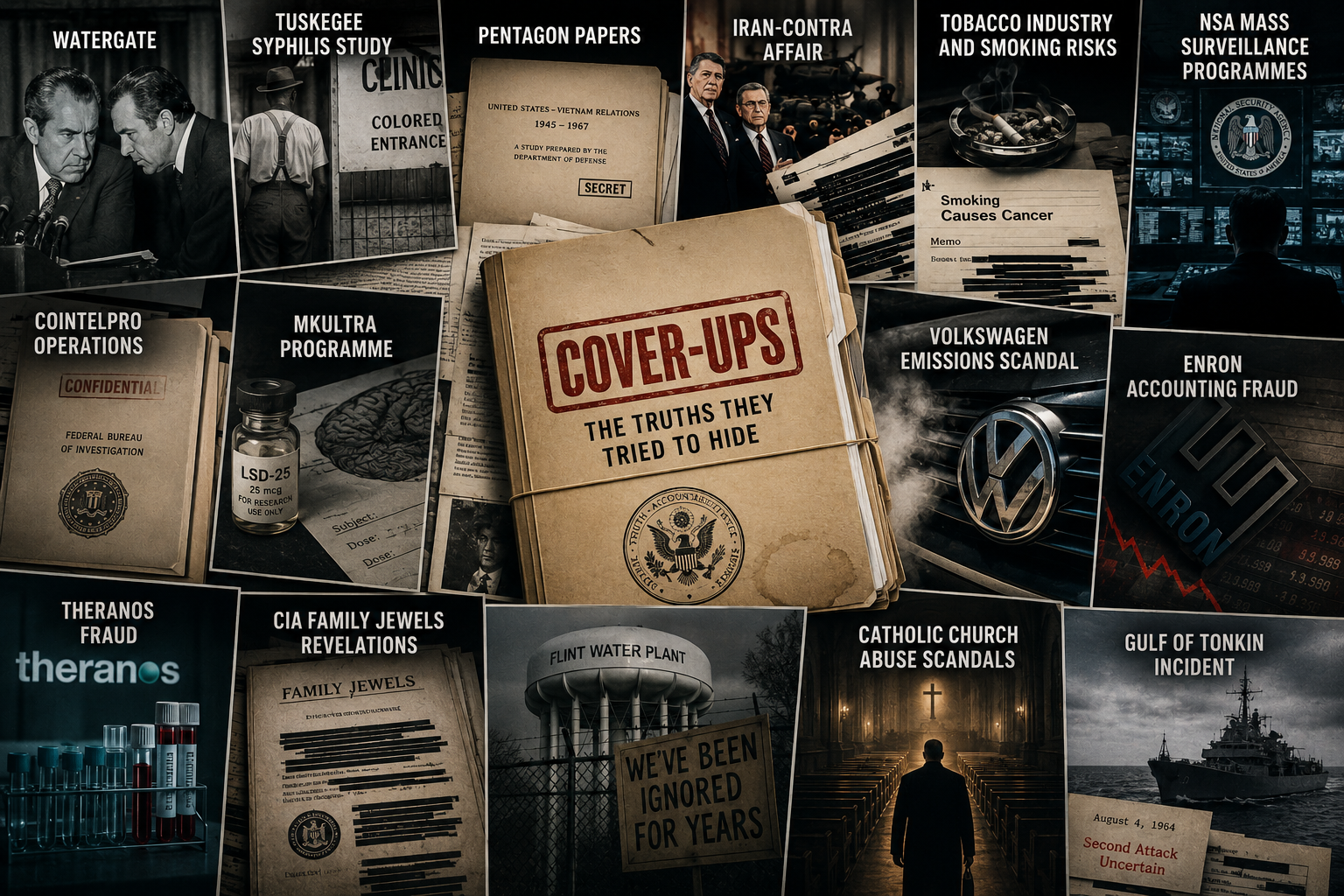
The Hidden Scandals That Changed Public Trust Forever
The Hidden Scandals Powerful Institutions Could Not Keep Buried
Why Powerful Institutions Try To Hide The TruthEvery major cover-up begins with the same calculation: disclosure will cost more than silence. A president fears political collapse. A corporation fears lawsuits. A church fears moral ruin. An intelligence agency fears oversight. A bureaucracy fears admitting that ordinary people were harmed because leaders chose convenience, ideology, money or reputation over honesty.
The most surprising thing is not that these cover-ups happened. It is how long they remained hidden despite so many people knowing the truth. Files existed. Meetings happened. Warnings were written down. Victims complained. Insiders understood the gap between the public story and the private reality. Yet the truth remained trapped because institutions are often designed to preserve themselves before they expose their own failures.
A cover-up rarely depends on one mastermind operating in the shadows. More often it depends on incentives. Loyalty. Fear. Career protection. Legal exposure. Political embarrassment. The human instinct to postpone consequences. The most important scandals in history are therefore not simply stories about villains. They are stories about systems that made concealment easier than accountability.
The cases in this ranking are not conspiracy theories. They are documented events eventually confirmed through official investigations, court cases, whistleblower testimony, declassified records, public inquiries and overwhelming evidence. Each exposed a hidden reality that powerful institutions desperately wanted to remain buried.
Fifteen — The Gulf Of Tonkin Incident
In August 1964, the United States government presented attacks on American naval vessels in the Gulf Of Tonkin as the justification for dramatically expanding military involvement in Vietnam. The first incident, involving the USS Maddox, genuinely occurred. The second alleged attack, however, quickly became far more controversial.
At the time, the public was led to believe that American forces had come under a clear and deliberate attack. The incident helped secure the Gulf Of Tonkin Resolution, granting President Lyndon Johnson broad authority to escalate military operations without a formal declaration of war.
What remained hidden for years was the uncertainty surrounding the second attack. Intelligence reports were conflicting. Radar readings were questionable. Communications were ambiguous. Yet those uncertainties were largely absent from the public narrative presented to Congress and the American people.
As historians gained access to declassified documents decades later, a different picture emerged. Records showed that officials possessed far more uncertainty than was publicly acknowledged. Questions arose about whether the second attack had occurred at all.
The consequences were enormous. The Vietnam War expanded dramatically, eventually claiming millions of lives and becoming one of the most divisive conflicts in modern history. Even today, the Gulf Of Tonkin remains one of the most frequently cited examples of how incomplete intelligence can be transformed into political certainty.
Its legacy extends far beyond Vietnam. It helped establish a deep public skepticism toward government claims made during periods of military escalation, particularly when evidence remains hidden from public scrutiny.
Fourteen — The Theranos Fraud
For a brief period, Theranos appeared to be one of Silicon Valley's greatest success stories.
Founded by Elizabeth Holmes, the company claimed it had developed revolutionary blood-testing technology capable of performing hundreds of medical tests from just a few drops of blood. Investors poured hundreds of millions of dollars into the business. Major corporations partnered with it. Influential political and business figures joined its board.
Behind the scenes, however, the reality was very different.
The technology repeatedly failed to perform as advertised. Internal concerns mounted. Employees raised questions about accuracy and reliability. Yet the company continued presenting itself as a transformative force in healthcare.
The cover-up relied on secrecy, aggressive legal tactics and carefully controlled demonstrations. Employees were compartmentalised. Critics were challenged. Potential partners were shown only limited portions of the technology.
For years, the company's reputation shielded it from scrutiny. Many powerful individuals wanted the story to be true. The idea of a young visionary founder revolutionising medicine was simply too attractive to question.
The truth emerged through whistleblowers, regulatory investigations and mounting evidence that the technology did not work as claimed. What followed was one of the most spectacular corporate collapses in modern history.
Theranos became a warning about charisma without evidence. It demonstrated how reputation, status and investor enthusiasm can sometimes overwhelm basic scientific verification.
The scandal permanently altered conversations around startup culture, venture capital and technological hype. It remains a cautionary tale about the dangers of believing extraordinary claims without demanding extraordinary proof.
Thirteen — The Flint Water Crisis
The Flint Water Crisis began in 2014 when officials in Flint, Michigan changed the city's water source as part of a cost-saving measure.
Almost immediately, residents began reporting problems. Water appeared discoloured. Strange smells emerged. Concerns about contamination spread through the community. Many residents believed something was seriously wrong.
Officials repeatedly reassured the public that the water was safe.
What was being hidden was not necessarily a secret document locked away in a vault. Instead, it was a pattern of denial, delay and institutional resistance to uncomfortable evidence.
As complaints increased, independent researchers, scientists and local residents continued gathering data. Their findings suggested dangerous levels of lead contamination and significant failures in water treatment procedures.
Yet official responses remained slow.
The crisis eventually became impossible to ignore. Investigations revealed multiple failures across different levels of government and regulatory oversight. Reports concluded that numerous warnings had either been ignored or inadequately addressed.
The consequences extended far beyond infrastructure.
Public trust collapsed. Residents felt betrayed by institutions responsible for protecting them. Communities that had repeatedly raised concerns discovered they had been dismissed despite being correct.
Flint became a symbol of what happens when bureaucratic self-protection outweighs responsiveness to public evidence.
It also exposed a broader reality. Environmental disasters are often not just technical failures. They become political failures when authorities choose reassurance over transparency.
Twelve — The Volkswagen Emissions Scandal
Volkswagen spent years promoting its diesel vehicles as clean, efficient and environmentally responsible.
The company's marketing suggested customers could enjoy strong performance while also reducing environmental impact. Millions of drivers purchased vehicles believing they met strict emissions standards.
The reality was very different.
Engineers had developed software capable of detecting when vehicles were undergoing official emissions testing. During those tests, emissions controls operated fully. During normal driving conditions, however, pollution levels could rise dramatically beyond regulatory limits.
The deception remained hidden because it was embedded inside highly complex software systems that few people outside the company fully understood.
Consumers trusted certification processes. Regulators relied on testing procedures. Investors believed corporate assurances.
The scandal finally exploded when independent researchers identified significant discrepancies between laboratory results and real-world performance. Regulatory investigations soon confirmed what had been hidden.
The fallout was immense.
Volkswagen faced billions in penalties, legal settlements, recalls and reputational damage. Executives faced investigations. Public confidence suffered.
Perhaps most importantly, the scandal demonstrated how modern deception can be written directly into code. Unlike traditional cover-ups involving secret meetings or hidden documents, this one operated silently through software.
It became one of the defining corporate scandals of the digital age.
Eleven — The Enron Accounting Fraud
At its peak, Enron was celebrated as one of America's most innovative companies.
Investors admired it. Business magazines praised it. Analysts viewed it as a symbol of modern corporate success.
Behind the public image, however, the company was constructing an elaborate financial illusion.
Debt was hidden through complex accounting structures. Losses were concealed. Financial performance was manipulated to maintain confidence among investors and markets.
The company's leadership understood that growth stories are often more powerful than financial reality. As long as investors believed the narrative, the system could continue operating.
The complexity of the fraud became one of its greatest protections.
Most investors lacked the expertise to fully understand the accounting structures involved. Analysts often relied upon information supplied by the company itself. Questions that should have triggered deeper scrutiny were often dismissed.
When the truth finally emerged, the collapse was catastrophic.
Billions of dollars in shareholder value disappeared. Thousands of employees lost jobs and retirement savings. Arthur Andersen, one of the world's largest accounting firms, collapsed alongside Enron.
The scandal reshaped corporate governance and financial regulation. It demonstrated how complexity can become a shield for deception and how market confidence can survive long after underlying reality has begun to crumble.
Ten — The CIA Family Jewels Revelations
In the early 1970s, senior officials inside the Central Intelligence Agency became increasingly concerned about activities that may have exceeded the agency's legal authority.
In response, the CIA compiled what later became known as the "Family Jewels" — a collection of internal records documenting controversial operations, surveillance activities and other actions that raised serious legal and constitutional questions.
For years, the existence of these records remained largely hidden from public view.
The documents covered a range of sensitive activities, including domestic surveillance concerns, questionable intelligence operations and incidents that challenged the agency's official public image.
What made the Family Jewels particularly significant was not merely the content itself, but what it revealed about institutional secrecy.
Intelligence agencies operate in darkness by design. Their effectiveness often depends upon secrecy. However, the same secrecy that protects legitimate national security operations can also conceal mistakes, abuses and mission creep.
As congressional investigations intensified during the 1970s, particularly following Watergate, elements of these activities began emerging into public view.
Decades later, further document releases provided an even clearer picture of how intelligence organisations can gradually drift beyond their intended boundaries when oversight becomes weak.
The Family Jewels remain a powerful reminder that secret institutions require robust external accountability precisely because the public cannot easily observe their actions.
The lesson is not that intelligence agencies are inherently corrupt. It is that concentrated power, when hidden from scrutiny, creates unique opportunities for abuse.
Nine — The MKUltra Programme
Few confirmed government programmes have generated as much public fascination as MKUltra.
Beginning during the Cold War, the CIA launched a series of covert experiments aimed at understanding mind control, behaviour modification, interrogation techniques and the potential use of psychoactive substances.
The programme operated under extreme secrecy.
Many participants were unaware they were involved. Experiments often lacked meaningful informed consent. Substances such as LSD were administered in circumstances that would be considered profoundly unethical by modern standards.
For years, very little was known publicly about the programme.
Much of the secrecy survived because records were deliberately destroyed. Key documentation disappeared before investigators gained access. What remained was fragmented, incomplete and often difficult to reconstruct.
The truth emerged gradually through congressional investigations, surviving documents and Senate hearings during the 1970s.
What investigators uncovered shocked the public.
The issue was not simply that government agencies were researching mind control. It was that secrecy had allowed ethical boundaries to erode without meaningful oversight.
MKUltra occupies a unique place in modern history because it represents one of the rare occasions where allegations that once sounded implausible were ultimately supported by documented evidence.
Its long-term legacy extends far beyond intelligence history.
The programme contributed to deep public mistrust of secret government activities and remains a defining example of how national security priorities can sometimes overwhelm ethical safeguards.
Eight — The FBI's COINTELPRO Operations
COINTELPRO began as an FBI counterintelligence programme designed to monitor groups perceived as threats to national security.
Over time, however, its scope expanded dramatically.
Civil rights organisations, anti-war movements, political activists and various ideological groups found themselves under surveillance and, in many cases, active disruption.
The objective moved beyond gathering information.
Investigations later revealed efforts to infiltrate organisations, spread disinformation, create internal conflict and weaken targeted groups.
Much of this activity occurred without public knowledge.
Those affected often suspected they were being monitored but lacked the evidence necessary to prove it. The secrecy surrounding intelligence operations made accountability extremely difficult.
The programme remained hidden until activists obtained internal FBI documents and subsequent investigations exposed the broader scale of the operation.
Congressional inquiries later confirmed extensive intelligence abuses involving multiple agencies.
The revelations transformed public understanding of domestic surveillance.
The scandal was not merely about collecting information. It was about the use of state power to influence political activity occurring within a democratic society.
COINTELPRO remains one of the most significant examples of how intelligence capabilities developed for security purposes can be redirected toward domestic political targets when oversight weakens.
Its legacy continues to influence debates surrounding civil liberties, protest movements and government surveillance.
Seven — The NSA Mass Surveillance Programmes
Following the terrorist attacks of September 11, 2001, surveillance powers expanded dramatically across the United States.
Many of those changes occurred behind closed doors.
For years, most citizens understood little about the scale of data collection taking place under national security authorities. Public discussions often focused on targeted surveillance of suspected threats rather than broad collection systems affecting millions of individuals.
The reality was considerably larger.
Government agencies had gained access to vast amounts of communications-related information through legal frameworks that remained largely invisible to the public.
The cover-up was maintained through classification, secret court proceedings and highly technical legal interpretations that few outside specialised circles could fully understand.
Because much of the system operated under national security restrictions, public scrutiny remained limited.
The situation changed dramatically when whistleblower disclosures brought details of these programmes into global public debate.
Subsequent investigations, oversight reviews and declassified materials revealed a surveillance architecture far broader than many citizens had previously imagined.
The impact was profound.
Questions surrounding privacy, civil liberties, government power and digital rights suddenly became central political issues around the world.
The scandal fundamentally changed how people viewed technology.
The internet was no longer simply a tool for communication. It had become an environment in which information, behaviour and personal relationships could potentially be monitored at unprecedented scale.
The debate continues today because the core tension remains unresolved: how much surveillance should governments possess in a digital society?
Six — The Iran-Contra Affair
The Iran-Contra Affair stands as one of the most remarkable political scandals of the twentieth century.
During the Reagan administration, officials secretly facilitated arms sales to Iran despite existing restrictions and public opposition to such dealings.
At the same time, proceeds from those sales were diverted toward supporting Contra rebels in Nicaragua despite congressional limitations designed to prevent exactly that outcome.
The operation effectively created a hidden foreign policy mechanism operating outside normal democratic oversight.
What was concealed was not only the activity itself, but the deliberate effort to bypass legal and political constraints.
The programme relied heavily on compartmentalisation.
Information was distributed selectively. Key decisions occurred within small circles. Public explanations often concealed rather than clarified the underlying reality.
As investigations progressed, evidence accumulated through leaks, hearings and independent inquiries.
The scandal ultimately revealed a parallel policy structure operating beyond the visibility of Congress and the public.
The consequences were significant.
Officials were prosecuted. Careers ended. Public confidence suffered. Debates over executive power intensified.
Yet the deeper lesson was arguably more important.
Iran-Contra demonstrated how governments can sometimes create unofficial systems when existing laws prevent preferred outcomes.
It remains one of the clearest examples of institutional actors believing their objectives were important enough to justify operating outside established democratic controls.
Five — The Pentagon Papers
The Pentagon Papers were never intended for public eyes.
Commissioned by the U.S. Department of Defense, the massive classified study documented decades of American involvement in Vietnam and examined decision-making across multiple presidential administrations.
When portions of the study became public, the consequences were explosive.
The documents revealed a profound gap between public statements and private assessments.
While government leaders often projected confidence publicly, internal evaluations frequently painted a much more pessimistic picture of the war's prospects and challenges.
The significance of the Pentagon Papers was not tied to a single revelation.
Instead, they exposed a long-running pattern in which officials privately understood realities they were unwilling to communicate openly to the public.
The truth emerged through one of the most consequential leaks in modern history.
Daniel Ellsberg's decision to provide the documents to the press triggered legal battles, constitutional confrontations and intense political controversy.
Attempts to suppress publication only increased public interest.
When the papers became widely available, trust in government suffered a major blow.
Citizens discovered that critical decisions involving war, diplomacy and national strategy had often been discussed very differently behind closed doors than they were in public.
The Pentagon Papers transformed debates surrounding government secrecy, press freedom and democratic accountability.
More than fifty years later, they remain one of history's most important reminders that information itself can become a battlefield.
The greatest damage often comes not from being wrong, but from knowing more than the public and choosing not to tell them.
Four — The Catholic Church Abuse Scandals
Few institutional scandals have inflicted more lasting damage on public trust than the abuse scandals that engulfed the Catholic Church.
For decades, allegations of child sexual abuse emerged across multiple countries, dioceses and jurisdictions. While individual cases differed significantly, investigators repeatedly uncovered similar patterns: complaints were minimised, allegations were handled internally, accused clergy were reassigned and institutional reputation was often prioritised over transparency.
The issue was never simply the crimes themselves.
The deeper scandal involved the systems that allowed abuse to continue while victims struggled to be heard. In many cases, those raising concerns found themselves ignored, disbelieved or pressured into silence.
The Church possessed enormous moral authority. That authority became one of the mechanisms that helped sustain the cover-up.
Families trusted clergy. Communities trusted diocesan leadership. Many people found it difficult to imagine that such accusations could be true.
As investigations expanded, survivors came forward in growing numbers. Lawsuits, public inquiries, internal records and independent reviews gradually revealed the scale of the problem.
The consequences were profound.
Billions of dollars were paid in settlements. Senior church leaders faced scrutiny. Public confidence declined dramatically across many regions. Entire dioceses experienced financial and reputational crises.
Most importantly, the scandal permanently changed how many people viewed institutional authority.
The lesson was devastatingly simple: organisations built upon trust can become uniquely dangerous when protecting reputation becomes more important than protecting victims.
Three — The Watergate Scandal
Watergate began as a burglary.
In June 1972, individuals connected to President Richard Nixon's re-election campaign were caught breaking into the Democratic National Committee headquarters inside the Watergate complex in Washington, D.C.
Had the story ended there, it might have been remembered as a relatively minor political crime.
Instead, it became one of the greatest constitutional crises in American history.
The true scandal was not merely the burglary itself. It was the effort that followed.
Investigators uncovered attempts to obstruct justice, interfere with investigations, conceal evidence and prevent the truth from reaching the public.
As journalists, courts, prosecutors and congressional investigators pursued the case, the web of concealment continued to unravel.
The turning point came when secret White House recordings emerged.
The tapes provided direct evidence that the highest levels of government were involved in efforts to obstruct the investigation. Suddenly, the cover-up became impossible to sustain.
The consequences were historic.
Richard Nixon became the first American president to resign from office. Senior officials faced prosecution. Public trust in government suffered a severe blow.
Watergate fundamentally reshaped attitudes toward political power.
The scandal established a principle that continues to influence democratic societies today: institutions may possess enormous authority, but no individual should be beyond accountability.
Perhaps Watergate's most enduring lesson is that the cover-up often becomes more damaging than the original misconduct.
Two — The Tuskegee Syphilis Study
The Tuskegee Syphilis Study remains one of the most disturbing medical ethics failures in modern history.
Beginning in 1932, hundreds of Black men in Alabama were enrolled in what was presented as a medical study. Participants were not fully informed about the nature of the research, and many believed they were receiving treatment.
In reality, researchers were observing the progression of untreated syphilis.
Even after penicillin became an effective treatment, many participants continued to be denied appropriate medical care.
The study continued for approximately forty years.
What was hidden was not simply information. It was the fundamental truth about the purpose of the programme and the choices being made regarding patient care.
The men involved trusted medical professionals and government institutions. That trust was exploited.
For decades, the study remained largely unknown to the wider public.
When details finally emerged in 1972, public outrage was immediate and widespread. Investigations followed. Lawsuits were filed. Medical ethics procedures were re-examined across the United States.
The scandal transformed research governance.
New requirements surrounding informed consent, institutional review boards and participant protections emerged directly from lessons learned through Tuskegee.
Yet the consequences extended beyond regulation.
The study severely damaged trust between medical institutions and many Black communities. That distrust has echoed across generations and continues to influence public health conversations today.
Tuskegee demonstrated how expertise without accountability can become profoundly dangerous when vulnerable populations lack the power to challenge authority.
One — The Tobacco Industry And Smoking Risks
No cover-up on this list affected more lives than the tobacco industry's long-running effort to obscure the dangers of smoking.
For decades, cigarette manufacturers publicly questioned, challenged or minimised evidence linking smoking to cancer, heart disease, addiction and other serious health conditions.
Behind the scenes, however, scientific evidence continued to accumulate.
Internal documents later revealed that industry leaders possessed far greater awareness of the risks than many public statements suggested.
The strategy was remarkably effective.
The industry did not need to prove cigarettes were safe. It only needed to create enough uncertainty to delay regulation, maintain sales and prevent decisive public action.
Doubt became a business model.
Scientific disagreements were amplified. Research was challenged. Public relations campaigns promoted uncertainty even as evidence grew increasingly overwhelming.
The truth emerged gradually through litigation, whistleblowers, scientific studies, regulatory investigations and internal company documents.
By the time the full scale of the deception became widely understood, millions of people had already suffered the consequences.
The impact transformed public health policy around the world.
Warning labels expanded. Advertising restrictions increased. Smoking bans became common. Major legal settlements reshaped the relationship between corporations and public health regulators.
The tobacco scandal ranks first because of its scale, duration and human cost.
It remains perhaps the clearest example in modern history of how powerful organisations can profit from delaying the acceptance of inconvenient truths.
What These Cover-Ups Have In Common
The scandals in this ranking differ dramatically in subject matter.
Some involved governments. Others involved corporations. Some centred on intelligence agencies, religious institutions or healthcare systems.
Yet beneath the surface, they share remarkably similar patterns.
In nearly every case, people inside the institution knew more than the public.
Information was compartmentalised. Warnings were ignored. Reputation was protected. Difficult truths were delayed.
The cover-up itself often became a separate system with its own momentum.
Once enough careers, reputations and political interests become tied to a particular narrative, changing course becomes increasingly difficult.
People stop protecting the original mistake.
Instead, they begin protecting themselves.
Another common feature is that the truth rarely emerges all at once.
Most major cover-ups collapse gradually.
A whistleblower speaks. A document leaks. A lawsuit uncovers records. An investigator asks the right question. A journalist finds an inconsistency. A victim refuses to remain silent.
The final revelation usually appears sudden.
In reality, the evidence often accumulates for years before the public finally sees the full picture.
Why Large Cover-Ups Usually Last Longer Than They Should
The uncomfortable reality is that large cover-ups often survive because they do not require everyone to lie.
They only require enough people to remain silent.
Fear is frequently more powerful than deception.
Fear of losing a career.
Fear of damaging an institution.
Fear of political fallout.
Fear of personal embarrassment.
Fear of legal consequences.
Many participants convince themselves they are protecting something important.
They believe disclosure would create panic, damage public confidence or harm a larger mission.
In some cases, those concerns may even contain elements of truth.
That complexity is precisely what makes cover-ups so difficult to detect and dismantle.
Most participants do not view themselves as villains.
They view themselves as loyal employees, responsible leaders or practical decision-makers navigating impossible situations.
The danger emerges when institutional preservation becomes more important than accountability.
At that point, secrecy stops protecting the public and starts protecting the organisation itself.
History shows that this transition happens far more often than societies would like to admit.
The Final Lesson From The Files That Opened
The greatest cover-ups in modern history reveal something both disturbing and reassuring.
The disturbing lesson is obvious.
Powerful institutions are capable of concealing extraordinary truths for surprisingly long periods of time. Governments, corporations, intelligence agencies, religious organisations and professional bodies can all become vulnerable to the same temptations when reputation, money or authority are threatened.
The reassuring lesson is equally important.
The truth has a remarkable tendency to survive.
Documents remain.
Witnesses remember.
Victims speak.
Whistleblowers emerge.
Investigators persist.
Records that were once classified eventually become public.
Again and again, history demonstrates that concealment is rarely permanent.
The greatest scandals on this list were not exposed because institutions suddenly chose transparency.
They were exposed because evidence accumulated faster than secrecy could contain it.
That may be the most important lesson of all.
The most surprising thing is not that these cover-ups happened.
It is how many people knew the truth long before the rest of the world finally caught up.
The Cover-Ups That Never Fully Disappear
One of the strangest aspects of major cover-ups is that exposure rarely ends the story.
Even after investigations conclude, documents are released and inquiries publish their findings, the consequences continue for decades. Public trust does not immediately return. Institutions do not automatically regain legitimacy. Victims do not suddenly recover what was taken from them.
The damage often becomes cultural.
Entire generations begin questioning official narratives more aggressively. Citizens become less willing to accept assurances from governments, corporations and other powerful organisations. Future scandals are viewed through the lens of past deception.
This creates a difficult paradox.
Transparency becomes more important than ever, yet trust becomes harder than ever to rebuild.
Many institutions discover that the original misconduct was not what permanently damaged their reputation.
The cover-up was.
People can forgive mistakes.
They struggle far more to forgive deliberate concealment.
History repeatedly shows that admitting failure early is usually less destructive than defending a false narrative for years.
The longer a cover-up survives, the greater the eventual cost becomes.
Why Whistleblowers Matter
Almost every major scandal on this list shares another common feature.
Someone eventually decided not to stay silent.
A government employee leaked documents.
A scientist challenged official claims.
A journalist pursued an uncomfortable lead.
A victim refused to accept dismissal.
An insider concluded that loyalty had become complicity.
Whistleblowers occupy a unique position within history.
They are often criticised before they are vindicated.
They frequently face professional consequences, legal threats, social isolation and public attacks long before the wider public understands what they revealed.
Yet many of history's most important truths emerged because somebody accepted those risks.
Without whistleblowers, numerous scandals on this list may never have been exposed.
Without documentary evidence, many would have remained allegations rather than established facts.
Without persistence, powerful institutions might have continued operating exactly as before.
The uncomfortable reality is that accountability often depends on individuals willing to challenge systems far larger than themselves.
The Future Of Cover-Ups In A Digital World
Technology has made secrecy both easier and harder.
Modern institutions possess unprecedented abilities to collect, store and control information. Vast databases, encrypted communications and complex technological systems can conceal activity from public view in ways previous generations could never imagine.
At the same time, digital records create permanent trails.
Emails survive.
Metadata survives.
Financial transactions survive.
Messages survive.
Surveillance footage survives.
Cloud storage survives.
Every major decision leaves traces.
Future investigations may therefore look very different from those of the twentieth century.
Instead of searching filing cabinets, investigators increasingly analyse digital footprints.
Instead of relying solely on witness testimony, they examine electronic records.
Instead of waiting decades for archives to open, information can sometimes spread globally within hours.
Yet the underlying challenge remains unchanged.
Technology changes.
Human nature does not.
Fear, ambition, loyalty, greed, ideology and institutional self-preservation continue to influence decision-making exactly as they did during Watergate, Tuskegee and countless other scandals.
The tools evolve.
The incentives remain remarkably familiar.
The Real Warning Hidden Inside Every Cover-Up
The greatest lesson from these scandals is not that powerful people sometimes lie.
History has always known that.
The deeper warning is that ordinary systems can gradually evolve into cover-up machines without most participants ever recognising what is happening.
A memo gets delayed.
A report gets softened.
A complaint gets ignored.
An investigation gets narrowed.
A disclosure gets postponed.
Each decision appears small in isolation.
Together they create an alternative reality.
That process is rarely dramatic at the beginning.
It becomes dramatic only when the truth finally emerges.
By then, the consequences are often impossible to reverse.
That is why accountability matters before a scandal becomes a headline.
Because once a cover-up reaches the public, the damage has usually already been done.
The final lesson is both sobering and hopeful.
Institutions are powerful.
But evidence is often more powerful.
Eventually, documents surface.
Witnesses speak.
Records emerge.
Truth accumulates.
And history catches up.
