

The Biggest Intelligence Failures In Modern History Ranked
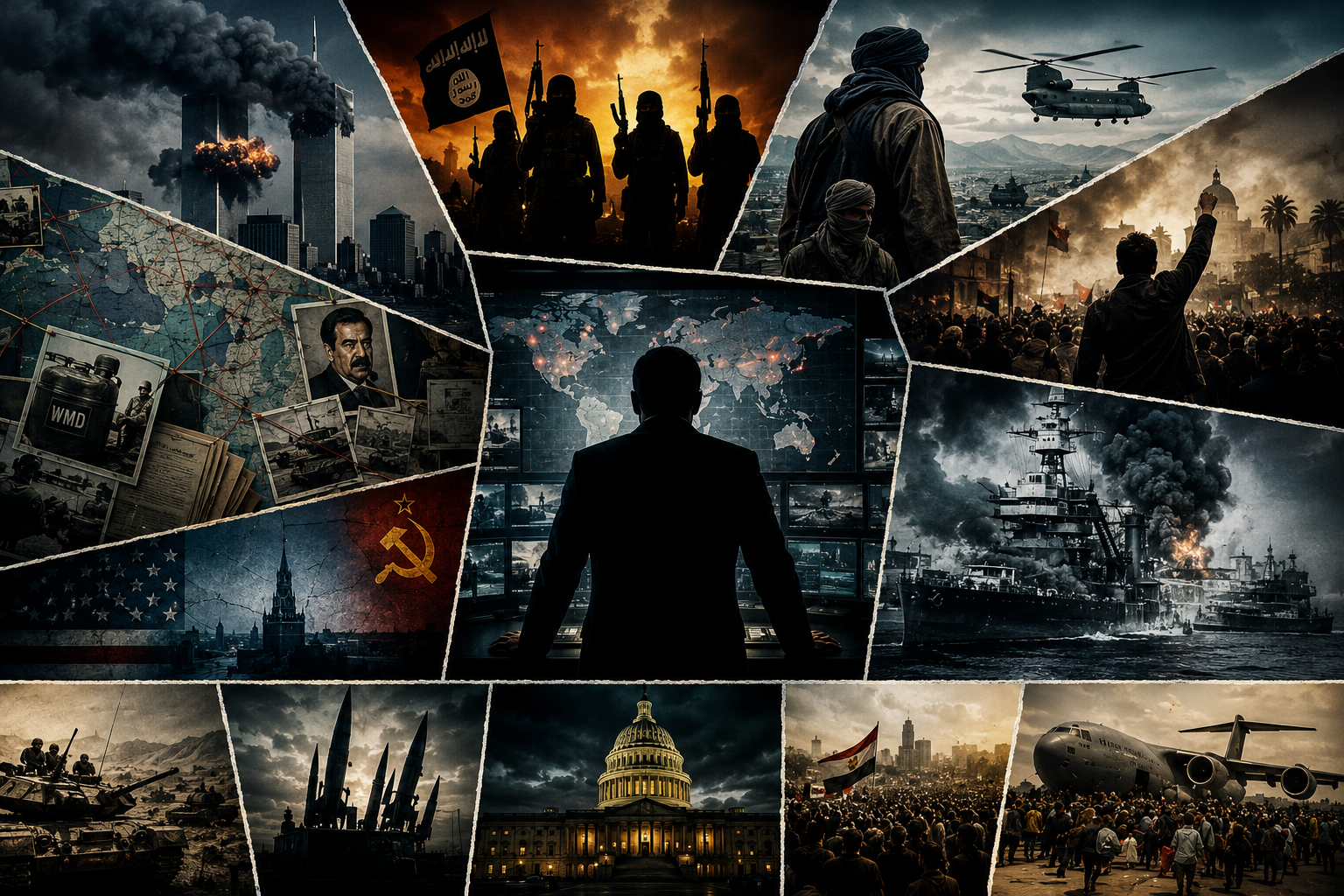
The Intelligence Mistakes That Led To Wars, Attacks And Global Crises
When The World’s Most Powerful Agencies Missed The Obvious
Why Intelligence Failures Keep HappeningThe modern intelligence state is one of the most expensive warning systems ever built. Governments spend billions collecting information through satellites, spies, intercepted communications, cyber surveillance, reconnaissance aircraft and human sources operating deep inside hostile territory. Entire agencies exist to provide warning before disasters occur.
Yet some of the most significant events in modern history still arrived as shocks.
That contradiction sits at the heart of every intelligence failure. Contrary to popular belief, the problem is rarely that nobody knew anything. In many cases, pieces of the truth already existed somewhere inside the system. Reports had been written. Warnings had been issued. Analysts had raised concerns. The challenge was connecting those fragments into a coherent picture before events overtook decision-makers.
The great intelligence failures of history reveal a recurring pattern. Information is collected but not shared. Warnings are received but not believed. Assumptions become so entrenched that contradictory evidence is ignored. Political leaders hear what they expect to hear rather than what they need to hear.
Technology has transformed intelligence gathering over the past century, but it has not solved the fundamental problem. Intelligence remains a human enterprise. Human beings are vulnerable to bias, overconfidence, wishful thinking and institutional inertia.
That is why the same mistakes continue to appear across generations.
The following failures occurred in different countries, different decades and under vastly different circumstances. Yet they all reveal the same uncomfortable truth.
Some of the world's most powerful governments had the information they needed.
They simply failed to understand what they were looking at.
15. The Failure To Predict The Arab Spring
When protests erupted in Tunisia in December 2010, few observers imagined they would trigger one of the most significant waves of political upheaval in modern history.
Within months, governments across North Africa and the Middle East faced mass demonstrations, revolutions, civil wars and regime-threatening unrest. Leaders who had appeared secure for decades suddenly found themselves fighting for political survival.
The warning signs had existed for years.
Youth unemployment remained stubbornly high throughout much of the region. Corruption was widespread. Economic opportunities were limited. Political participation was heavily restricted. Many populations viewed ruling elites as disconnected from everyday realities.
Intelligence services understood these problems existed.
What they failed to understand was how quickly those pressures could combine into a revolutionary force.
Many governments treated social frustration as a chronic condition rather than an immediate threat. Analysts saw anger but not ignition. They recognised dissatisfaction but underestimated the power of collective action once fear began to break down.
The self-immolation of Tunisian street vendor Mohamed Bouazizi became the spark that transformed isolated frustrations into a regional movement. Demonstrations spread rapidly through social media networks and personal connections, creating momentum that traditional intelligence models struggled to track.
The failure was not the absence of information.
It was a failure to recognise how rapidly political legitimacy could collapse once populations realised they were not alone in their frustrations.
The consequences were enormous.
Tunisia's government fell. Egypt's long-serving president was removed. Libya descended into civil war. Syria entered a conflict that would reshape global geopolitics for more than a decade. The wider Middle East entered a period of instability whose effects are still being felt today.
The lesson was profound.
Stability and legitimacy are not the same thing.
A government can appear stable for years before collapsing with astonishing speed.
14. The Falklands Invasion
On 2 April 1982, Argentine forces invaded the Falkland Islands, triggering a conflict that would become one of Britain's most significant military campaigns since the Second World War.
The invasion shocked many observers in London.
Argentina's claims over the islands were well known. Diplomatic tensions had existed for decades. Yet British decision-makers failed to appreciate how seriously Argentina's military junta was considering military action.
Warning signs existed throughout the months leading up to the invasion.
British officials understood that negotiations were deteriorating. Intelligence assessments recognised that increased pressure from Argentina remained possible. Some scenarios even considered more aggressive actions.
What many policymakers failed to grasp was how the junta interpreted Britain's behaviour.
Domestic economic difficulties and political instability were placing enormous pressure on Argentina's leadership. The regime increasingly viewed the Falklands issue as an opportunity to restore national pride and strengthen domestic legitimacy.
Meanwhile, signals from Britain may have unintentionally suggested reduced commitment to defending the islands.
Actions that appeared routine in Whitehall looked very different from Buenos Aires.
The intelligence failure was not simply a lack of information.
It was a failure to understand how another government interpreted risk, opportunity and political necessity.
The invasion triggered a rapid British military response that ultimately retook the islands. Yet the conflict exposed weaknesses in strategic warning, intelligence communication and political assumptions.
The Falklands remain a classic example of how governments can misread both intentions and incentives.
Understanding what an adversary can do is important.
Understanding why they may choose to do it is often even more important.
13. The Collapse Of The Soviet Union
The collapse of the Soviet Union remains one of the most debated intelligence failures of the twentieth century.
For decades, the Soviet Union had stood as one of two global superpowers. Its military strength, nuclear arsenal and geopolitical influence shaped international affairs on an unprecedented scale.
Then, remarkably quickly, it disappeared.
Many critics later argued that Western intelligence agencies failed to recognise the extent of Soviet weakness.
The reality is more complicated.
Western analysts understood that serious problems existed inside the Soviet system. Economic stagnation had become increasingly visible. The war in Afghanistan was draining resources and morale. Nationalist movements were growing stronger. Political reforms under Mikhail Gorbachev were creating new pressures rather than solving old ones.
The information existed.
What proved much harder was predicting exactly how and when the system would collapse.
Large institutions rarely appear fragile from the outside.
The Soviet Union had survived famine, political purges, world war, economic hardship and decades of confrontation with the West. Predicting its complete disintegration seemed extreme even to many experts who recognised its problems.
The failure was ultimately one of timing and imagination.
Analysts could identify weaknesses.
Few believed those weaknesses would destroy the entire system so quickly.
When the Soviet Union formally dissolved in December 1991, the geopolitical consequences were immense.
The Cold War ended.
Fifteen independent states emerged.
Global power structures were transformed.
Entire intelligence doctrines required reassessment.
Perhaps the most important lesson concerned state fragility.
Power often appears permanent until suddenly it does not.
The collapse taught intelligence agencies to pay greater attention to legitimacy, elite confidence, economic resilience and political cohesion rather than focusing exclusively on military strength.
12. The Soviet Invasion Of Afghanistan
The Soviet invasion of Afghanistan in December 1979 demonstrated how intelligence agencies can correctly identify risks yet still underestimate the likelihood of dramatic action.
Afghanistan had already become increasingly unstable during the late 1970s.
The Soviet Union possessed significant strategic interests in the country. Moscow was closely monitoring developments and maintaining strong relationships with Afghanistan's communist government.
Western analysts understood the situation was deteriorating.
What many struggled to believe was that the Soviet Union would commit itself to a full-scale military intervention.
The logic seemed straightforward.
An invasion would be expensive.
It would damage Soviet international standing.
It would provoke resistance.
It would risk long-term instability.
In short, it appeared irrational.
The problem was assuming that decision-makers would view the situation through the same analytical framework.
As the Afghan government weakened, Soviet leaders increasingly concluded that intervention represented the least bad option available.
On Christmas Eve 1979, intelligence reporting began indicating a massive Soviet military airlift into Afghanistan. Within days, Soviet forces had launched one of the largest military interventions of the Cold War.
The consequences extended far beyond Afghanistan.
The invasion intensified tensions between East and West. It helped shape American foreign policy throughout the 1980s. It contributed to the eventual exhaustion of Soviet resources and legitimacy.
The conflict also created conditions that would influence future generations of militant movements operating throughout the region.
The lesson remains highly relevant today.
Analysts frequently evaluate actions according to what appears rational from the outside.
History repeatedly demonstrates that governments under pressure often choose options that appear strategically disastrous to external observers.
11. The Cuban Missile Crisis Miscalculations
The Cuban Missile Crisis is usually remembered as one of history's greatest intelligence successes.
American reconnaissance aircraft discovered Soviet nuclear missile sites in Cuba before they became fully operational, allowing the United States to respond before the balance of power changed dramatically.
Yet hidden within that success was a significant intelligence failure.
Many American officials initially dismissed the possibility that the Soviet Union would deploy offensive nuclear missiles to Cuba at all.
Reports indicating unusual Soviet military activity emerged throughout 1962.
Refugees provided warnings.
Observers noted increasing Soviet shipments.
Various intelligence indicators suggested that something unusual was occurring.
However, many senior officials remained convinced that Moscow would never accept the risks associated with placing strategic nuclear weapons ninety miles from the American coastline.
That assumption became a blind spot.
Evidence that contradicted it received less attention than it deserved.
When U-2 reconnaissance photographs finally confirmed the presence of missile installations, the world suddenly found itself closer to nuclear war than at any previous point in history.
The crisis ultimately ended through negotiation rather than catastrophe.
But it revealed how dangerous assumptions can become when they harden into certainty.
The failure was not technological.
The failure was psychological.
Decision-makers believed they understood the limits of Soviet behaviour.
They were wrong.
The Cuban Missile Crisis transformed intelligence collection and strategic warning systems throughout the Cold War. It reinforced the value of aerial reconnaissance, improved communication mechanisms and encouraged greater scrutiny of prevailing assumptions.
Most importantly, it demonstrated that adversaries are capable of actions that appear irrational right up until the moment they happen.
The challenge for intelligence agencies is not simply identifying threats.
It is recognising threats that existing assumptions insist should not exist.
10. The Bay Of Pigs
The Bay of Pigs invasion in April 1961 remains one of the most infamous intelligence failures in modern American history.
The operation was designed as a covert effort to overthrow Fidel Castro's government using a force of Cuban exiles trained and supported by the CIA. The assumption was simple: once the invasion began, large numbers of Cubans would rise against Castro, triggering a broader rebellion that would topple the regime.
It was an assumption that proved catastrophically wrong.
The warning signs existed throughout the planning process.
Intelligence assessments overestimated opposition to Castro and underestimated the strength of his security apparatus. Many planners became increasingly invested in the success of the operation and gradually lost the ability to challenge their own assumptions objectively.
Perhaps most importantly, officials failed to distinguish between what they hoped would happen and what evidence suggested would happen.
The invasion force landed on Cuba's southern coast on 17 April 1961.
Instead of sparking a popular uprising, the operation encountered determined resistance. Cuban government forces reacted quickly. Air support proved inadequate. Communication problems emerged. Within days the invasion collapsed.
The consequences extended far beyond military embarrassment.
The failure damaged American credibility, strengthened Castro's position domestically and internationally, and pushed Cuba closer to the Soviet Union. Some historians argue that the Bay of Pigs helped create the conditions that later contributed to the Cuban Missile Crisis.
The deeper lesson concerned groupthink.
As plans moved closer to execution, dissent became increasingly difficult. Alternative viewpoints were softened or ignored. Decision-makers became trapped inside a self-reinforcing cycle of optimism.
The Bay of Pigs remains a classic warning about what happens when intelligence agencies stop questioning their own assumptions and begin treating hopes as evidence.
9. The Tet Offensive
In January 1968, North Vietnamese and Viet Cong forces launched one of the most significant military offensives of the Vietnam War.
Known as the Tet Offensive, the attacks targeted cities, military installations and government facilities across South Vietnam. The scale and coordination of the offensive shocked both military planners and political leaders.
The intelligence picture before Tet was complicated.
Warnings existed. Reports suggested unusual enemy activity. Some commanders recognised that major operations might be imminent. Yet the overall assessment remained heavily influenced by the belief that American and South Vietnamese forces were steadily winning the war.
That belief shaped how intelligence was interpreted.
Evidence that supported progress received greater attention than evidence suggesting a major enemy offensive.
The result was not complete surprise but strategic underestimation.
The attacks themselves failed to achieve many of their military objectives. American and South Vietnamese forces ultimately repelled the offensive and inflicted heavy casualties on communist forces.
Yet the political consequences were profound.
Television audiences around the world watched fighting erupt in places previously considered relatively secure. The offensive shattered confidence in official claims that victory was close. Public trust in government assessments suffered significant damage.
The lesson from Tet extended beyond Vietnam.
Intelligence agencies learned that battlefield success and strategic success are not always the same thing. An operation can fail militarily while succeeding politically.
The offensive also highlighted the dangers of measuring progress through metrics that reinforce existing assumptions. When analysts become invested in a particular narrative, contradictory evidence often struggles to receive the attention it deserves.
Tet remains one of the clearest examples of how perception can become just as important as military reality.
8. The Iranian Revolution
Few events shocked American intelligence planners more than the Iranian Revolution of 1979.
For decades, Iran had been viewed as one of Washington's most important allies in the Middle East. The Shah possessed a powerful military, extensive security services and strong international backing. On the surface, the regime appeared stable.
Beneath that surface, however, pressure was building.
Religious opposition was growing. Economic frustrations were increasing. Corruption had damaged public confidence. Large sections of society felt disconnected from the political system and alienated by the direction of the country's leadership.
The warning signs existed.
The challenge was interpreting them correctly.
Many analysts focused heavily on the regime's visible strengths. The Shah controlled the military. The security services remained active. State institutions appeared functional. Historical experience suggested that opposition movements could be contained.
What many failed to appreciate was the speed at which legitimacy was eroding.
Political systems can survive economic problems.
They can survive protests.
They can survive international pressure.
What they often struggle to survive is the widespread belief that they no longer deserve to govern.
As demonstrations intensified throughout 1978, momentum shifted rapidly. By early 1979 the Shah had left the country. Ayatollah Khomeini returned from exile. One of America's most important regional partners had effectively collapsed.
The consequences transformed Middle Eastern geopolitics.
The Islamic Republic emerged as a major regional actor. The hostage crisis reshaped American foreign policy. Relations between Washington and Tehran entered a period of hostility that continues today.
The revolution also changed how intelligence agencies approached political analysis.
Military strength alone could no longer be treated as a reliable indicator of regime durability. Questions of legitimacy, ideology, identity and belief became increasingly important components of intelligence assessment.
The Iranian Revolution demonstrated that political systems often collapse from the inside long before outsiders realise how fragile they have become.
7. The Rise Of ISIS
The rise of ISIS ranks among the most significant intelligence failures of the post-9/11 era.
By 2014, the group controlled large areas of Iraq and Syria, governed millions of people and projected an image of unstoppable momentum. Its rapid expansion shocked governments across the world and forced a major international military response.
The warning signs had been visible for years.
The remnants of al-Qaeda in Iraq remained active. Sectarian tensions were worsening. The Syrian Civil War created vast ungoverned spaces. Foreign fighters flowed into the region. Local grievances created fertile recruiting conditions.
Intelligence agencies tracked many of these developments.
The failure was not recognising that extremist organisations existed.
The failure was underestimating how quickly multiple crises could combine into something far larger.
ISIS exploited political collapse, sectarian division, military weakness and technological innovation simultaneously. The group used social media more effectively than many governments. It attracted recruits from around the world and adapted rapidly to changing conditions.
When Mosul fell in June 2014, the scale of the collapse stunned observers.
Entire military formations disintegrated. Weapons and equipment were abandoned. ISIS suddenly possessed territory, resources and international visibility far beyond what many analysts had anticipated.
The consequences were global.
The organisation inspired terrorist attacks across multiple continents. Military coalitions were assembled to combat its expansion. Intelligence priorities shifted dramatically as governments attempted to understand and counter the group's appeal.
One of the most important lessons involved organisational resilience.
Analysts often measure success by counting territory, leadership losses or military defeats. ISIS demonstrated that movements can survive setbacks when the underlying conditions that created them remain unresolved.
Defeating an organisation and eliminating the environment that produced it are not the same thing.
That distinction continues to shape counterterrorism strategy today.
6. The Fall Of Kabul
The fall of Kabul in August 2021 produced some of the most striking images of strategic collapse in modern history.
For two decades, the United States and its allies had invested enormous resources in building Afghan institutions, training security forces and supporting the Afghan government.
Yet when the final withdrawal began, the collapse came with astonishing speed.
Province after province fell to the Taliban. Security forces surrendered or disintegrated. Political leaders fled. Within days, Kabul itself was under Taliban control.
The warning signs had existed for years.
Afghan forces depended heavily on Western logistical support, intelligence assistance, contractors and airpower. Corruption weakened state institutions. Morale varied significantly across different regions. The Taliban maintained influence throughout large areas of the country.
Many analysts understood these vulnerabilities.
The critical error involved estimating how quickly collapse could occur once external support disappeared.
Forecasts often assumed a gradual deterioration.
Reality moved far faster.
Political legitimacy evaporated. Command structures fractured. Confidence disappeared. Entire units surrendered without major resistance because soldiers increasingly believed the outcome was already decided.
The fall of Kabul revealed one of the most difficult challenges in intelligence analysis.
Military capability is relatively easy to measure.
Morale is not.
Equipment inventories can be counted. Personnel numbers can be tracked. Logistics networks can be mapped.
The willingness of people to continue fighting is far harder to quantify.
The consequences extended far beyond Afghanistan.
The withdrawal prompted major debates about nation-building, alliance credibility, intelligence forecasting and military intervention. Governments around the world reassessed assumptions about state resilience and strategic planning.
Perhaps the most important lesson was psychological.
States rarely collapse because they run out of weapons first.
More often, they collapse because they run out of belief.
When enough people conclude that a system has already failed, events can move faster than even the most sophisticated intelligence models can predict.
5. The Russian Invasion Of Ukraine Predictions
Russia's full-scale invasion of Ukraine in February 2022 occupies a unique place in intelligence history.
Unlike many entries on this list, Western intelligence agencies largely got the central prediction right.
For months, American and British officials warned publicly that Russia was preparing to invade. Satellite imagery showed military build-ups. Logistics hubs expanded near the border. Medical facilities were positioned for combat operations. Intelligence assessments increasingly pointed toward an attack.
The invasion came.
Yet the story does not end there.
While the invasion itself was successfully predicted, many of the assumptions surrounding the war proved deeply flawed.
Russian intelligence appears to have dramatically underestimated Ukrainian resistance. Moscow expected a rapid collapse of political leadership and military command structures. Instead, Ukrainian forces held their ground, rallied public support and transformed what many expected to be a short campaign into a prolonged war.
Western analysts also underestimated the speed and scale of international support that Ukraine would receive.
The deeper lesson is that intelligence success and strategic success are not the same thing.
Predicting an event does not automatically prevent it.
Intelligence agencies can identify a threat, expose a threat and communicate a threat, yet still fail to alter the final outcome.
The war also demonstrated the increasing importance of open-source intelligence. Satellite imagery, social media, commercial tracking tools and civilian analysts played a role unlike anything seen in previous conflicts.
For decades, intelligence was dominated by secrecy.
Ukraine showed that the future may belong to those capable of interpreting publicly available information faster than their adversaries.
The invasion ultimately became a reminder that understanding intentions is only half the challenge.
Understanding capability, resilience and national will remains just as important.
4. The Yom Kippur War
On 6 October 1973, Egypt and Syria launched a coordinated surprise attack against Israel during Yom Kippur, the holiest day in the Jewish calendar.
The attack shocked a nation widely regarded as possessing some of the world's most capable intelligence services.
What makes the Yom Kippur War particularly fascinating is that warning signs existed in abundance.
Arab military activity increased dramatically. Troop movements were observed. Human intelligence sources provided alerts. Jordan's King Hussein personally warned Israeli leaders about the growing danger.
Yet the warnings failed to produce the response they should have.
The reason was something known simply as "The Concept."
Israeli intelligence had developed a deeply held belief that Egypt would not initiate war until it possessed sufficient military capabilities to challenge Israeli air superiority. Because analysts viewed this assumption as fundamentally true, evidence that contradicted it was often discounted or explained away.
Exercises were mistaken for preparations.
Warnings were interpreted through existing theories.
Contradictory information was forced into familiar frameworks.
The result was one of the most significant intelligence surprises in modern military history.
When the attacks began, Israeli forces were initially caught off balance. The war eventually turned in Israel's favour, but only after suffering losses far greater than expected.
The consequences extended well beyond the battlefield.
The conflict triggered major reforms in Israeli intelligence analysis and remains one of the most studied examples of confirmation bias in national security history.
The lesson was both simple and profound.
The most dangerous intelligence assessment is often the one that everyone agrees with.
When an organisation becomes too confident in its understanding of reality, reality has a habit of delivering unpleasant surprises.
3. Pearl Harbor
Few intelligence failures have become as iconic as Pearl Harbor.
On the morning of 7 December 1941, Japanese aircraft attacked the American naval base in Hawaii, killing more than 2,400 people and drawing the United States into the Second World War.
The attack entered history as a symbol of strategic surprise.
Yet the reality was more complicated than a complete absence of warning.
American intelligence agencies understood that relations with Japan were deteriorating rapidly. Diplomatic communications had been intercepted. Military tensions were escalating. The possibility of war was widely recognised.
The critical failure involved determining where and when Japan would strike.
Most American planners believed any major offensive would target Southeast Asia, the Philippines or other strategic locations across the Pacific.
Hawaii seemed unlikely.
That assumption shaped how incoming information was interpreted.
Even on the morning of the attack, radar operators detected incoming aircraft. The warning was dismissed because officers believed the contacts represented expected American bombers rather than Japanese attackers.
The information existed.
The interpretation failed.
Pearl Harbor became a defining moment in the development of the modern American intelligence system.
Investigations following the attack identified communication failures, organisational fragmentation and inadequate coordination between agencies.
These lessons contributed to major structural reforms that eventually helped create the post-war national security architecture, including the CIA, the National Security Council and broader intelligence integration.
The attack demonstrated a timeless reality.
Adversaries often succeed not by hiding everything, but by attacking where assumptions are strongest.
Pearl Harbor remains one of history's clearest warnings about the dangers of treating probability as certainty.
2. The Iraq WMD Intelligence Failure
The Iraq Weapons of Mass Destruction intelligence failure remains one of the most consequential analytical mistakes of the modern era.
In the years leading up to the 2003 invasion of Iraq, intelligence agencies in multiple countries assessed that Saddam Hussein possessed active weapons of mass destruction programmes.
Those assessments played a significant role in shaping political decisions and public arguments supporting military intervention.
Following the invasion, no active stockpiles of weapons of mass destruction were discovered.
The consequences were enormous.
The failure damaged trust in intelligence institutions, altered global perceptions of Western credibility and intensified scrutiny of how intelligence assessments are produced.
What makes the case particularly important is that the failure emerged from multiple causes rather than a single mistake.
Analysts relied heavily on fragmented information, disputed human sources, ambiguous technical indicators and assumptions rooted in Iraq's previous behaviour.
Uncertainty gradually became transformed into confidence.
Possibilities became probabilities.
Probabilities became conclusions.
Subsequent investigations found widespread analytical shortcomings, including excessive confidence, insufficient challenge to prevailing assumptions and failures to communicate uncertainty clearly.
Groupthink played a major role.
Once a dominant narrative emerged, alternative interpretations struggled to gain traction.
The Iraq case transformed intelligence methodology throughout much of the Western world.
Analysts became more cautious about expressing certainty. Greater emphasis was placed on competing hypotheses, structured analytical techniques and clearly communicating confidence levels.
The lesson remains highly relevant today.
Intelligence is most dangerous when uncertainty disappears from the conversation.
A flawed assessment presented confidently often causes more damage than an uncertain assessment presented honestly.
1. The 9/11 Attacks
No intelligence failure has shaped the modern world more profoundly than the attacks of 11 September 2001.
Nineteen al-Qaeda terrorists hijacked four commercial airliners and launched a coordinated attack against the United States.
Nearly three thousand people were killed.
The geopolitical consequences continue to influence global affairs more than two decades later.
What makes 9/11 particularly significant is that the warning signs were not absent.
Al-Qaeda had already attacked American interests overseas. Intelligence agencies understood that the organisation intended to strike the United States. Various reports indicated growing terrorist activity. Individual pieces of information existed across multiple agencies.
The challenge was assembling those fragments into a coherent warning.
Critical information remained compartmentalised.
Agencies operated within separate bureaucratic structures.
Data sharing proved inadequate.
Potential threats were identified but not connected.
Perhaps most importantly, few officials fully imagined the precise form the attack would take.
The failure became known as a failure of imagination as much as a failure of intelligence.
Decision-makers understood that terrorism posed a threat.
What many struggled to envision was terrorists transforming civilian aircraft into guided missiles.
The attacks fundamentally reshaped global security.
The Department of Homeland Security was created.
Intelligence-sharing systems were redesigned.
Counterterrorism became a dominant priority for governments around the world.
Surveillance capabilities expanded dramatically.
Military interventions followed.
The lesson from 9/11 remains one of the most important in intelligence history.
The greatest danger is not always failing to see information.
Sometimes it is failing to recognise what that information means when combined.
The Pattern Behind The Failures
Although these events occurred across different continents, decades and political systems, the same themes appear repeatedly.
The first is confirmation bias.
Human beings naturally seek evidence that supports existing beliefs and often discount information that challenges them. The Yom Kippur War, Iraq WMD assessments and numerous other failures demonstrate how dangerous this tendency can become when embedded within institutions.
The second is overconfidence.
Intelligence organisations are often expected to provide certainty in environments defined by uncertainty. The pressure to deliver clear answers can encourage analysts to become more confident than evidence actually justifies.
The third is bureaucracy.
Information rarely exists in one place. It is scattered across agencies, departments, databases and reporting structures. The larger an organisation becomes, the harder it becomes to connect fragmented information quickly and effectively.
The fourth is political pressure.
This does not necessarily involve direct interference. More often, it emerges subtly. Leaders favour certain outcomes. Institutions develop preferred narratives. Analysts become aware of which conclusions are welcomed and which create friction.
Finally, there is imagination.
Many of history's greatest intelligence failures occurred because decision-makers struggled to imagine that something unprecedented could happen.
The attack seems obvious afterwards.
Before it happens, it often appears impossible.
The Uncomfortable Truth About Intelligence Failure
Technology continues to evolve at extraordinary speed.
Artificial intelligence can process vast amounts of information. Satellites monitor activity across the globe. Cyber capabilities collect data on a scale previous generations could scarcely imagine.
Yet none of these developments eliminate the fundamental problem.
Information is not understanding.
Data is not wisdom.
Collection is not interpretation.
The greatest intelligence failures in history were rarely caused by complete blindness. More often, they occurred because people misread what they could already see.
That is the uncomfortable truth running through every entry in this ranking.
Pearl Harbor.
The Yom Kippur War.
The Iranian Revolution.
Iraq.
Kabul.
9/11.
In each case, pieces of the truth existed before disaster arrived.
The challenge was never simply obtaining information.
The challenge was recognising its significance before events made that significance impossible to ignore.
That is why intelligence failure remains one of the most enduring problems in national security.
The tools become more sophisticated.
The budgets become larger.
The databases become faster.
But the final decision still belongs to human beings.
And history repeatedly demonstrates that the most dangerous blind spots are often the ones created by certainty itself.
What Modern Intelligence Agencies Fear Most Today
The intelligence failures of the twentieth century were often built around armies, missiles, governments and conventional warfare.
The twenty-first century looks very different.
Today's intelligence agencies are increasingly concerned about threats that do not fit traditional warning models. Cyberattacks can be launched anonymously from thousands of miles away. Artificial intelligence can generate convincing misinformation at industrial scale. Terrorist networks can organise through encrypted platforms. Hostile states can influence elections without crossing a border.
Many of these threats produce enormous amounts of data but very little clarity.
That creates a new challenge.
Historically, intelligence agencies often suffered because they lacked information. Increasingly, they suffer because they have too much of it.
The modern analyst faces a flood of signals every day. Satellite imagery, social media posts, intercepted communications, financial transactions, commercial databases and open-source intelligence create a volume of information unprecedented in human history.
The danger is no longer simply missing a warning.
The danger is drowning in one.
The Rise Of Open-Source Intelligence
One of the most significant developments in modern intelligence has been the rise of open-source intelligence, often known as OSINT.
For most of history, intelligence was built around secrets.
Governments recruited spies.
Intercepted communications.
Stole documents.
Conducted covert operations.
Today, some of the most valuable intelligence in the world is publicly available.
Commercial satellites can photograph military movements. Social media posts can reveal troop locations. Flight-tracking websites can expose unusual activity. Shipping databases can reveal sanctions evasion. Public procurement records can expose strategic priorities.
The war in Ukraine demonstrated this dramatically.
Independent analysts using publicly available information often identified developments that would once have been the exclusive domain of major intelligence agencies.
The result is a profound shift in the intelligence landscape.
Secrets remain important.
But increasingly, the advantage belongs to those who can identify meaningful patterns within publicly available information faster than everyone else.
Artificial Intelligence And The Future Of Intelligence Failure
Artificial intelligence promises to transform intelligence gathering more radically than any technology since the satellite age.
Machine-learning systems can analyse imagery, monitor communications, identify behavioural patterns and process vast quantities of information far faster than human analysts.
Supporters argue that AI could reduce many traditional causes of intelligence failure.
Algorithms do not suffer fatigue.
They do not become emotionally attached to theories.
They do not care about institutional politics.
Yet artificial intelligence introduces entirely new risks.
AI systems can inherit biases embedded within their training data.
They can generate convincing but inaccurate conclusions.
They can create an illusion of certainty that exceeds the quality of the underlying evidence.
Most importantly, AI does not eliminate human decision-making.
It merely changes where mistakes occur.
History suggests that every major technological advance creates new blind spots alongside new capabilities.
Artificial intelligence is unlikely to be different.
The future intelligence failure may not occur because a warning was missed.
It may occur because a machine-generated warning was trusted too much.
The Intelligence Lessons Every Leader Should Understand
Looking across every case in this ranking, several lessons emerge with remarkable consistency.
First, assumptions are often more dangerous than ignorance.
Most intelligence disasters did not occur because nobody knew anything. They occurred because decision-makers believed they already understood the situation.
Second, confidence should never be confused with accuracy.
History is filled with highly confident assessments that proved catastrophically wrong.
Third, dissent matters.
The organisations most vulnerable to surprise are often those where disagreement becomes difficult.
Fourth, incentives shape analysis.
Analysts, managers and political leaders all operate within systems that reward certain behaviours and discourage others.
Finally, uncertainty is not weakness.
One of the most dangerous phrases in intelligence history is "we know."
The reality is that intelligence rarely deals in certainty.
It deals in probabilities.
The moment uncertainty disappears from the discussion is often the moment risk becomes greatest.
The Final Warning
The greatest intelligence failures in history are often remembered as stories about governments, generals, spies and secret agencies.
In reality, they are stories about human nature.
Pearl Harbor was not simply an intelligence failure.
It was a failure of assumptions.
The Yom Kippur War was not simply a failure of collection.
It was a failure of confidence.
The Iraq WMD assessments were not simply failures of evidence.
They were failures of judgement.
The same pattern appears again and again.
Human beings create models to understand the world.
Those models become beliefs.
Those beliefs become assumptions.
Those assumptions eventually become blind spots.
Technology changes.
Governments change.
Threats change.
Human psychology changes very little.
That is why intelligence failure remains one of the most enduring challenges in modern history.
The greatest danger is rarely what nobody sees.
The greatest danger is often what everybody thinks they already understand.
