The Chinese Revolution Explained: How An Empire Collapsed, Mao Won And Modern China Was Born
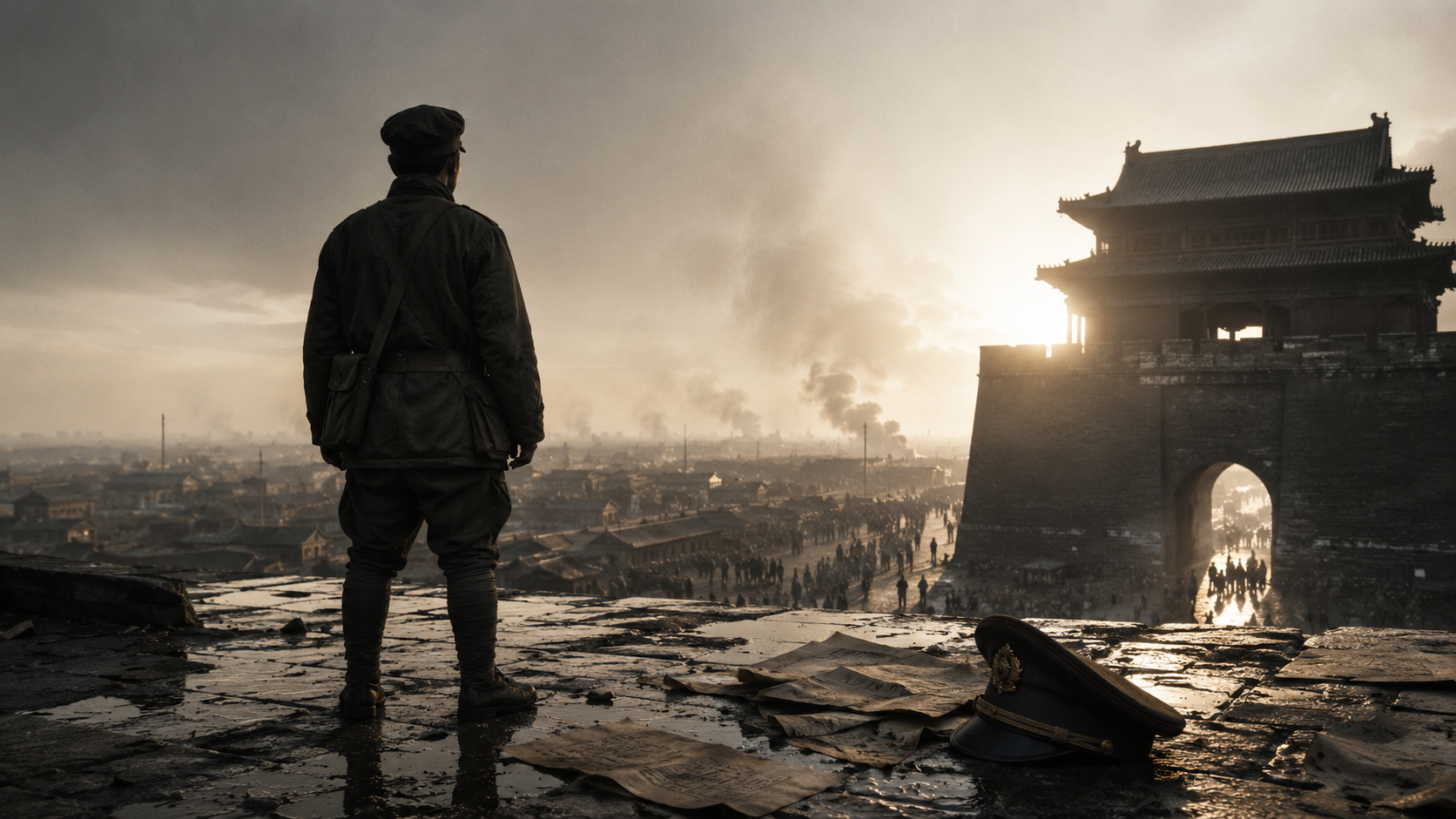
The Revolution That Created Modern China — And Changed The World Forever
From Emperor To Mao In 38 Years Of Chaos
China did not become communist in a single uprising, and Mao Zedong did not suddenly seize a stable country in 1949. The revolution that created modern China was the culmination of almost four decades of collapsing imperial authority, failed republican government, foreign invasion, warlord rule, ideological conflict and one of the largest civil wars of the twentieth century.
To understand what happened, it helps to think of the Chinese Revolution as a chain reaction rather than one event. The Qing dynasty fell in 1911, a republic replaced it in 1912, that republic fragmented, Nationalists and Communists fought for control, Japan invaded, civil war resumed after 1945, and finally Mao proclaimed the People’s Republic of China on 1 October 1949. Even the United States’ official historical account describes 1949 as completing a process of governmental upheaval that had begun with the revolution of 1911.
The central question is therefore not simply why communism came to China. It is why repeated attempts to create a strong, legitimate Chinese state failed until the Communist Party built an organisation capable of combining nationalism, military power, rural mobilisation, ideology and ruthless political discipline.
The result transformed far more than China. The Communist victory created one of the most important states of the Cold War, forced Chiang Kai-shek’s Nationalist government to Taiwan, changed the strategic balance in Asia and produced a political division across the Taiwan Strait that remains unresolved more than seven decades later.
Before The Revolution: An Empire In Deep Trouble
For centuries China had been governed by imperial dynasties, with the Qing ruling from 1644. By the nineteenth century, however, the dynasty faced problems it could no longer comfortably contain: population pressure, corruption, fiscal weakness, rebellions, technological backwardness relative to industrialising powers and increasingly aggressive foreign intervention.
The Opium Wars against Britain exposed the military weakness of the Qing state. Defeat brought unequal treaties, foreign privileges and the opening of ports on terms that many Chinese regarded as humiliating. Later clashes with foreign powers deepened the impression that the empire which regarded itself as the centre of civilisation could no longer protect its territory or dictate its own future.
Domestic catastrophe made matters worse. The Taiping Rebellion between 1850 and 1864 devastated enormous areas of the country and became one of the deadliest conflicts of the nineteenth century. Other uprisings and regional crises forced the imperial government to depend increasingly on provincial military leaders, weakening the centre even when rebellions were defeated.
China attempted reform. The Self-Strengthening Movement pursued modern weapons, industry and military technology, while reformers increasingly argued that institutional change was necessary as well. Yet China's defeat by a rapidly modernising Japan in the First Sino-Japanese War of 1894–95 delivered another psychological shock: Japan had adopted Western-style institutions and military methods with far greater speed, and it had now defeated the much larger Chinese empire.
The disastrous Boxer crisis around 1900 intensified foreign intervention and imposed further burdens on the Qing government. By the beginning of the twentieth century, the question was no longer whether China needed reform. It was whether the dynasty itself was capable of delivering it.
That distinction became fatal. Modern schools, foreign education and the creation of new military units were intended to strengthen the Qing state, but they also produced students, officers and intellectuals exposed to nationalism, republicanism and revolutionary ideas. The empire was inadvertently creating some of the people who would destroy it.
Sun Yat-Sen And The Idea Of A Chinese Republic
One of the most important revolutionaries was Sun Yat-sen. He spent years organising anti-Qing groups, raising support among overseas Chinese communities and arguing that China needed revolutionary political reconstruction rather than another limited attempt to repair the imperial system.
Sun's political ideas eventually became associated with his Three Principles of the People: nationalism, democracy and the people's livelihood. These concepts were broad enough to unite groups that disliked the Qing for very different reasons, from committed republicans to anti-Manchu nationalists and modernisers who believed that only a new political system could save China.
Sun did not personally command the uprising that finally brought the dynasty down. That fact matters because the 1911 Revolution was less a perfectly coordinated national seizure of power than a rapid collapse of imperial authority once one revolt demonstrated just how vulnerable the system had become.
On 10 October 1911 revolutionary soldiers in Wuchang rebelled after an anti-Qing conspiracy within modernised army units was exposed. The uprising spread with extraordinary speed as provinces declared their independence from the Qing government; by late November, fifteen of twenty-four provinces had done so.
This was the moment imperial China began to disintegrate. The Qing still possessed military forces, but the political foundation of the dynasty was collapsing beneath them.
The 1911 Revolution Destroyed The Dynasty But Did Not Build A Strong State
Sun Yat-sen returned to China and became provisional president of the new Republic of China in Nanjing on 1 January 1912. On 12 February, the child emperor Puyi formally abdicated, bringing more than two millennia of imperial government to an end.
It was a spectacular political transformation. Yet destroying a dynasty proved much easier than constructing a functioning republic.
Sun's revolutionaries did not possess sufficient military power to dominate the entire country. The decisive armed figure was Yuan Shikai, commander of the powerful Beiyang Army and a former senior Qing official. Sun therefore accepted a compromise in which he relinquished the presidency to Yuan in the hope that China could be unified peacefully under a republican system.
The compromise solved the immediate problem and created a much larger one. Yuan had the military strength the republic needed but little interest in accepting the restraints of genuine parliamentary government.
The Kuomintang, or Nationalist Party, emerged from the revolutionary movement and performed strongly in parliamentary elections. Its prominent organiser Song Jiaoren was assassinated in 1913, and Yuan increasingly concentrated authority in his own hands. The young republic slid towards dictatorship rather than constitutional democracy.
Yuan eventually attempted to make himself emperor. The move was a spectacular miscalculation, provoking opposition and further weakening his authority. He abandoned the monarchy shortly before his death in 1916.
China was now officially a republic, but the central state had fractured. Military strongmen controlled different territories, shifting alliances and fighting one another in what became known as the Warlord Era.
The first Chinese revolution had therefore achieved something enormous and yet profoundly incomplete. It abolished the dynasty, but it failed to answer the question that would dominate Chinese politics for the next generation: who could actually reunify and govern China?
The May Fourth Movement Radicalised A Generation
The upheaval after 1911 was not only political. Chinese intellectual life was also changing rapidly as students and writers challenged traditional ideas, explored Western political philosophy and debated how China could regain strength.
Then came another humiliation.
China had joined the First World War on the Allied side, hoping in part to recover German rights in Shandong. Instead, the post-war settlement transferred those interests to Japan. On 4 May 1919, students demonstrated in Beijing, and the protests grew into the May Fourth Movement.
The anger went beyond one diplomatic dispute. To many younger Chinese, the episode seemed to prove that neither the old imperial order nor liberal promises from foreign powers could guarantee China's national independence.
The movement became connected to a wider intellectual rebellion against inherited authority. Nationalism, science, democracy, feminism, vernacular literature, socialism and Marxism competed for attention. China's political crisis was becoming an ideological one.
The Russian Revolution of 1917 now assumed enormous importance. The Bolsheviks appeared to demonstrate that a disciplined revolutionary organisation armed with Marxist ideology could overthrow an old regime and construct a radically different state.
For Chinese radicals confronting fragmentation, poverty and foreign pressure, the attraction was obvious. Marxism promised not just reform but a theory explaining exploitation, imperialism, class conflict and revolutionary power.
In 1921 the Chinese Communist Party was founded in Shanghai. It was tiny: a revolutionary organisation that would eventually govern hundreds of millions began with only a small circle of activists. The historical significance of the May Fourth period lies partly in this radicalisation of figures who would help build the new party.
Mao Zedong was among the young activists drawn into this political world.
He was not yet the unquestioned leader of Chinese communism. That would take years of political struggle, military disaster and civil war.
Nationalists And Communists Were Allies Before They Became Mortal Enemies
China's two great revolutionary movements originally shared a major objective. Both the Nationalists and Communists wanted to destroy warlord power, overcome national weakness and build a unified state.
With Soviet encouragement, the Communist Party entered an alliance with Sun Yat-sen's Nationalist movement known as the First United Front. Communists worked within the broader Nationalist organisation while both sides prepared to challenge China's regional warlords.
Sun died in 1925. Leadership of the Nationalist movement increasingly passed to Chiang Kai-shek, a military commander who emerged as the dominant figure within the Kuomintang.
In 1926 the Nationalists launched the Northern Expedition. Its objective was to defeat major warlords and bring much of China back under a single national government.
At first the campaign achieved dramatic success. But beneath the alliance was an unresolved struggle over what kind of revolution China was actually experiencing.
Communists were organising workers and peasants. Conservatives, business interests, landlords and anti-Communists within the Nationalist coalition increasingly feared that the social revolution would become more important than national unification.
Chiang eventually moved against his supposed allies. In 1927 Nationalist forces and allied groups violently purged Communists in Shanghai and elsewhere. The alliance collapsed and the revolutionary movement split into two competing projects for China's future.
From this point, Nationalist and Communist rivalry became one of the central conflicts of modern Chinese history.
Mao's Great Insight: China's Revolution Could Come From The Countryside
Classical Marxist expectations placed industrial workers at the centre of socialist revolution. That presented an obvious problem in China, where the overwhelming majority of the population lived in rural areas.
Mao increasingly developed a revolutionary strategy tailored to this reality.
Instead of waiting for an enormous urban proletariat to emerge, the Communist movement could organise China's peasants, establish rural bases, redistribute land, create local political structures and build an army from the countryside.
This was not simply ideological innovation. It was a response to survival.
After the 1927 purge, Communist organisations in major cities had been devastated. Rural guerrilla warfare offered a place to retreat, reorganise and rebuild.
Mao and Zhu De helped develop Communist armed bases in the countryside, eventually creating a major Soviet area in Jiangxi. By the early 1930s the Communists had constructed their own revolutionary administration across territory containing millions of people.
Land was crucial. Rural China contained profound inequality and longstanding conflicts involving rents, debt, taxation and landlord power, although conditions differed greatly from region to region. Communist organisers learned that changing village power structures could bind poor peasants directly to the revolutionary cause.
The Communist revolution therefore became more than an army trying to seize Beijing. It sought to create an alternative political society inside China before it controlled the country.
That strategy would eventually prove extraordinarily powerful. But first it came close to destruction.
The Long March Nearly Ended The Communist Revolution
Chiang Kai-shek understood that the Communist base areas represented an existential threat. Nationalist forces launched repeated encirclement campaigns intended to destroy them.
By 1934 Communist positions in Jiangxi had become untenable. The Red Army broke through and began the retreat that became known as the Long March.
The phrase can make the event sound like a planned heroic expedition. In reality, it began as an escape from impending military defeat.
The central Red Army left its base with more than 80,000 people according to the Chinese government's historical account, while other Communist forces undertook their own withdrawals. The wider Long March period stretched from 1934 to 1936 and carried Communist forces through some of China's most difficult terrain.
Losses were enormous. Fighting, disease, hunger, exhaustion and desertion devastated the forces that began the journey.
Yet the retreat changed the Communist Party in another way. During the Zunyi Conference in January 1935, Mao's influence increased sharply and he emerged as the party's effective central leader. The Communist Party's own official historical resolution treats the meeting as a decisive turning point in its development.
The Long March subsequently became one of the foundational myths of Communist China: an ordeal proving endurance, sacrifice and revolutionary commitment.
There was truth beneath the mythology. The movement had escaped annihilation.
More importantly, the survivors were now concentrated around a leadership increasingly dominated by Mao. A retreat that looked like catastrophic defeat helped create the organisation that would win China fourteen years later.
Then Japan Changed Everything
While Nationalists and Communists fought one another, China faced an even greater external threat.
Japan had occupied Manchuria in 1931 and established the puppet state of Manchukuo. Tensions escalated until full-scale war erupted in 1937 following fighting near the Marco Polo Bridge outside Beijing.
The consequences were catastrophic. Japanese forces captured major cities, including Shanghai and Nanjing, and the conflict caused enormous civilian suffering. The Nationalist government withdrew inland to Chongqing while continuing the war.
The Japanese invasion forced the Nationalists and Communists into another uneasy alliance, the Second United Front. They shared an enemy but remained profoundly suspicious of one another.
For Chiang Kai-shek, Japan represented the immediate national threat while the Communists remained a long-term political threat. For Mao, resistance to Japan offered both a patriotic mission and a vast opportunity to expand Communist influence.
The years of war altered the balance between the two Chinese movements.
The Nationalist government carried much of the burden of conventional resistance. Its armies fought enormous battles and suffered severe losses, while governing under bombardment, economic disruption and massive population displacement.
The Communists generally relied more heavily on guerrilla warfare behind Japanese lines and expanded their organisational presence in rural areas. They presented themselves as disciplined patriots fighting both foreign occupation and domestic injustice.
American officials later concluded that wartime corruption and suppression of dissent had damaged the Nationalist government, while Communist influence among peasants had grown.
The Nationalists emerged from the Second World War internationally recognised and apparently much stronger than the Communists. Yet beneath that appearance they were exhausted.
Mao's movement, meanwhile, had become far larger, more experienced and more deeply embedded in the countryside.
Why The Nationalists Still Looked Likely To Win
When Japan surrendered in August 1945, Chiang Kai-shek's government had advantages that seemed overwhelming.
It was internationally recognised as China's government. It controlled major cities, possessed larger conventional forces, had access to American equipment and represented China among the victorious Allied powers.
The Communists controlled significant rural territory but held relatively few major cities. On paper, the Nationalists appeared to be the natural winners of any struggle for the country.
There was even an attempt to avoid renewed civil war. Mao travelled to Chongqing in 1945 and negotiated directly with Chiang. Agreements spoke of democracy, unity, political equality and peaceful reconstruction.
The mistrust was too deep.
The United States attempted mediation, most prominently through General George Marshall. But by 1946, large-scale civil war had resumed.
Early developments seemed to favour Chiang. Nationalist armies occupied important territory and Communist forces sometimes abandoned cities rather than defend them.
The underlying contest was more complicated than territory on a map. Mao did not need to hold every city immediately. His forces needed to preserve their strength, expand politically and force the Nationalists into a prolonged war they could no longer afford.
That is exactly what happened.
Why Chiang Kai-Shek Lost China
There is no single explanation for the Nationalist collapse. The outcome came from several interacting weaknesses, and simply saying that peasants "preferred communism" misses much of what occurred.
First came economic breakdown.
Years of war had damaged China's economy, and the post-war Nationalist government struggled with extraordinary inflation. Money lost value rapidly. Salaried urban families saw savings destroyed, officials became harder to pay and popular confidence collapsed.
Second came corruption and administrative weakness.
The Nationalist state contained capable officials and committed soldiers, but it also carried a reputation for corruption, patronage and coercion that undermined its claim to represent a modern national government. American assessments at the time explicitly noted corruption, mismanagement and authoritarian suppression as factors eroding support.
Third came military problems.
The Nationalist armed forces remained numerically formidable, but troop morale and leadership were uneven. Some formations were exhausted after years of fighting Japan. Command structures could be rigid, coordination poor, and soldiers did not always possess the political commitment seen among core Communist forces.
Fourth came geography and overextension.
Chiang's government attempted to recover huge areas rapidly after Japan's surrender. American aircraft transported tens of thousands of Nationalist troops to take Japanese surrenders, while the Soviet occupation of Manchuria created a complicated struggle over control of one of China's most industrially valuable regions.
Fifth came Communist organisation.
The Communists were not simply guerrillas by the decisive phase of the civil war. Their forces had developed into large armies capable of increasingly sophisticated conventional operations.
The People's Liberation Army also proved adept at isolating Nationalist positions, mobilising local support and turning captured men and equipment against their former owners.
Then there was land reform.
Communist promises to transform rural property relations gave millions of poor peasants a direct material stake in revolutionary victory. The process was often coercive and could become brutally violent, but politically it attacked one of the deepest structures of traditional village power while recruiting supporters, labour and soldiers.
Research into the later nationwide land reform describes enormous transfers of rural property; one economic study estimates that at least 43 per cent of rural land assets changed hands during the broader reform process.
Mao's great advantage was therefore not a magical military formula. It was the fusion of politics and warfare.
Where Chiang's forces often looked like an army defending a deteriorating government, the Communist movement could present its army, party organisation, land programme, propaganda and village institutions as parts of one revolutionary machine.
The Civil War Turned With Extraordinary Speed
By 1947 the military balance was shifting.
Communist forces increasingly moved from strategic defence to large-scale offensive warfare. Nationalist units became isolated, surrendered or were destroyed, providing the Communists with additional weapons.
The decisive campaigns of 1948 and early 1949 broke the Nationalist position.
In Manchuria, the Liaoshen Campaign destroyed or captured major Nationalist forces and gave the Communists control of the region. The Huaihai Campaign in central China then became one of the largest and most consequential battles of the civil war, eliminating another enormous concentration of Nationalist military power.
Further north, the Pingjin Campaign brought Beijing — then called Beiping — into Communist hands.
The strategic picture had reversed. The Nationalists still possessed armies, cities and territory, but they had lost the initiative and were shedding the forces required to recover it.
By January 1949 Chiang temporarily stepped aside as president while peace negotiations were attempted. They failed.
Communist armies crossed the Yangtze in April. Nanjing, capital of the Nationalist government, fell, followed by other major centres as the remaining Nationalist position on the mainland disintegrated. Contemporary American diplomatic records trace the Communist crossing of the Yangtze and the subsequent fall of Nanjing, Shanghai and other cities during the rapid collapse of 1949.
What had looked four years earlier like an unequal contest favouring Chiang was now effectively decided.
1 October 1949: Mao Declares A New China
On 1 October 1949 Mao Zedong appeared above Tiananmen Square in Beijing and proclaimed the establishment of the Central People's Government of the People's Republic of China.
Hundreds of thousands gathered in the square. The new leadership had already approved the Common Program, chosen Beijing as the capital, adopted the five-star red flag and created the institutions of the new central government. Mao became chairman of that government and Zhou Enlai premier.
The symbolism was enormous.
China's Communists had gone from a tiny political organisation formed in 1921, through urban repression, rural insurgency, the Long March, war against Japan and civil war, to control of the world's most populous country in twenty-eight years.
Yet 1 October did not mean that every battlefield suddenly fell silent. Nationalist resistance continued in several areas, and the political geography of the Chinese world remained unsettled.
Chiang Kai-shek and the Republic of China government retreated to Taiwan along with large numbers of soldiers, officials and civilians. Taipei became the Nationalist capital, while Mao's government controlled the mainland.
Both governments claimed to represent China.
The Chinese Civil War had produced a Communist victory on the mainland, but it had not produced a mutually recognised permanent settlement.
That unfinished outcome still defines one of the most dangerous geopolitical disputes in the world.
Why Mao Won
Mao's victory is sometimes explained as though China inevitably became communist because it was poor. That is far too simple.
Poverty can destabilise societies, but it does not determine which political movement wins.
The Communists prevailed because they survived when they were weak, adapted their ideology to Chinese conditions, built rural organisations, created disciplined military forces, exploited Nationalist errors and presented themselves as both social revolutionaries and Chinese nationalists.
Mao also understood time.
He did not require immediate victory. Communist strategy could sacrifice territory, withdraw when necessary and return after the political or military balance changed. The Long March itself demonstrated this willingness to abandon a base rather than allow the revolutionary organisation to be destroyed.
The party also became exceptionally effective at penetrating society. Cadres did not merely enter villages asking people to support a distant government. They classified households, organised associations, redistributed property, recruited soldiers, conducted political education and altered local hierarchies.
This generated support among some groups and intense fear or hostility among others. The Communist victory was therefore simultaneously a popular mobilisation, a social revolution, an organised seizure of power and a military conquest.
Chiang's weaknesses magnified every Communist strength.
The Nationalists had helped reunify much of China, fought Japan for eight terrible years and possessed genuine nationalist legitimacy. But by the late 1940s, inflation, corruption, exhaustion and military defeat were destroying confidence in the regime faster than foreign assistance could restore it.
Washington could provide equipment and money. It could not manufacture political legitimacy for Chiang's government.
That distinction was decisive.
Was The Chinese Revolution Really A Communist Revolution?
Yes, but only if the term is understood properly.
The events of 1949 were clearly a Communist revolution in the sense that the Chinese Communist Party defeated its principal political and military rival, seized control of the mainland and began transforming ownership, institutions and society according to a Marxist-Leninist revolutionary programme.
But the movement was never solely about class.
Chinese nationalism was equally important.
For generations, reformers had asked why China had become vulnerable to foreign powers. The collapse of the Qing, unequal treaties, foreign concessions, Japan's expansion and the brutality of the Sino-Japanese War created a powerful demand for a state strong enough to defend China's sovereignty.
Mao linked that national story with social revolution.
His message was not simply that workers and peasants should overthrow landlords and capitalists. It was that the Communist Party could end China's weakness, eliminate the old ruling structures, reunify the country and restore national independence.
That combination helps explain why Chinese Communist political language has always blended Marxism with an intense narrative of national rejuvenation.
The revolution promised both equality and power.
In 1949, many Chinese had lived their entire lives amid revolution, warlordism, invasion or civil war. A government that could restore order and national unity therefore possessed a powerful source of legitimacy even before the results of its economic programme were known.
What Changed After The Communists Won
The Communist victory did not merely replace Chiang Kai-shek with Mao Zedong. It began an enormous restructuring of Chinese life.
Land reform expanded through the newly conquered areas. The 1950 Land Reform Law sought to abolish landlord ownership and redistribute property to poorer peasants, and hundreds of millions of rural people were eventually affected by the transformation.
The new state also moved against political opponents and established Communist Party control over the institutions of government. Alternative centres of organised political power disappeared.
Social reform reached into private life. The Marriage Law of 1950 attacked arranged marriage, concubinage and other traditional practices while formally promoting marriage by consent and greater legal equality for women.
Industry and finance increasingly came under state control.
At first, peasants who received land could experience the revolution as the creation of private ownership. That did not last. Agricultural policy moved towards collectivisation, ultimately bringing rural households into cooperatives and then much larger collective structures.
The revolutionary state was not finished transforming China because it had won the civil war. In many respects, taking Beijing made a much more radical phase possible.
The Revolution's Darker Consequences
The Communist victory restored a powerful central state after decades of fragmentation, expanded literacy and public health over subsequent decades and created institutions capable of mobilising resources on an enormous scale.
It also established a one-party political system prepared to use sweeping coercion in pursuit of ideological objectives.
Campaigns against perceived counter-revolutionaries and class enemies followed victory. Land reform itself involved violent struggle sessions, executions and persecution as landlords and other designated enemies were dispossessed.
Later, Mao pushed China into experiments far beyond the immediate revolution of 1949.
The Great Leap Forward, launched in 1958, attempted to accelerate agricultural and industrial transformation through communes, mass mobilisation and radical production targets. The programme contributed to catastrophic economic disruption and famine, with scholarly estimates of excess deaths varying widely but reaching into the tens of millions.
Then came the Cultural Revolution in 1966.
Mao encouraged a vast political campaign against supposed bourgeois, revisionist and traditional influences. Students organised into Red Guard groups, officials and intellectuals were persecuted, institutions were disrupted and political struggle spread through society.
The Cultural Revolution continued in varying forms until Mao's death in 1976. Chinese and international historical assessments agree that it produced severe political persecution and social upheaval.
These events did not cause the Communist victory of 1949. They were consequences of the political system that emerged from it: a revolutionary party with extraordinary authority, limited institutional restraints and a leader whose ideological campaigns could mobilise the state and society simultaneously.
That is why judging the Chinese Revolution requires holding two realities together.
It ended decades in which China had been repeatedly invaded, divided and politically fractured. It also created a regime capable of imposing disastrous policies on an unprecedented scale.
The Revolution Created The Taiwan Question We Still Live With
One of the most important consequences of 1949 remains unfinished.
The Communists conquered mainland China, but they did not eliminate the Republic of China. Chiang Kai-shek's government survived on Taiwan.
For years the Republic of China retained China's seat at the United Nations and continued to claim that it represented all of China. The People's Republic likewise regarded Taiwan as Chinese territory and rejected the idea of permanent separation.
The international balance gradually changed. The People's Republic obtained China's UN seat in 1971, and the United States formally established diplomatic relations with Beijing in 1979.
But the civil war never ended in the conventional sense of a final peace treaty between Beijing and Taipei.
That makes the Taiwan Strait a living remnant of the Chinese Revolution.
When modern Chinese leaders speak about national reunification, sovereignty and the historical humiliation of China, they are operating inside a political narrative stretching back through 1949, the Japanese invasion, the republican collapse and ultimately the weakening of the Qing empire.
The People's Republic sees the Communist revolution as the moment China finally stood back up after a century of foreign pressure and internal weakness. Taiwan's democratic development has produced a radically different political system from the one established on the mainland.
Two modern societies therefore emerged from the same civil war.
That conflict is no longer principally about whether Mao or Chiang should rule China. But its geography was created by their struggle.
Was The Revolution Inevitable?
No.
History can look inevitable once we know who won.
In 1912 there was nothing inevitable about a Communist China. The Communist Party did not even exist.
In 1927 it was conceivable that Chiang Kai-shek had destroyed communism as a major political force.
In 1934 the Communist movement came close enough to military catastrophe that it was forced to abandon its central base.
In 1945 Chiang governed the internationally recognised Chinese state and possessed military advantages that made a complete Communist victory far from certain.
Different decisions could have produced different outcomes.
A more effective republican system after 1911 might have prevented warlord fragmentation. A less authoritarian Nationalist government might have built broader legitimacy. Successful political compromise after Japan's defeat might have postponed or transformed the civil war. Different military decisions in Manchuria could have changed the timetable.
Even Mao's leadership was contingent. The Long March and the internal battles surrounding it were instrumental in establishing his dominance within the Communist movement.
The revolution was therefore not destiny.
What made Communist victory increasingly likely was the repeated destruction of alternatives.
Imperial government failed. Early republicanism failed. Warlord rule offered no national solution. Chiang's Nationalist state restored a degree of unity but could not overcome war, invasion, political repression and economic collapse.
The Communists remained standing after each successive crisis.
Eventually, survival became supremacy.
Why The Chinese Revolution Matters So Much Today
The Chinese Revolution explains the political instincts of the state that now possesses the world's second-largest economy, nuclear weapons, a permanent seat on the UN Security Council and growing global power.
The Communist Party still governs China.
Mao is dead, Marxist economic orthodoxy has been transformed beyond recognition, private companies operate across the economy and contemporary Chinese cities would have been unimaginable to the revolutionaries of 1949. Yet the political organisation that won the civil war remains at the centre of the state.
That continuity is extraordinary.
Many twentieth-century Communist regimes disappeared. The Soviet Union collapsed. Communist governments across Eastern Europe fell. China instead combined continued one-party rule with market reform and became a global economic power.
This gives the revolution a significance beyond its immediate ideological ambitions.
Mao won a country that had been shattered by decades of war. His successors inherited the state created by that victory and repeatedly changed how it functioned without surrendering the Communist Party's monopoly on national political power.
Modern China's concern with unity also makes more sense through this history.
The Qing collapse had led not directly to stable democracy but to fragmentation. Warlords divided the country. Foreign powers held privileges. Japan seized territory. Nationalists and Communists then fought over what remained.
For the Communist Party, political division is therefore not remembered as healthy pluralism. Its official historical narrative associates fragmentation with weakness, invasion and national humiliation.
That interpretation does not prove that authoritarian government is necessary for Chinese stability. It explains why the party repeatedly presents its own rule as the barrier preventing a return to chaos.
The Revolution That Never Completely Ended
The Chinese Revolution began as a struggle to answer a seemingly simple question: how could China become strong enough to govern itself in the modern world?
The Qing dynasty could not provide the answer. The first republic could not stabilise the country. Warlords could rule provinces but not create a durable national system. The Nationalists reunited much of China but were battered by internal opposition, Japanese invasion, economic crisis and renewed civil war.
Mao's Communist Party offered its own answer: a disciplined revolutionary state built from the countryside, backed by an army, sustained by mass political organisation and determined to destroy rival centres of power.
In 1949, that answer won.
It was one of the greatest political reversals in modern history. A movement hunted almost to extinction during the 1930s defeated a government with international recognition, superior initial resources and control of China's largest cities, then established a state that survives to this day.
But Mao's victory did not resolve every conflict created by the revolution. Taiwan remained outside Communist control. Political repression became embedded within the new order. Later revolutionary experiments produced suffering on a vast scale. The Communist Party survived those disasters and eventually transformed the economy without relinquishing political supremacy.
That is the deepest reason the Chinese Revolution matters.
It was not merely the moment China "became communist." It was the violent conclusion of the search for a new Chinese state after the imperial system collapsed — and the beginning of the political order that governs China more than a century after the first revolution erupted at Wuchang.
The final irony is that the revolution's greatest long-term achievement may not have been the society Mao originally imagined. China today is vastly richer, more urban, more technologically sophisticated and more commercially integrated with the world than the revolutionaries of 1949 could have predicted.
Yet one feature remains remarkably intact.
The party that emerged from a secret gathering of a handful of revolutionaries in 1921, survived Chiang Kai-shek's purges, escaped across China in the Long March, expanded during the war against Japan and defeated the Nationalists in 1949 still controls the Chinese state.
The empire disappeared. The republic fractured. Mao died. Communist economics changed.
The revolution's political victor did not.
