

The Cuban Missile Crisis: What If It Turned Hot?
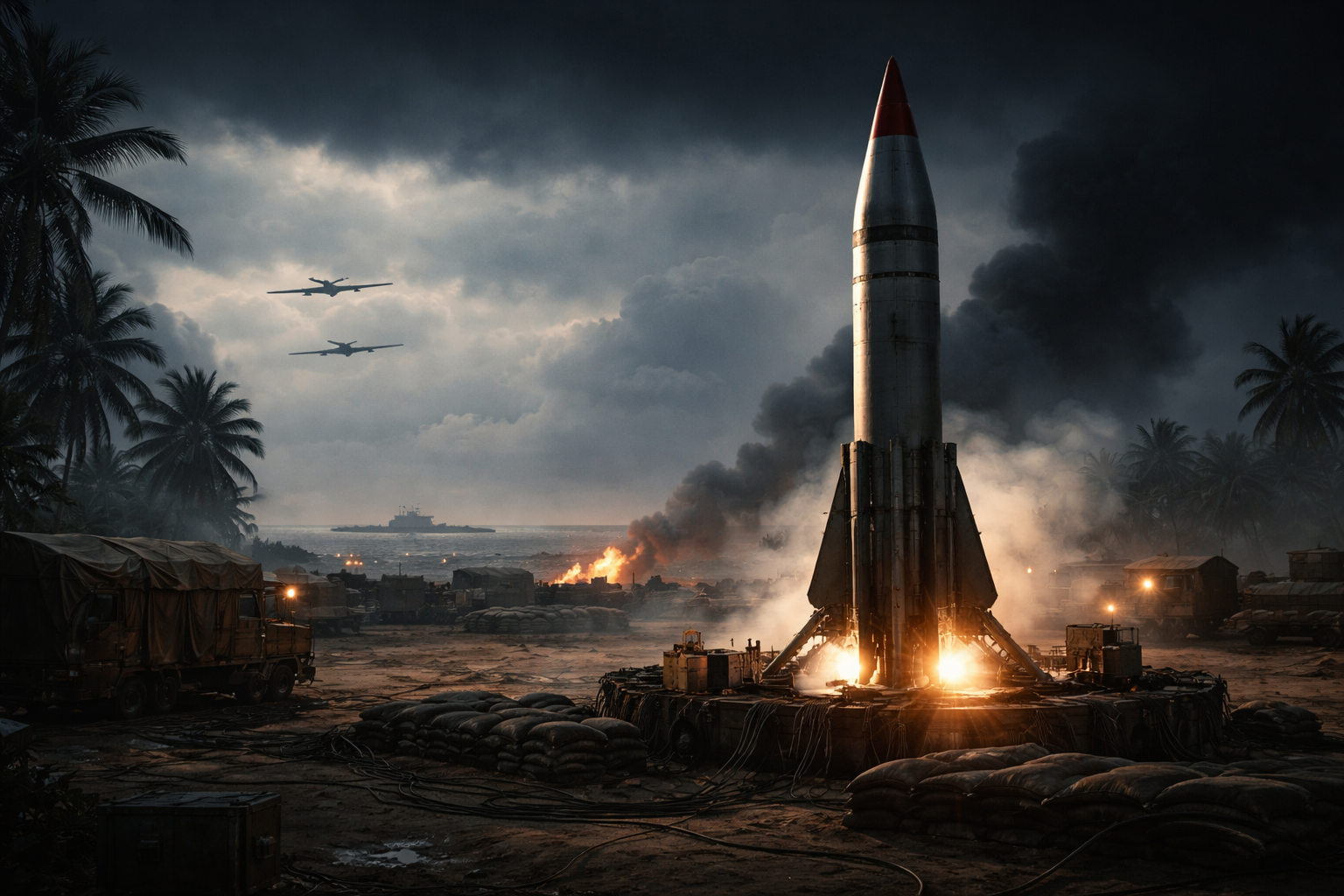
A realistic escalation path from misread signals to control loss—and why “limited” strikes could have tipped 1962 into nuclear use.
A Plausible Escalation Ladder From Misread Signals to Nuclear Use
The declassified record still supports a hard truth: the Cuban Missile Crisis was not one “decision” away from peace. Human error, local fear, and rigid military procedures interacted faster than leaders could have anticipated.
The crisis is usually told as a high-level chess match between Washington and Moscow. But if it turned hot, it likely would not start with a presidential order. It would start lower down: a radar blip, a pilot lost over the Arctic, a nervous air-defense commander, and a submarine captain convinced war had already begun.
And once blood is drawn, the logic of escalation can become self-propelling.
The story turns on whether local commanders interpret ambiguity as attack
Key Points
The most plausible “hot” path begins with misread signals (airspace violations, naval harassment, shootdowns) that create casualties and political pressure for retaliation.
A local U.S. strike (for example, against Cuban air defenses or missile sites) is the likeliest first kinetic step—because it fits existing plans and can be framed as “limited.”
The Soviets in Cuba had short-range, nuclear-capable systems alongside strategic missiles; a battlefield nuclear use becomes plausible if an invasion appears imminent.
Command-and-control friction—delays, jamming, broken communications, and pre-delegated initiative—raises the chance of “use it or lose it” decisions.
Once the first nuclear weapon is used (even “tactical”), escalation pressure rises sharply because leaders must decide whether to absorb it, match it, or end the war quickly.
The dangerous feature is not irrationality. It is incentives under uncertainty: each side believes restraint invites defeat, and action prevents surprise.
Background
In October 1962, the United States discovered Soviet nuclear missile deployments in Cuba and imposed a naval “quarantine” to stop further deliveries. Both sides mobilized forces and prepared options that ranged from continued blockade to air strikes and invasion.
Two realities shaped the risk.
First, information was imperfect and time-sensitive. Leaders were reacting to partial intelligence, delayed messages, and ambiguous military encounters.
Second, each side feared a sudden loss of advantage. Washington worried missiles would become operational and politically irreversible. Moscow was concerned that the destruction of its forces in Cuba could occur before they could deter any action.
That tension—time pressure plus mistrust—creates a natural slope toward escalation even when neither leader wants war.
Analysis
Misreading signals can turn a crisis into a conflict.
The most likely cause of the crisis is not ideological differences. It is a misinterpretation. an attack.
During the crisis, multiple incidents created the conditions for accidental or semi-accidental escalation: aircraft straying into sensitive airspace, shootdowns, naval forces attempting to signal submarines, and commanders acting on local rules rather than global strategy.
One of these incidents, occurring in a "hot" timeline, results in deaths that demand political attention. The key is not the death itself; it is what it does to decision space. It narrows options, hardens public messaging, and empowers military advice that was previously contained.
The immediate signposts are simple:
A fatal incident that can be framed as deliberate aggression.
There has been a swift transition from the language of "containment" to that of "punishment".
There has been a noticeable transition from maintaining a blockade posture to implementing strike packages and staging an invasion.
A limited U.S. strike represents the initial step in the escalation process.
Once a U.S. aircraft is shot down (or a ship is hit), the most “available” response is a limited strike: destroy the specific air-defense site, suppress air defenses, hit known missile infrastructure, or sink a submarine contact.
This is an escalation of convenience. Military organizations prepare playbooks. When faced with stress, leaders make decisions based on available options.
The political logic also pushes in that direction. A limited strike can be sold as proportional—enough to restore deterrence without “starting a war.” The danger is that it creates Soviet casualties and makes the next Soviet choice feel existential: respond or accept humiliation and vulnerability.
The signposts:
Attacks framed as "defensive" or "protective" of reconnaissance are authorized.
Short timelines: “strike within hours” rather than “wait for another message.”
Operational commanders receive orders that delegate target selection.
Soviet Retaliation: The Invasion Trigger
From Moscow’s perspective, U.S. strikes on Cuba could look like the opening of an invasion campaign. From the perspective of the Soviet commander on the island, these strikes might appear even worse: they could signify the beginning of a decapitation attempt aimed at severing communications and destroying missiles before they can be used.
In that frame, retaliation is not vengeance. It serves as a warning to stop immediately, lest the cost escalate.
The most plausible Soviet retaliation is conventional at first: attacks on U.S. ships, aircraft, or the U.S. base at Guantánamo Bay, using available local forces. However, the crucial factor is that Soviet forces in Cuba possessed nuclear-capable short-range systems within the theater. If local leaders believe an invasion is imminent and communications with Moscow are unreliable, battlefield nuclear use becomes a last-ditch stop sign.
The signposts:
U.S. forces moving from “quarantine” to “landing preparation.”
Soviet communications disruptions or silence.
Orders emphasizing “prevent seizure of missiles” or “deny landing beaches.”
Control Loss: This occurs when command-and-control systems become the primary focus of the battlefield.
Nuclear crises are often described as negotiations. In a high-stakes situation, nuclear crises transform into command-and-control contests.
War compresses time. Communications break. Local units act on partial orders. Leaders receive reports that are late, wrong, or both. The risk is not a single rash decision; it is multiple “reasonable” decisions made under different assumptions.
This is where submarines matter. A submarine under harassment, unable to surface safely, can interpret signals as hostile action—especially if it cannot confirm whether war has begun. Similarly, an air-defense unit in Cuba can interpret incoming aircraft as attack rather than surveillance.
In a hot scenario, this is the moment where escalation stops being centrally managed. It becomes emergent behavior across dozens of nodes.
The signposts:
Jamming, broken links, and delayed diplomatic messages are among the signs.
Local engagements are a misinterpretation. multiplying faster than diplomats can respond.
There are conflicting instructions between the political and military chains of command.
The Nuclear Threshold: The First Use Problem
If a nuclear weapon is used first—most plausibly a short-range weapon against an invasion force, a base, or a naval concentration—leaders face a brutal choice set:
Absorb it and try to de-escalate (risking further nuclear use and appearing weak).
Leaders must respond proportionately by launching a limited nuclear strike, which carries the risk of rapid escalation.
Escalate to end it by striking broader nuclear forces (risking full exchange).
The “tactical vs strategic” distinction matters less than people think. Once nuclear use is real, both sides must assume the other is now willing to climb. That fear accelerates worst-case planning: “use it or lose it,” “strike before being struck,” “engagements are struck,” and “finish the job.”
The signposts:
The signposts include prompt consultations with strategic command authorities.
Movement of strategic forces to maximum readiness.
The public messaging transitions from negotiation to a demand for action.
What Most Coverage Misses
The hinge is that a hot war could begin without a deliberate decision for war, because the escalation ladder is built from organizational reflexes interacting with uncertainty.
The mechanism is simple: each side’s “limited” action is designed to control escalation, but it also signals intent to the other side under conditions where trust is near zero. When communications are strained, the safest interpretation becomes the darkest one. That pushes local commanders toward preemption and pushes political leaders toward “decisive” action before options disappear.
What would confirm this dynamic early?
Rapid, localized violence paired with ambiguous central messaging (“we did not authorize…” or “we cannot confirm…”).
There is evidence of a communications breakdown, including missed deadlines, contradictory orders, and delayed hotlines.
There are movements of forces that appear to indicate an irreversible commitment, such as staging invasions, dispersing nuclear-capable units, and escalating submarine engagements.
What Happens Next
In a hot Cuban Missile Crisis timeline, the first 24–72 hours determine whether the conflict is contained as a conventional war in the Caribbean or detonates into nuclear exchange.
The first group to be most affected is not an abstract concept like "the world." It is U.S. and Soviet forces in and around Cuba, Cuban civilians near military sites, and decision-makers whose credibility collapses if they appear indecisive.
In the short term, the decisive variable is whether leaders can reassert control over local violence—because every additional clash generates pressure for a larger response.
Long-term, if nuclear weapons are used even once, the global order changes for decades: alliance commitments harden, arms control becomes politically radioactive, and leaders everywhere build doctrine around speed, preemption, and survivability.
The main consequence is significant because the underlying mechanism is clear: once nuclear weapons are used, leaders fear that delaying action increases their vulnerability, prompting them to respond more quickly and with greater force.
Impact
A U.S. Navy officer on a destroyer hears that a contact might be a hostile submarine. The “signal” charges are dropped. The intent is communication; the effect is panic below the waterline.
A Cuban family near an air-defense site sees trucks and sirens at night, then sudden explosions at dawn. They do not know if it’s a limited strike or the start of an invasion.
A U.S. aircrew is told their mission is “protective” and “limited,” but they watch friendly aircraft fall out of the sky and realize the rules changed mid-flight.
A Soviet commander on the island loses contact with Moscow. He has weapons meant to deter invasion. He must decide whether silence means restraint—or decapitation.
The Fork in the Road That Decided the Century
If the Cuban Missile Crisis turned hot, the path would likely run through a familiar human weakness: certainty under fear.
A limited strike meant to restore control can be read as a prelude to conquest. A defensive shot can be read as a deliberate first blow. A delayed message can look like deception. Then leaders begin choosing actions that reduce uncertainty by force—because force gives immediate feedback.
That is how brinkmanship becomes war: not by villainy, but by compressed time, rigid plans, and leaders trying to prevent surprise.
In the end, the signposts are the story: rising tempo of local clashes, shrinking diplomatic intervals, and military moves that cannot be easily reversed—because once those appear together, history stops being negotiated and starts being executed.
