

The Great Smog Of 1952: Why London’s Air Became Deadly
How The Great Smog Changed Britain’s Clean-Air Debate
How London’s Pollution Became Trapped
London’s Great Smog combined cold weather, trapped coal smoke and a failure to recognise how dangerous familiar air could become.
The fog that settled over London in December 1952 was familiar enough to be underestimated. The city had lived with coal smoke for generations. A murky winter sky did not, by itself, announce an emergency.
Yet between 5 and 9 December, the atmosphere over the capital became a trap. Smoke accumulated near the ground, visibility deteriorated and people breathed a concentrated mixture of pollutants. The first estimates associated about 4,000 deaths with the episode and its immediate aftermath. Later research suggested a substantially larger toll when subsequent weeks were included.
The Great Smog was neither simply bad weather nor a mysterious poison that arrived from nowhere. It was a collision between the way London generated heat and the conditions that normally carried its waste away. Understanding that collision explains why the disaster mattered far beyond four December days.
Why The Pollution Stayed Over London
Air near the ground usually has opportunities to mix with the atmosphere above it. Winds move polluted air horizontally; rising warm air can carry it upwards. Neither process removes pollution from existence, but both can prevent emissions building into an exceptionally concentrated local exposure.
In early December 1952, a high-pressure weather system brought cold, still conditions. According to the Met Office’s account, an inversion developed: a layer of warmer air lay above colder air near the surface. This arrangement resisted vertical mixing.
The term sounds technical, but the relevant principle is straightforward. A parcel of cold air beneath warmer air does not readily rise through it. The boundary acted like a lid, keeping emissions within a comparatively shallow layer over the city.
London continued producing smoke beneath that lid. Homes burned coal for warmth. Industry and power generation added emissions. The cold encouraged heating precisely when the weather was least able to disperse its by-products.
Fog formed in the moist air, bringing water droplets into the same space as soot and gases. The result was a dense, polluted atmosphere rather than ordinary clean-water mist.
A useful distinction follows. The inversion did not manufacture the coal smoke. It changed the concentration and persistence of pollution from sources already present. If those emissions had been much lower, the same weather would not have produced the same disaster.
A City With Very Little Atmospheric Room
Imagine the same quantity of smoke entering two spaces: one large and well ventilated, the other small with little air exchange. The second space becomes polluted much faster. This is an illustration of dilution, not a calculation of London’s actual exposure, but it captures why the height of the mixing layer matters.
An outdoor setting can feel unlimited because there is no visible ceiling. Meteorology can nevertheless restrict the volume into which pollutants disperse. For the people below, open air can function as a badly ventilated space on an enormous scale.
That is why a familiar source can become acutely dangerous without an equally dramatic increase in emissions. The rate at which pollution leaves matters alongside the rate at which it enters.
What Made The Smog Harmful
Coal combustion produces a mixture. Soot and other particles contribute to visible darkness, while sulphur-containing fuel releases sulphur dioxide. Atmospheric reactions can transform emissions after they leave a chimney.
The distinction between a gas leaving a fire and the mixture people eventually inhale is important. Air pollution is chemistry in motion. Temperature, water, sunlight and other pollutants affect what forms, how long it persists and where it travels.
Research into the London episode has examined how sulphate formation could have intensified the pollution in fog droplets. A 2016 study led by researchers investigating atmospheric sulphate connected laboratory work with observations of severe haze. It proposed a pathway involving nitrogen dioxide and aqueous chemistry under suitable conditions.
Such research helps explain plausible processes. It cannot reconstruct every person’s inhaled dose in 1952, and it does not turn one chemical reaction into a complete explanation for every death. The historical exposure was a mixture, varying across locations and over time.
Particles also differ in size and composition. Some are trapped higher in the respiratory system; finer particles can penetrate deeper into the lungs. Irritating gases and particles can aggravate respiratory illness, while air pollution can also affect cardiovascular health.
For someone already struggling to breathe, additional exposure can be critical. Population harm therefore depends on both the pollution and the people encountering it: their health, age, living conditions and ability to reduce exposure.
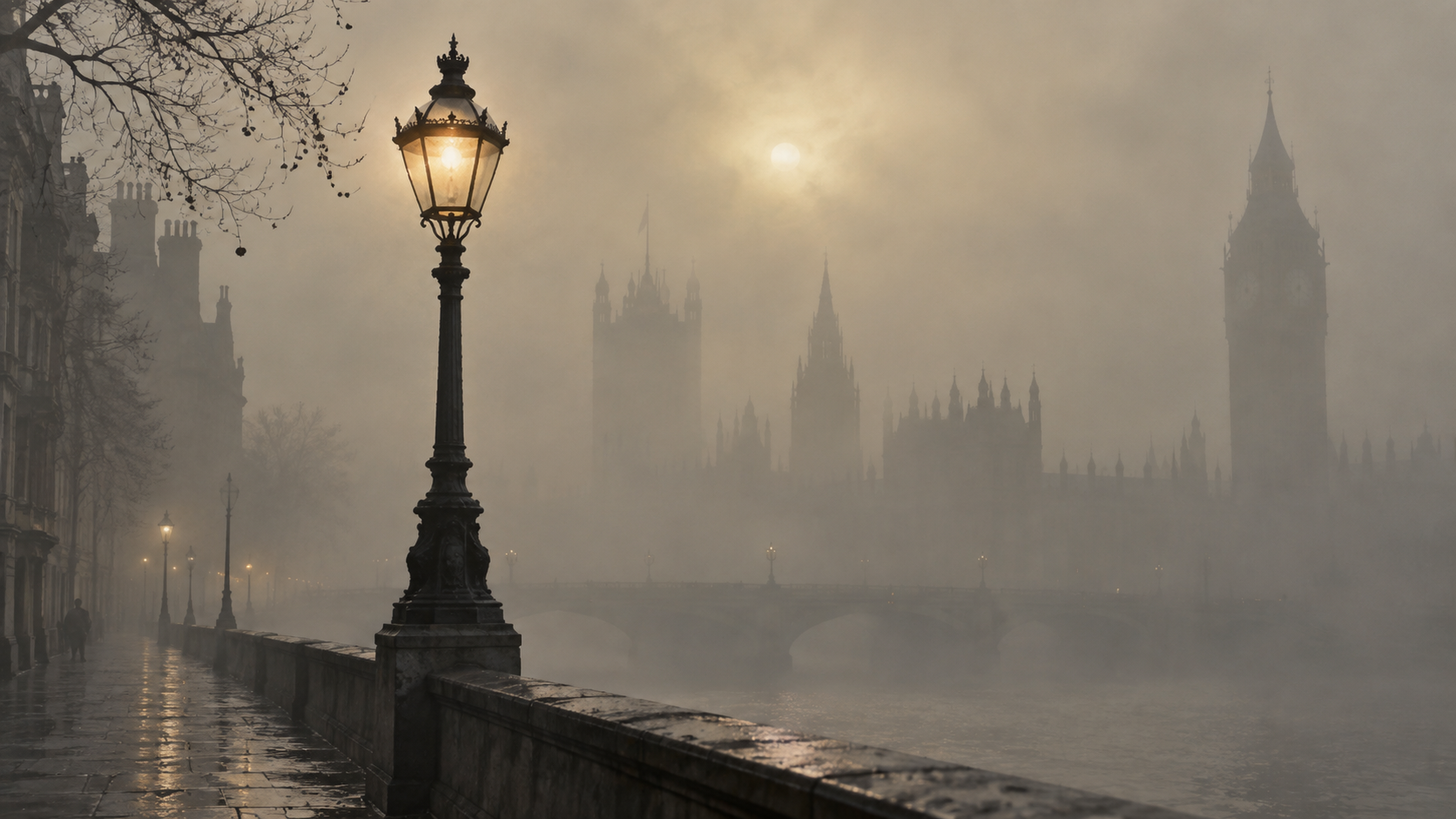
The dramatic photographs show what the atmosphere looked like. They cannot show all the biologically important components of that atmosphere. Visibility and health risk overlap, but they are not interchangeable measurements.
Why London Did Not Instantly Recognise The Emergency
A disaster is easier to identify retrospectively than while it is taking shape. Later observers possess a death toll, a named event and a clear beginning and end. People living through the smog initially had a severe version of something their city already knew.
That familiarity could conceal the change in scale. If smoke is treated as the unavoidable background to urban life, a worsening episode may first register as inconvenience: delayed travel, lost visibility, dirty surfaces and difficulty getting around.
The Met Office describes major disruption, including the interruption of transport and the penetration of smog into buildings. Moving indoors did not automatically create clean air. Many buildings were permeable to outdoor pollution, while domestic heating could itself contribute to the wider problem.
The deaths were also dispersed. They occurred across homes, hospitals and neighbourhoods rather than at one spectacular impact site. An individual death might be recorded as a respiratory or cardiac event without an immediately obvious connection to thousands of others.
Recognising the collective disaster required aggregation. Mortality records could reveal a sharp increase that no single observer was positioned to see.
This is one reason environmental harm can remain politically weaker than a more visually concentrated emergency. A collapsed building produces a clear scene. A polluted atmosphere produces exposures spread across an entire population, followed by illnesses that arrive through different doors.
Why The Death Toll Is An Estimate
The familiar figure of approximately 4,000 deaths should not be treated as a final list of individually proven smog fatalities. It represents an estimate of excess mortality associated with the episode and its immediate aftermath.
Excess mortality compares observed deaths with an estimate of the number expected without the unusual event. Establishing that expected baseline requires judgement: which previous years are comparable, how seasonal patterns are handled and what other causes of death were circulating.
Researchers also have to choose a time window. A short window captures an immediate spike. A longer one can include people whose health deteriorated after exposure, but it also introduces more opportunities for other influences to affect the count.
A retrospective assessment by Michelle Bell, Devra Davis and Tony Fletcher examined mortality after the London smog and the possible contribution of influenza. Their work is associated with the widely reported estimate of roughly 12,000 deaths across the longer aftermath.
The difference between the figures does not mean that someone simply discovered 8,000 overlooked death certificates stamped “smog”. It reflects a broader assessment of excess deaths and competing explanations.
Why Influenza Matters To The Argument
Winter respiratory deaths can rise for several reasons. If influenza was circulating, researchers had to ask how much of the observed increase it could plausibly explain. Treating every additional winter death as pollution-related would be too simple; treating the end of visible fog as the end of all pollution-related harm would also be too simple.
The valuable question is how well the timing and scale of alternative explanations fit the records. A strong historical analysis tests those alternatives rather than selecting whichever number produces the most striking headline.
There is another complication: an exposure may bring forward the death of someone already seriously ill. That does not make the exposure harmless. It does affect how researchers interpret the duration and distribution of the resulting mortality increase.
For general readers, the defensible conclusion is that the immediate toll was already catastrophic and that the longer-term burden was probably greater than the first estimate suggested. Precision beyond what the historical records can support would weaken that conclusion rather than strengthen it.
Who Could Escape The Air?
Pollution was shared, but the ability to avoid it was unequal. A person who could leave London, stop travelling or obtain help had options unavailable to someone whose work and housing kept them exposed.
It is tempting to imagine prevention as a collection of individual decisions: burn less coal, stay inside, find cleaner air. That framing becomes inadequate when heating, employment and urban infrastructure depend on the same fuel system.
Cold itself is dangerous. Asking a household to stop heating without an affordable alternative transfers the burden of a public problem onto the people with the fewest choices.
The policy challenge was therefore larger than persuading Londoners to dislike smoke. It involved changing appliances, fuels, industrial practices and the conditions under which cleaner heating could become practical.
This remains a useful way to assess environmental interventions. A rule can be technically sound while failing in practice if the people expected to comply cannot obtain or afford the alternative. Effective prevention connects standards with the means to meet them.
The Great Smog also illustrates why protecting the most vulnerable cannot be separated entirely from reducing general exposure. People with existing illness may suffer first, but they share the same air system as everyone else. Reducing pollution at source reaches people who may not know they are especially susceptible.
What The Clean Air Act Changed
The disaster became a major force behind the Clean Air Act 1956. The Act supported measures including smoke-control areas and a transition away from the most smoke-producing domestic practices. Further legislation followed in 1968.
The mechanism mattered. Rather than relying only on warnings during exceptional weather, smoke control addressed the emissions that would be trapped when those conditions returned.
That approach is preventive in a literal sense. A city cannot promise never to experience an inversion. It can reduce the amount of harmful material accumulating beneath one.
The legislation did not instantly eliminate air pollution. Changing buildings and heating systems takes time, and different pollutants require different controls. The Met Office records another serious London smog in December 1962, associated with hundreds of deaths.
That later episode is a necessary corrective to a tidy story in which a disaster leads to an Act and the problem disappears. Laws establish authority and direction; implementation determines what changes in streets and homes.
Nor should the 1956 Act be credited to a single moment in isolation. Campaigning, scientific investigation and earlier debates about smoke preceded the disaster. December 1952 made the consequences harder to dismiss and helped turn longstanding arguments into stronger action.
Why Cleaner-Looking Air Can Still Be Polluted
London’s modern air does not usually resemble the photographs of 1952. That is a meaningful improvement in the visible coal-smoke conditions associated with the disaster. It is not proof that all harmful exposure has vanished.
Different sources produce different mixtures. Traffic, heating, industry and atmospheric reactions can contribute pollutants that are difficult to see. A clear horizon is a poor substitute for measurement.
This does not mean every modern pollution episode is another Great Smog. The sources, concentrations, regulations and population exposures differ. Historical analogy is useful when it clarifies a mechanism; it becomes misleading when it erases those differences.
The strongest connection is the relationship between emissions and dispersion. Weather still influences where pollutants accumulate. Measurement still matters because perception is unreliable. Public-health evidence still has to connect individual illness with population-level patterns.
A second connection concerns delay. The visible end of an event may come before its full health consequences are counted. Public attention can move on while researchers and families are still dealing with the aftermath.
Taylor Tailored’s explanation of what “clean coal” can and cannot mean develops the distinction between reducing particular air pollutants and addressing other environmental consequences. The useful question is always which substance is being measured and which source is being controlled.
What A Monitor Can Show That A Photograph Cannot
A photograph records visibility at one moment from one viewpoint. An air-quality instrument records a specified property of the atmosphere at its location. Neither automatically describes the exposure of every person in the city.
A worker travelling through several neighbourhoods may encounter a different mixture from someone staying in one room. A monitor outside a building may not fully represent the air inside it. Historical exposure assessment has to work with these differences rather than assume one concentration applies everywhere.
The timing of measurements matters too. A daily average can conceal a shorter peak, while a brief reading can exaggerate the importance of a transient condition if treated as typical. Researchers need to know what interval a number represents before connecting it with health outcomes.
This does not make population evidence unusable. It explains why multiple sources of information are valuable: weather records, pollution measurements, death registrations and clinical observations can address different parts of the same event.
Their convergence is especially persuasive when each contributes something the others cannot. Meteorology explains why emissions accumulated. Measurements establish aspects of the resulting atmosphere. Mortality records reveal the population consequence. No single photograph has to carry all three arguments.
The Great Smog’s visual legacy remains powerful, but its scientific legacy depends on learning to see beyond visibility. The most consequential change in a city’s air may be something people cannot recognise by looking out of a window.
The Lesson Beneath The Fog
The Great Smog was exceptional in intensity, but many of its ingredients were ordinary: cold weather, domestic heating, industrial activity and assumptions inherited from everyday life.
That combination is what gives the story its force. Catastrophe did not require a completely new technology or a substance nobody had encountered. It required an established hazard to accumulate under conditions that stripped away the margin people had taken for granted.
The evidence also changed what counted as the problem. Smoke could no longer be understood adequately as dirt, inconvenience or an unfortunate sign of prosperity. Mortality records made its cost visible in another form.
There is no need to inflate the death toll or claim a single chemical explanation to make the event matter. Thousands died, the wider burden remains a subject of careful retrospective assessment, and the disaster helped reshape the responsibilities of government towards the air people breathe.
When the wind changed, London’s immediate smog dispersed. The more durable change came from recognising that waiting for the wind was not a public-health policy.
