The Greatest U.S. Prioners Of War Rescues Ever Carried Out, Ranked
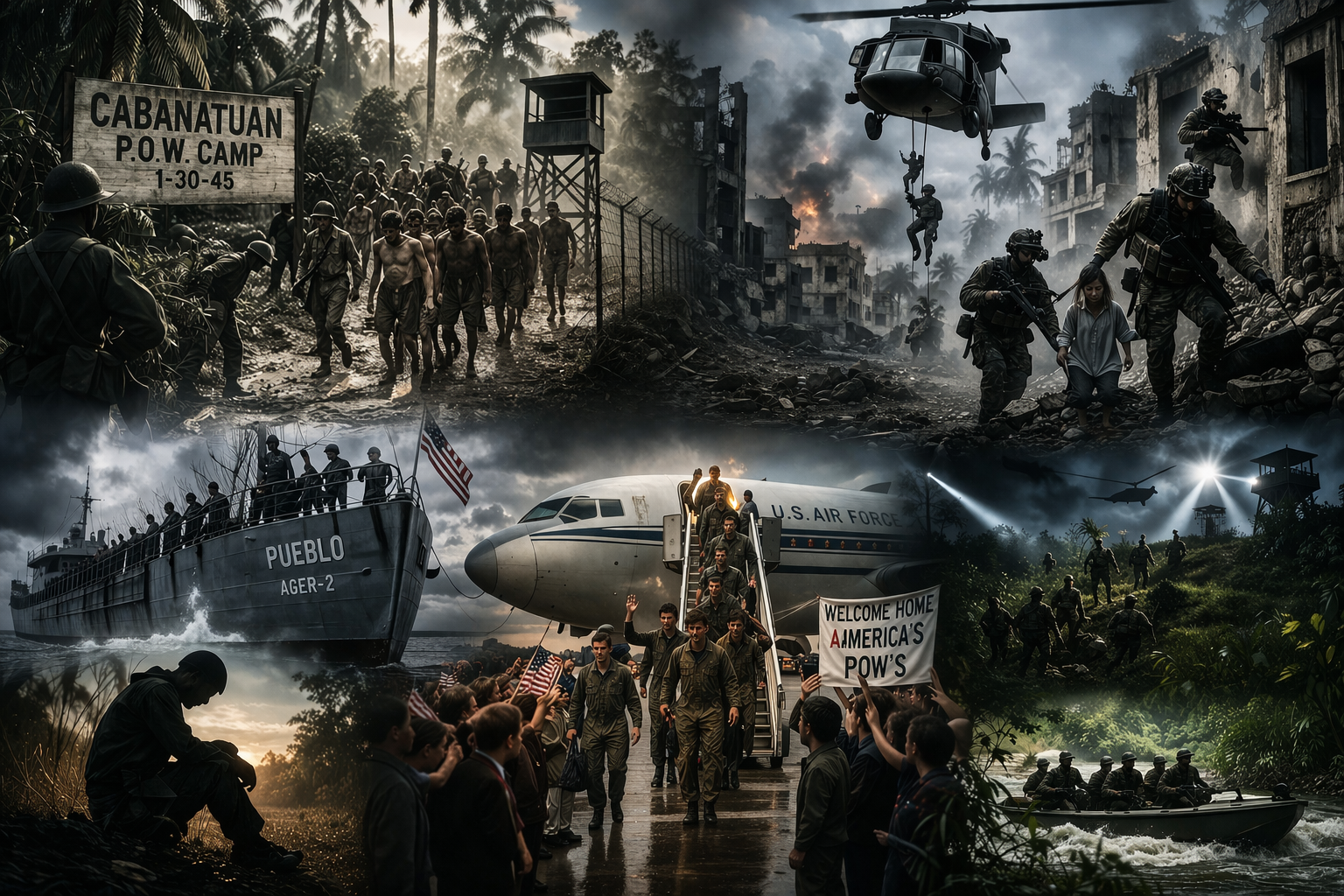
From Cabanatuan to Iraq: America’s Biggest POW Rescues
The Daring Missions That Brought American POWs Home
When people search for the greatest U.S. prisoner-of-war rescues, they usually mean one thing: the moments when America either pulled captives out under fire or brought them home through a pressure campaign so large it altered national memory. By that standard, the United States has a few truly defining POW saves, but not many.
Some were clean battlefield rescues. Some were negotiated recoveries after months or years of captivity. One famous mission saved nobody, yet still changed the POW story of an entire war. That is why any serious ranking has to separate drama from scale and symbolism from actual results.
This list ranks the most historically important U.S. POW saves by outcome, danger, strategic weight, and lasting significance.
The story turns on whether a POW save should be judged mainly by daring, by numbers, or by what it changed afterward.
Key Points
The Cabanatuan raid remains the clearest example of a classic American combat rescue of POWs under extreme risk.
Operation Homecoming was not a commando raid, but it was the largest and most consequential return of American POWs in modern U.S. history.
The release of the USS Pueblo crew showed that a POW save can come through coercive diplomacy rather than battlefield action.
The Jessica Lynch rescue became famous not only because it succeeded but also because it exposed how quickly wartime rescue stories can become mythologized.
The Son Tay raid failed to recover prisoners, yet it still ranks historically because it transformed POW morale, planning, and U.S. special operations thinking.
Some of the most important POW stories are remembered less for body counts than for what they revealed about national will, military reach, and the promise not to leave captives behind.
1. The Cabanatuan Raid, 1945
If the question is the greatest pure U.S. POW rescue mission ever carried out, Cabanatuan is the strongest answer.
In January 1945, American Rangers, Alamo Scouts, and Filipino guerrillas pushed deep behind Japanese lines on Luzon to free Allied prisoners held at the Cabanatuan camp. Many of the men inside were survivors of Bataan and years of brutal captivity. They were weak, starved, sick, and at immediate risk. American planners feared that if Japanese forces began collapsing fast enough, the prisoners might simply be massacred.
What made the raid extraordinary was not just the number saved. It was the combination of timing, distance, intelligence, and precision. The rescue force had to move across open ground, coordinate with local resistance, avoid alerting a nearby enemy force, breach the camp, kill or scatter the guards, and evacuate hundreds of half-starved men who could barely move.
This is the operation most people picture when they think of an all-time POW rescue. It had the ingredients of legend because it earned them. The mission was high-risk, tactically elegant, and morally clear. It also became a lasting symbol of the American military principle that prisoners are not abandoned, even when saving them requires striking deep into hostile territory.
Cabanatuan ranks first because it combined real danger, a large successful extraction, and a story simple enough to survive into public memory without losing its force.
2. Operation Homecoming, 1973
Operation Homecoming was not the most cinematic POW save in U.S. history. It may have been the most consequential.
After the Paris Peace Accords, American POWs held during the Vietnam War were returned in a staged repatriation effort that became one of the defining emotional moments of the postwar era. Images of gaunt prisoners stepping off aircraft, saluting, blinking into daylight, and rejoining their families cut through years of strategic argument. Whatever Americans believed about the war itself, the return of the POWs was immediate, human, and politically electric.
This is why Homecoming ranks so high. It was not a raid. It was a recovery on a national scale. It brought closure to hundreds of families, shaped the POW-MIA issue for decades, and became central to the American memory of Vietnam. In many ways, it turned the POW from a military subject into a civic one. The returning prisoners were not just survivors. They became living evidence of endurance, discipline, and sacrifice under captivity.
Homecoming also mattered because it exposed what remained unresolved. Even as hundreds came home, the question of missing Americans did not disappear. It hardened into a lasting national wound. That tension gave the returnees enormous symbolic weight. Their release closed one chapter while opening another.
If Cabanatuan is the greatest combat rescue, Homecoming is the biggest American POW return with the deepest political and cultural afterlife.
3. The Return of the USS Pueblo Crew, 1968
The USS Pueblo case sits in a category of its own: a POW save through pressure, humiliation, and hard diplomacy rather than a rescue assault.
When North Korea seized the intelligence ship in January 1968, one crewman was killed and the survivors were taken captive. The crisis arrived at one of the worst possible moments for Washington, with the Vietnam War already stretching U.S. focus and credibility. The prisoners were abused, interrogated, and exploited for propaganda. Their captivity became a test not only of survival but also of whether the United States could recover Americans without igniting a larger war.
The crew eventually came home in December 1968, but only after months of negotiations and a deeply uncomfortable diplomatic formula. That matters to the ranking. The Pueblo crew were saved, but not through battlefield dominance. They were saved through a grim strategic compromise that reminded Washington that recovering captives sometimes means accepting political pain.
Why does this rank above more dramatic single-person rescues? Because of scale and stakes. Dozens of Americans were held by a hostile state in a Cold War flashpoint. Their release became a major national event and a lesson in the limits of military freedom of action under nuclear-era pressure.
The Pueblo story is historic because it proved that POW recovery is not always about striking harder. Sometimes it is about absorbing humiliation long enough to get people back alive.
4. The Rescue of Jessica Lynch, 2003
The rescue of Private First Class Jessica Lynch became one of the most famous American POW recoveries of the modern era almost instantly.
Captured after her convoy was ambushed in Iraq, Lynch was rescued from a hospital in Nasiriyah by U.S. Special Operations forces. The mission itself was real, valid, and dangerous enough to be treated seriously. But what followed turned it into something larger and messier: a media storm, a symbolic national narrative, and later a fierce argument over exaggeration and mythmaking.
That is exactly why it belongs on this list. Historically, the Lynch rescue matters twice. First, as a genuine POW recovery operation under combat conditions. Second, as a case study in how modern war turns rescue into narrative and narrative into controversy.
In older wars, famous rescues entered legend slowly. In Iraq, the legend machine activated almost immediately. Claims about firefights, resistance, and cinematic heroism raced ahead of the evidence. Later reviews pulled the story back toward a more disciplined understanding. The result was not that the rescue was fake. It was that the event and its public packaging became fused.
That makes the Lynch case one of the most revealing POW saves in American history. It showed that in the television and internet age, the rescue is only half the event. The other half is how the state, the media, and the public process it.
What Most Coverage Misses
Most coverage of famous POW saves leans too heavily on the raid itself. The deeper hinge is usually what the rescue does afterward.
Cabanatuan helped define the American ideal of reaching back for captured troops. Homecoming transformed POW return into a national ritual. The Pueblo case showed the costs of getting prisoners back without widening the war. Jessica Lynch exposed the modern struggle between real operations and inflated storytelling.
That is the better way to rank these events. Not just by how dramatic the entry was, but by what changed once the prisoners came home.
5. Colonel James “Nick” Rowe’s Escape and Recovery, 1968
Nick Rowe’s case was not a mass rescue. It remains one of the most historically important American POW survivals of the Vietnam era.
Captured by the Viet Cong and held for more than five years, Rowe eventually escaped in late 1968. His survival story matters partly because long-term escapes from that kind of captivity were rare. But its larger importance came later. Rowe helped shape the modern U.S. approach to Survival, Evasion, Resistance, and Escape training.
That moves his case beyond personal endurance. Rowe did not just get out. His experience fed directly into how later generations of American personnel were prepared for capture, resistance, and recovery.
In pure ranking terms, Rowe cannot sit above Cabanatuan or Homecoming because the scale was smaller. But historically, his case punches above its size because it changed institutional memory. Some POW stories become legend. Rowe’s became doctrine.
6. The Son Tay Raid, 1970
A failed rescue can still become one of the most important rescue operations in history. Son Tay is the proof.
In November 1970, American forces launched a deeply planned joint raid into North Vietnam to rescue POWs believed to be held at Son Tay. The operation displayed remarkable precision, secrecy, and courage. The raiders hit the target cleanly.
But the prisoners were not there.
On the surface, that should push Son Tay off a ranking like this. In practical terms, no POWs were recovered. Yet history is rarely that simple. Son Tay mattered because it demonstrated that the United States was willing to run an extraordinarily bold mission deep inside hostile territory for its captured personnel. For American POWs elsewhere in North Vietnam, word of the raid reportedly had a profound psychological effect. It told them they had not been forgotten.
The raid also forced adjustments in enemy handling of prisoners and became a landmark in special operations planning. In that sense, Son Tay was a failed mission with successful consequences.
It ranks here because historical importance is not only a matter of bodies moved. It is also a matter of doctrine, morale, and national signal.
7. The Broader 1945 Liberation Campaign in the Philippines
Cabanatuan was the most famous raid, but it sat inside something bigger: a broader Allied and American-led drive in the Philippines to prevent Japanese forces from murdering prisoners and internees as the war turned against them.
This wider campaign matters because it reveals the strategic context that made Cabanatuan so urgent. The fear was not abstract. Allied prisoners had already been massacred elsewhere. That changed the moral and operational logic. Rescue was no longer just desirable. It was time-sensitive in the most brutal sense.
The broader liberation of camps and internment sites in the Philippines is sometimes overshadowed by the single most cinematic raid. But historically it deserves a place in the ranking because it shows that the U.S. did not execute one dramatic POW save in isolation. It undertook a larger race to beat atrocity with speed.
That wider picture sharpens the meaning of the whole list. POW saves are remembered as heroic episodes. They are often responses to a darker calculation: rescue now, or the captives may not survive long enough for conventional victory to reach them.
Why These Stories Still Matter
The enduring power of POW rescue stories is not just military. It is moral.
They test whether a state will take real risks for trapped people. They test whether public emotion can be separated from myth. They test whether rescue means a helicopter assault, a diplomatic compromise, or a years-long national effort to bring prisoners home. And they test whether the country learns anything once the moment of celebration passes.
That is why Cabanatuan remains the benchmark for a battlefield POW rescue. That is why Operation Homecoming still towers over modern American memory. That is why the Pueblo crew’s return still stings. That is why Jessica Lynch still gets debated. And that is why Son Tay still matters, even in failure.
The best way to read these events is not as isolated war stories. It is as a running argument about what the United States owes its captured service members, what it is willing to spend to recover them, and what kind of truth survives after the headlines fade.
