The History of Good Friday and Easter: How a Sacred Story Became a Global Season
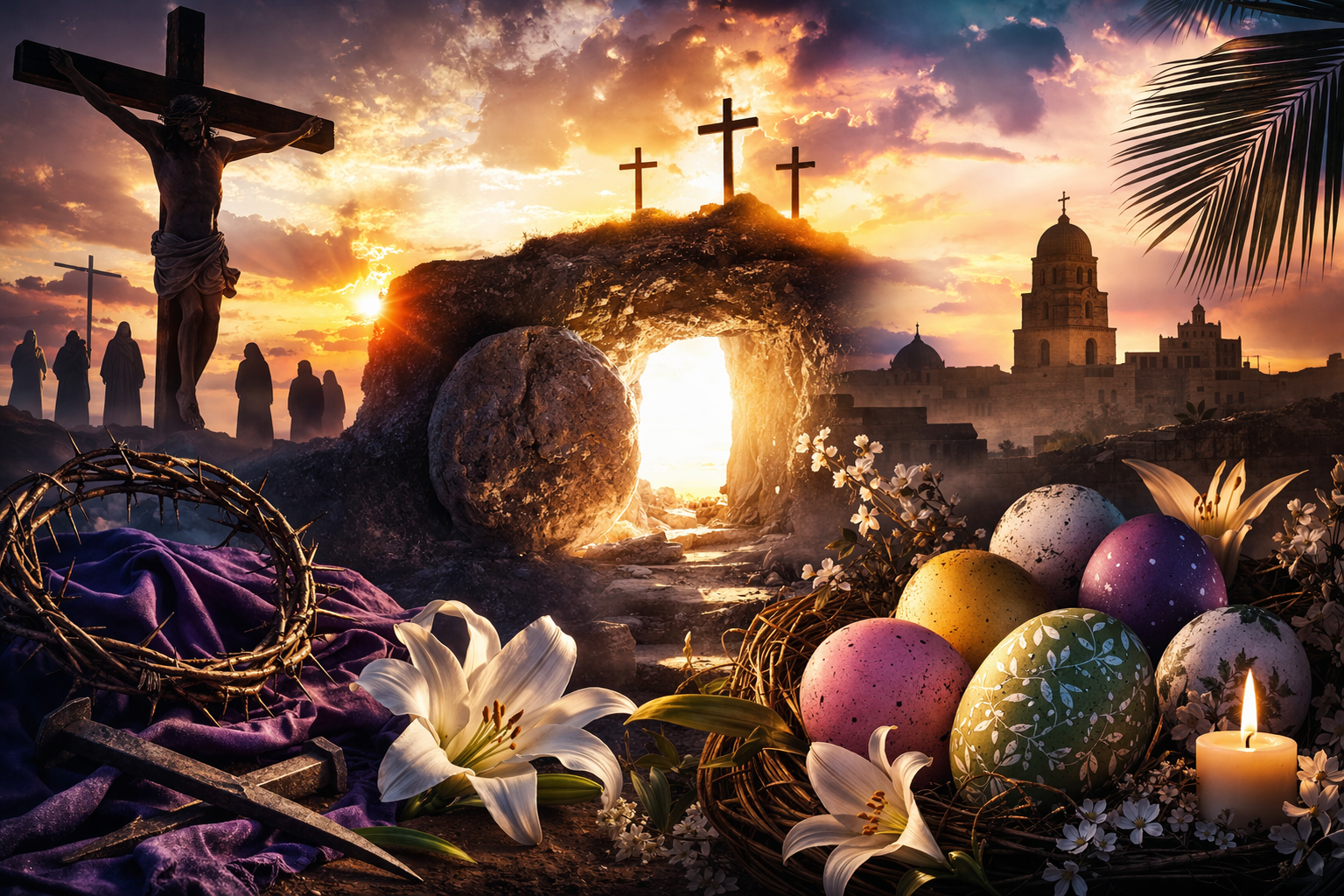
The Strange Two-Thousand-Year Evolution of Good Friday and Easter
The Real Origins of Good Friday and Easter Are More Complex Than Most People Think
Good Friday and Easter began as the central Christian remembrance of Jesus Christ’s death and resurrection, but they did not arrive fully formed. What started as a tightly focused act of worship in the earliest church gradually expanded into a liturgical season, a calendar battle, a civic holiday, a family tradition, and, in many places, a largely cultural event. The deep history is not just about belief. It is about how memory becomes ritual, how ritual becomes institution, and how institution absorbs local custom without fully losing its core.
That matters now because Easter sits at an unusual crossroads. It remains the holiest season in Christianity, yet it is also one of the most commercialized and culturally elastic periods in the Western calendar. The story of Good Friday and Easter is therefore also the story of how religion changes under pressure from empire, language, migration, folk practice, modern media, and secularization.
At the center of that history is a simple tension: the Christian meaning has remained remarkably stable, while the way people mark it has changed again and again.
The future of Easter hinges on the balance between religious continuity and cultural reinvention.
Key Points
Holy Friday commemorates the trial, crucifixion, and death of Jesus; Easter celebrates the resurrection and has been one of Christianity’s principal feasts since the earliest centuries.
The earliest Christians likely commemorated the resurrection very early, but the first recorded Easter observance appears in the 2nd century, and Holy Week developed more fully by the later 4th century.
Disputes over when to celebrate Easter became one of early Christianity’s major calendar controversies, with Nicaea in 325 establishing the broad formula still used in the West.
Many familiar customs, including eggs and the Easter bunny, arrived much later and reflect the fusion of Christian observance with older seasonal symbols and regional folk practice.
The modern season now spans solemn liturgy, national holidays, retail culture, travel, and family ritual, often all at once.
Its future will likely be shaped by three forces: secularization, efforts to unify the Easter date across Christian traditions, and the growth of digital and hybrid forms of worship.
Where Good Friday and Easter Actually Begin
In Christian tradition, Holy Friday and Easter are inseparable. Good Friday marks the crucifixion of Jesus. Easter marks the resurrection on the third day. From the beginning, Christians treated those events not as two isolated anniversaries but as one dramatic arc: suffering, burial, waiting, and triumph. That is why the season eventually came to be organized as a sequence running through Holy Week, the Paschal Triduum, and the Easter Vigil.
The earliest Christians did not begin with chocolate eggs or spring décor. They began with theology and memory. The resurrection was not an optional doctrine. It was the hinge of the faith. Britannica notes that the earliest recorded observance of Easter comes from the 2nd century, though commemoration of the resurrection likely goes back to the earliest Christian communities themselves.
That early stage mattered because the first Easter was less a holiday than a proclamation. It told believers what death meant, what salvation meant, and why Sunday became the defining day of Christian worship. In that sense, Easter did not begin as an annual add-on. It grew out of the deeper weekly rhythm of Sunday observance and only later became a more elaborate yearly feast.
How the Earliest Church Turned Memory Into Ritual
The season deepened as the church became more structured. Lent emerged as a period of preparation before Easter, rooted in fasting, penance, and especially the preparation of baptismal candidates. Britannica traces that preparatory season to very early practice, with formalization associated with the Council of Nicaea in 325. The Paschal vigil became especially important because baptism, instruction, repentance, and resurrection symbolism all converged there.
By the later 4th century, Christians were increasingly separating the events of Jesus’ final week and assigning them to particular days. Holy Week became a liturgical map of the Passion: Palm Sunday, Maundy Thursday, Good Friday, Holy Saturday, and Easter. That development turned the Passion from a single remembered event into a lived sequence that worshippers could enter step by step.
Good Friday itself took on a particularly austere character. Britannica describes it as a day of sorrow, penance, and fasting from the early days of Christianity. Over time, traditions such as the reading of the Passion, veneration of the cross, silence, and later meditations like the Jesuit-influenced Three Hour Service gave the day a distinctive emotional and devotional weight.
The Calendar Fight That Helped Shape Christianity
One of the most important parts of Easter’s history is also one of the least glamorous: the date. Early Christians argued over when Easter should be observed. That dispute was not trivial. It touched authority, uniformity, scriptural interpretation, and the relationship between Christian and Jewish calendars.
The Council of Nicaea in 325 became the critical turning point. Britannica states that the council decreed Easter should be observed on the first Sunday after the first full moon following the spring equinox, fixing the equinox as March 21 in ecclesiastical calculation. That is why Easter remains a movable feast in the West, falling between March 22 and April 25.
That did not end all disagreement. Britannica also notes that Eastern Orthodox churches use a different calculation tied to the Julian calendar, which often places Orthodox Easter later than Roman Catholic and Protestant Easter. In other words, one of Christianity’s holiest celebrations still carries a calendar fracture that dates back to ancient disputes and later divergences between East and West.
How Folk Symbols Attached Themselves to Easter
This area is where the history gets muddy and where bad internet history thrives. Easter is Christian in core meaning, but many of its most recognizable public symbols are not original to the earliest church. Over the centuries, people layered on eggs, hares, spring greenery, and eventually a commercial gift culture.
The meaning of the word “Easter” is still disputed. Britannica says the English word is of uncertain origin, though one old explanation given by Bede linked it to Eostre, an Anglo-Saxon figure associated with spring. That is very different from the lazy online claim that Easter is simply a pagan festival with a thin Christian mask. The evidence is messier than that. The Christian feast is anchored in the Passion and resurrection; the English-language name may preserve an older seasonal term, and local customs attached themselves unevenly over time.
Eggs became natural Easter symbols because they already carried associations with life and renewal, and in Christian interpretation they could also represent the sealed tomb and new life emerging from it. Britannica notes that decorating eggs has been practiced in both Eastern Orthodox and Western churches since the Middle Ages.
The rabbit came later. According to Britannica, the Easter bunny first appeared in Protestant regions of Europe during the 17th century, but it didn't gain widespread popularity until the 19th century. That means one of the most recognizable Easter symbols is not ancient Christianity at all, but a comparatively recent folk addition that spread through family custom and later mass culture.
What Most Coverage Misses
What most shallow explainers miss is that Easter did not evolve in a straight line from “pagan spring festival” to “Christian holiday” to “modern commercial event.” That is to” That is to” That is too neat and too lazy. The real process was layered. Christian communities built a distinct theological season around the death and resurrection of Jesus. Then, over centuries, regional languages, calendar systems, agricultural symbols, local customs, and state holiday structures attached themselves to it.
That distinction matters because it explains why Easter can look contradictory without being incoherent. A single weekend can contain solemn fasting, an all-night vigil, red-dyed eggs in Eastern churches, children hunting chocolate eggs in suburban gardens, and secular bank-holiday travel. That is not proof the holiday has lost its identity. It is proof that religious observances survive historically by adapting their outer form while defending an inner core.
It also explains why debates over “true origins” usually go nowhere. The core Christian claims and the later cultural wrappers are both historically real. They are just not the same layer of history.
From Sacred Triduum to Global Holiday Season
Modern Easter is the product of several later developments. In liturgical churches, the Paschal Triduum became the emotional center: Maundy Thursday, Good Friday, Holy Saturday, and Easter. In the Roman Catholic Church, 20th-century reforms restored the evening Easter Vigil more fully, reversing the long drift that had pushed the vigil away from its original nighttime setting. Britannica notes that the evening vigil was restored beginning in 1955, while Orthodox churches had never abandoned it. Official Vatican texts likewise describe the reform of the Easter Vigil and Holy Week under Pius XII as a major stage in liturgical renewal.
At the same time, national cultures turned the season into a public holiday. In many countries Good Friday and Easter Monday became civic time off, not just church observance. In places with weakening religious practice, that widened the gap between what the church meant and what the public consumed. The result is familiar: one population marks the Passion, another marks spring, and a large middle group marks both without fully separating them.
How Good Friday and Easter Could Evolve Next
Three factors, rather than a single one, will likely shape the future of Good Friday and Easter.
First, secularization will continue to alter the way people experience the season in Europe and other parts of the West. Pew reported in 2025 that the number of Christians in Europe fell 9 percent from 2010 to 2020, while the religiously unaffiliated grew sharply, and separate Pew work found substantial religious switching out of Christianity in many countries. That does not mean Easter disappears. It means Easter may increasingly function as a mixed religious-cultural season rather than a universally church-centered one.
Second, churches may keep pushing for a common date of Easter. The World Council of Churches has continued backing efforts toward a shared date, and 2025 was notable because Christians of different traditions celebrated Easter on the same day, April 20, alongside the 1700th anniversary of Nicaea. Britannica notes renewed early-21st-century interest in a fixed or common date, though no final agreement has been reached. If that ever changes, it would be one of the biggest practical shifts in Easter observance for centuries.
Third, the form of observance will keep modernizing even where the theology does not. Livestreamed vigil liturgies, globalized devotional media, hybrid family rituals, and more personalized observance are likely to become normal. The historical pattern suggests the core narrative will endure, but the social packaging around it will keep shifting with technology, migration, and culture. That is not a rupture with the past. It is precisely how this season has always developed.
The Fork in the Road for Easter’s Next Era
The history of Good Friday and Easter is really the history of a faith tradition learning how to carry one event across two thousand years without freezing it in one cultural form. The Passion and resurrection remained the center. Around that center, language changed, rites matured, the calendar split, folk customs gathered, reform movements corrected old habits, and modern consumer culture built an outer shell of its own.
So the real question is not whether Easter will survive. It almost certainly will. The real question is what kind of thing it will increasingly be: a deeply lived sacred drama, a broad civil spring festival with Christian roots, or a hybrid of both. The signposts to watch are church participation, calendar reform, and the balance between liturgy and lifestyle. However that balance shifts, Easter will remain one of the clearest examples of how religious memory can outlast empires, absorb cultures, and still ask the same human question about death, hope, and what comes after.
