Trump and Iran History: The Long Arc of a Hostility He Kept Reframing, From Oil Seizure Talk to Nuclear Red Lines
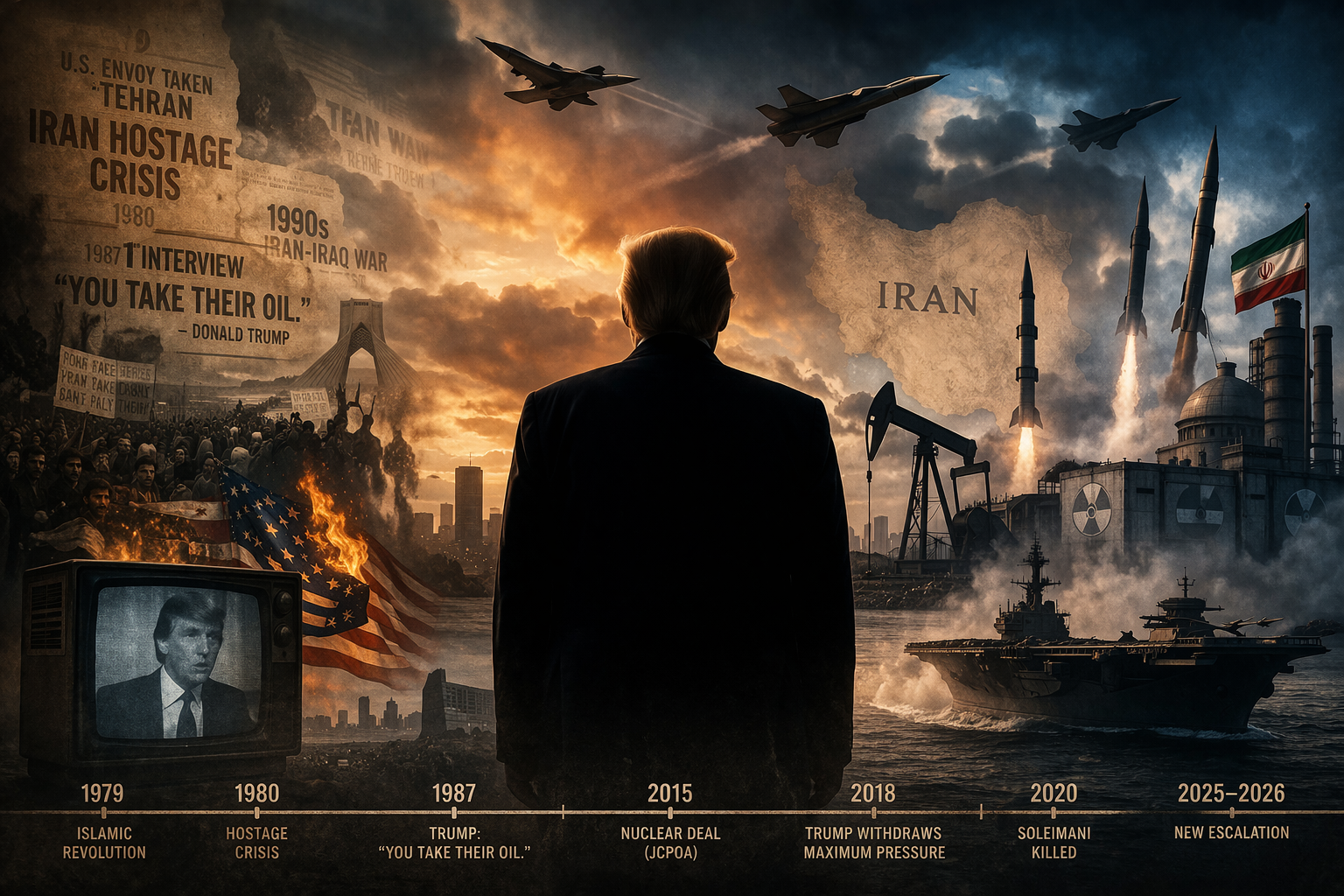
Why Trump Has Always Seen Iran as the Test of American Strength
From Take Their Oil to No Nuclear Weapon: Trump’s Iran Views Explained
Donald Trump’s view of Iran is best understood not as a series of random outbursts but as a long-running pattern with one fixed core and several changing methods. The fixed core is simple: he has repeatedly insisted Iran must never get a nuclear weapon. The changing methods are what matter: in different eras, he has talked about seizing oil, cutting a tougher deal, tearing up the Obama-era nuclear agreement, applying maximum pressure, using targeted force, and now openly threatening devastating military action.
That is why Trump’s Iran rhetoric can sound contradictory when heard in fragments. At times he has said he wants Iran to be “successful” or “great.” At other times he has described the regime in apocalyptic terms and threatened to hit it “forcefully” or “bring them back to the Stone Ages.” Both strands are real. He often frames Iran as a country whose people could prosper while treating the regime as irredeemably dangerous and uniquely untrustworthy.
The earliest clearly attested public record of Trump talking this way about Iran does not come from his childhood but from his early public celebrity years. In a resurfaced 1987 television interview, he argued that weakness invited war and suggested the United States should take Iranian oil rather than merely react defensively. In the clip, when asked what that meant, he said, “You take their oil,” then added that “you’re going to have a war by being weak.” That is an important starting point because it shows two instincts that never fully left him: first, that Iran responds only to force; second, that American power should produce a concrete, visible gain.
The story turns on whether Trump’s Iran policy is really about one stable end goal or about an older, deeper belief that America proves strength by imposing costs and taking leverage.
Key Points
Trump’s most consistent public position on Iran has been that it must never obtain a nuclear weapon. That line appears in remarks stretching from at least 2011 through his 2015 campaign, his first term, his post-presidency campaign speeches, and into his second term.
What changed over time was not the red line itself, but the instrument. Trump moved from blunt seizure-and-strength rhetoric in the late 1980s to dealmaking language, then to sanctions, withdrawal from the nuclear deal, targeted killing, and finally large-scale military escalation.
He has often paired hardline pressure with language suggesting Iran could prosper if it gave up the bomb. That mix of coercion and conditional normalization is one of the clearest through-lines in his rhetoric.
Trump’s real objection to the 2015 nuclear deal was not only that he thought Iran might cheat. He argued the deeper flaw was that Iran could comply for a time, wait out the restrictions, keep infrastructure, and still emerge stronger later.
His current rhetoric is more openly maximalist than during much of his first term. In his April 1, 2026 address, he tied military operations directly to a pledge he says he made from the first day of his 2015 campaign and threatened much harsher strikes if Iran does not comply.
The historical pattern suggests Trump does not see Iran as a normal bargaining counterpart. He sees it as an adversary that can be talked to only after being severely weakened. That changes the odds of diplomacy, the shape of deterrence, and the risk of repeated escalation.
Where Trump’s Iran View Really Begins
Trump’s earliest public Iran comments already contained the emotional grammar that would later define his politics. In the late 1980s, during the final phase of the Iran-Iraq War and years after the hostage crisis, he spoke in transactional, punitive terms. His point was not subtle statecraft. It was that if Iran menaced U.S. interests, Washington should stop being reactive and impose a cost so large that weakness would never be mistaken for restraint again.
This is significant because Trump's later rhetoric on Iran did not arise spontaneously in 2015 or 2016. The seed was already there: Iran was cast as a humiliator of weak American leaders, and the answer was not patience, balance, or containment, but dominance. Even before nuclear diplomacy took center stage, Trump instinctively believed that visible strength and economic-strategic leverage were the keys to handling Iran.
The Nuclear Red Line Becomes the Whole Argument
By 2011, Trump had moved into a more concise formula. One of his public lines from that period was: “We can’t allow Iran to go nuclear.” By January 2015, as he edged toward presidential politics, he was using a near-identical construction: “We can’t let Iran get a nuclear weapon.” That continuity matters because it predates his presidency, predates the killing of Qassem Soleimani, and predates the current war.
Once the Obama-era nuclear deal was reached, Trump’s criticism sharpened. He contended at the 2016 AIPAC conference that the deal's main issue was more than just a violation. In his telling, Iran could “keep the terms and still get the bomb by simply running out the clock.” He also argued the agreement did not truly dismantle Iran’s military nuclear capability. This was one of the clearest statements of his lasting objection: he did not trust time-limited constraints on a regime he believed would exploit delay as strategy.
That is why Trump’s anti-deal rhetoric was always broader than a standard partisan attack. He repeatedly described the agreement as among the worst deals he had ever seen, but behind the slogan was a specific belief: that a regime like Iran should not be managed through phased incentives and sunset clauses, because time itself becomes a weapon in the regime’s hands.
The Presidency: From Critique to Maximum Pressure
Once in office, Trump quickly folded Iran into his wider message of reversing perceived American weakness. In February 2017, standing with Benjamin Netanyahu, he called the Iran deal “one of the worst deals” he had ever seen and said he would do more to prevent Iran from ever developing a nuclear weapon. That was the bridge from campaign rhetoric to state policy.
The decisive break came on May 8, 2018, when Trump announced that the United States would withdraw from the Iran nuclear deal. His language was sweeping and absolute. He said the deal was “defective at its core,” argued that it could not prevent an Iranian bomb, and paired withdrawal with the return of severe sanctions. The underlying message was pure Trump: the old framework was weak, America would no longer make empty threats, and pressure had to be restored at the highest level.
From there, “maximum pressure” became the organizing phrase. In 2019 and beyond, his Iran posture fused sanctions, military deterrence, and repeated public insistence that the one non-negotiable issue was nuclear capability. Even when his wording varied, the formula did not. Iran could be rich, stable, or even “great,” but only if it surrendered the bomb path.
What Most Coverage Misses
Most coverage reduces Trump’s Iran position to temperament: hawkish, impulsive, bellicose, or theatrical. That misses the more useful distinction. Trump’s rhetoric is inconsistent in tone, but it is surprisingly consistent in structure. He does not really talk about Iran as a country to be integrated through trust-building. He talks about it as a coercive bargaining problem: break its leverage first, then offer it a way back.
That is why his softer-sounding lines are easy to misread. When Trump says he wants Iran to be prosperous or successful, he is not suddenly becoming conciliatory in the conventional diplomatic sense. He is defining the reward side of a dominance model. Surrender the nuclear path, stop the proxy warfare, and accept the imposed terms, and prosperity becomes imaginable. Refuse, and pressure escalates.
The deeper hinge is that Trump appears to see deterrence and bargaining as sequential, not simultaneous. Traditional diplomacy often tries to mix incentives, restraints, and communication at once. Trump’s language suggests a different order: first establish fear, then test for a deal. That helps explain why negotiation talk and extreme threats keep appearing side by side rather than canceling each other out.
From Soleimani to 2024 and 2025: The Message Hardens, Then Simplifies
By the end of his first term, Trump’s language had become even more compressed. In January 2020, after the killing of Qassem Soleimani and the spike in tensions that followed, he posted in all caps: “IRAN WILL NEVER HAVE A NUCLEAR WEAPON!” That line mattered because it reduced a sprawling regional conflict into one sentence he believed voters could understand instantly.
During the 2024 campaign and after returning to office in 2025, Trump repeated the same core position again and again. The public wording from this period is striking for its repetition: “They can’t have a nuclear weapon,” “That’s all I want,” and variations on the same theme. In February 2025, the White House formally said he was restoring maximum pressure and denying Iran all paths to a nuclear weapon. The repetition was not accidental. It was a political strategy: to present Iranian policy as a single, clear line and a measure of strength.
What Trump Is Saying Now
Trump's address on April 1, 2026, brought the entire narrative together in a remarkably explicit manner. He said that “from the very first day” he announced his 2015 campaign, he had vowed never to allow Iran to have a nuclear weapon. He described the current campaign as necessary for “the safety of America and the security of the free world,” claimed Iran’s military capacity had been devastated, and threatened to hit it “extremely hard” over the next two to three weeks and “bring them back to the Stone Ages” if no deal is made.
That is the clearest way to read Trump’s historical view of Iran today. The language has become more openly warlike. The methods have escalated. The room for ambiguity has narrowed. But the core argument is still the same one he has been making publicly for years: Iran is a regime that must be denied nuclear capability, and if diplomacy does not do it on Trump’s terms, force and pressure will.
The Pattern to Watch Next
The real question now is not whether Trump dislikes the Iranian regime. That has been obvious for decades. The question is whether his long-running formula can produce a durable settlement or whether it only produces cycles of coercion, temporary rollback, and renewed escalation.
The signposts are concrete. Watch whether Trump continues pairing annihilatory threats with offers of a deal. Watch whether “no enrichment” becomes the practical red line rather than the broader slogan of “no nuclear weapon.” Watch whether economic coercion remains central or gives way almost entirely to military compulsion. And watch whether his language shifts from regime punishment to post-conflict order, because that is where a strategy either matures into settlement or hardens into permanent confrontation.
If the past forty years are any guide, Trump’s view of Iran has never really been about nuance. It has been about proving that American weakness invites danger and that only overwhelming leverage can close the Iranian question on terms he trusts.
