

The History of Iran–Israel–U.S. Tensions: Coup, Revolution, and Nuclear Risk
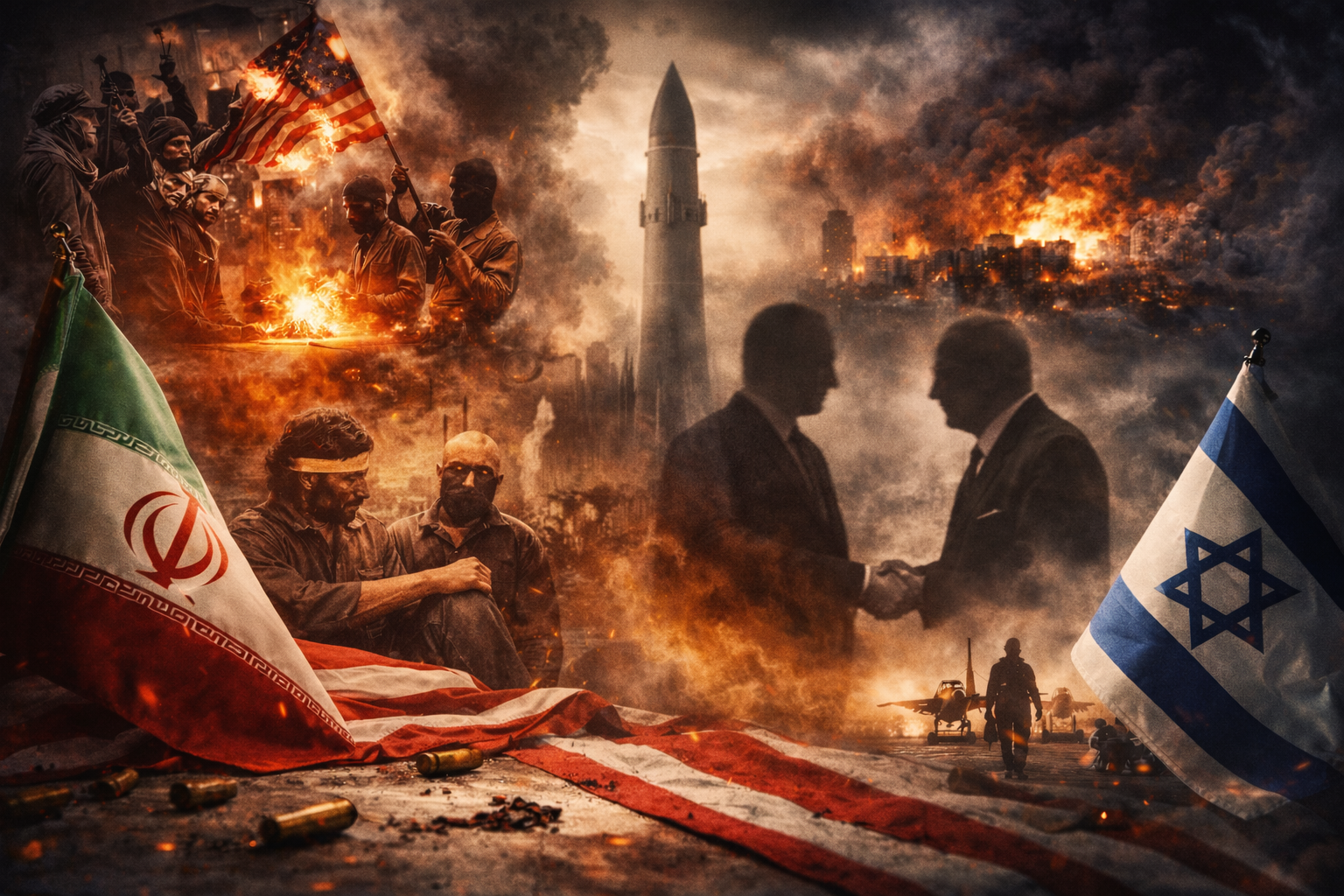
The Long Fuse: The History Behind Iran–Israel–U.S. Tensions
Revolution, Retaliation, and Red Lines: The History of Iran–Israel–U.S. Tensions
Three countries keep colliding around the same set of stakes: survival, control, and the fear of strategic surprise.
That collision is not just ideological. It is mechanical. Each side tries to deter the others, but no one trusts the enforcement system, and each crisis rewrites the “rules” for the next one.
In late February 2026, tensions escalated again into direct U.S.-Israeli strikes on Iran and Iranian retaliation against Israel and U.S. regional positions, underscoring how quickly the conflict can jump from shadow war to open exchange.
The hinge is not whether anyone wants a wider war. Most do not. The hinge is whether deterrence can function when every actor believes the other side benefits from ambiguity.
The story turns on whether credible limits can be restored before the next threshold is crossed.
Key Points
Iran–Israel–U.S. tensions are powered by competing survival narratives: Israel’s fear of strategic encirclement, Iran’s fear of regime strangulation, and America’s fear of nuclear proliferation and regional collapse.
The U.S.–Iran relationship carries deep “memory scars,” especially the 1953 coup and the 1979 hostage crisis, which hardened mistrust into policy defaults.
Israel and Iran spent years in a shadow war of sabotage, cyberattacks, and strikes on networks and personnel, often tied to Iran’s nuclear and missile programs.
The nuclear issue acts like a countdown timer: agreements slow it, withdrawals speed it, and each acceleration reshapes military planning and political risk.
The post-2023 regional environment made direct exchanges more likely, including Iran’s April 2024 mass drone and missile attack on Israel after the Damascus consulate strike.
When “red lines” are declared but inconsistently enforced, they become incentives to test. That is the engine that turns proxy conflict into open confrontation.
The modern triangle begins with two overlapping histories: Iran–U.S. distrust and Iran–Israel hostility, both intensified by Cold War choices and post-1979 ideology.
In 1953, the United States backed a coup that removed Iranian Prime Minister Mohammad Mossadegh, a formative episode in Iran’s political memory and a recurring reference point in its suspicion of U.S. intentions.
After 1979, the relationship snapped. Revolutionary students seized the U.S. embassy in Tehran and held American diplomats hostage for 444 days. The crisis poisoned diplomatic space for decades and embedded “humiliation and betrayal” narratives on both sides.
Israel’s relationship with Iran also transformed. Before 1979, Iran and Israel had quiet ties. After the revolution, the Islamic Republic positioned itself as a champion of “resistance” against Israel, supporting armed groups that threatened Israel’s borders and raising the stakes from rivalry to existential fear.
Through the 1980s and 1990s, the U.S. and Israel increasingly treated Iran as a sponsor of militant violence and regional instability, while Iran treated U.S. power in the region—bases, sanctions, alliances—as an architecture of containment aimed at regime change.
The nuclear file turned this into a durable strategic conflict. The 2015 Joint Comprehensive Plan of Action (JCPOA) constrained Iran’s nuclear program in exchange for sanctions relief, but the United States withdrew in May 2018 and reimposed sanctions, reopening the escalation cycle around enrichment, inspections, and “breakout” timelines.
From 2010 onward, Israel’s campaign expanded into a sustained shadow war: cyber operations, sabotage, targeted strikes, and efforts to disrupt Iran-linked networks across the region. Iran responded through proxy pathways and, increasingly, through more direct signaling.
A critical inflection came after October 2023’s Gaza war, which acted like a stress test for regional deterrence. On April 13–14, 2024, Iran launched a large-scale drone and missile attack on Israel in what it said was retaliation for the strike on its consulate compound in Damascus. That direct attack blurred the old boundary between proxy conflict and state-on-state exchange.
The legitimacy conflict: how each side frames survival and control
Israel’s strategic story is simple: a hostile state with advanced missiles and nuclear potential cannot be allowed to reach a point where deterrence fails in a single night. Even if Iran insists it does not seek a nuclear weapon, Israel’s planning is driven by the risk of catastrophic miscalculation.
Iran’s strategic story is also simple: the United States and Israel seek to constrain Iran permanently—economically, militarily, and politically—until the regime fractures. Sanctions are read not as policy tools but as instruments of internal pressure, which makes compromise feel like surrender.
The United States sits between them. It wants to prevent nuclear proliferation, keep energy flows stable, protect regional partners, and avoid another major Middle East war. Those aims often conflict, and each administration inherits the same constraints: domestic politics at home, alliance expectations abroad, and limited ability to shape Iranian internal decision-making.
The proxy pressure valve: why indirect war stops working
For years, proxies and partners served as a pressure valve. Iran could threaten Israel and U.S. forces without immediate direct war, and Israel could strike Iran-linked targets while avoiding full escalation.
But proxy systems create their own instability. They multiply actors, shorten response times, and blur authorship. That makes deterrence harder because the target is never fully clear: is the “real” opponent Tehran, a militia commander, a regional branch, or an opportunistic ally?
The result is an escalating signaling game. Each side uses calibrated force to send messages, but calibration becomes guesswork when audiences interpret the same act as either restraint or weakness. Shadow-war timelines show repeated cycles of action and counteraction tied to nuclear, missile, and operational capabilities.
The nuclear clock problem: how timelines replace diplomacy
The nuclear issue behaves like a clock because it can be measured: enrichment levels, centrifuge capacity, stockpiles, inspection access, and time to produce enough fissile material for a weapon, if a decision were made.
Agreements like the JCPOA (Joint Comprehensive Plan of Action) slow the clock and widen diplomatic space. Breakdowns speed it up and shrink choices. Once the perceived timeline compresses, military options gain political gravity because leaders fear waking up “too late.”
This is why nuclear negotiations are never only about uranium. They are also about credibility: whether constraints will hold, whether sanctions relief will arrive, whether inspectors can verify, and whether the next domestic political swing will reverse everything again.
The “red line” credibility gap: why deterrence becomes a dare
A “red line” is supposed to prevent action. But when red lines are repeatedly tested without consistent consequence, they mutate into dares. They invite probing behavior because each test can yield intelligence: how fast the opponent responds, what assets move, and what political statements signal appetite for risk.
This credibility gap is visible in how the conflict has repeatedly edged from covert disruption toward overt exchange, including large direct strikes and retaliation cycles in the mid-2020s and again in February 2026.
At that point, deterrence ceases to function as a barrier and transforms into a feedback loop. Each side believes it must act now to avoid worse choices later, which is how escalation becomes “rational” even when everyone fears the outcome.
The boundary-breaking moment: when shadow war turns into open strikes
The April 2024 Iranian strike on Israel was a boundary-breaking moment because it normalized direct state-to-state fire, even if most projectiles were intercepted and damage was limited.
Crossing that boundary establishes a new baseline for future crises, making direct retaliation a possibility. That makes later escalations easier to imagine, easier to justify domestically, and harder to stop quickly.
By late February 2026, direct exchanges escalated again, with major strikes and immediate retaliation, demonstrating how rapidly a “contained” confrontation can expand across borders, bases, and airspace.
What Most Coverage Misses
The hinge is deterrence without a referee: when no actor trusts the enforcement mechanism, each tries to create security through unilateral proof of capability.
That changes incentives in a specific way. Instead of trading concessions, each side trades demonstrations. Demonstrations are designed to be “limited,” but they still force responses, because the cost of seeming passive can be higher than the cost of escalation.
Two signposts would confirm this hinge in the coming days and weeks: first, whether future statements and deployments focus more on “restoring deterrence” than on specific negotiable terms; and second, whether verification language (inspectors, access, and measurable limits) loses priority to strike threats and retaliation promises.
What Happens Next
In the short term, the risk is rapid escalation through misread signals, because direct exchanges compress decision time and raise the chance of accidents, especially around regional bases and air defense systems.
In the medium term, the pressure point is the nuclear timeline, because leaders act differently when they believe they are approaching an irreversible threshold. This holds true even when public positions remain maximalist, as private planning necessitates the assumption of worst-case scenarios.
In the long term, the systemic risk is that each crisis "teaches" all sides the same lesson: force gets attention faster than diplomacy. That lesson becomes self-fulfilling, because it encourages more testing, more covert action, and more rapid escalation when the next shock arrives.
Because deterrence is a credibility game, the decisions to watch are the ones that shape credibility: concrete negotiation moves tied to verifiable limits, the scope and duration of military deployments, and whether both sides can create off-ramps that do not look like humiliation at home.
Real-World Impact
A shipping manager reroutes cargo as insurers raise premiums and routes become uncertain, even before any formal embargo is declared, because risk pricing moves faster than policy.
A family in a regional hub city checks alert apps nightly, not because they expect a strike tomorrow, but because the baseline has shifted from “unlikely” to “possible,” and that changes routines.
An energy-intensive manufacturer delays hiring and investment because price volatility and supply uncertainty make long-term contracts harder to sign.
A diaspora household watches relatives’ messages for hours after major strikes, because communications outages and rumors move faster than official confirmation.
The Lasting Risk: a region living on thresholds, not treaties
The Iran–Israel–U.S. triangle is not one conflict. It is a system: memory, ideology, capability, and incentives interacting under stress.
The pivotal point does not lie in choosing between peace and war. The question is whether the region relies on negotiated verification or on repeated demonstrations of force, each framed as "defense" and each raising the baseline for the next.
Watch the signposts that show which path is winning: measurable limits and inspections gaining political oxygen, or strike threats and retaliation vows dominating the language of leaders.
History will likely mark this era as the moment when the shadow-war model stopped containing risk—and when the Middle East’s most dangerous rivalry began testing the limits of confrontation.
