The Pen That Moves Washington: How Executive Orders Shape US Power
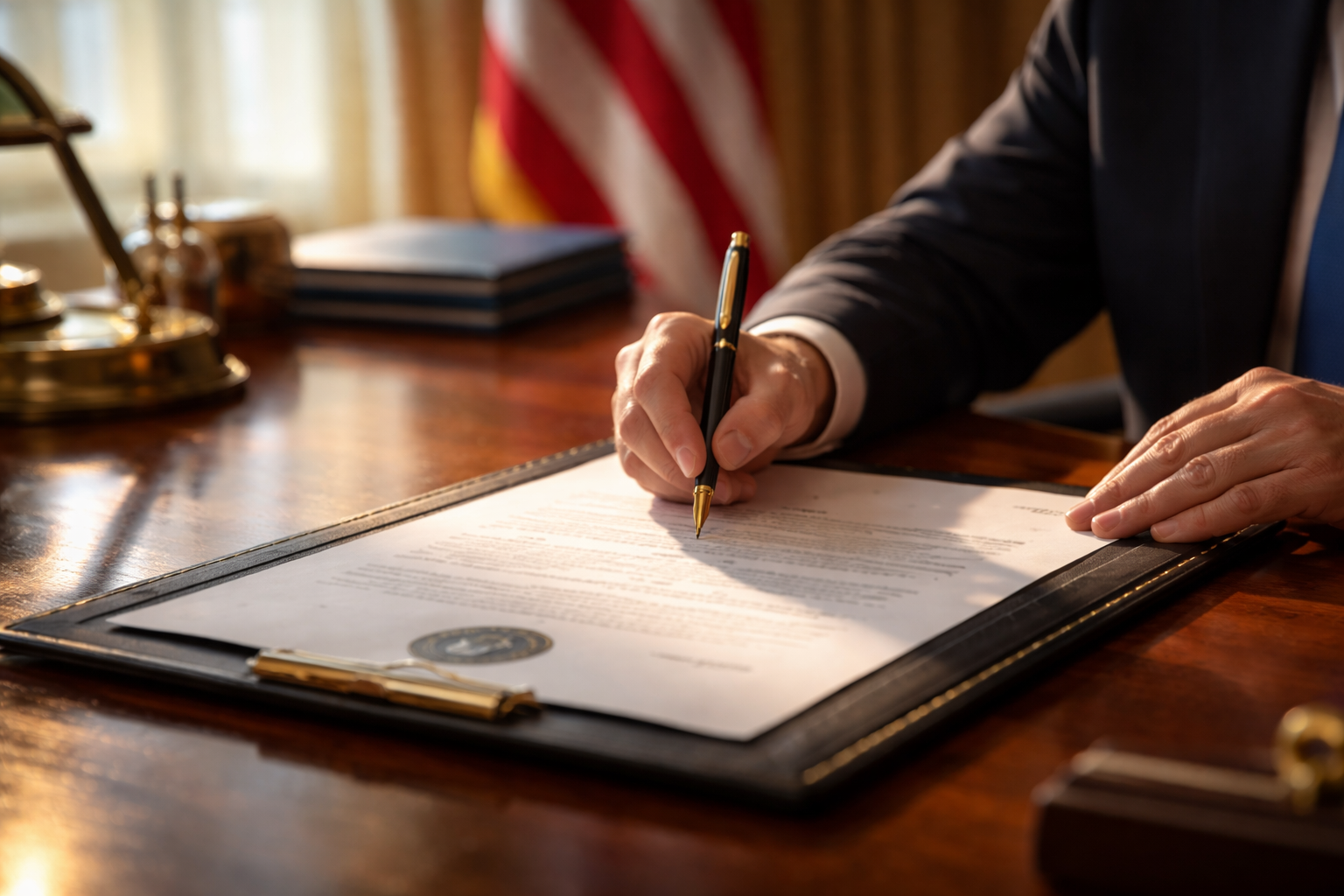
One Signature, National Impact: The Real Power of Executive Orders
How Presidents Change Policy Overnight With Executive Orders
In Washington, power often moves slowly. Laws must pass both houses of Congress, survive political bargaining, and clear constitutional hurdles. Yet presidents possess another tool that can reshape government policy almost instantly: the executive order.
An executive order is a formal directive signed by the President of the United States that instructs federal agencies and officials on how to carry out the law. These orders can change how government works overnight—redirecting policy, altering enforcement priorities, or responding to emergencies—without a new act of Congress.
But the authority behind executive orders is more complicated than the dramatic headlines suggest. They derive from the president’s constitutional duty to enforce existing laws and manage the federal government, not from a power to create new legislation.
The real debate is not whether executive orders are powerful. It is how far they can stretch before courts, Congress, or the Constitution push back.
The story turns on whether executive orders are a tool for executing laws—or a way to reshape policy without Congress.
Key Points
An executive order is a written directive from the US president instructing federal agencies on how to implement laws or manage government operations.
The authority comes primarily from Article II of the US Constitution, which grants the president executive power and the duty to enforce laws.
Executive orders can carry the force of law within the federal government, but they cannot create new laws or appropriate money.
Congress can override executive orders by passing legislation, while courts can strike them down if they violate the Constitution or statutory limits.
Presidents frequently use executive orders to move quickly on policy when legislation is slow or politically difficult.
A future president can revoke or amend executive orders issued by predecessors, making them powerful but often temporary tools.
Executive orders have existed since the earliest days of the United States. President George Washington issued directives to guide the new federal government, establishing the precedent for presidential instructions to the executive branch.
Despite their long history, the US Constitution does not explicitly mention executive orders. Instead, their authority is inferred from Article II, which vests “executive power” in the president and requires that the president ensure laws are faithfully executed.
In practice, this means the president can direct federal agencies—such as the Department of Defense, Department of Homeland Security, or Environmental Protection Agency—on how to interpret and enforce existing laws.
Executive orders are typically published in the Federal Register and remain in force until they are revoked, replaced, expire, or are ruled unlawful by courts.
Over time, presidents have used them for actions ranging from routine administrative changes to sweeping national policy decisions.
Historic examples include:
Desegregating the US military after World War II
Expanding workplace protections in federal contracting
Creating sanctions regimes against foreign governments
These examples illustrate how executive orders can significantly influence policy—even without new legislation.
Political and Geopolitical Dimensions
Political gridlock often necessitates the use of executive orders.
When Congress is divided or slow-moving, presidents may use executive action to demonstrate leadership or push policy priorities forward. Presidents have shaped immigration enforcement priorities, imposed sanctions on foreign states, and established environmental regulations through executive orders.
However, the political risk is evident: the next administration can reverse the orders issued by the previous one. This situation creates a cycle in which major policies swing with presidential elections.
Possible scenarios include:
Stable executive policy
Orders survive because courts uphold them and Congress does not intervene.
Signpost: few legal challenges and bipartisan acceptance.Judicial reversal
Courts strike down orders deemed unconstitutional or beyond statutory authority.
Signpost: rapid legal challenges from states or civil society groups.Legislative override
Congress passes a law reversing or limiting an executive action.
Signpost: bipartisan votes to curb presidential authority.
Economic and Market Impact
Executive orders can influence markets and industries almost immediately.
Because federal agencies regulate sectors such as energy, finance, healthcare, and trade, presidential directives can alter enforcement priorities or regulatory frameworks.
For example, orders affecting environmental regulation can change permitting timelines for energy projects. Orders involving trade or sanctions can reshape international supply chains within days.
Businesses closely monitor executive actions because they often signal how existing laws will be enforced—a crucial factor in regulatory compliance and investment decisions.
Social and Cultural Fallout
Executive orders also frequently touch politically sensitive areas of social policy.
Presidents have used them to address civil rights protections, federal workforce policies, immigration enforcement priorities, and public health responses.
Because these orders can rapidly affect millions of people—including government employees, contractors, and immigrants—they often trigger intense political debate.
Supporters consider executive orders essential leadership, especially when Congress is stagnant. Critics argue that relying heavily on them risks concentrating too much power in the presidency.
Technological and Security Implications
In recent decades, executive orders have become a central tool in national security policy.
Executive action often implements sanctions regimes, cyber defense policies, intelligence directives, and emergency powers.
This reflects the president’s constitutional role as commander in chief of the armed forces and chief executive responsible for foreign policy operations.
However, even in national security contexts, executive orders remain subject to judicial review if they exceed constitutional or statutory authority.
What Most Coverage Misses
The most important constraint on executive orders is not political—it is legal.
Every executive order must rest on an existing legal foundation. That foundation can come from two places: powers granted directly by the Constitution or authority delegated by Congress through legislation.
If neither exists, the court may strike down the order.
A landmark Supreme Court decision in 1952 established this principle when the Court ruled that President Harry Truman lacked authority to seize steel mills during a labor dispute. The ruling made clear that presidential orders must derive from either statutory authority or constitutional power.
This legal framework clarifies why executive orders may appear sweeping, yet they meticulously align their authority with existing laws.
In other words, executive orders do not create new presidential power. They push the limits of existing power.
Why This Matters
Executive orders shape how the US government operates on a daily basis.
In the short term, they allow presidents to move quickly—responding to crises, implementing policy priorities, or directing agencies without waiting for Congress.
In the longer term, heavy reliance on executive orders can shift the balance of power between the presidency and the legislature.
Key developments to watch include:
Court rulings on controversial executive orders
Congressional attempts to limit executive authority
New administrations reversing prior executive actions
These battles help define how much unilateral authority future presidents will have.
Real-World Impact
A federal agency employee receives new guidance instructing them to enforce environmental regulations differently after a presidential order changes enforcement priorities.
A defense contractor adjusts compliance procedures because an executive order introduces new cybersecurity requirements for federal suppliers.
An immigration officer shifts enforcement focus following an order redefining deportation priorities.
A multinational company reevaluates trade exposure after a presidential order imposes sanctions on a foreign industry.
The Future of Presidential Power
Executive orders remain one of the most visible tools of presidential authority—quick, dramatic, and politically powerful.
Yet they exist within a system designed to limit unilateral rule.
Courts can strike them down. Congress can legislate around them. Future presidents have the power to eliminate them with a simple signature.
This creates a paradox at the core of American governance: while executive orders can quickly alter policy, their longevity is contingent on the broader constitutional balance of power.
And that balance ultimately determines whether presidential power expands—or snaps back.
