

The Moon Landing: Hoax, Myth, or Misunderstood History?
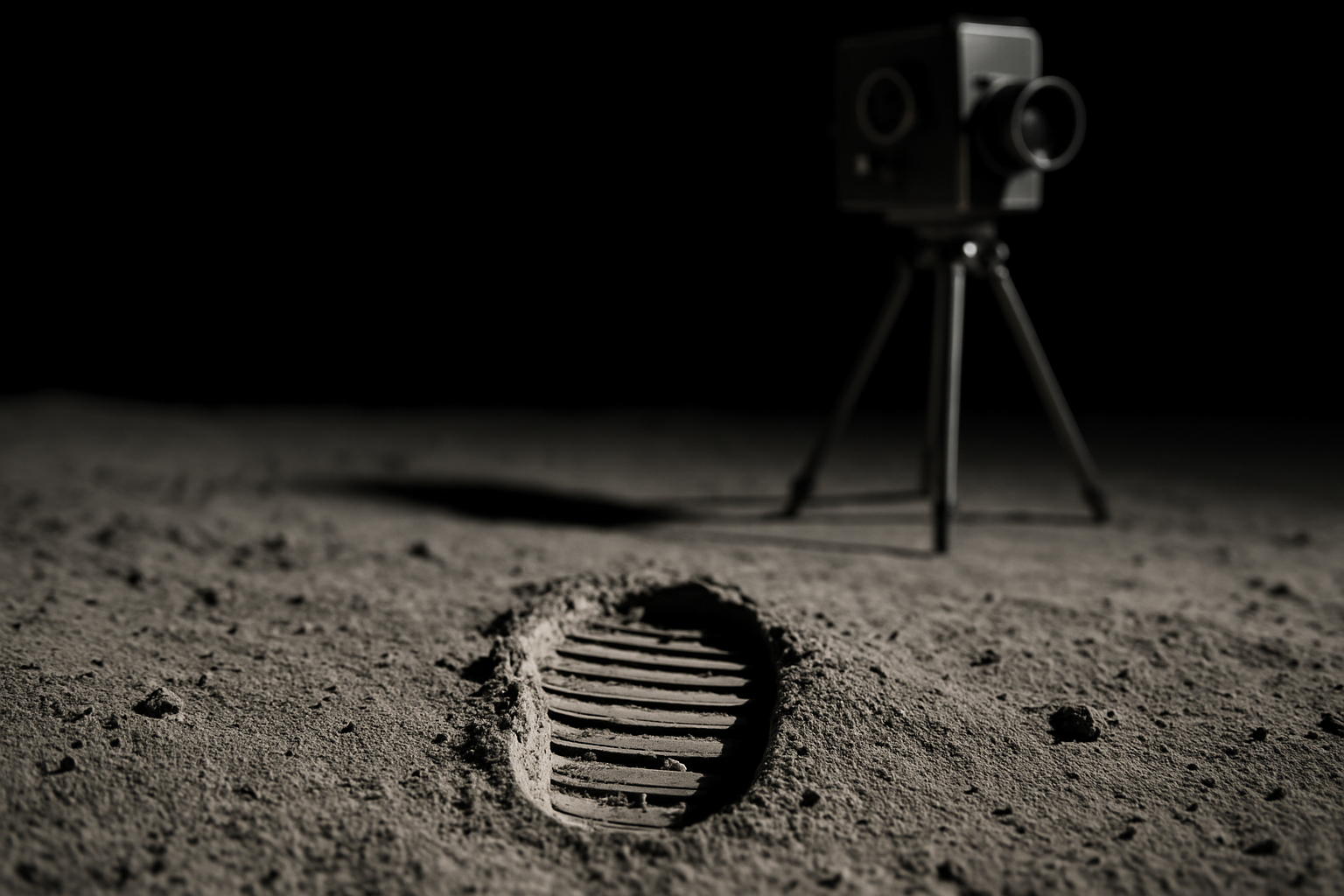
Humanity’s first steps on the Moon in July 1969 are among the most replayed images in modern history. Yet more than fifty years later, a persistent minority still insists the Moon landing was a hoax staged on a soundstage rather than the Sea of Tranquility. The argument now lives on in YouTube rabbit holes, TikTok clips, and late-night forum threads.
At the heart of the debate is a collision between two instincts: trust in large, complex scientific projects versus suspicion of governments, media, and institutions that have lied before. For some, Apollo 11 is proof of what coordinated effort can achieve; for others, it is the ultimate symbol of how easily the public can be fooled.
This article unpacks where Moon landing hoax claims came from, what evidence actually exists, and why the controversy has refused to die. It sets the political stakes of the space race, explores how conspiracy thinking spreads, and looks at what the argument reveals about the modern information ecosystem.
By the end, the reader can see why the Moon landing remains settled history for scientists and engineers, yet still unsettled territory in the culture wars over truth.
The story turns on whether a small set of doubts can outweigh a vast, messy, but remarkably consistent body of evidence.
Key Points
Apollo 11’s Moon landing in 1969 is one of the best-documented events in modern history, yet hoax claims have lingered since the 1970s.
Surveys over the years show a small but persistent minority of people, in several countries, who doubt the landings really happened.
Hoax theories often focus on photos, flags, and shadows, while largely ignoring engineering records, telemetry, and independent tracking data.
The Cold War space race made the Moon landing intensely political, but also made faking it extraordinarily risky and hard to conceal.
Today, social media, influencer culture, and distrust of institutions help keep Moon landing hoax narratives alive.
The debate is less about what happened in 1969 and more about how people decide what to believe in a world flooded with information.
Background
On July 20, 1969, the Apollo 11 mission placed Neil Armstrong and Buzz Aldrin on the surface of the Moon, while Michael Collins orbited above. The mission was the culmination of a crash program launched in the early 1960s, when the United States and the Soviet Union were locked in a high-stakes struggle for technological and ideological prestige.
The Apollo program involved hundreds of thousands of workers across multiple contractors and agencies, from rocket engineers and test pilots to seamstresses who hand-stitched spacesuit layers. Decades of rocketry research, navigation work, and human spaceflight experiments fed into the Saturn V launches that sent astronauts to lunar orbit and back.
The Moon landing was broadcast live to audiences around the world. Amateur radio operators tracked the signals. Observatories followed the spacecraft. The mission returned photographs, film, telemetry data, and hundreds of kilograms of lunar rock and soil, which have been studied in labs across many countries.
Moon landing hoax claims began to appear more prominently in the 1970s, as the high drama of the space race faded and public trust in government was shaken by scandals and wars. Self-styled investigators pointed to unfamiliar details in Apollo photographs and videos—the behavior of the American flag, the absence of stars in the sky, the odd look of shadows on the lunar surface—and argued that these anomalies proved the landings were staged.
Over time, scientists, engineers, photographers, and space historians have answered these claims in detail. Many of the alleged “mysteries” are explained by basic physics, camera settings, or the unusual conditions on the Moon. Nonetheless, the idea that the Moon landing might have been faked has become part of the wider constellation of modern conspiracy narratives, sitting alongside debates over assassinations, secret programs, and more recent events.
Analysis
Political and Geopolitical Dimensions
The Moon landing was not just a scientific milestone. It was a Cold War move, carried out in public, under the gaze of a rival superpower that had every incentive to expose a fraud if it could.
The United States and the Soviet Union were racing for strategic and symbolic advantage. Early in the space age, the Soviet side had scored major firsts with the first satellite, the first man in orbit, and other visible successes. Landing humans on the Moon was a way for the United States to reclaim prestige and signal technological superiority.
In that context, a faked Moon landing would have been a geopolitical gamble of extraordinary scale. Soviet tracking stations monitored Apollo missions, as did other nations and independent observers. Any serious discrepancy would have been a propaganda gift. Instead, Soviet scientists studied lunar samples and incorporated Apollo data into their own understanding of the Moon.
Today, the politics of the Moon landing debate look different. The event itself is settled, but the way people talk about it has become a proxy for wider attitudes to authority, expertise, and the state. Those who already distrust governments or global institutions find it easier to believe they would fake a Moon landing; those who see science-driven collaboration as a force for good tend to view hoax narratives as part of a larger pattern of destabilizing misinformation.
As new space powers emerge and commercial players push toward lunar missions, the Apollo story remains a reference point—either as a heroic achievement to emulate or, for skeptics, as a symbol of elite manipulation.
Economic and Market Impact
The Apollo program was one of the most expensive peacetime projects in history, costing tens of billions of dollars at the time. The spending funded aerospace firms, electronics makers, universities, and a vast supporting supply chain. It also generated technological spin-offs that filtered into sectors from computing to materials science.
If the Moon landing had been faked, all of that funding would still have flowed. However, the economic logic would have looked very different. A secret studio production would have required far fewer people and far less hardware than the actual program, but it would also have offered far fewer concrete technological returns. The huge investment in real rockets and real engineering only makes sense if the goal was to actually reach the Moon.
In the decades since, a smaller but noticeable economy has grown up around Moon landing skepticism itself. Books, documentaries, merchandise, lectures, and online channels that question Apollo draw audiences and, in some cases, revenue. The Moon landing hoax narrative has become a content category, competing with mainstream science communication for attention and advertising.
As space once again becomes a commercial arena—with private companies planning Moon missions and lunar infrastructure—the legacy of Apollo functions as both a marketing tool and a benchmark. Firms highlight their links to Apollo-era expertise or stress how new technologies have moved beyond it. In that sense, belief in the reality of the Moon landings remains economically relevant: it underpins the value of brand stories built on that heritage.
Social and Cultural Fallout
Culturally, the Moon landing is remembered as a collective high point: people gathered around televisions, radios, and public screens, sharing a sense of global awe. But that memory has to coexist with a later era in which trust in media and institutions has eroded.
Moon landing hoax theories feed on that gap. They offer a story in which the viewer is no longer a spectator to a shared triumph but a detective, spotting clues that others missed. The appeal is emotional as much as intellectual: it is about feeling clever, skeptical, and independent.
Schools, museums, and science communicators now operate in an environment where some students and visitors arrive already exposed to doubt. A teacher explaining Apollo might find a student waving a phone clip that questions the flag’s motion. A museum curator designing an exhibit has to decide whether to address hoax theories directly or simply present the evidence and move on.
Online, Moon landing content is part of a broader ecosystem in which recommended videos, algorithmic feeds, and influencer commentary can nudge curious viewers from mainstream history toward more speculative or fringe material. Once someone enters a general “conspiracy” pipeline, the Moon landing becomes one stop among many, and the specific facts matter less than the feeling that “they” are hiding things.
Technological and Security Implications
Technologically, the Moon landings produced tangible physical evidence: hardware left on the surface, retroreflectors used in laser ranging experiments, and samples studied by geologists. They also drove advances in computing, navigation, and telecommunications.
Yet hoax narratives have steadily shifted away from these hard-to-fake elements toward softer targets: photographs, film footage, and televised images. Pictures are easier to argue over than engineering logs or lunar rock chemistry. That shift has become even more significant as photo and video manipulation tools have grown more powerful and more accessible.
In a world of deepfakes and synthetic media, the idea that famous images might be staged no longer feels purely speculative. For some, the existence of modern fakery is retroactively used to argue that Apollo footage could have been faked as well, even though the technology and infrastructure needed in the late 1960s would have been vastly more complex and easier to detect.
From a security perspective, the persistence of Moon landing hoax beliefs is a warning sign. If a well-documented, decades-old event can be recast as suspicious in the minds of millions, more recent events with less archival depth are even more vulnerable. The Moon landing debate shows how historical achievements can be pulled into contemporary information conflicts, affecting public resilience to disinformation and propaganda in other domains.
What Most Coverage Misses
Much coverage of Moon landing hoax theories treats the issue as a simple battle between facts and falsehoods: scientists present evidence, skeptics deny it, and the solution is assumed to be better explanations. That frame misses a key point.
For many believers, the hoax narrative is not really about the Moon at all. It is about a deep emotional logic: large institutions feel distant and opaque; media narratives feel polished and sometimes self-serving; past scandals have shown that governments can and do lie. Within that emotional landscape, the idea that something as grand as a Moon landing might be fake fits an existing template of suspicion.
Another overlooked element is scale. The real Apollo effort was diffuse, with thousands of people each contributing a small piece. In contrast, the hoax story is often told as if a handful of powerful insiders controlled everything. That simpler story can feel more intuitive, even though it requires believing that vast numbers of engineers, technicians, and ordinary workers either lied or were somehow fooled without leaving a trace.
Recognizing these psychological and social dynamics does not mean conceding any ground on the historical facts. It does, however, suggest that the Moon landing debate will not vanish simply through another technical rebuttal. It is tied to wider questions about how people form identity and loyalty in an era of overload and mistrust.
Why This Matters
The Moon landing debate affects several groups in different ways. Educators and scientists must navigate classrooms and audiences where baseline agreement on major historical events can no longer be assumed. Media organizations and cultural institutions grapple with how to present scientific achievements to audiences that may be primed to doubt them.
In the short term, Moon landing hoax narratives might seem like a niche curiosity. But they are part of a larger pattern in which people question elections, public health campaigns, climate science, or international agreements with similar arguments and rhetorical tools. The way society responds to relatively stable, well-documented historical events sets the tone for how it will handle contested, fast-moving crises.
Over the longer term, as new lunar missions are planned and more countries and companies head for the Moon, the Apollo story is likely to be replayed and reinterpreted. Some will use it to inspire investment and cooperation; others will fold it into broader narratives of deception and control.
Developments to watch include upcoming crewed missions back to lunar orbit and, eventually, the surface; the release of new high-resolution data from lunar orbiters; and education initiatives that combine history, media literacy, and basic physics. How these are received will signal whether trust in shared reality is stabilizing or fraying further.
Real-World Impact
A physics teacher in a midwestern American town prepares a lesson on space exploration. Before class even begins, a student raises a hand and asks whether the Moon landing was faked, quoting a video seen the night before. The teacher now has to decide whether to spend precious time debunking, risk ignoring the question, or try to fold it into a broader discussion of evidence and skepticism.
A freelance video editor in Europe earns part of a living cutting clips for an online channel that mixes genuine space footage with speculative commentary. The editor senses that some of the material misleads viewers about Apollo but also relies on the income. The line between entertainment, curiosity, and misinformation becomes blurred.
A parent scrolling through social media notices that their teenager is following accounts promoting a range of conspiracies, including Moon landing hoax content. The parent faces a familiar modern dilemma: confront the issue directly and risk a defensive reaction, or try to model critical thinking more indirectly.
A small aerospace start-up pitching investors uses Apollo as a case study in how ambitious technological projects can succeed. At the same time, its communications team has to plan for the possibility that some online commentators will question any dramatic footage the company releases, given the wider culture of skepticism.
Legacy
The conflict over the Moon landing is often framed as a simple clash between truth and lies, science and superstition. In practice, it is a more complicated collision between detailed, cumulative evidence and powerful, emotionally satisfying stories of hidden control.
On one side is the messy reality of the Apollo program: overworked engineers, incremental tests, political compromises, and a final, risky mission that left hardware and footprints on another world. On the other side is a tidy narrative of staged sets, clever camera tricks, and a small circle of masterminds who fooled everyone else.
The road ahead depends less on rediscovering new evidence from 1969 and more on strengthening the habits that let people weigh claims today: checking sources, understanding basic scientific reasoning, and recognizing how algorithms and incentives shape what appears in their feeds.
Signals to watch include whether future polls show growing or shrinking doubt about historic events like Apollo; how upcoming Moon missions are framed and debated online; and whether schools and public institutions find effective ways to discuss conspiracies without amplifying them.
The Moon landing itself is settled history, but the struggle over what it represents—to science, to politics, and to the public’s sense of reality—is still very much underway.
Meta description: Did the Moon landing really happen, or was it a hoax? This deep dive into Moon landing hoax claims and evidence cuts through myth, politics, and mistrust.
