The Most Powerful People Who Ever Lived Ranked — And Who Holds Power Today
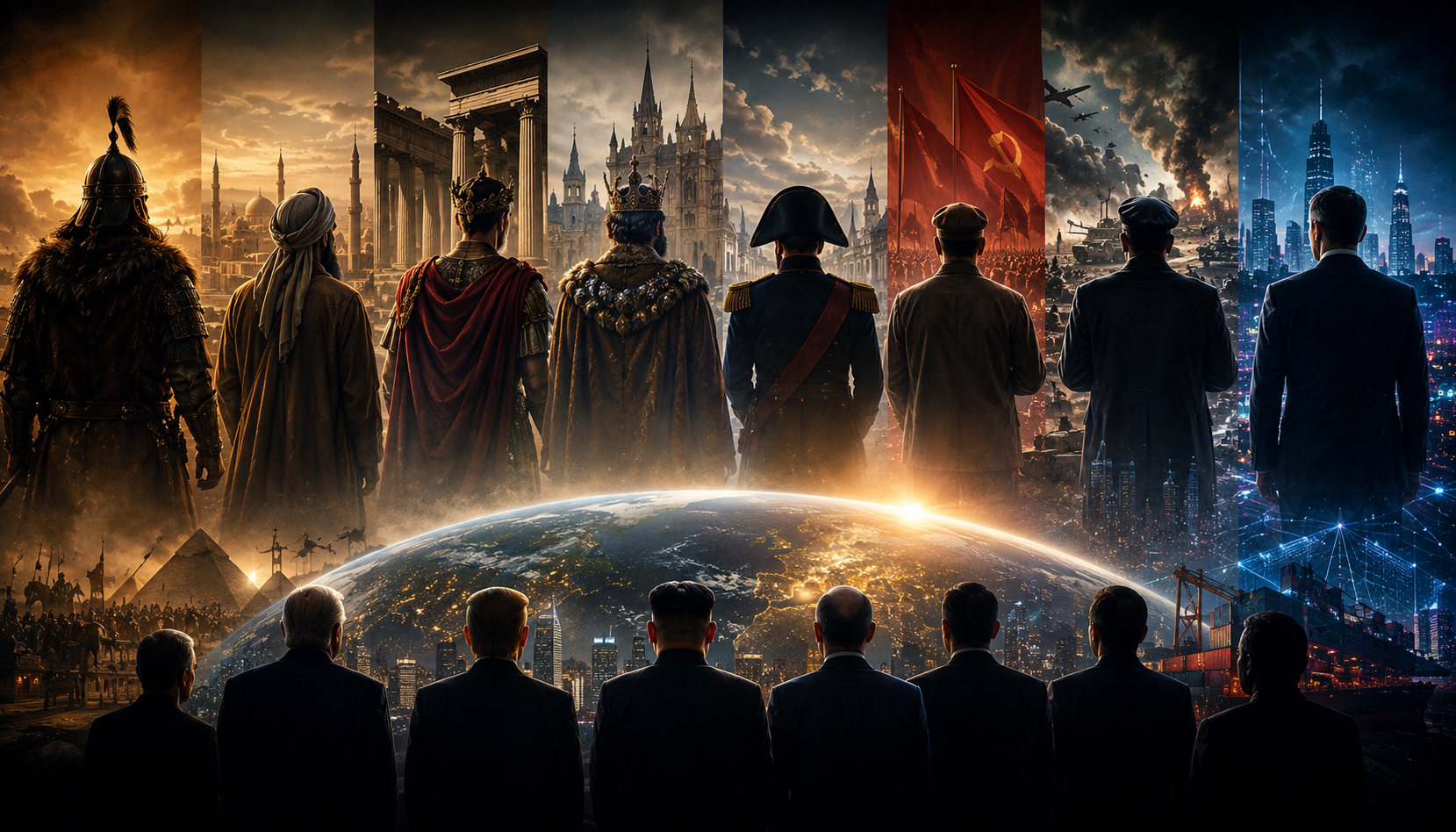
The Leaders Who Changed The World Forever Ranked
The People Who Bent The World To Their Will
Power is not the same as fame. Some people are remembered because they were admired, some because they were feared, and some because the world they created is still impossible to escape.
This ranking is not about who was the most moral, popular, rich, intelligent or beloved. It is about raw historical consequence: who commanded the most people, redirected the biggest institutions, founded the most durable systems, triggered the greatest upheavals, or left behind an order that survived long after their body was gone.
That is why ancient conquerors can rank beside prophets, dictators beside lawgivers, and emperors beside revolutionaries. It is also why modern leaders such as Donald Trump, Xi Jinping and Vladimir Putin matter to the debate without automatically outranking the giants of history. Today’s most powerful people command states, armies, nuclear weapons, economies, intelligence systems and global alliances, but the highest places still belong to those whose power survived their lifetime.
The uncomfortable truth is that human history has often been shaped less by goodness than by the ability to impose a vision on millions of people at once. Some did it through faith. Some through terror. Some through law, empire, revolution or conquest. The result is a ranking where moral judgment and historical consequence cannot be treated as the same thing.
What Counts As Real Power?
Real power has three parts: control, reach and afterlife. Control means the ability to command armies, governments, wealth, law or belief during a lifetime. Reach means how far that command travelled across territory, population and institutions. Afterlife means whether the person’s decisions still shape the world after their death.
That is why this list does not simply rank the biggest empires by landmass. It also weighs religious authority, state-building, legal systems, military shock, ideological spread and civilisational inheritance. Genghis Khan controlled an empire-building machine. Muhammad founded a religious and political order. Qin Shi Huang created the imperial template for China. Augustus made monarchy acceptable inside a republic that claimed to hate kings.
The ranking is necessarily arguable, but the criteria are clear. The highest places go to people whose power was not merely personal, but structural. They did not just rule a country. They created a new operating system for civilisation.
20. Queen Victoria
Queen Victoria was not an absolute ruler in the way ancient emperors were, but symbolic power can still be enormous when attached to the largest empire of the age. Her reign from 1837 to 1901 coincided with British imperial expansion, industrial dominance, global trade routes and the consolidation of the monarchy as a national and imperial symbol.
Victoria’s power was constitutional, not autocratic. She could influence ministers, family diplomacy and imperial image, but she did not personally direct every act of empire. That limits her rank.
Her importance lies in what she represented. Under Victoria, monarchy became less about personal command and more about institutional legitimacy, imperial identity and public theatre. Her name became an era, and few rulers can claim that.
She sits at the edge of this list because her personal power was smaller than the empire attached to her. But power is not always a sword in the hand. Sometimes it is a crown that gives a vast system its face.
19. George Washington
George Washington’s power came partly from command and partly from restraint. He led the Continental Army through the American Revolutionary War and became the first president of the United States, setting precedents for executive authority, peaceful transition and civilian control of the military.
Washington could have tried to turn military victory into personal rule. Instead, his refusal to become a monarch gave the American presidency a different foundation. That decision shaped not only the United States, but the modern idea that executive power could be limited without becoming weak.
He ranks below empire-builders because his direct territorial command was smaller. He ranks on the list because he helped create the political machine that later became the most powerful state on Earth.
His power was not the power of domination. It was the power of precedent. In a list filled with conquerors, dictators and emperors, Washington matters because he proved that giving power away could shape history as much as seizing it.
18. Vladimir Lenin
Lenin did not rule as long as Stalin, but he detonated one of the most consequential political transformations in modern history. He converted revolutionary theory into a one-party state, helped destroy the old Russian order, and built the structure from which the Soviet Union emerged.
His power was compressed but explosive. In a few years, he helped transform Russia from an imperial monarchy into a revolutionary state that would shape the twentieth century, global communism, the Cold War and anti-colonial movements.
Lenin ranks below Stalin because Stalin controlled the Soviet machine for longer and on a larger coercive scale. But Lenin built the machine. Without Lenin, the ideological geography of the modern world looks entirely different.
His place on this list comes from ignition rather than duration. Lenin did not simply win a revolution. He created a template for revolutionary rule that travelled far beyond Russia.
17. Constantine The Great
Constantine’s power came from joining imperial authority to religious transformation. As Roman emperor, he did not create Christianity, but he changed its legal and political position inside the Roman world. The Edict of Milan in 313 helped give Christianity legal recognition and marked a decisive shift in imperial policy toward Christians, even though Christianity became the Roman state religion later, under Theodosius.
That makes Constantine one of history’s great hinge figures. He sat at the point where empire, law, religion and legitimacy began to move together in a new direction. The consequences reached into medieval Europe, the Byzantine world, church-state politics and the identity of Western civilisation.
He ranks below the founders of the great religious traditions because he inherited Christianity rather than originating it. But few rulers ever changed the political destiny of a faith so dramatically.
Constantine’s power was not simply that he ruled Rome. It was that he helped redirect the spiritual future of Rome. That decision outlived his dynasty, his capital and the empire he tried to hold together.
16. Ashoka
Ashoka ruled the Mauryan Empire in India and became one of history’s most striking examples of power redirected after conquest. His reign matters because he combined imperial control with religious and moral messaging, using inscriptions and state authority to project Buddhist-influenced principles across a vast empire.
His power was not only military. It was administrative, ethical and cultural. He helped give Buddhism a broader political platform and showed how an empire could use moral language as a tool of rule.
Ashoka ranks here because his influence was huge but regionally more bounded than the highest figures. Even so, he remains one of the rare rulers whose legacy rests as much on renunciation and law as on conquest.
That makes him unusual in a ranking dominated by expansion. Ashoka’s power came not only from what he conquered, but from what he claimed conquest had taught him.
15. Cyrus The Great
Cyrus founded the Achaemenid Persian Empire and built one of the ancient world’s great imperial systems. He defeated major powers, absorbed older civilisations of the Near East, and created a model of rule that could govern different peoples, languages and traditions under one imperial roof.
His power was not only expansionist. It was integrative. Cyrus helped pioneer an imperial style that did not simply erase conquered peoples, but often absorbed and managed them.
That administrative genius is why he remains more than a battlefield name. He belongs in the ranking because he helped define empire as a system, not just a raid.
Cyrus matters because he understood scale. Conquest can win a capital. Administration keeps it. His empire became one of the great models of ancient imperial rule because it could hold difference together under command.
14. Charlemagne
Charlemagne turned Frankish kingship into imperial revival. Crowned emperor in 800, he fused conquest, Christianity, law, education and royal authority into a new Western European order. His empire did not survive intact, but its memory shaped medieval politics for centuries.
His power lay in reconstruction. After the collapse of the Western Roman Empire, Charlemagne offered Europe a new model of Christian kingship and imperial legitimacy. The Holy Roman Empire, medieval monarchy and later European political imagination all drew from that inheritance.
He ranks below Augustus and Constantine because they stood closer to the source of Roman imperial power. But Charlemagne deserves his place because he made empire imaginable again in Western Europe.
His legacy was not one clean state. It was a political idea: that Europe could be reordered around Christian imperial authority. That idea kept returning long after his empire fractured.
13. Suleiman The Magnificent
Suleiman ruled the Ottoman Empire at one of its peaks. His authority stretched across military command, law, religion, diplomacy and architecture. Under him, Ottoman power pressed deep into Europe, dominated the eastern Mediterranean and projected Islamic imperial authority across three continents.
His rank rests on scale and sophistication. Suleiman was not just a conqueror. He was a lawgiver and administrator whose reign became a high point of Ottoman prestige.
He does not rank higher because the Ottoman system preceded him and survived through institutions larger than one man. But as a peak ruler of one of the most formidable empires in history, his power was immense.
Suleiman represents the power of a mature imperial machine at full confidence. He did not found the Ottoman state, but he gave it one of its most dazzling moments of reach, authority and cultural force.
12. Julius Caesar
Julius Caesar never became emperor in the formal later sense, but he broke the Roman Republic so thoroughly that monarchy became almost inevitable. He conquered Gaul, defeated Pompey, crossed the Rubicon and became dictator for life before his assassination in 44 BCE.
Caesar’s power was personal, military and theatrical. He understood that armies, money, public image and political timing could overpower constitutional tradition. His murder was meant to save the Republic, but it instead accelerated the struggle that ended it.
He ranks below Augustus because Augustus completed what Caesar made possible. Caesar was the rupture. Augustus was the system.
His importance lies in the fact that he exposed the Republic’s weakness. Once Rome had seen one man gather that much military loyalty, wealth and public devotion, the old order could not fully recover.
11. Napoleon Bonaparte
Napoleon rose from revolutionary chaos to become emperor of France and the dominant military figure in Europe. He conquered or controlled much of the continent, redrew borders, exported legal reforms and forced every major European power to react to him.
His power was spectacular but unstable. Napoleon could defeat coalitions, create client states and impose law, but he could not make his empire permanent. His greatest victories produced fear; his defeats produced a new European balance.
Still, few individuals have bent an entire continent around their ambition so visibly. Napoleon ranks high because he proved that modern power could come from speed, merit, propaganda, law and war at once.
He was not merely a general. He was a political system in motion. Even after his defeat, Europe had to reorganise itself around the memory of what one man had nearly done.
10. Alexander The Great
Alexander created one of history’s most astonishing military records. Starting as king of Macedon, he overthrew the Persian Empire, conquered Egypt, pushed into Central Asia and reached the Indian subcontinent before his death at thirty-two.
Alexander’s limitation is durability. He conquered faster than he could institutionalise. After his death, his empire fragmented among his successors.
But power is not only measured by how long a state survives. Alexander spread Greek language, cities, military models and cultural exchange across a vast zone. His personal power burned briefly, but the shockwave lasted centuries.
He ranks this high because almost no one changed the map so quickly at such a young age. Alexander’s life was short, but his conquests opened the Hellenistic world and changed the cultural bloodstream of Eurasia.
9. Adolf Hitler
Hitler’s inclusion is not admiration. It is recognition of catastrophic power. As dictator of Nazi Germany, he unleashed the Second World War in Europe, built a totalitarian state, drove genocidal policy, and caused destruction on a scale that still defines modern moral and political memory.
His power was ideological, military and murderous. He controlled a modern state, mobilised mass propaganda, destroyed democratic institutions and pulled much of the world into war.
He ranks below Stalin and Mao because his rule was shorter and ended in total defeat. But the scale of destruction he caused makes him one of the most powerful and dangerous people who ever lived.
Hitler shows the darkest version of modern power: the ability of one leader to fuse grievance, bureaucracy, technology, propaganda and mass violence into a system of catastrophe. His legacy is not durability in office. It is the permanent warning his regime left behind.
8. Mao Zedong
Mao Zedong founded the People’s Republic of China and ruled the world’s most populous country through revolution, civil war, mass mobilisation and ideological campaigns. His power reached into land ownership, class identity, education, party loyalty, language and the relationship between the individual and the state.
Mao’s power was enormous because it reached deep into daily life. He did not merely control government. He reshaped society from above and demanded ideological participation from below.
His legacy is still central to Chinese state identity, even where later leaders moved away from parts of his programme. Mao ranks above Hitler because his regime lasted longer, governed a larger population and left a still-existing state structure behind.
His place on this list is not based on economic success or moral approval. It is based on scale. Few modern leaders have imposed themselves so deeply on such a vast population.
7. Joseph Stalin
Stalin controlled the Soviet Union from the 1920s until his death in 1953 and turned it into an industrial, military and ideological superpower at immense human cost. He oversaw forced collectivisation, purges, wartime mobilisation and the Soviet role in defeating Nazi Germany before shaping the opening structure of the Cold War.
His power was terrifying because it combined bureaucracy with fear. Stalin did not need charisma alone; he built a system in which party machinery, secret police, planning targets and ideological suspicion made power permanent.
He ranks above Mao only narrowly because Stalin’s decisions directly shaped the outcome of the Second World War and the division of Europe. But both men show the same brutal lesson: modern states can make one person’s will industrial in scale.
Stalin’s power did not stop at Soviet borders. It shaped Eastern Europe, nuclear rivalry, communist movements and the global structure of the twentieth century. His shadow was geopolitical as well as domestic.
6. Qin Shi Huang
Qin Shi Huang unified China in 221 BCE and became its first emperor. His reign standardised law, administration, weights, measures, writing and imperial authority, creating a centralised model that influenced Chinese rule for more than two thousand years.
His power was foundational. Before Qin Shi Huang, China was a field of rival states. After him, unity under an emperor became the political ideal that later dynasties inherited, restored or claimed.
He ranks this high because he created one of history’s most durable state templates. His dynasty was short. His model was not.
That is the difference between a ruler and a founder. Qin Shi Huang’s personal regime was harsh and brief, but the idea he imposed — one China, centralised, bureaucratic, imperial — became one of the most important political ideas in world history.
5. Augustus
Augustus was the man who made Roman autocracy look like restoration. After civil war, he became Rome’s first emperor and ruled from 27 BCE to 14 CE, founding the imperial system that shaped the Mediterranean world for centuries.
His genius was political disguise. Caesar had made monarchy too obvious and was killed. Augustus kept republican forms while holding real command over army, provinces, money and succession.
That made him one of the most effective power operators in history. He did not just seize authority. He made a new regime feel legitimate enough to survive.
Augustus ranks above Caesar because he turned disruption into permanence. He understood that the strongest power is sometimes the power that hides its own revolution.
4. Jesus Of Nazareth
Jesus did not command armies, rule a state or hold office. During his lifetime, his direct political power was tiny compared with emperors and conquerors. Yet judged by historical afterlife, few people have ever had greater influence.
Christianity grew from a persecuted religious movement into a world religion, shaping empires, law, art, education, morality, colonisation, reform movements, wars and political legitimacy. Its influence reached far beyond theology, becoming one of the central forces in the formation of Europe, the Americas and much of global history.
He ranks below Muhammad because Muhammad combined spiritual authority with direct political leadership in his own lifetime. But Jesus ranks above most emperors because no empire on this list escaped the long shadow of religion, and Christianity became one of the most powerful forces in human history.
Jesus is the clearest example of power without office. He did not rule the Roman world. Over time, the Roman world and much of what followed had to reckon with him.
3. Muhammad
Muhammad ranks above almost every emperor because his power was spiritual, political, legal, military and civilisational. Born in Mecca around 570, he founded Islam, built a community in Medina, united much of Arabia under a new religious order, and left behind a movement that rapidly became imperial after his death.
His power had an unusually complete structure. He was not only a preacher. He became a lawgiver, statesman, commander and model of conduct for a community that continued expanding after him.
That combination explains his rank. Many rulers built empires. Muhammad founded a civilisation-scale religious and political order that still structures the lives of well over a billion people.
He ranks this high because his influence operated on multiple levels at once. Faith, law, politics, community, language, identity and empire all moved through his legacy. Few lives have produced a wider historical afterlife.
2. Genghis Khan
Genghis Khan may be the greatest conqueror in history. In 1206, he united the Mongol tribes and launched an expansion that created the largest contiguous land empire ever known.
His power was brutally practical. He turned steppe mobility, discipline, intelligence gathering, terror, adaptation and meritocratic command into a war machine that shattered older kingdoms. His empire linked East and West, transformed trade routes, spread technologies and devastated populations.
He ranks near the top because his direct personal impact was enormous. Few individuals have ever changed the map so quickly. But his empire fragmented, and that keeps him just below the highest form of power: the kind that changes the world without needing one continuous empire to survive.
Genghis Khan’s power was the purest form of conquest on this list. If the ranking measured only the ability to impose will by force across land, he would have the strongest claim to number one.
1. Muhammad
The most powerful person who ever lived depends on whether power means direct command or lasting consequence. If it means command, Genghis Khan has the strongest claim. If it means civilisational afterlife, Muhammad and Jesus have the strongest claims. If it means state design, Augustus and Qin Shi Huang are almost impossible to ignore.
But ranked across all categories together, Muhammad takes the top position. He combined what most historical giants only partly possessed: religious authority, political leadership, legal influence, military command, state formation and posthumous civilisational expansion. His authority did not end with his death; it became scripture, law, memory, identity and empire.
Genghis Khan conquered more land by force. Augustus built a more durable imperial model. Jesus inspired a world religion of vast scale. But Muhammad fused belief and government in a way that produced one of history’s most enduring global systems.
That is why he edges the ranking. The most powerful person in history was not simply the man who ruled the most territory. It was the man whose life became the foundation for a civilisation.
Who Holds The Most Power Today?
The modern world creates a different kind of power from the ancient world. Today’s most powerful people do not need to ride with armies or personally conquer cities. They sit at the centre of nuclear command chains, central banks, intelligence networks, industrial systems, technology platforms, reserve currencies and alliances.
Measured by present-day command, the most powerful people alive today are not necessarily the most historically important. They can move markets, shape wars, redirect supply chains, control borders and influence billions of lives. But their final historical rank depends on what survives them.
A modern leader can dominate the news cycle and still vanish from history’s top tier. To reach the level of Augustus, Qin Shi Huang, Genghis Khan, Jesus or Muhammad, a person must do more than hold office. They must create a system, break a system, or leave behind an order future generations cannot easily escape.
The Most Powerful People Alive Today, Ranked
1. Donald Trump
As President of the United States, Donald Trump holds the most powerful elected office in the world. The presidency gives him command over the world’s most capable military apparatus, the executive branch of the world’s largest nominal economy, the central role inside NATO, and enormous influence over sanctions, trade, diplomacy, intelligence and war.
The reason Trump ranks first in present-day power is not because every president automatically becomes historically great. It is because the office he holds combines military reach, economic force, diplomatic weight and global media attention in a way no other single office quite matches.
His long-term historical ranking is still unsettled. If his second presidency permanently changes America’s institutions, alliances, trade posture or global role, his eventual rank could rise. If not, he remains an extremely powerful present-day figure rather than an all-time civilisational one.
2. Xi Jinping
Xi Jinping may have the strongest claim among living leaders to eventual all-time historical importance. He controls China’s party-state, serves as the central figure in its political system, chairs its military command structure, and governs a country whose economy, population, manufacturing base and technological ambitions give it global weight.
Xi’s power is deeper than normal elected leadership because it is institutional, ideological and strategic. He sits at the centre of the Communist Party, the state, the military and China’s long-term national project. That makes him not just a head of government, but the central organiser of a rival model of power to the Western-led order.
He ranks below the U.S. president in live global power because America still has unmatched military reach, reserve-currency influence and alliance depth. But judged by possible historical afterlife, Xi may be the more consequential figure. If China becomes the defining superpower of the twenty-first century, his ranking would rise sharply.
3. Vladimir Putin
Vladimir Putin remains one of the most powerful and consequential leaders alive because he controls a nuclear-armed state, a large military, an intelligence-heavy political system and a war that has reshaped European security. His invasion of Ukraine changed NATO’s posture, hardened Europe’s security debate and made Russia the central military threat in European politics.
Putin’s power is destructive, coercive and geopolitical. He does not command the economic scale of the United States or China, but he has shown that a determined nuclear power can force the world to respond to its choices.
His all-time ranking is harder. If Russia’s current course produces a durable new order, he could rise in historical significance. If it leaves Russia weaker, isolated or strategically diminished, his legacy may be remembered more as rupture than construction.
4. Narendra Modi
Narendra Modi leads the world’s largest democracy and one of the most important rising powers. India’s population, economy, technology sector, military capacity and strategic location make its prime minister one of the most powerful people alive.
Modi’s power is not simply electoral. It is civilisational and geopolitical. He has reshaped Indian politics, strengthened a more assertive national identity, and placed India at the centre of major debates over China, the Indo-Pacific, technology, manufacturing and the future of the Global South.
He ranks below Trump, Xi and Putin because India does not yet project global hard power at the same scale as the United States, China or Russia. But his long-term importance could grow if India becomes one of the defining powers of the century.
5. Ursula Von Der Leyen
Ursula von der Leyen does not command a nation-state in the traditional sense, but as President of the European Commission she sits at the centre of one of the world’s largest regulatory, economic and diplomatic blocs. Her power lies in rule-setting, trade policy, sanctions, competition law, digital regulation and the EU’s collective response to war, energy and migration.
This is not the theatrical power of a conqueror or a wartime president. It is bureaucratic power at continental scale. The European Commission can shape how companies behave, how markets operate, how technology is regulated and how Europe responds to external pressure.
She ranks below national leaders with direct military command, but her influence over rules is enormous. In the modern world, the person who writes the rules can sometimes matter almost as much as the person who commands the army.
6. Mohammed Bin Salman
Mohammed bin Salman has become one of the most powerful figures in the Middle East. As Saudi Crown Prince and Prime Minister, he sits at the centre of a state with immense energy influence, religious significance, sovereign wealth and strategic importance.
His power comes from leverage. Saudi Arabia matters to oil markets, Islamic politics, Middle Eastern security, investment flows and relations between the United States, China, Russia and the wider region. Few leaders can move so many diplomatic conversations at once.
He ranks below the leaders of the United States, China, Russia and India because Saudi Arabia is not a civilisational-scale superpower in the same way. But in terms of regional influence, wealth and strategic positioning, he is one of the most powerful people alive.
7. The Head Of The Federal Reserve
The head of the U.S. Federal Reserve is not a conventional political ruler, but monetary power is real power. Interest-rate decisions, central-bank credibility, inflation management and financial stability can affect jobs, mortgages, currencies, stock markets, debt costs and capital flows across the world.
This kind of power is quieter than military command, but it touches more ordinary lives than many wars. When the Federal Reserve moves, governments, investors, banks and households react far beyond the United States.
The Fed chair does not belong above presidents and party-state leaders because the role is constrained by law, committees and economic reality. But in a world built on debt, credit and dollar liquidity, central banking remains one of the great hidden command posts of modern life.
8. The Most Powerful Technology Leaders
Modern power is no longer held only by presidents, generals and monarchs. The leaders of the largest technology companies control platforms, data infrastructure, cloud systems, artificial intelligence, communications channels and digital ecosystems used by billions of people.
This power is different from state power because it is not usually backed by armies or lawmaking authority. But it can shape speech, commerce, attention, surveillance, automation, elections, markets and even military capability.
No single technology leader yet ranks alongside the greatest figures in history. But as artificial intelligence becomes more central to economies and governments, the people who control the systems beneath public life may become more historically important than many elected leaders.
Why Today’s Leaders May Not Become Historical Giants
The gap between live power and historical power is the most important distinction in this article. The U.S. president may be the most powerful person in the world today. Xi Jinping may be the most structurally consequential living leader. Putin may be the most dangerous geopolitical disruptor. Modi may lead the most important rising democracy. But none of them automatically ranks above the giants of the past.
That is because history does not only reward scale. It rewards survival. A leader becomes truly historical when their system keeps operating after they are gone.
That is why Augustus outranks many conquerors, why Qin Shi Huang outranks longer-reigning monarchs, and why religious founders sit above almost every emperor. Their power did not end when their body died. It became law, faith, administration, identity or memory.
What The Ranking Reveals
The list exposes a harsh pattern. The most powerful people in history did not merely win battles or inherit thrones. They built systems that survived them.
The conquerors changed maps. The emperors changed institutions. The prophets changed meaning itself. The dictators revealed how terrifying modern state power could become when bureaucracy, ideology and violence were fused together.
That is why the highest ranks belong not only to people with armies, but to people who created frameworks that later armies, states and societies marched inside. Power at its highest level is not fame, wealth or even command. It is the ability to make future generations live inside your consequences.
Today’s leaders may dominate the present, but the greatest figures in history still dominate the world they left behind.
